"I haven't DONE anything to it. So why does my whole body ache at 63?"
The Old-World "Pepper Trick" That Gets Turmeric Into Your Bloodstream Instead Of Down The Drain
Why the same knee that healed in a week at 30 can ache for months at 60.
 By Mary Miller, Herbalist and Natural Health Researcher, Old World Healing
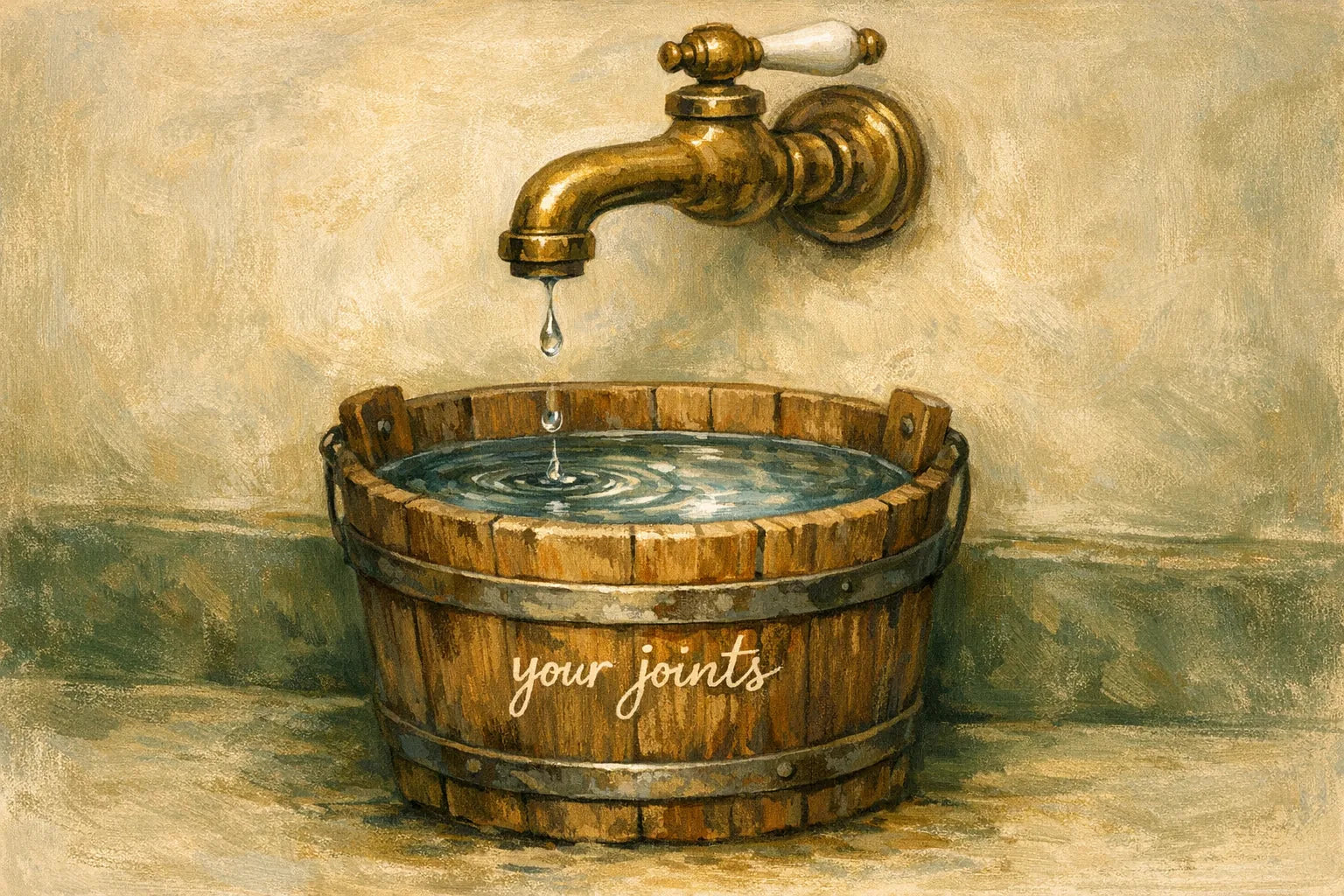
There's a faucet inside you that stopped closing all the way.
You can't hear it and you can't feel it drip.
But the bucket underneath is your joints, and after 50 that bucket never gets a chance to empty.

That picture isn't poetry.
It's the plainest English I can find for something researchers have been measuring in aging bodies for about 25 years now.
And it explains the one thing that makes people feel like they're going crazy.
The same knee that healed in a week when you were 30 can now ache for months at 60.
You didn't fall and you didn't lift anything stupid.
You just woke up one Tuesday in your fifties and your body had started keeping a grudge.
My name is Mary Miller.

I'm an herbalist, and I spend most of my week reading research papers that were written for people with three letters after their name.
I do that because we started Old World Healing on a simple bet: that the remedies our great-grandparents swore by weren't superstition, they were unfinished science.
And nothing has proved that bet out harder than what I'm about to show you about turmeric.
Because here's the part almost nobody tells you.
If you've already tried turmeric and felt nothing, it probably wasn't the turmeric's fault.
It never got in.
Your body threw it away before it ever reached your bloodstream.
I'll show you the 1998 human study that measured exactly that, and the pinch of black pepper that changes the whole equation.
But first you need to understand the faucet.
Because if you don't fix the faucet, nothing else on this page matters.
First, The 3 A.M. Part Nobody Says Out Loud
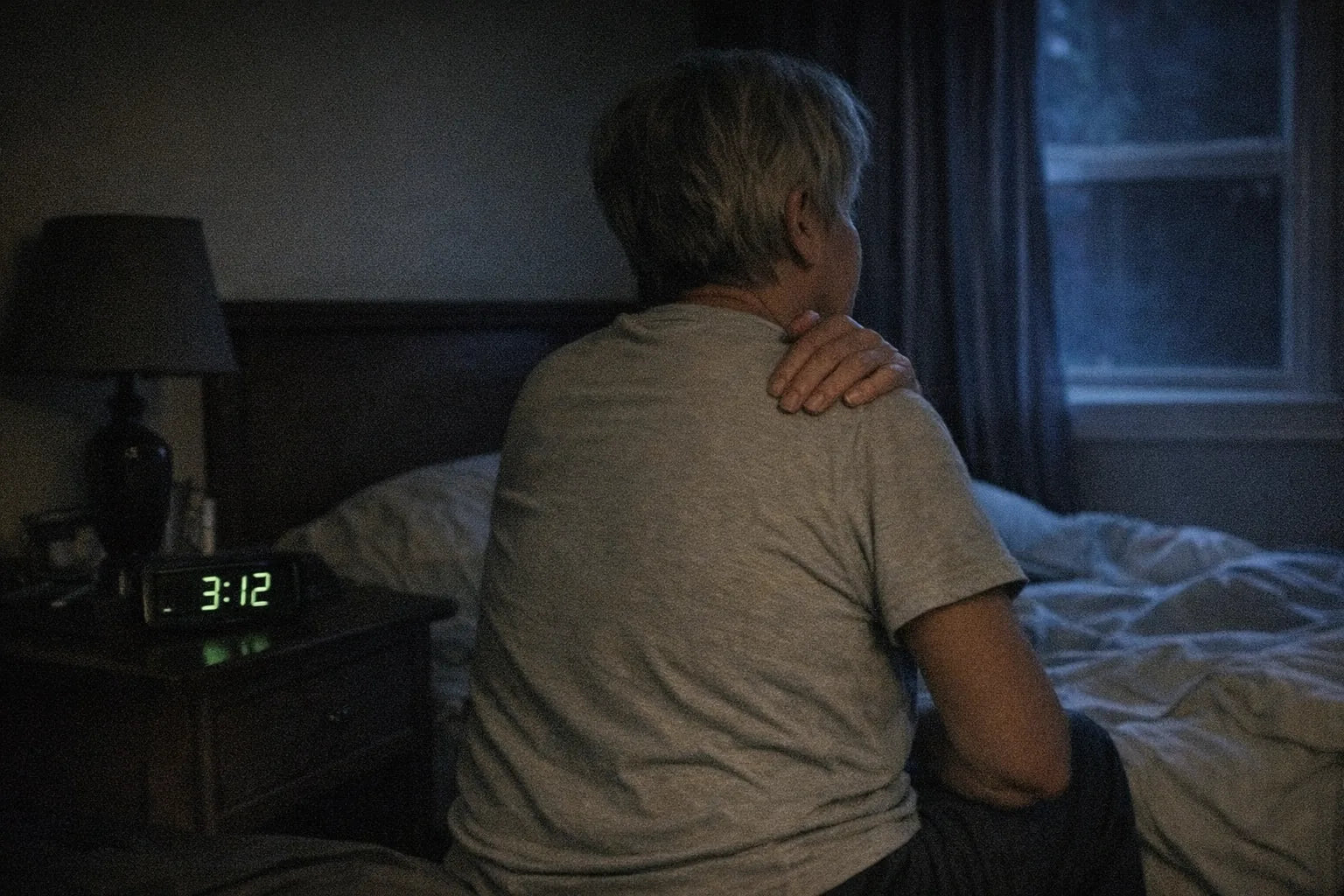
It's a little after three.
Tonight it's the shoulder, which is new, because last month the shoulder was fine.
You lie there doing the arithmetic you always do.
Did I do something to it?
No.
You didn't garden yesterday and you didn't sleep on it funny.
You did nothing at all, and here you are staring at a dark ceiling with your arm arranged at the one angle that hurts least.
And that's the thought that gets you.
Not the ache itself.
The fact that there's no reason for it.
When you were 30 you sprained an ankle, it screamed for a week, and then it was over and you forgot about it.
Now nothing is ever over.
Now everything just simmers.
So you go through the list of things you've been told.
"It's just age, everybody's got something at your age."
"Have you tried an Advil before bed?"
And you swallow the answer you'd actually like to give, because the doctor was looking at your chart instead of at you.
What you wanted to say was this.
I'm not asking you to make me twenty-five again. I'm asking why my own body keeps sounding an alarm when there is nothing wrong.
Here is what I want you to take from this page more than anything else.
That ache isn't in your head, and it isn't a character flaw.
It has a name and a measurement, and researchers have been chasing it since the year 2000.
The Pain Switch: Why Your Body Stopped Turning It Off
Inside almost every cell you own, there's a switch.
Scientists call it NF-kB, which is a terrible name for something so simple.
Think of it as the master switch for your body's alarm system.
You cut your thumb slicing tomatoes, the switch flips ON, and your body floods the area with a cleanup crew that shows up as swelling and heat.
Once the thumb is mended, the switch flips back OFF and everything goes quiet.
That's a young body.
Fast ON, and just as importantly, fast OFF.
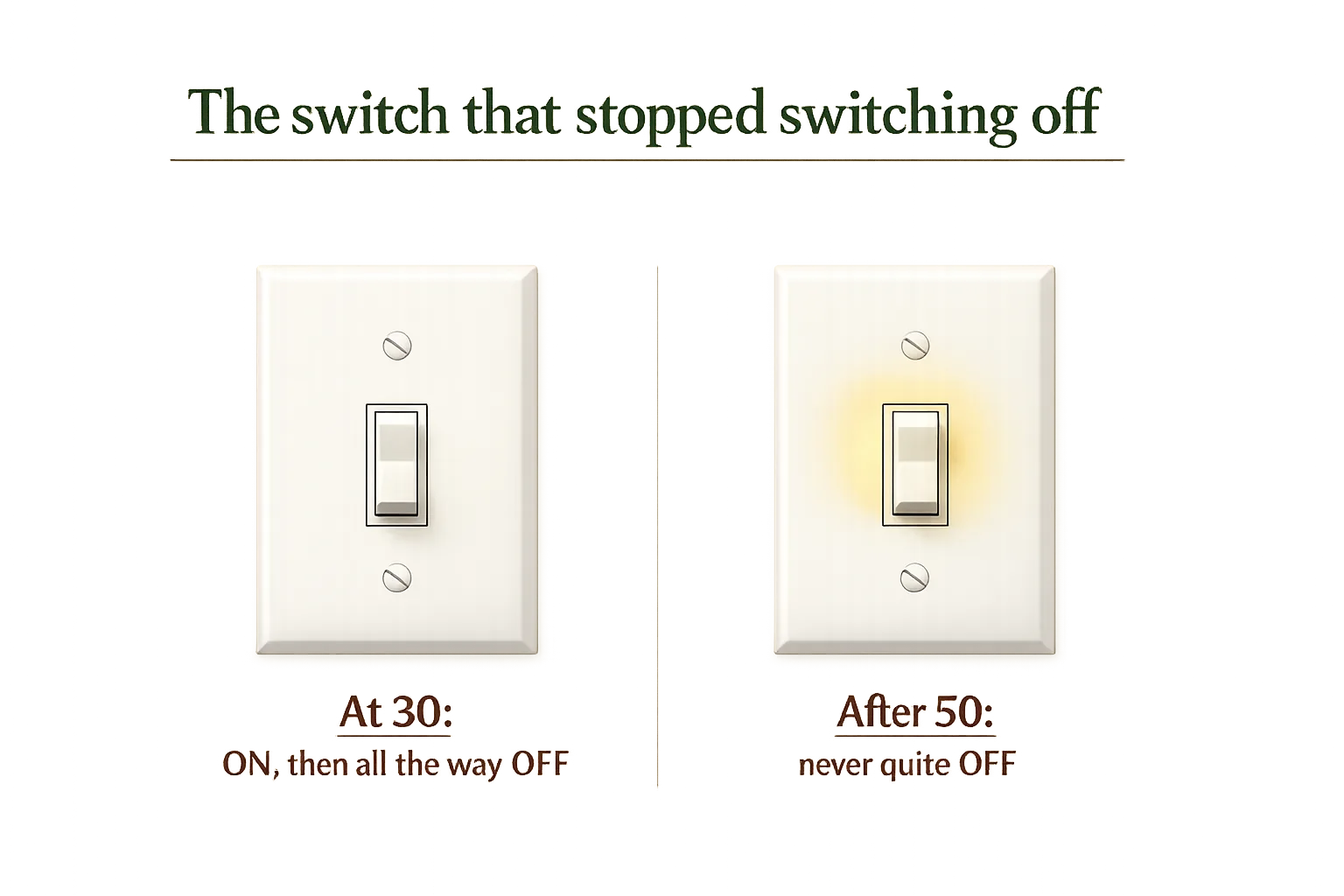
Somewhere around 50, that second half starts failing.
The switch still flips ON just fine.
It just stops going all the way back OFF.
It settles at a low hum instead, with nothing wrong and nobody to fight.
Immunologist Claudio Franceschi put a name on this pattern in the year 2000, and the research world has been building on it ever since.9
His term for it was "inflammaging," and I only use his word once, because the word matters far less than the picture.
The picture is that faucet.
You turn the handle, the stream stops, and then you hear it.
Drip.
Drip.
You don't notice a single drop of that faucet on any given day.
But the bucket underneath fills anyway, and the bucket is your joints.
And this isn't a fringe idea somebody cooked up to sell you a capsule.
A 2023 review published out of an NIH workshop describes this same low-grade, age-related process as a driver behind most of the conditions we associate with getting older.10
Researchers can see it on a blood panel.
Markers with names like CRP, IL-6 and TNF-alpha sit higher in older adults than in younger ones, even when there's no infection anywhere and no injury to point at.9
Read that again, because it's the whole ballgame.
Your body is sounding an alarm with no fire.
That's why the knee that healed in a week at 30 aches for months at 60.
Not because you're old.
Because the OFF switch is sticky.
Which Stage Are You In?
I've watched this progress in the same predictable order for years.
See if you can find yourself in it.
Late forties into your fifties.
Nothing hurts exactly, but the first twenty minutes of the day belong to your body, not to you.
You sit on the edge of the mattress and wait for the machinery to boot up before you trust your knees with your weight.
Mid fifties into your sixties.
It stops being one bad knee.
Now the hands are in on it, and then a shoulder joins in on the days you do too much.
You catch yourself cataloguing new spots, and you notice that things which used to settle in three days now take three weeks.
Sixties and up.
Now you don't have flare-ups, you have a baseline.
You plan around the ache without admitting you're planning around it.
The stairs get counted, and the invitation that involves standing for two hours gets a polite no.
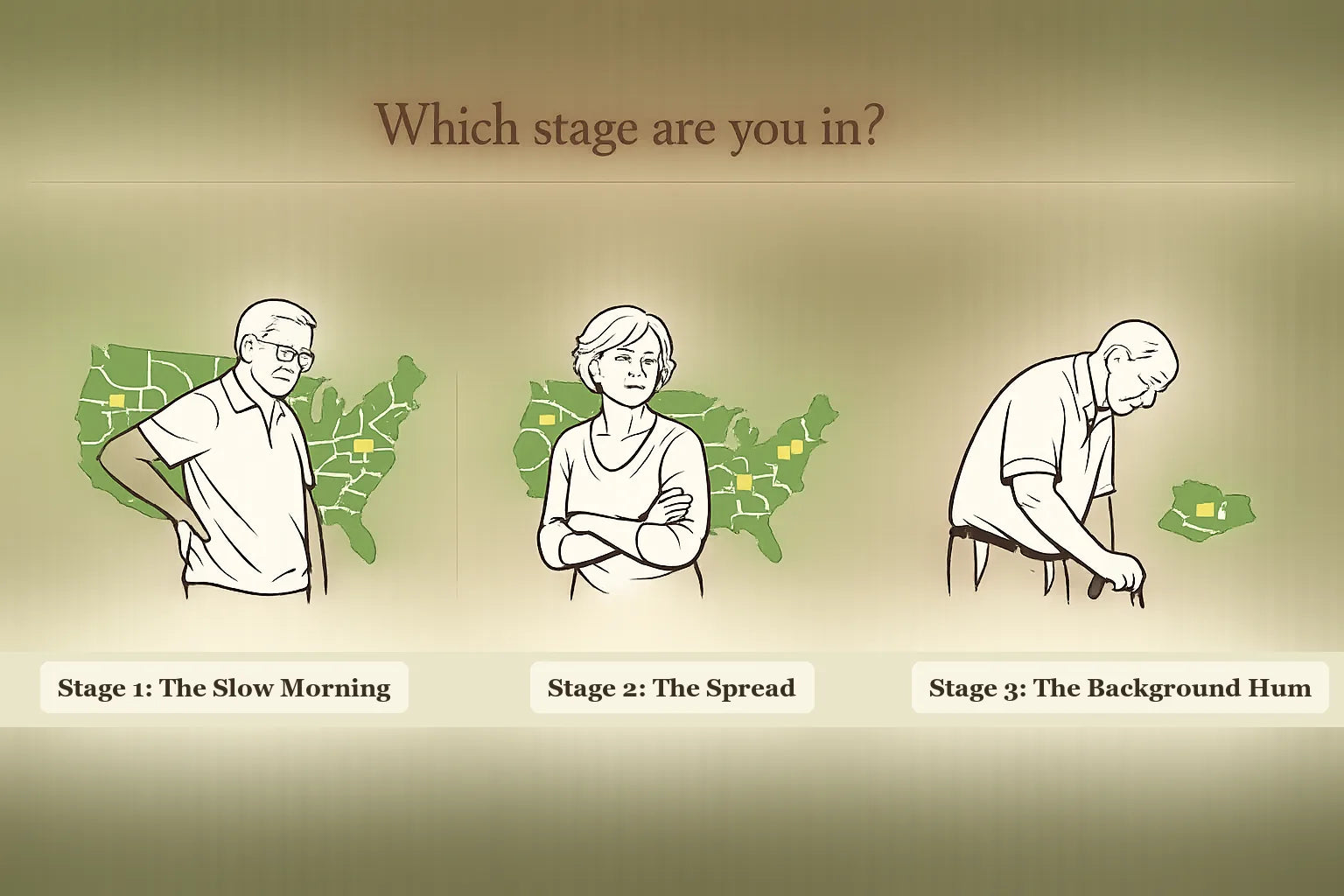
Most people reading this are somewhere in Stage 2, sliding toward Stage 3 and hoping nobody notices.
Let me be honest about where that line goes if nothing changes.
The fear you have at 3 a.m. isn't really about today.
It's about the year you stop kneeling in the garden, and the day somebody offers you an arm on the porch steps and you take it.
It's about becoming a person your kids manage instead of a person your kids visit.
You're not being dramatic.
You're doing math.
Why The Pill Bottle Never Fixed It
Here's the cruel joke.
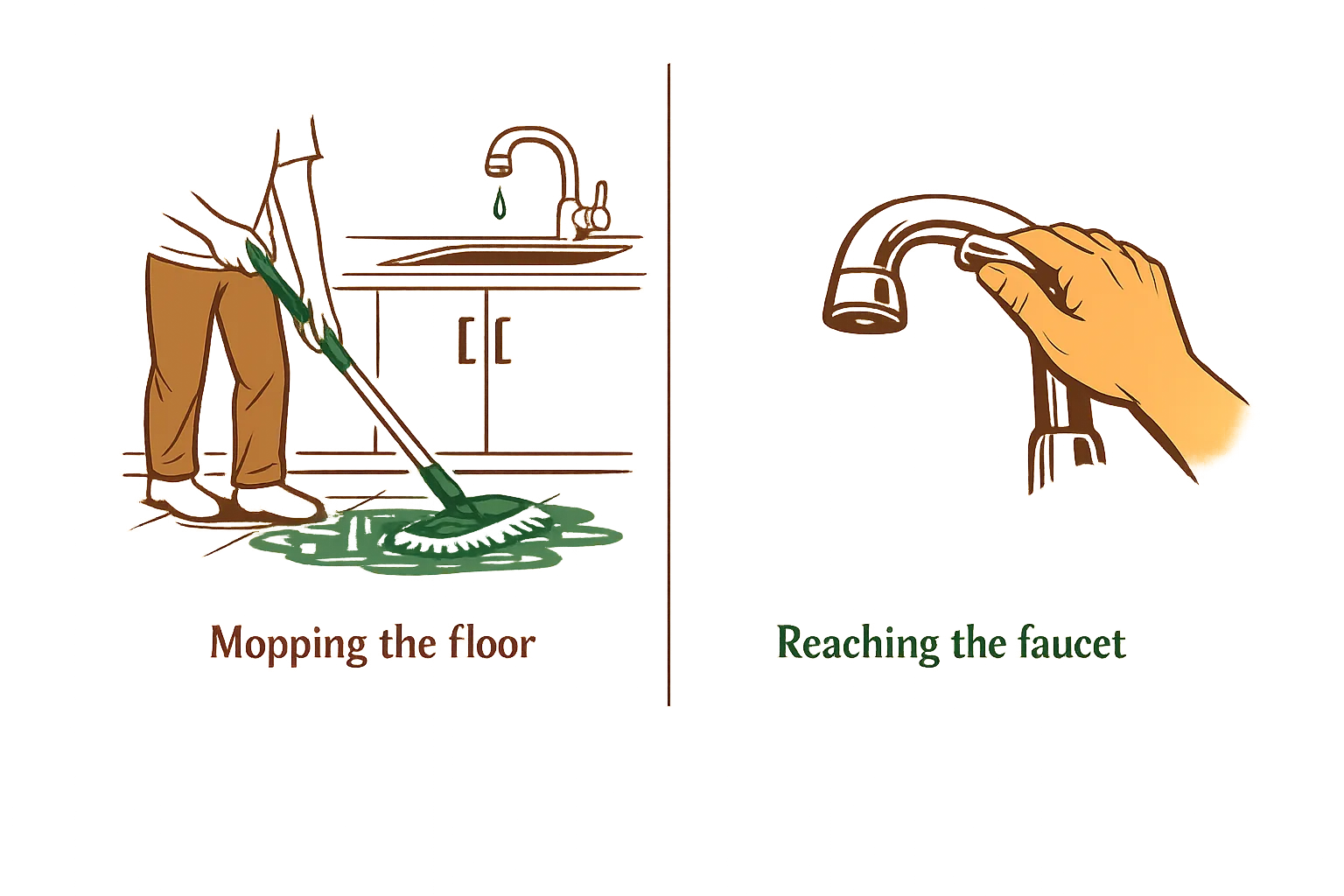
The whole painkiller aisle is built to mop the floor.
Not one product on that shelf goes anywhere near the faucet.
An ibuprofen quiets the signal for six or eight hours, and while it's working you feel great, and then it wears off and the drip is exactly where you left it.
You aren't failing at the mopping.
Nobody has ever mopped faster than a faucet runs, and nobody ever will.
And there's a second reason I want you to know about the mop, especially if you're past 65.
The everyday painkillers are not the harmless little candies we all treated them as in the 1990s.
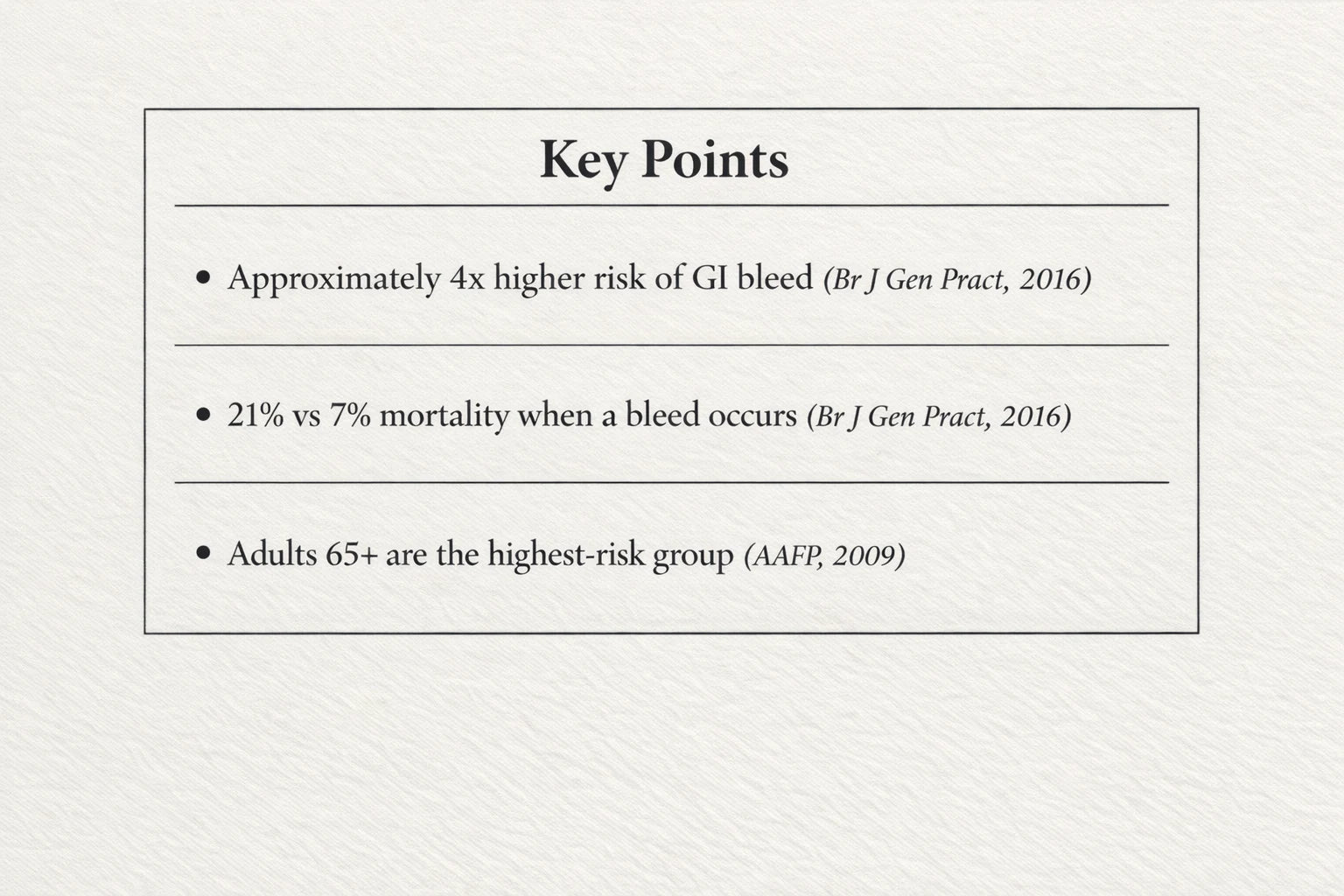
A 2016 review in the British Journal of General Practice reports that non-selective NSAIDs carry roughly four times the risk of a gastrointestinal bleed.14
The same review notes something grimmer.
When a bleed happens on these drugs, it's more often fatal than a bleed off them, 21% versus 7%.14
And guidance published by the American Academy of Family Physicians names adults 65 and older as the highest-risk group of all.15
That risk climbs further for anyone also taking blood thinners or corticosteroids.15
Now hear me clearly, because this part is not optional.
I'm not telling you to stop taking anything your doctor put you on.
That decision belongs to you and your doctor, and nobody else.
I'm telling you what the mop actually costs, so that "just take an Advil every day" stops sounding like free advice.
And Yes, You Probably Already Tried Turmeric
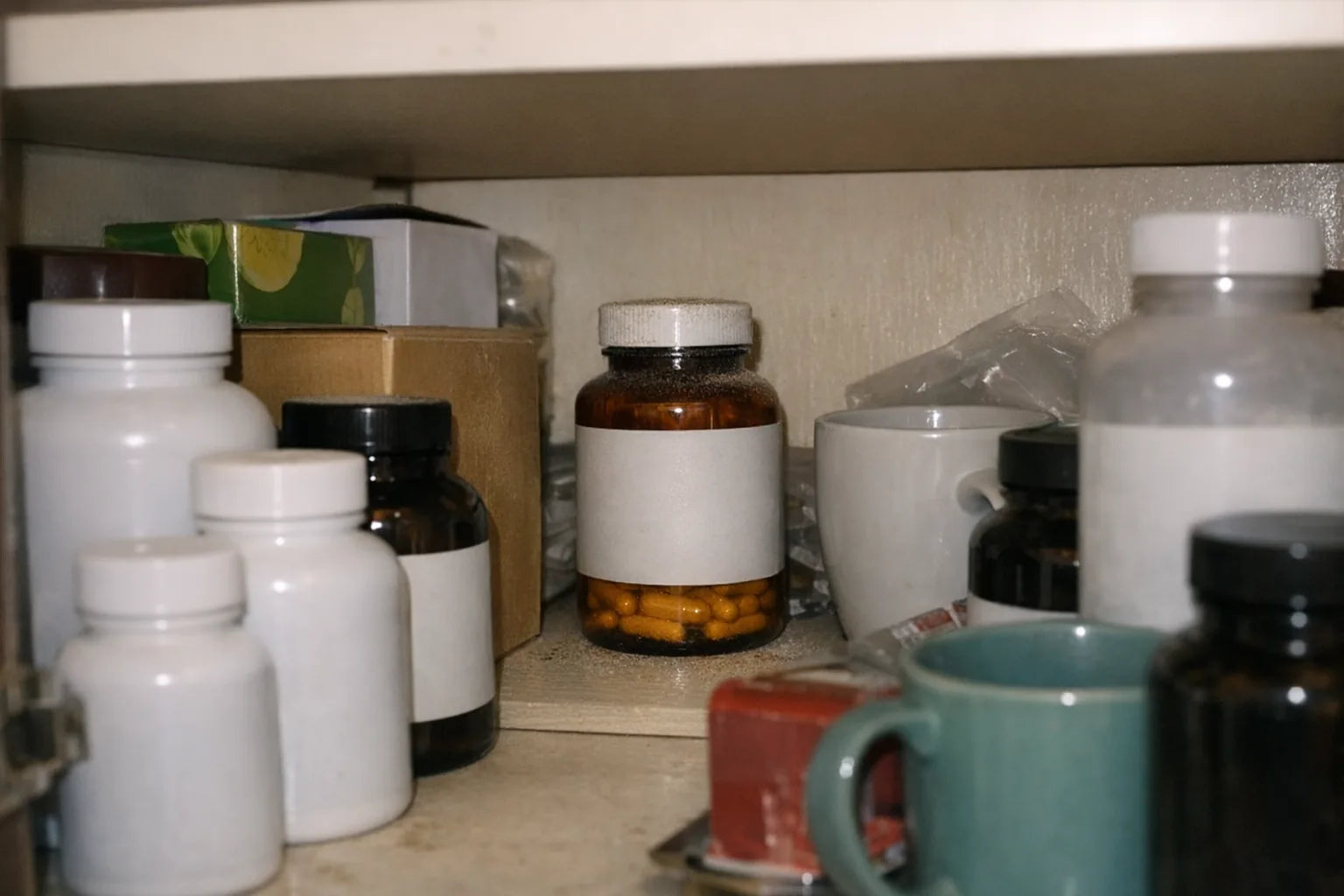
There's a decent chance there's a bottle of it in your cabinet right now, three inches behind the vitamin D, with maybe forty capsules gone out of ninety.
You bought it because somebody you trust swore by it, or because the label said "supports joint comfort."
And you thought, fine, worth a shot.
You took it for a month.
You felt exactly nothing.
So you wrote the whole idea off as another jar of hopeful powder, and honestly, I don't blame you one bit.
But I need to tell you what actually happened in your body during that month, because it's not what you think.
The turmeric didn't fail you.
It never got in.
The Disposal Crew In Your Gut And Liver
Curcumin is the active compound in turmeric, the part all the research is about.
And your body has a very old, very efficient system for deciding what's food and what's garbage.
When curcumin comes through your gut wall, a set of enzymes in your gut lining and your liver grabs it and slaps a chemical tag on it.
That tag means one thing: dispose of this.
Researchers call the process glucuronidation, which is a mouthful, so picture it the way I do.
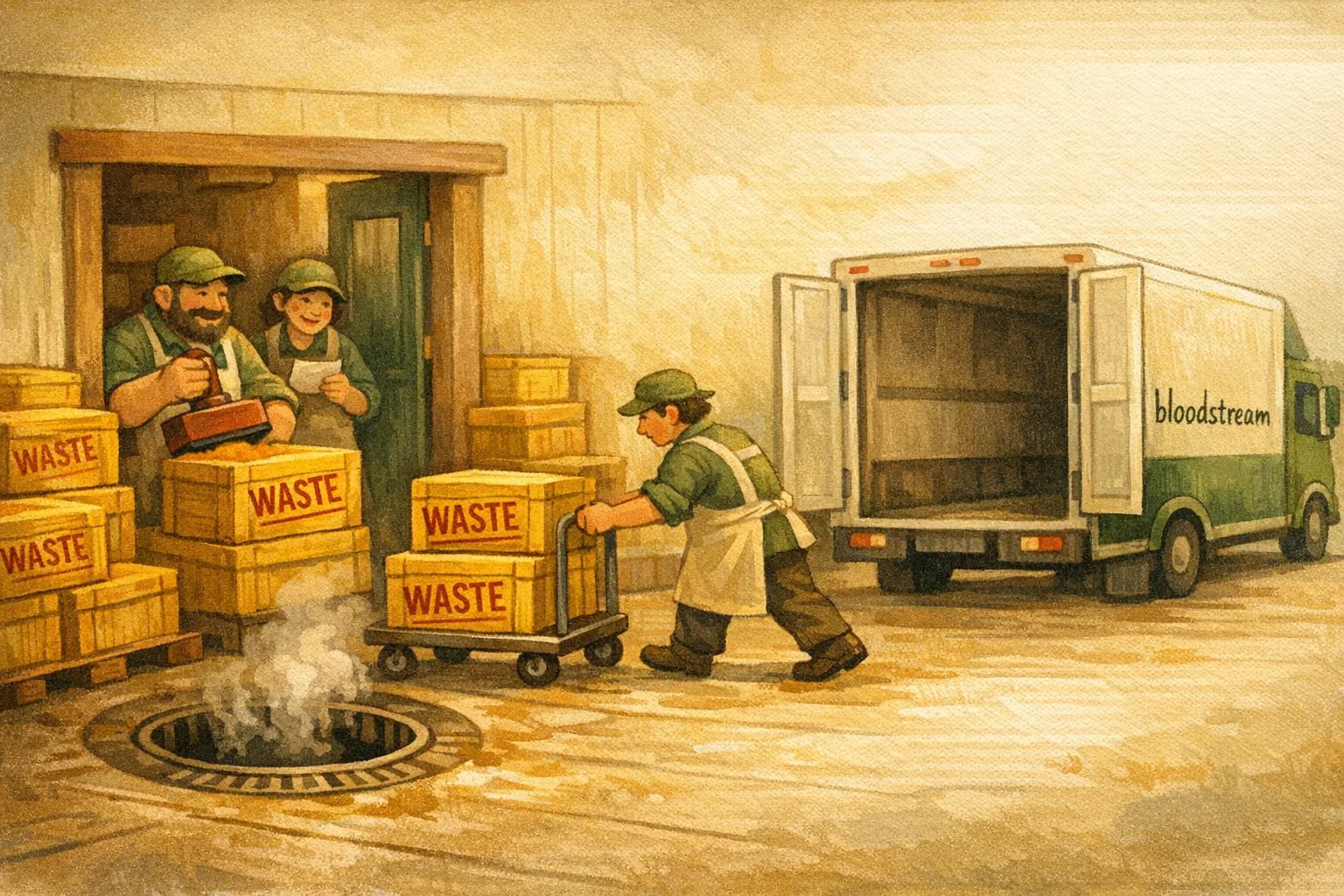
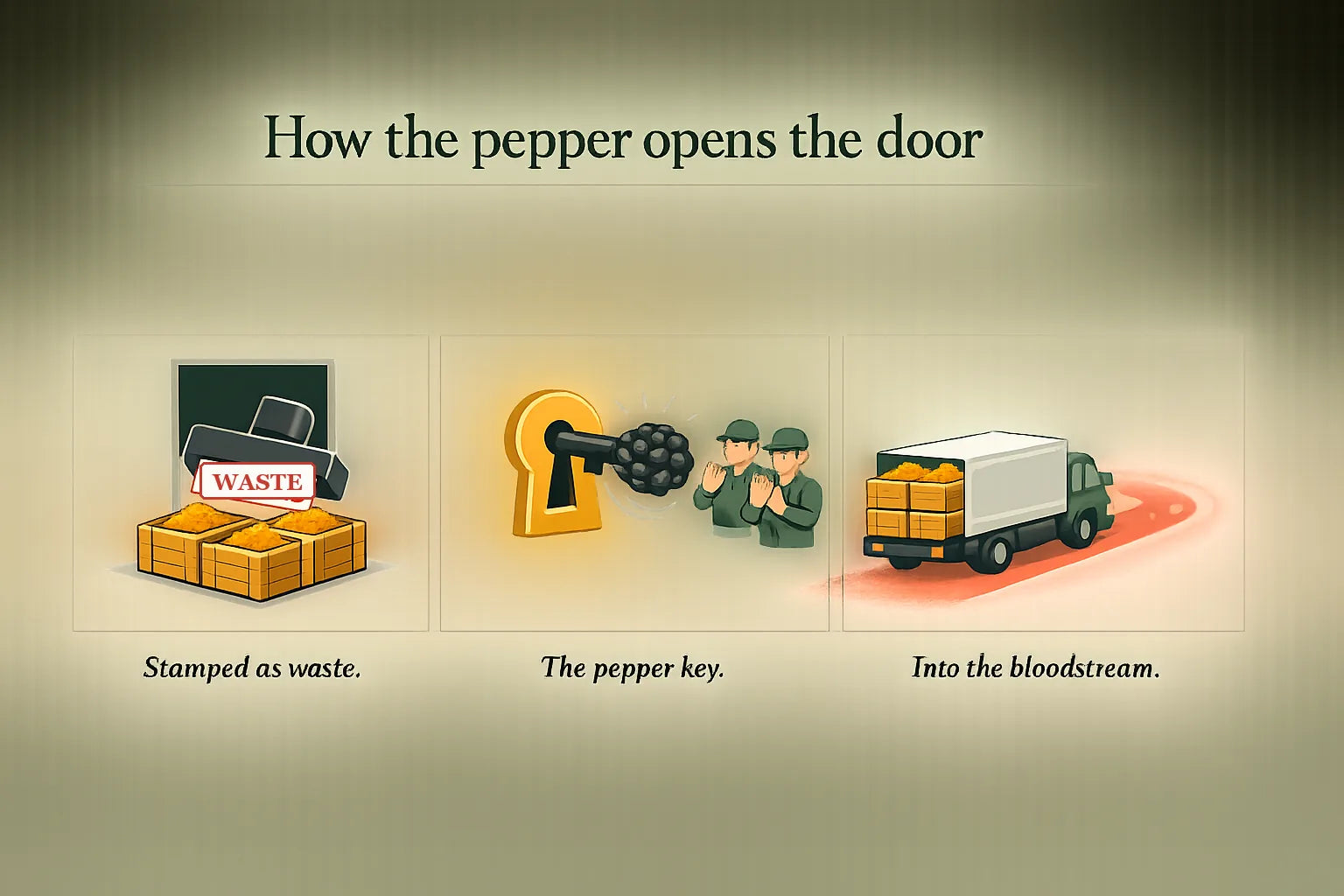
Picture a shipping dock inside you.
The turmeric arrives at the dock, and a crew in the doorway stamps every single box "WASTE."
Then they wheel it straight out to the drain, before one box ever gets loaded onto the truck headed for your bloodstream.
The disposal crew isn't a theory.
A 2007 paper in Molecular Pharmaceutics laid it out plainly.
Curcumin absorbs poorly, gets tagged and cleared fast, and shows up in the blood at astonishingly low levels even when volunteers swallowed enormous amounts.12
Enormous, as in grams per day.
Still barely anything in the blood.
So every clinical trial you'll read about in a minute, every impressive result, depended on one thing happening first.
The curcumin had to get past the disposal crew.
And that is where a 4,000-year-old kitchen habit turns out to have been solving a biochemistry problem it had no words for.
The Pairing Nobody Thought To Question
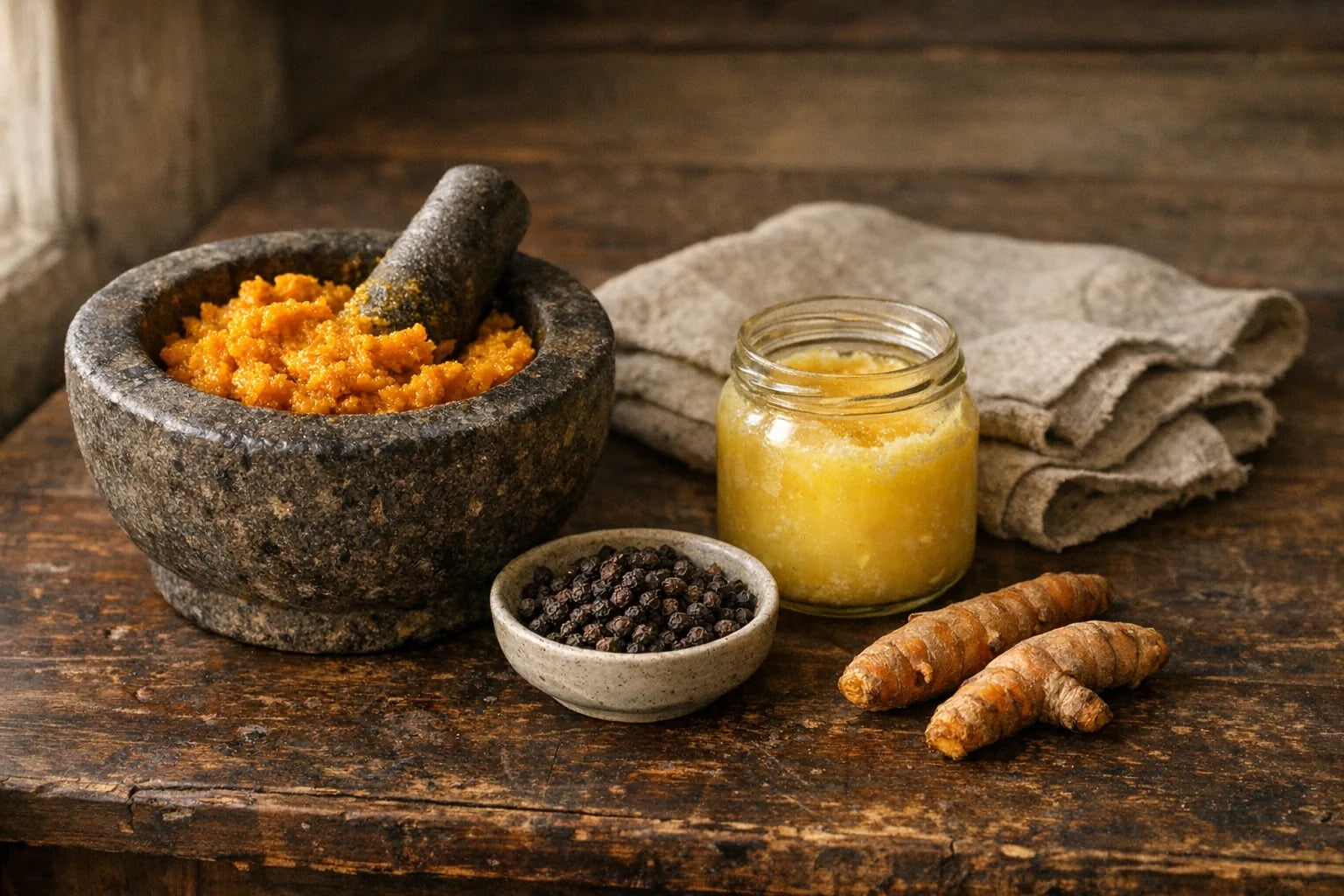
Go and look at how turmeric has actually been used, as opposed to how it's sold.
In the kitchens of India, the Middle East, and everywhere the spice route touched, turmeric almost never went into a pot by itself.
It went in with black pepper, and it went in with fat.
Ghee in one kitchen, whole milk in the next, and the fat varied by region, but the pairing never did.
Golden milk gets pepper, and so does the curry paste.
Grandmother's poultice for a sore knee gets pepper.
For thousands of years, in cultures that never met each other, the same two things kept traveling together.
Modern food science looked at that pairing and shrugged.
Flavor, they said.
Pepper makes it taste better.
And for most of the 20th century, that was the end of the conversation.
Then, in 1998, a research team decided to actually measure it.
The Pepper Key
The study was published in the journal Planta Medica by Shoba and colleagues, and it's the reason I do this work.
They gave healthy human volunteers curcumin on its own, then gave them the same curcumin with 20 mg of piperine added.
Piperine is the active compound in black pepper, and the researchers measured what showed up in the bloodstream either way.
With the pepper added, the researchers measured a 2,000% increase in curcumin's bioavailability.13
Twenty times more of it made it through.
And the reason is exactly the shipping dock.
Piperine puts the disposal crew on pause.
Piperine slows those disposal enzymes in the gut and liver, so the boxes don't get stamped "WASTE."
The truck to your bloodstream finally leaves the dock loaded.
The pepper doesn't add anything.
It doesn't have its own joint benefit hiding in it.
It unlocks what's already there.
That's the whole idea behind what we call the Pepper Key, and it's why the old-world cooks were right for reasons they could never have explained.
They weren't seasoning.
They were building a delivery system.
Now, I'm going to be straight with you about that 2,000% figure, because you deserve better than a marketer's number.
That measurement comes from one small human study in 1998, and it has not been independently repeated at that exact magnitude since.13
The finding is real and published, and it points in a clear direction.
The 2,000% figure isn't a guarantee, and anyone waving it around as a product promise is telling you a story.
I'd rather you trust me on the small numbers than catch me stretching a big one.
Now Here's What The Curcumin Does Once It Gets In
Remember the sticky switch?
Curcumin's whole reputation in the lab is built on that exact switch.
In cell and animal research, curcumin has been shown to interfere with NF-kB activation.11
Which is to say it goes at the switch itself, not at the noise the switch makes.
Downstream, the same body of research shows curcumin dialing back COX-2 and the messengers your body uses to keep the alarm ringing.11
That's the lab bench.
Here's what happened when researchers put it in front of actual humans.
367 people. Head to head with ibuprofen.
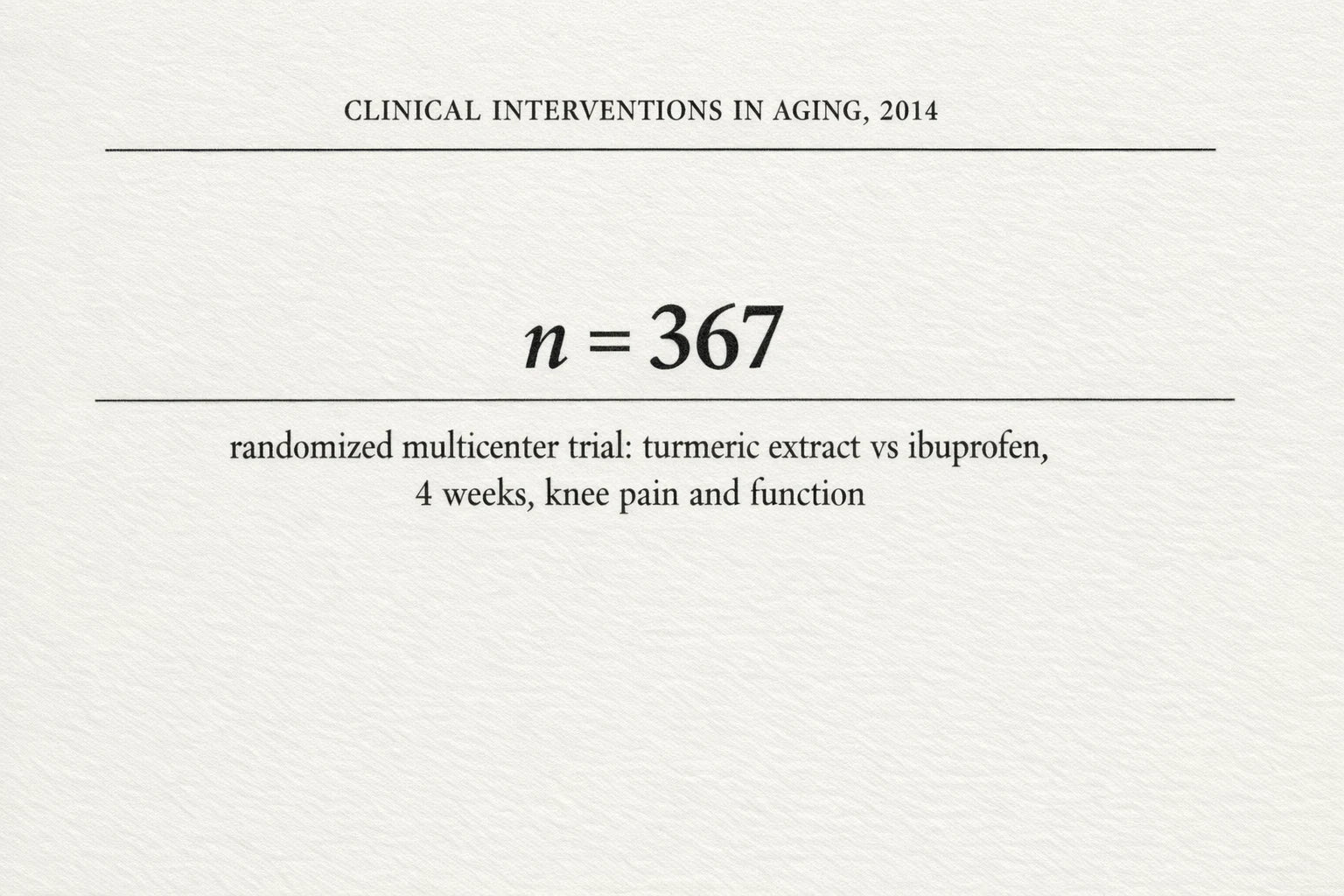
In a multicenter randomized trial published in Clinical Interventions in Aging in 2014, researchers gave 367 adults either a turmeric extract or ibuprofen for four weeks.1
Then they tracked knee pain and knee function in both groups.
The turmeric extract came out non-inferior to the drug on both measures.1
The turmeric extract matched the drug.
And the turmeric group reported significantly fewer episodes of stomach pain and discomfort than the ibuprofen group.1
It matched a prescription drug too.
A 2019 trial published in Trials compared a curcumin formula against prescription-strength diclofenac in 139 adults with knee pain.2
Similar pain improvement at day 14 and again at day 28, with better tolerability on the curcumin side.2
A separate 2021 trial, also in Trials, compared a bioavailable turmeric extract against paracetamol and found it non-inferior.3
That same trial measured drops in the blood markers CRP and TNF-alpha.3
And when you zoom all the way out, the pattern holds.
A 2022 systematic review pooled 15 randomized trials covering 1,670 people with knee pain.4
Meaningful improvements in both pain and function versus placebo, with no increase in adverse events.4
A 2023 Bayesian network meta-analysis went wider still, 23 trials across seven countries and 2,175 people, and landed in the same place.5
The blood work is the part that gave me goosebumps.
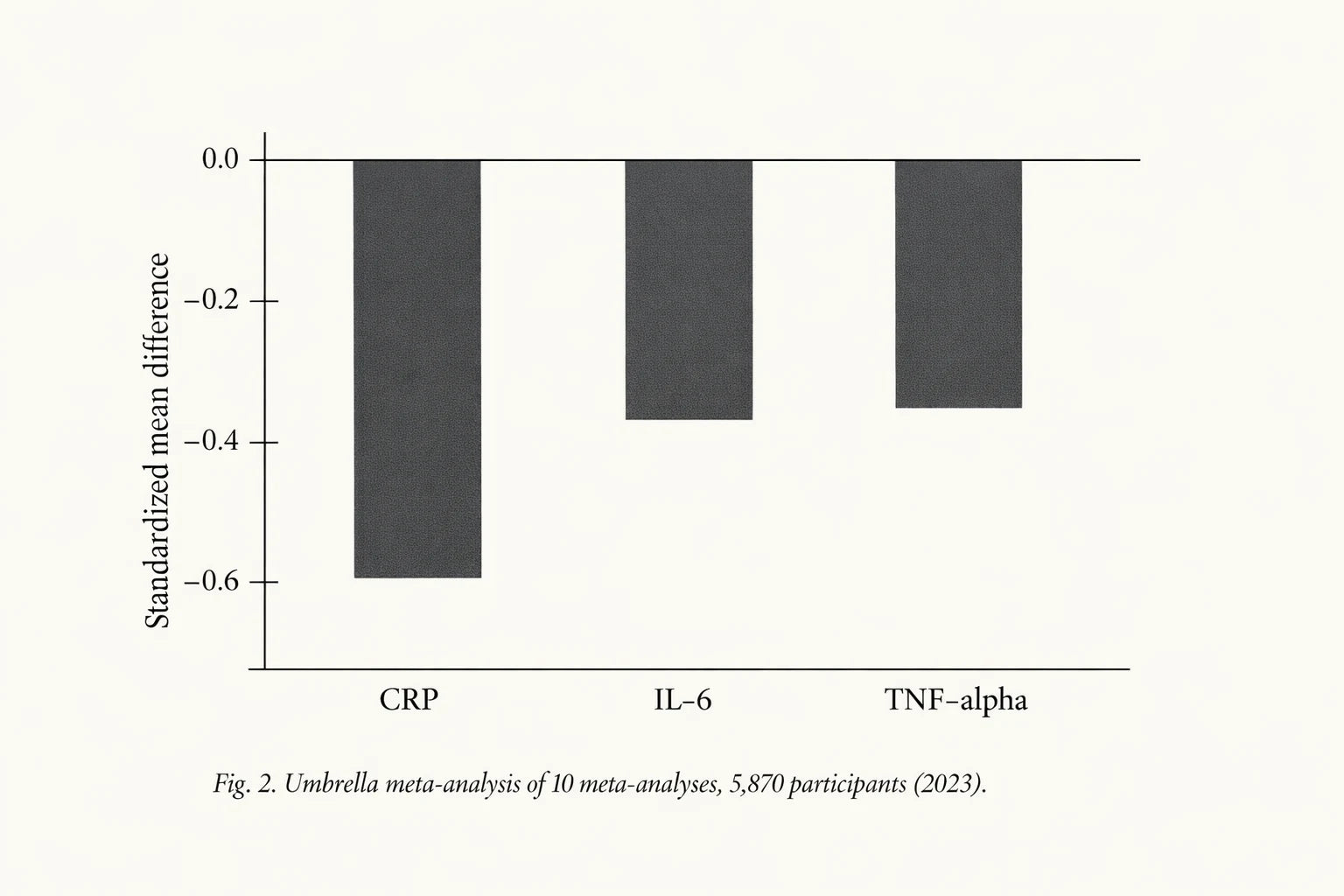
In 2023, researchers published an umbrella meta-analysis, which is a study of studies of studies.
It pooled 10 meta-analyses covering 5,870 participants, and found that curcumin significantly lowered CRP, IL-6 and TNF-alpha.6
Those are the exact three markers that sit stubbornly elevated in the aging bodies Franceschi was writing about.9
And a separate 2023 meta-analysis found something that made me sit up.
The effects were larger in the trials where the average participant was over 45.7
The older the group, the more there was to settle.
Now, the honest footnote, and I'm putting it in the same size type as the good news.
One 2019 meta-analysis, looking specifically at people with chronic inflammatory conditions, found no significant change in those markers.8
The evidence is strong, and it isn't unanimous.
I'd rather you know that from me than find it yourself later and wonder what else I skipped.
So Why Doesn't Every Turmeric Capsule Work Like That?
Because most of them are the herb with its key removed.
Walk down the supplement aisle and read the backs of the bottles.
Plenty of them will say "with black pepper extract" in small print, treated like a checkbox somebody added because a competitor had one.
Nobody explains what the pepper is for.
Nobody tells you about the disposal crew, or the shipping dock, or the 1998 study.
The industry sold you the golden powder and quietly left the key in the drawer.
Then you took it for a month, felt nothing, and blamed yourself or blamed the herb.
That's the part that makes me genuinely angry.
An entire industry turned millions of people into turmeric skeptics to save themselves the trouble of explaining one sentence about black pepper.
You didn't waste your money on a bad herb.
You paid for a delivery system that somebody left out of the box.
What We Made: Old World Turmeric
We started Old World Healing to bring back the remedies that worked long before anyone could explain them.
And to hold every one of them up against the modern research instead of hiding from it.
Old World Turmeric is the old-world pairing, done on purpose.
Not turmeric with a checkbox.
Turmeric built around the key.
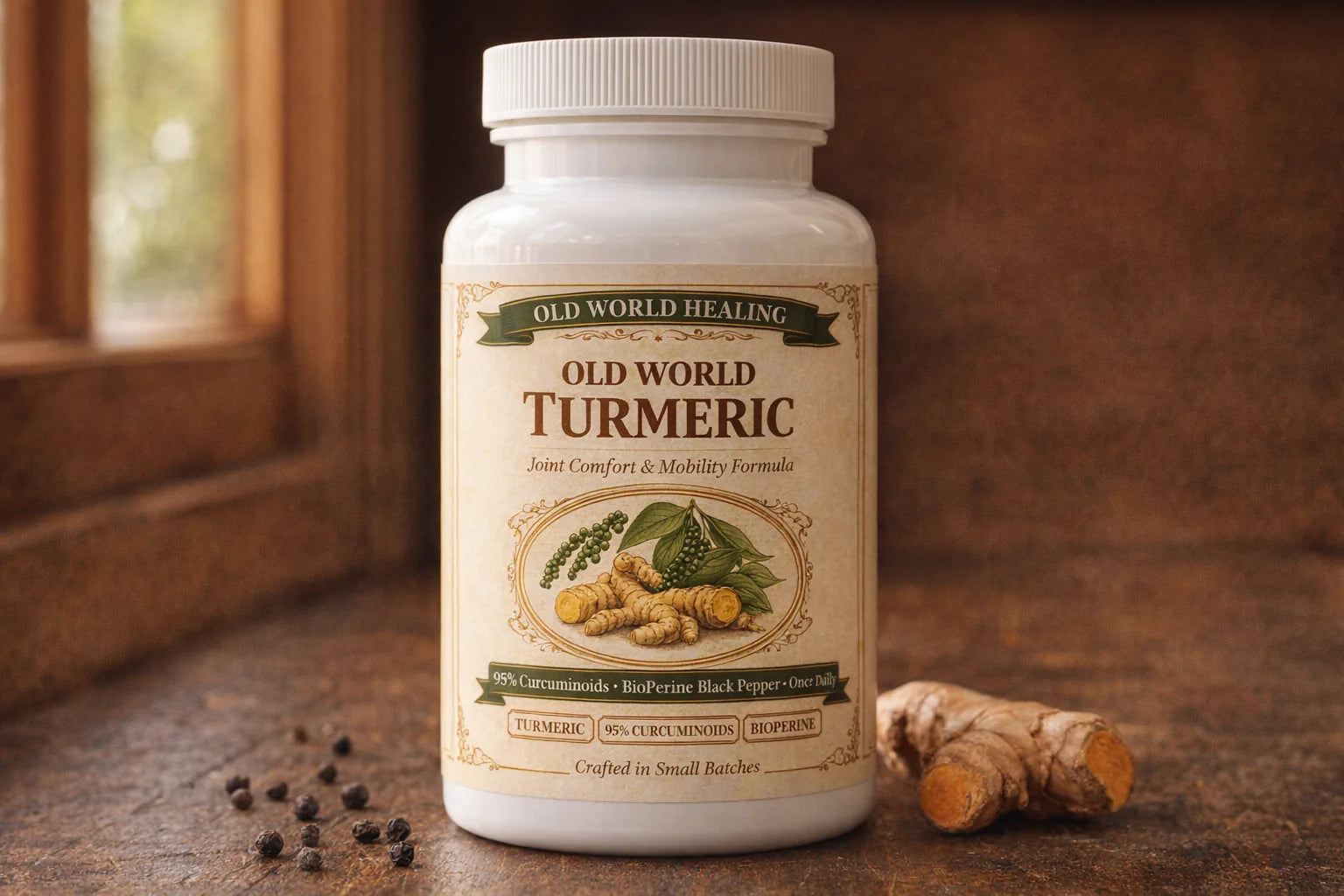
Here is exactly what's in a serving, and I'll walk you through why each piece is there.
The 95% extract is the concentrated form, the part the clinical research is actually about.
The 4:1 extract is the fuller root, closer to what went into the mortar and pestle.
It carries the compounds that travel alongside curcumin in the whole spice.
The Pepper Key.
The reason the rest of the label has a chance of mattering.
Forskolin nudges up cAMP, the little messenger your cells use to pass instructions along and keep their energy work moving.16
Forskolin is here for the everyday energy and wellbeing side of things, not the joint side, and the human research on it is thin.17
The Three Things That Have To Happen, In Order
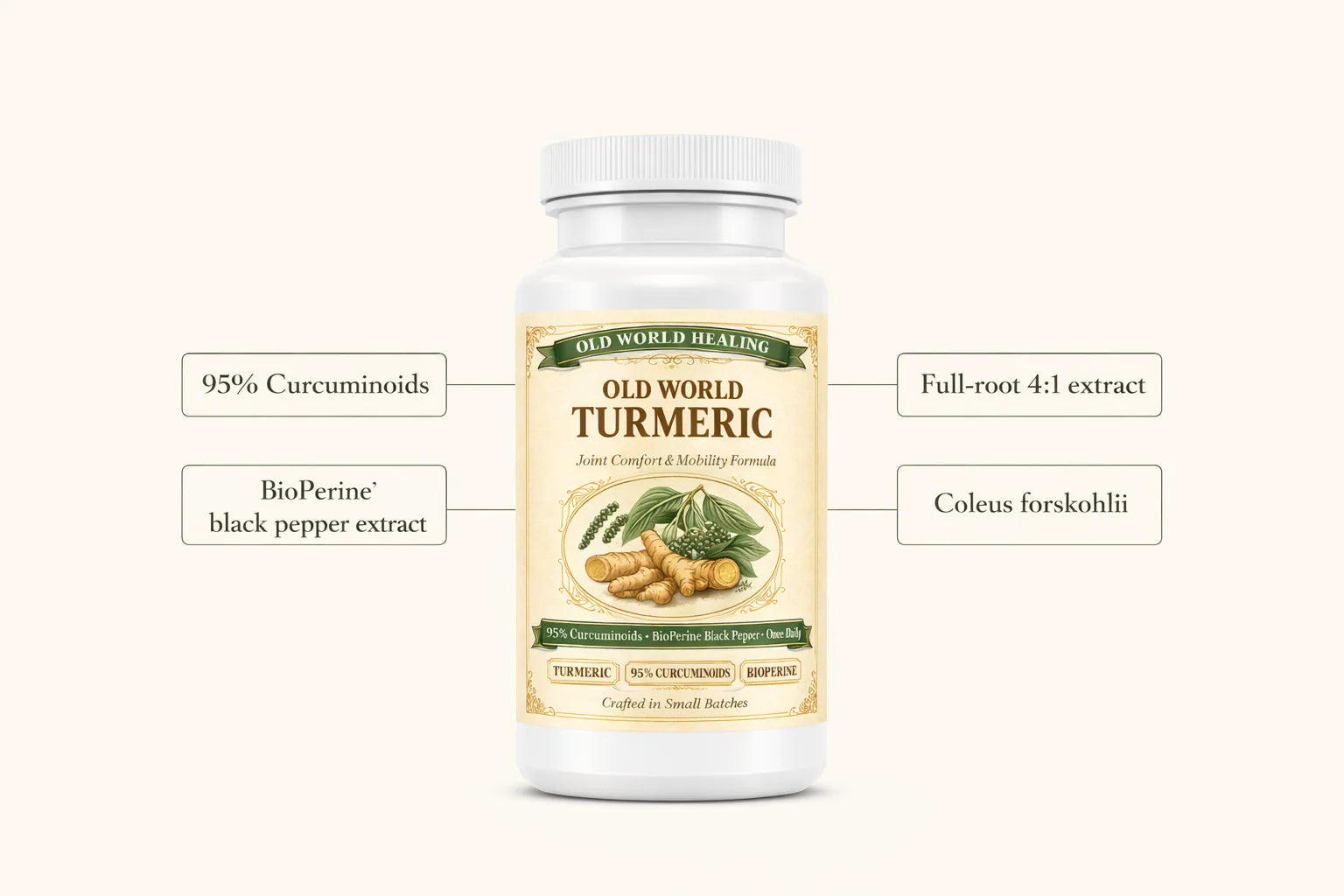
Every serving is built around the same three-step sequence.
Miss step one and the other two never happen, which is the single reason most turmeric disappoints people.
Step 1: PAUSE THE DISPOSAL CREW.
The BioPerine goes to work on the doorway, slowing the enzymes that would otherwise stamp the curcumin as waste on its way through.
Step 2: GET PAST THE DOCK.
With the stamping slowed, curcuminoids have a real chance to load onto the truck and reach circulation instead of the drain.
Step 3: REACH THE SWITCH.
Once curcumin is actually circulating, it can do the thing the research is about, which is act on the alarm system itself rather than muffle the noise it makes.
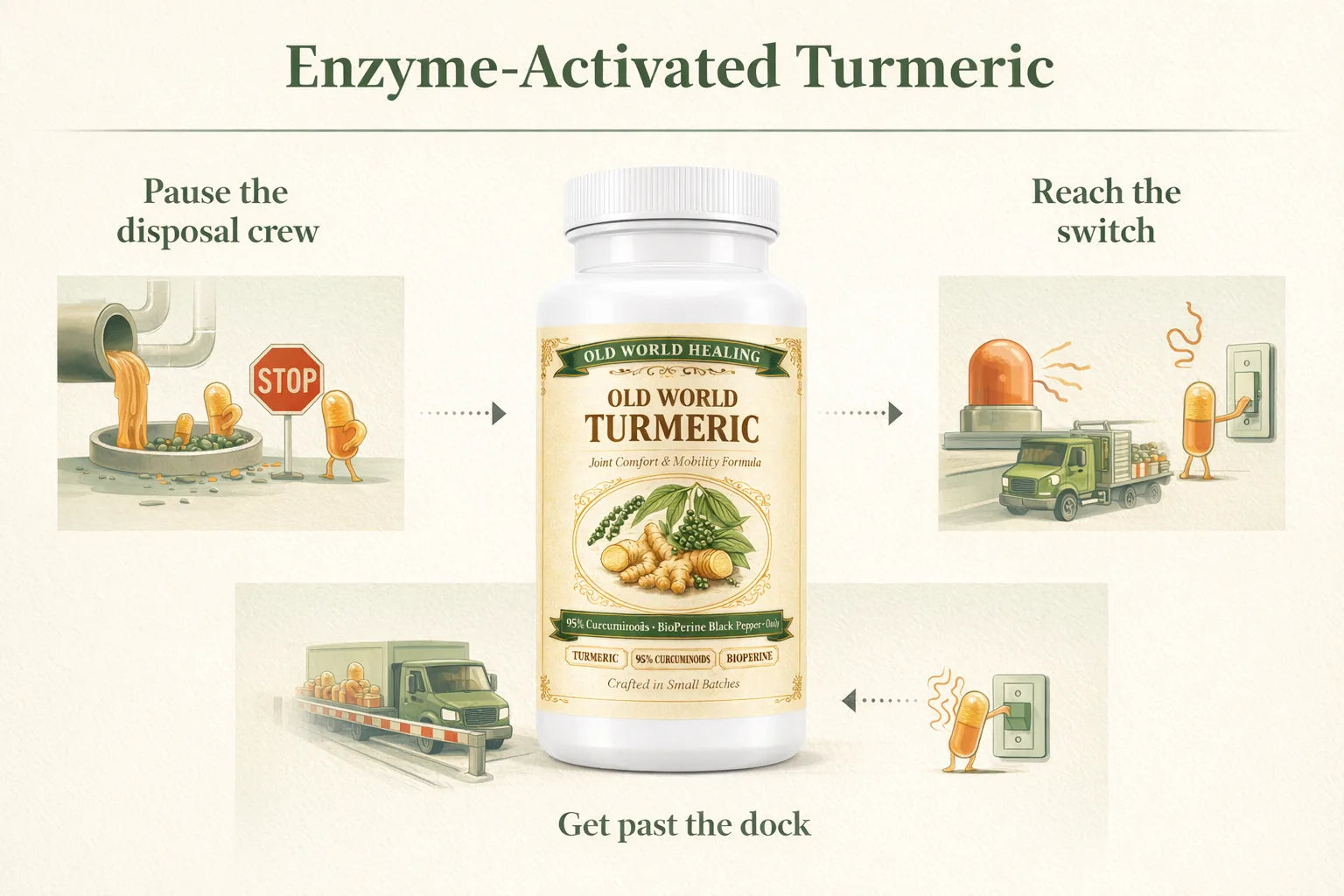
That sequence is what we mean by Enzyme-Activated Turmeric.
It isn't a fancier turmeric.
It's turmeric that gets to show up for work.
What I Will Not Tell You
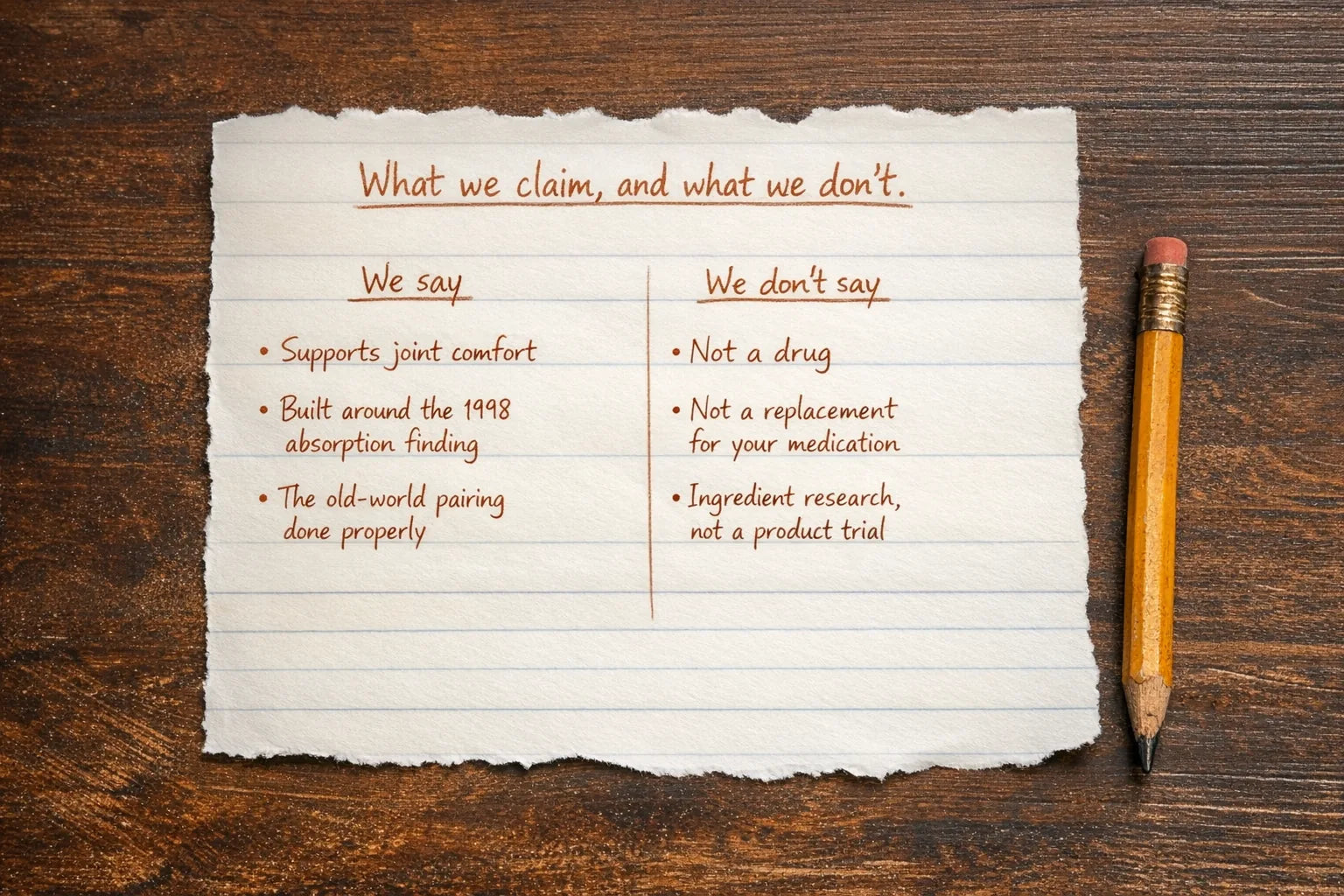
I want to draw a line here, and I want to draw it in public.
Everything I showed you above is research on curcumin and on piperine as ingredients.
The trials used their own doses and their own extracts, and I'm not going to stand here and claim our bottle reproduces a clinical trial.
Old World Turmeric supports joint comfort and supports a healthy inflammatory response.
It isn't a drug, and it's no substitute for anything your doctor prescribed.
What it is: the pairing the research says gives curcumin its best shot at reaching your bloodstream.
Made by people who read the studies, including the ones that didn't say what we hoped.
If You Already Use Old World Relief, Read This Part Twice
Some of you have had a jar of our cream on the nightstand for a year or more.
You already know what it does, and you already know its one honest boundary.
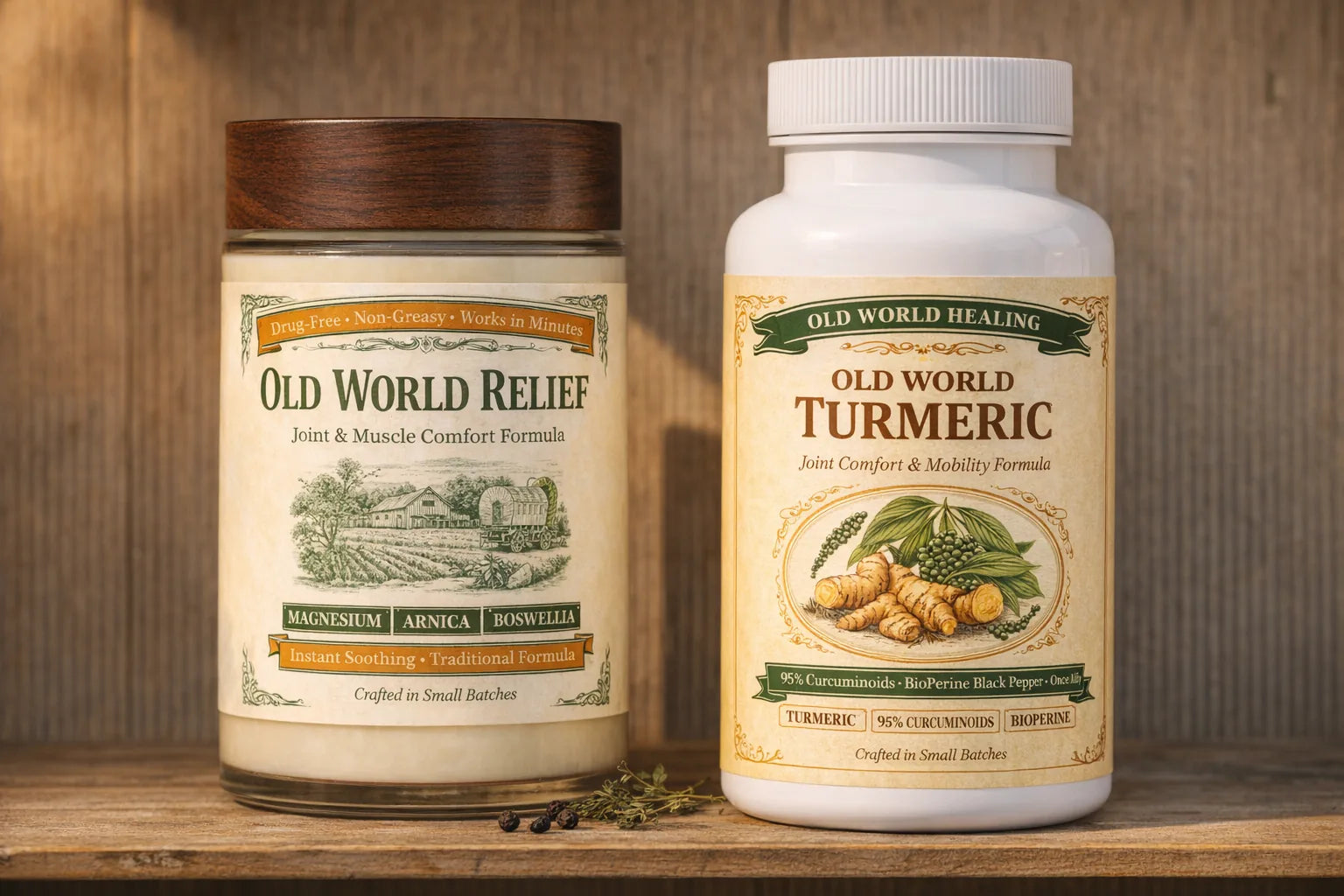
Here is what one Old World Relief customer wrote about the cream:
"Within 30 minutes, a gentle warmth spread through my hands. For the first time in years I'm sleeping through the night without having to shake my hands out at 3 a.m. I call it my little miracle in a jar."
Margaret Brammer, 82, on Old World Relief.
That's the cream doing the cream's job, at the spot where she rubbed it.
The cream works where you rub it.
That's not a flaw, that's the design.
But the faucet isn't in your knee.
The faucet is systemic, which means it's feeding every joint you have at once, including the ones you can't reach and the ones that haven't started complaining yet.
So the cream calms the fire from the outside, right at the spot that's burning.
Old World Turmeric works on it from the inside.
Outside-in and inside-out, at the same time, which is exactly how old-world healers always worked.
They never picked one door.
A Note On Proof
You may already know us.
Old World Healing started with Old World Relief, our topical cream.
More than 47,000 jars have gone out the door, with a 4.8 rating and over 2,800 five-star reviews.
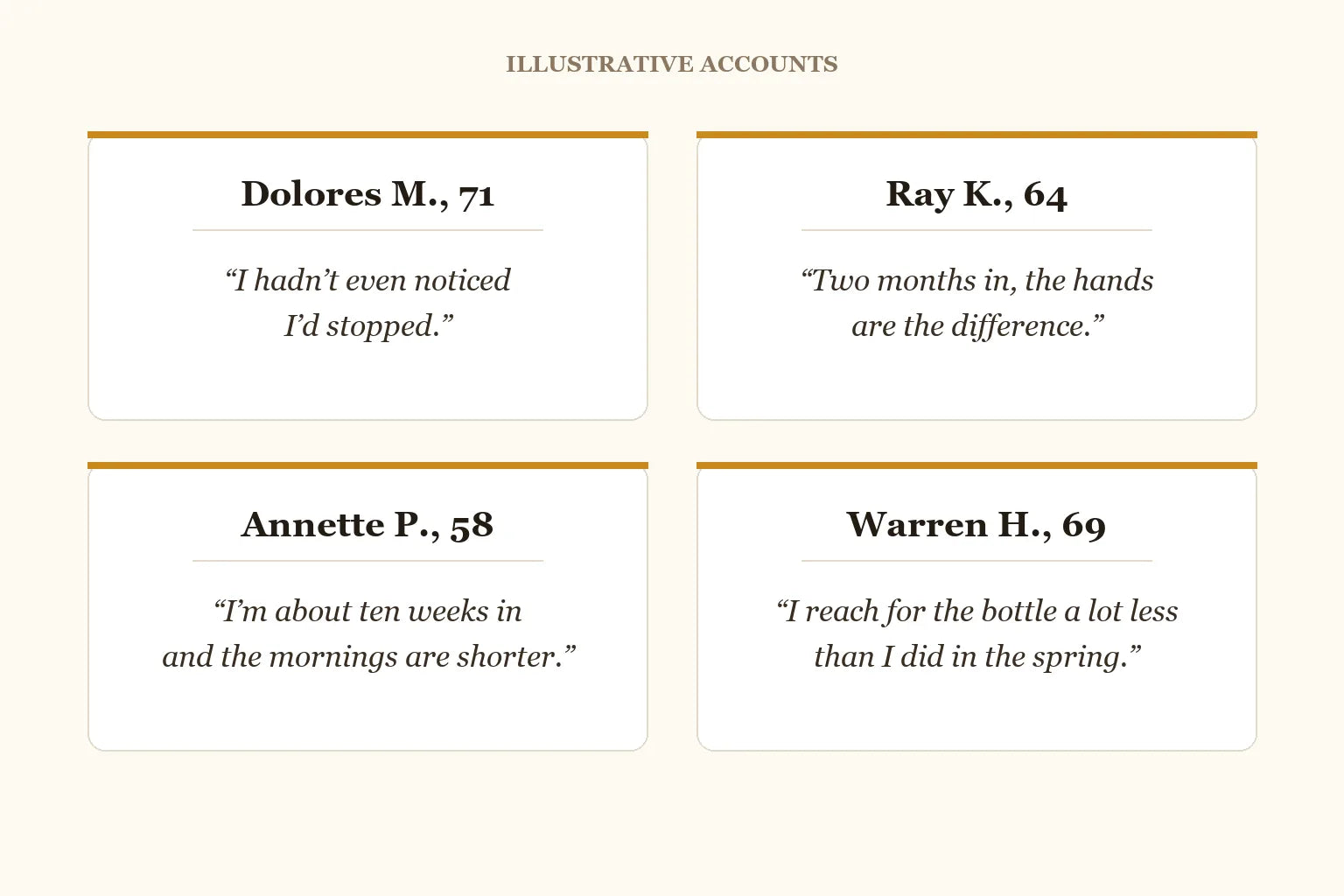
Old World Turmeric is new, so the accounts below are illustrative rather than customer reviews.
What This Actually Looks Like For People
I want to set your expectations honestly before you read these.
In the research, the blood-marker changes showed up over four to twelve weeks, not four to twelve days.6 7
You are closing a faucet, not mopping a floor, and closing a faucet is slower and better.
Illustrative customer stories
"I've been the one who takes an hour to get going in the morning for about six years now.
I started this in early spring and honestly the first month I thought, here we go again.
Week seven is when my daughter said something, not me.
She said I'd stopped doing 'the thing' where I hold the counter before I walk to the coffee pot.
I hadn't even noticed I'd stopped."
"I'd tried turmeric twice before and I told my wife it was ground-up disappointment.
Nobody had ever explained to me that my own liver was throwing it out.
That's the only reason I gave it another go.
Two months in, the hands are the difference.
I can open the truck door in January without doing the whole ritual first."
"What sold me was that the page told me what the studies didn't find.
I've never had a supplement company do that.
I'm about ten weeks in and the mornings are shorter.
That's the honest version."
"I was taking ibuprofen most days and not telling my doctor how many.
I'm not off anything, I want to be clear about that, my doctor and I are handling that part together.
But I reach for the bottle a lot less than I did in the spring, and my stomach has noticed."
Getting Started With Old World Turmeric
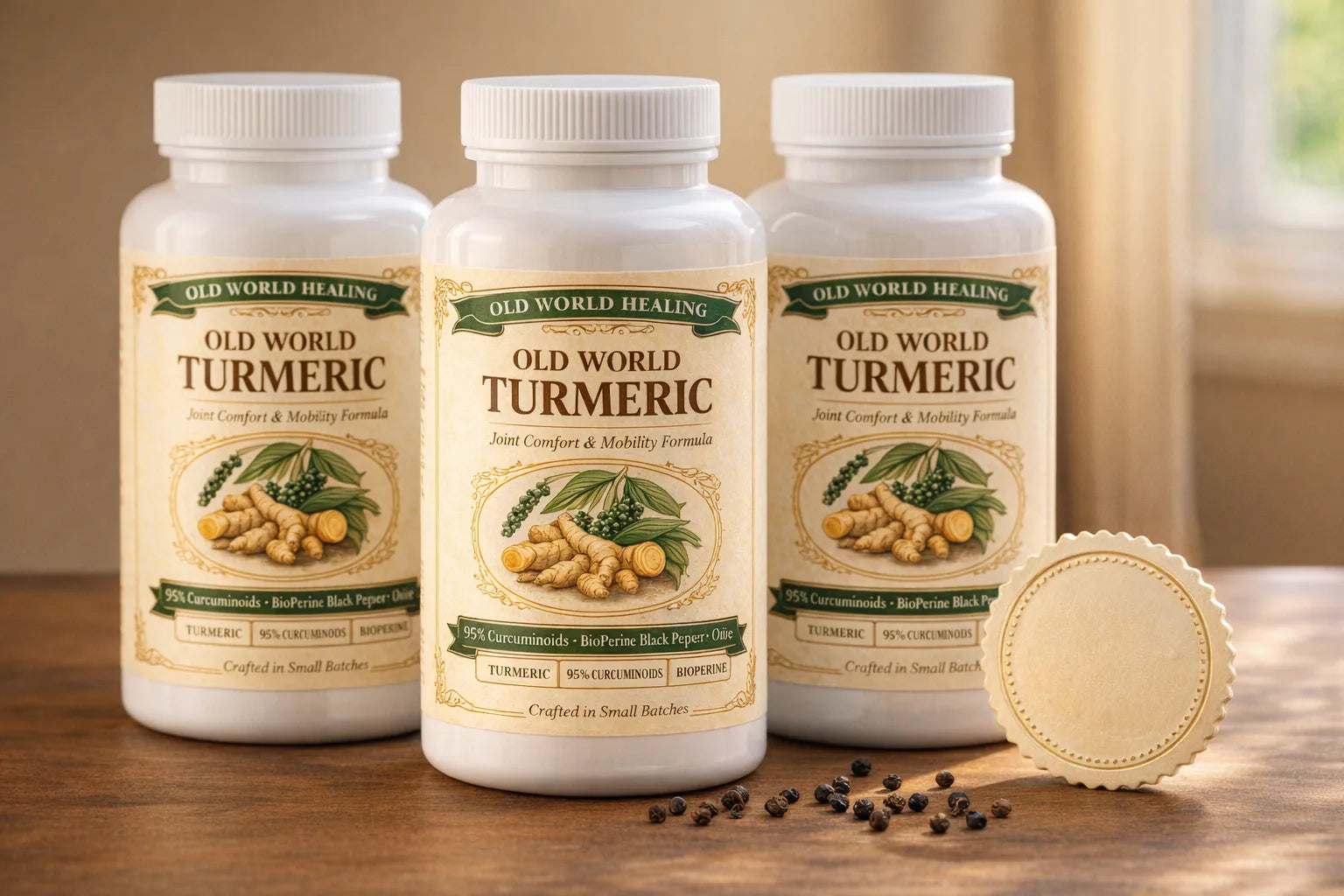
Old World Turmeric comes in three supplies, and you choose how you buy it.
On subscription: $49 | $89 | $129
The struck figure is what the same supply costs bought once, and it's the only comparison price on this page.
- Free shipping on every order, whichever way you buy.
- Your subscription bills the same price from the very first month, with no introductory rate to expire.
- Cancel anytime before your next ship date, with no fee and no phone call.
- 90-day money-back guarantee on both ways to buy, in full, with no need to send the bottle back.
And I'm not going to hook you with a cheap first month, then quietly double the price on you in week five.
There's no introductory rate here to expire, so your subscription bills the same in month one and month twelve.
Most people don't buy one bottle of something like this, and there's a reason that isn't just upselling.
The research timeline is four to twelve weeks.6 7
A single bottle can't cover a twelve-week window.
So people who start with the smallest option tend to run out right around the point where the studies say things start showing up.
Our Guarantee
You have 90 days, and you get all of your money back.
If Old World Turmeric isn't working for you, email us within 90 days of your order for a full refund.
You don't need to send the bottle back.
The refund holds whether you bought it once or started a subscription.
Ninety days is deliberate, because the research window is four to twelve weeks.6 7
A 30-day window would ask you to judge the bottle before the studies say there's anything to judge.
What I can promise you right now is the part that doesn't need a policy document.
I'll show you the studies that disagree with us alongside the ones that agree.
I'll tell you the 2,000% figure comes from a single 1998 study every single time I say it out loud.
And I'll never tell you to stop taking something your doctor gave you.
How To Take It
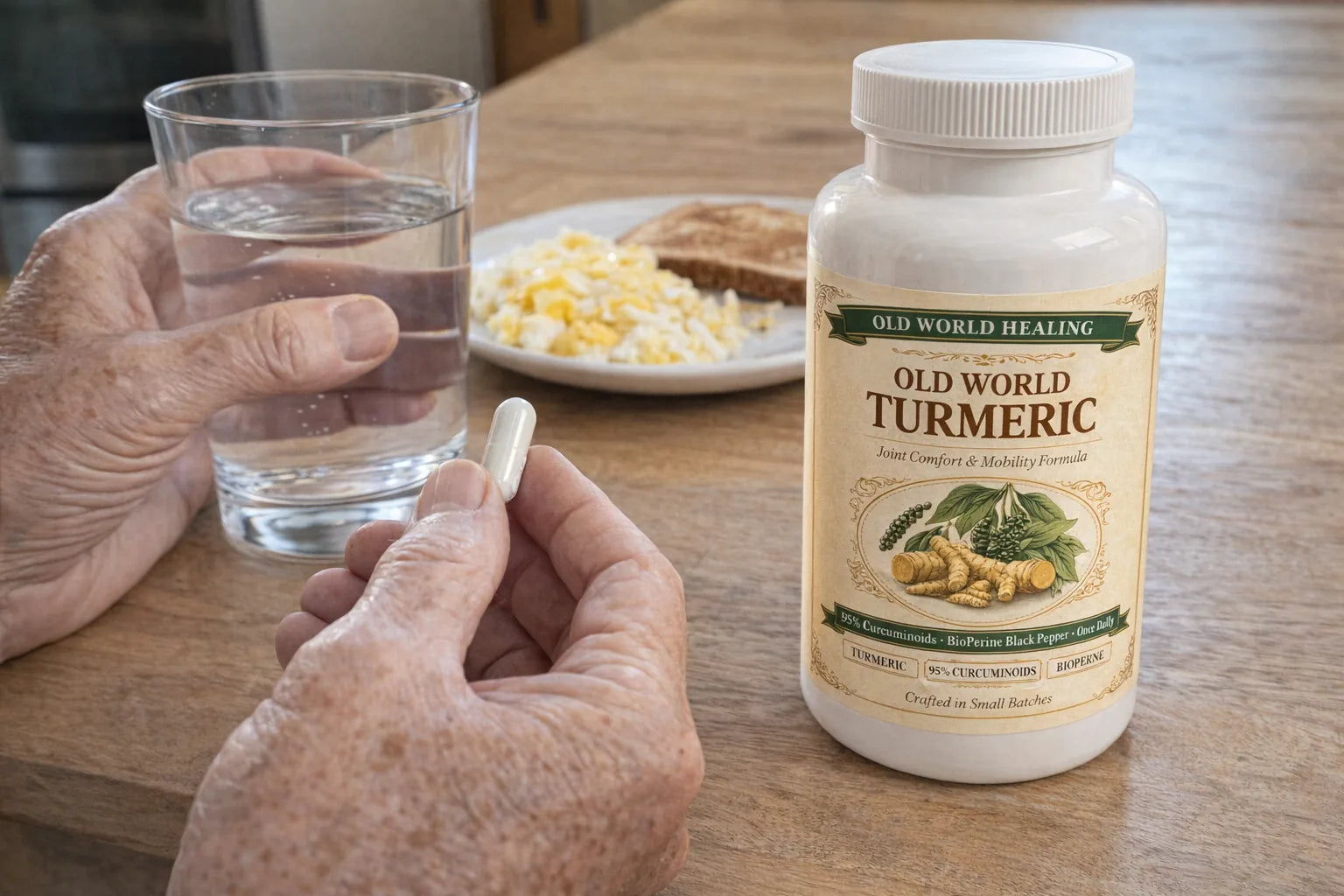
One capsule a day, with an 8 oz glass of water.
One capsule is the whole serving, and a bottle holds 30 of them, so one bottle is one month.
There's no loading week and no second capsule at night.
One thing I'll add from the research, regardless of when you take it.
Curcumin is fat-friendly, which is part of why the old-world kitchens paired it with ghee and whole milk and oil.12
Taking it alongside a meal that has some fat in it is simply working with your own chemistry instead of against it.
Two Versions Of Next Spring
I want you to picture both of them, because one of them is going to happen.
The first version.
You close this page, which is easy, because closing pages is what we all do at 11 at night.
The faucet keeps dripping, because faucets don't care whether you read about them.
Next spring the hands are worse than the knees were this year, and the year after that you stop offering to do the driving.
You go on mopping, more often, with a drug whose own risk profile gets worse the older you get.14 15
And somewhere in there, quietly, you accept that this is just what the rest of it looks like.
The second version.
You start tonight.
The first few weeks are boring, honestly, because that's how the research says it goes.
Then somewhere in week six, seven, eight, somebody who loves you notices something before you do.
That you got off the floor without the little pause.
That you carried both bags in.
That you knelt down in the garden bed on a Saturday, and stood back up, and knelt down again, and the evening afterward was a warm bath instead of a reckoning.

You can't un-know the faucet now.
That's the thing about mechanisms.
Once somebody shows you where the drip is coming from, "just take an Advil" never sounds the same again.
A Note On Availability
Here's the honest version, because you've earned it by reading this far.
There's no countdown clock on this page, and there won't be one.
I'm not going to tell you a batch is nearly gone in order to move you along tonight.
Old World Turmeric is made in small batches, and we plan production against the number of people actually on a subscription.
If a batch ever runs behind, you'll hear it from us by email before your ship date, and you can pause or cancel in one click.
The prices on this page are our standing prices, not a flash sale.
Nothing on this page expires tonight.
Questions People Ask Me
A: Because of what happens in the first ten minutes after you swallow it.
Enzymes in your gut lining and liver tag curcumin for disposal before it ever reaches circulation.
A 2007 review found curcumin barely shows up in the blood even at very large amounts.12
Piperine, the active compound in black pepper, slows those enzymes.
In the 1998 human study I keep citing, adding 20 mg of piperine to curcumin raised its bioavailability by 2,000%.13
Old World Turmeric is built around that finding, which is the difference between a bottle of turmeric and a bottle of turmeric with its key.
A: Talk to your doctor before you start, and tell them specifically that it contains black pepper extract.
Piperine slows down some of the same enzymes your body uses to process certain medications, which is exactly why it helps with curcumin absorption.
That same property means it can affect how your body handles some prescriptions.
This matters more if you take blood thinners, diabetes medication, or anything with a narrow dosing window.
Your doctor or pharmacist can check your list in about two minutes, and that two minutes is worth it.
A: Slower than you want.
In the biomarker research, changes showed up over four to twelve weeks.6 7
I'd rather under-promise here than have you quit at day 12 like most people quit their first turmeric bottle.
Closing a faucet is slower than mopping, and it's the only one of the two that ever gets you anywhere.
A: Because it isn't doing joint work, it's doing door work.
Piperine's job in this formula is to pause the disposal enzymes long enough for the curcuminoids to get through.
A doorman doesn't need to be the size of the crowd.
A: You could, and I'd encourage it, but understand the ceiling.
The 2007 absorption research showed curcumin staying at very low blood levels even at doses far beyond what anybody sprinkles on rice.12
The old-world kitchens got around that by never serving turmeric alone, which is the whole insight this product is built on.
A capsule is just that pairing, standardized, without asking you to eat curry twice a day for twelve weeks.
A: They do genuinely different jobs.
The cream calms the fire from the outside, exactly where you rub it.
Old World Turmeric works from the inside, on the systemic side that no cream can reach.
If the cream helps you but the ache keeps turning up in new places, that pattern is the reason this product exists.
A: Turmeric Root Extract at 95% curcuminoids (30 mg), Turmeric Root Extract 4:1 (75 mg), Coleus Forskohlii Extract (15 mg), and Black Pepper Extract as BioPerine (5 mg).
Those four actives all sit in one capsule, which is the full serving, and the bottle holds 30 of them.
The other ingredients are microcrystalline cellulose, gelatin and magnesium stearate, so the capsule itself is gelatin rather than vegetarian.
A: You have 90 days, and you get all of your money back.
Email us within 90 days of your order and we'll refund it in full.
You don't need to send the bottle back.
What I'll say regardless of the policy: give it the full research window before you judge it.
Four weeks is where most people quit, and the studies say four weeks is barely the starting line.6 7
Don't Spend Another Season Mopping
You've been handed the same two answers for years.
"It's just age, everybody's got something."
"Have you tried an Advil?"
Neither of those sentences contains a mechanism, which is exactly why neither one ever helped you.
The sticky switch is a mechanism, and so is the disposal crew that throws your turmeric away.
A mechanism is the only kind of thing a person can actually do something about.
The question I get asked most about turmeric is whether the black pepper really makes the difference.
The short answer: a 1998 human study measured it, we built this formula around that finding, and the honest caveats travel with it every time I say it out loud.13
To see the three supplies, and both ways to buy them, use the button below.
P.S. If you take one thing off this page, make it this.
Your turmeric didn't fail you.
Your body threw it away before it ever got in, and a pinch of black pepper is the difference between those two outcomes.13
That's not marketing, that's a published human study from 1998 and a kitchen tradition four thousand years older than the study.
P.P.S. The research timeline is four to twelve weeks.6 7
So please don't start this with a two-week expectation.
Start it the way you'd start closing a faucet.
Slowly, on purpose, and with the understanding that the bucket has been filling for a long time.
The customer stories on this page are illustrative accounts, written to show how people typically use Old World Turmeric and what the research timeline realistically looks like.
They are not reports from named customers, and individual results vary.