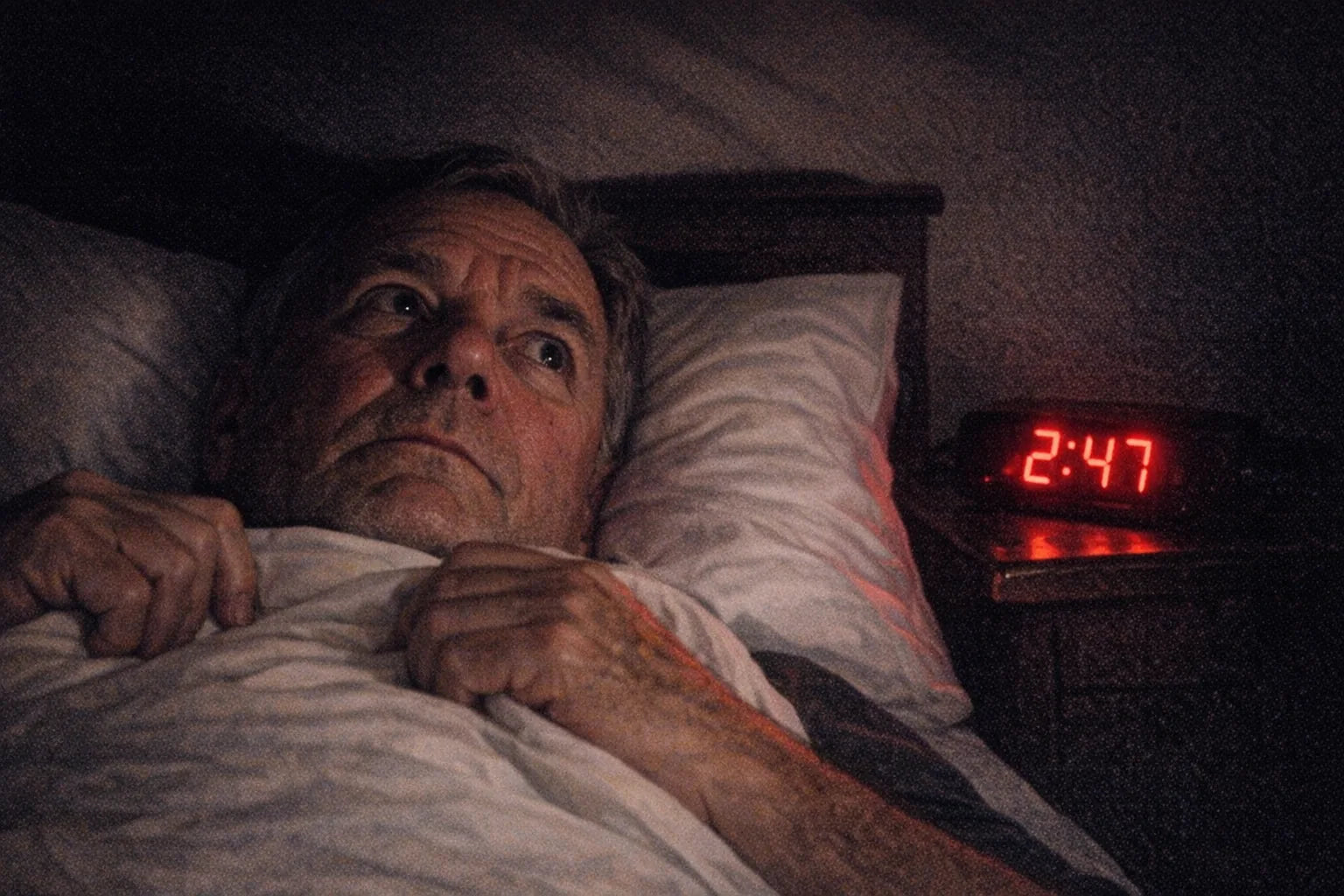
"It's 2:47 In The Morning And I'm Wide Awake AGAIN... And The Only Answer Anyone Gave Me Was 'That's Normal At Your Age.'"
The 1 "Old Sleep Secret" That Helps You Sleep Through The Night Again After 55 (No Sleeping Pills)
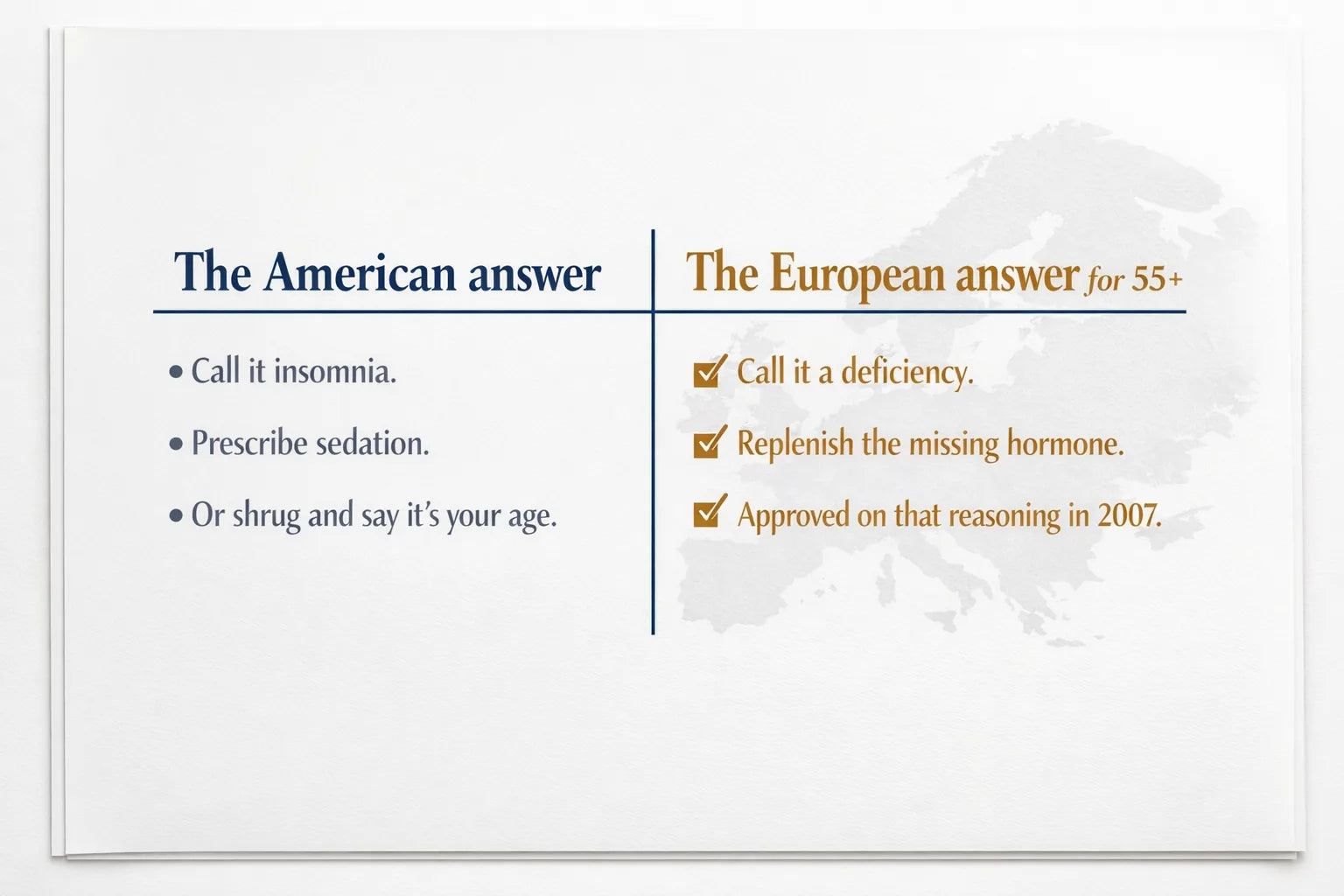
In Europe, doctors don't call it insomnia after 55... they call it a melatonin deficiency...
And they answer it with replacement, not sleeping pills...
Because there's a pea-sized gland in the middle of your head that slowly fills with what radiologists actually call "brain sand"...
Refill what that little gland stopped making, and your body can run its night shift again... which is where mornings with less ache, and afternoons with enough battery left to say yes to the grandkids, come from...
In Europe, doctors don't call it insomnia after 55.
They call it a melatonin deficiency.
And they answer it with replacement, not sleeping pills.
Over here you get a shrug and one word.
Age.
Nobody has ever sat you down and explained WHY the sleep you had at 40 stopped showing up at 60.
So let me do that right now, because the reason is physical, it has a name, and doctors can see it on an ordinary scan.
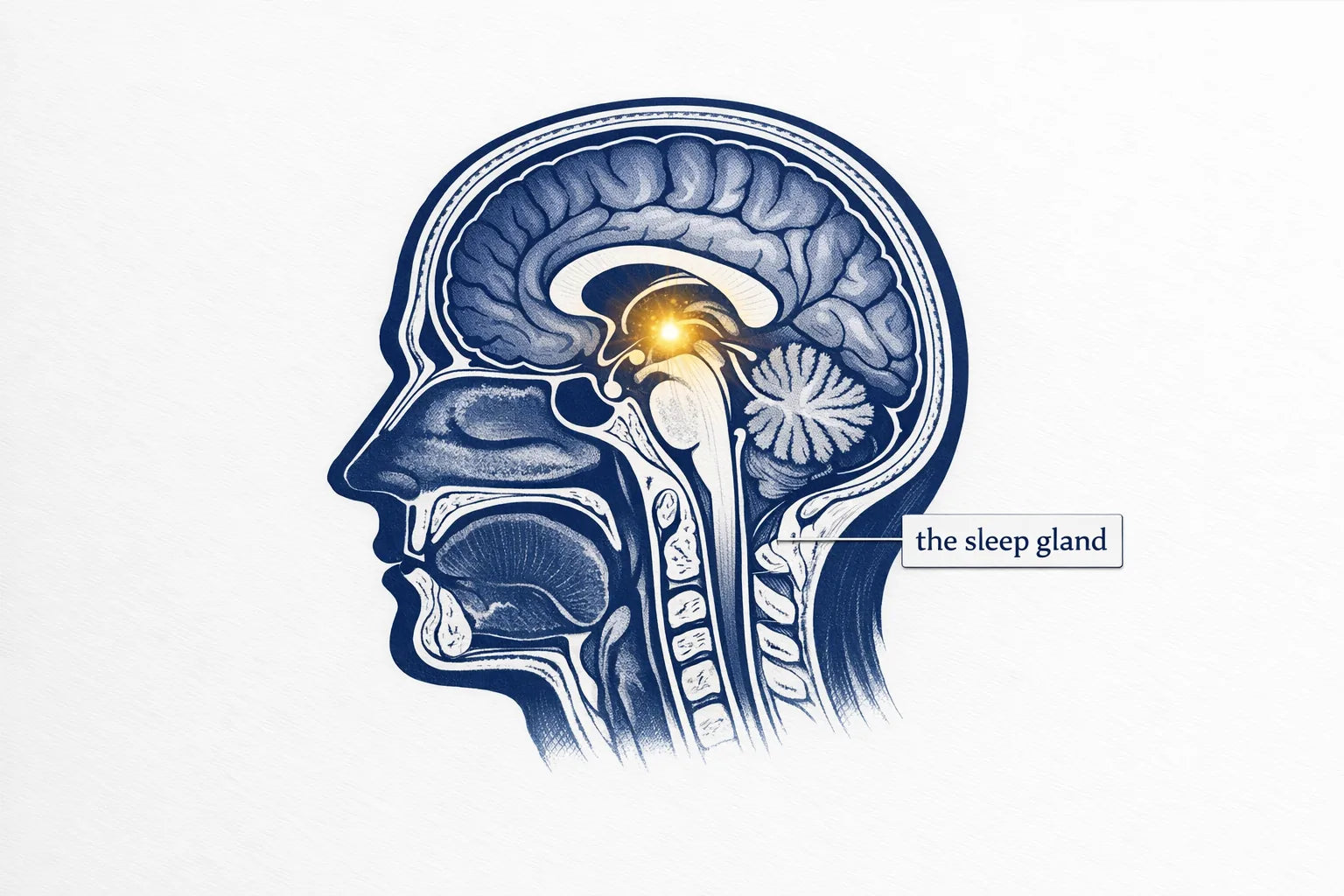
Right in the middle of your head, tucked between the two halves of your brain, sits a gland the size of a pea.
It has one job.
When darkness falls, it releases melatonin, the hormone that tells every cell in your body the same thing: night shift, stand down, rest.
That signal is what puts you under.
It's also what HOLDS you under at 3 in the morning.
And here is the part almost nobody over 55 has been told.
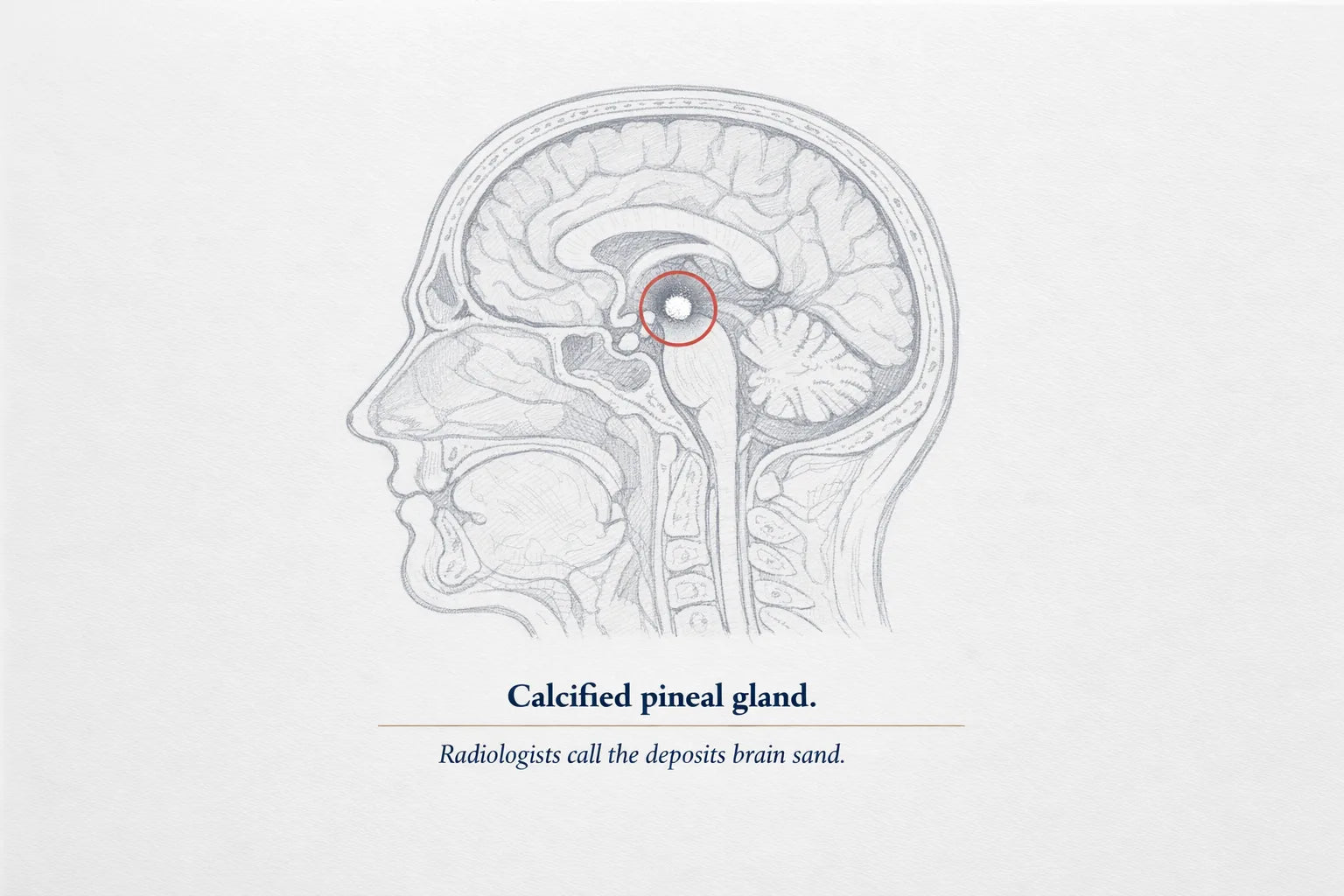
That pea-sized gland calcifies faster than any other organ or tissue in your body.1
Radiologists watch it happen on ordinary X-rays and CT scans.
They see little chalky white specks sitting where soft tissue used to be.
They have a name for those specks.
They call it brain sand.
I'm Mary Miller.
I'm an herbalist and a natural health researcher, and we started Old World Healing to bring back remedies the modern world got too busy to keep.
I've spent the last two years reading everything I could find about why sleep breaks down after 55.
Our own customers kept writing to me with the same story, over and over, and not one of them had ever been given a reason.
What I found honestly made me angry.
Not because the science is hidden.
Because it's sitting right there in the research, and an entire generation is being told to buy a new mattress instead.

First, Let's Talk About Your 2:47
You know the exact minute, don't you.
That's the part that gets me.
Almost everyone who writes to us about this can name the time on the clock, to the minute, like their body set an alarm nobody asked for.
You fell asleep fine. You were tired at ten.
And now you're on your back with your eyes open, listening to the house tick, doing the arithmetic.
If I fall asleep right now I can still get four hours.
Now three and a half.
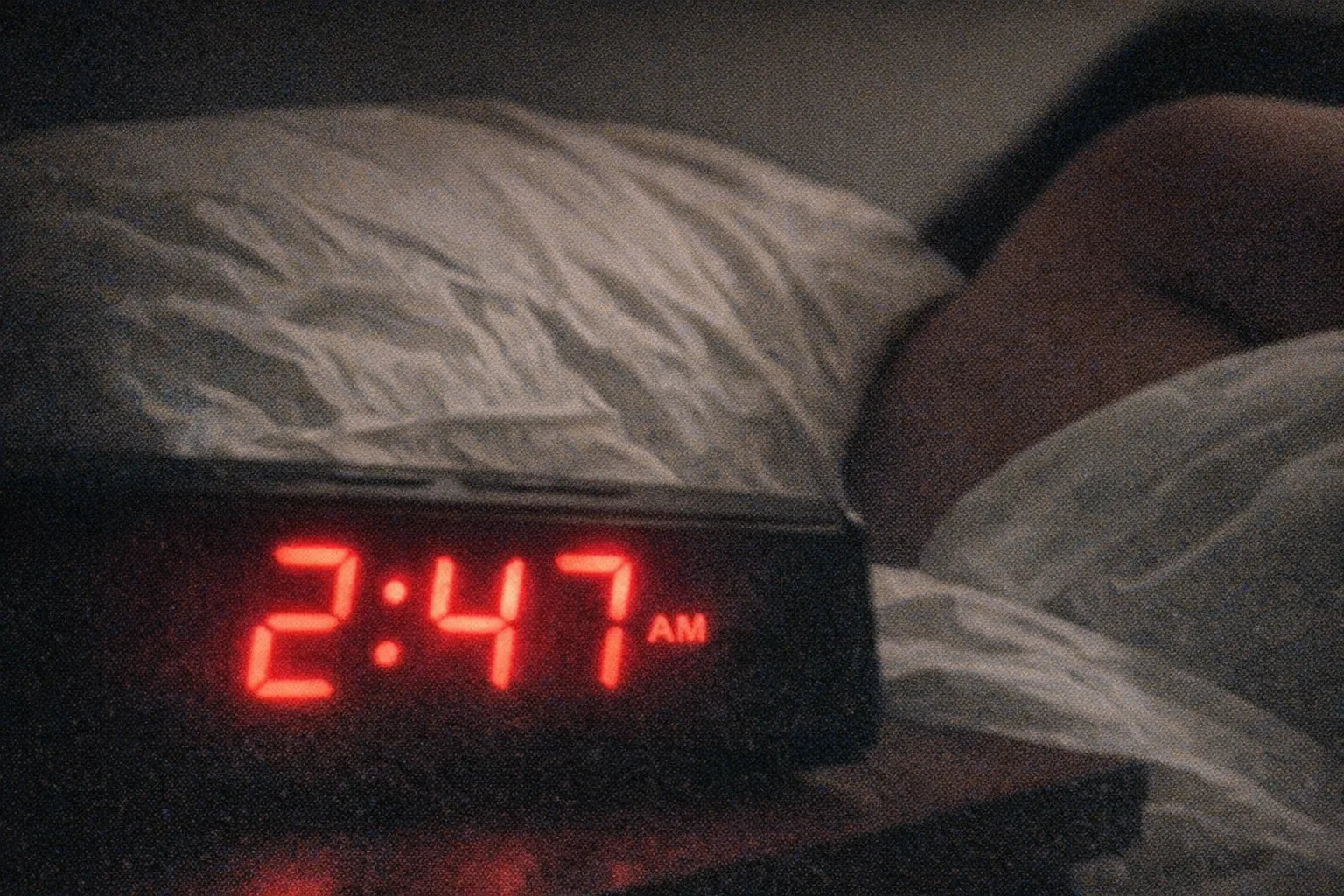
You don't turn on the light because you don't want to wake the person next to you, who is sleeping like a stone, which is its own particular kind of lonely.
Your knees start talking around three.
By four you've given up and you're thinking about tomorrow, which is now today.
Tomorrow there's the grandchild's recital, and you're going to sit through it like a zombie in your good clothes.
You'll smile at all the right moments while your body screams at you from the inside.
And you're not going to ask anybody for the pills, because you've watched where those go.
So you lie there and you take it, one hour at a time, the way you have for years.
And underneath all of it there's a thought you have never once said out loud.
"Is this just what the rest of it looks like?"
Hold onto that thought.
We're coming back to it, and the answer is a great deal better than you think.
But first you need to see what's actually happening inside your head at 2:47, because nearly everything you've been told about it is wrong.
Picture An Old Well
Here's the whole mechanism, and you can draw it on a napkin.
Your sleep gland is a well.
At 20 years old, that well was deep and clean, and every night at sundown it filled the bucket to the brim.
That bucket is melatonin. It's the "lights out" message that goes to every cell you own.
Now picture a little sand settling into the bottom of that well each year.
Not enough to notice in any single year.
But by your forties, sand has taken up real space in there. By your sixties, more.
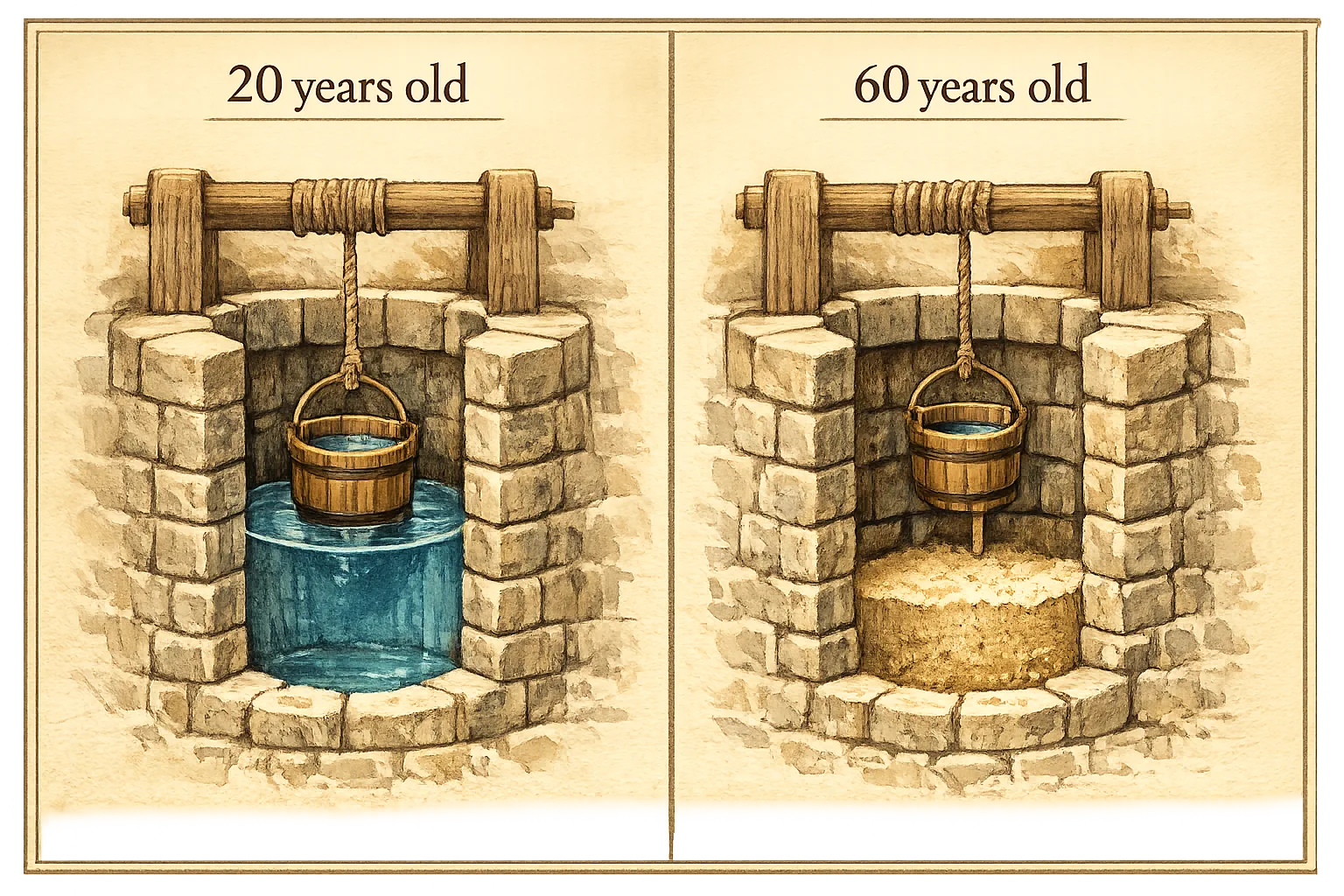
The well still works, and the rope still turns.
The bucket just comes up half full, and it comes up late.
That is your sleep hormone after 55, and here's the number the research puts on it.
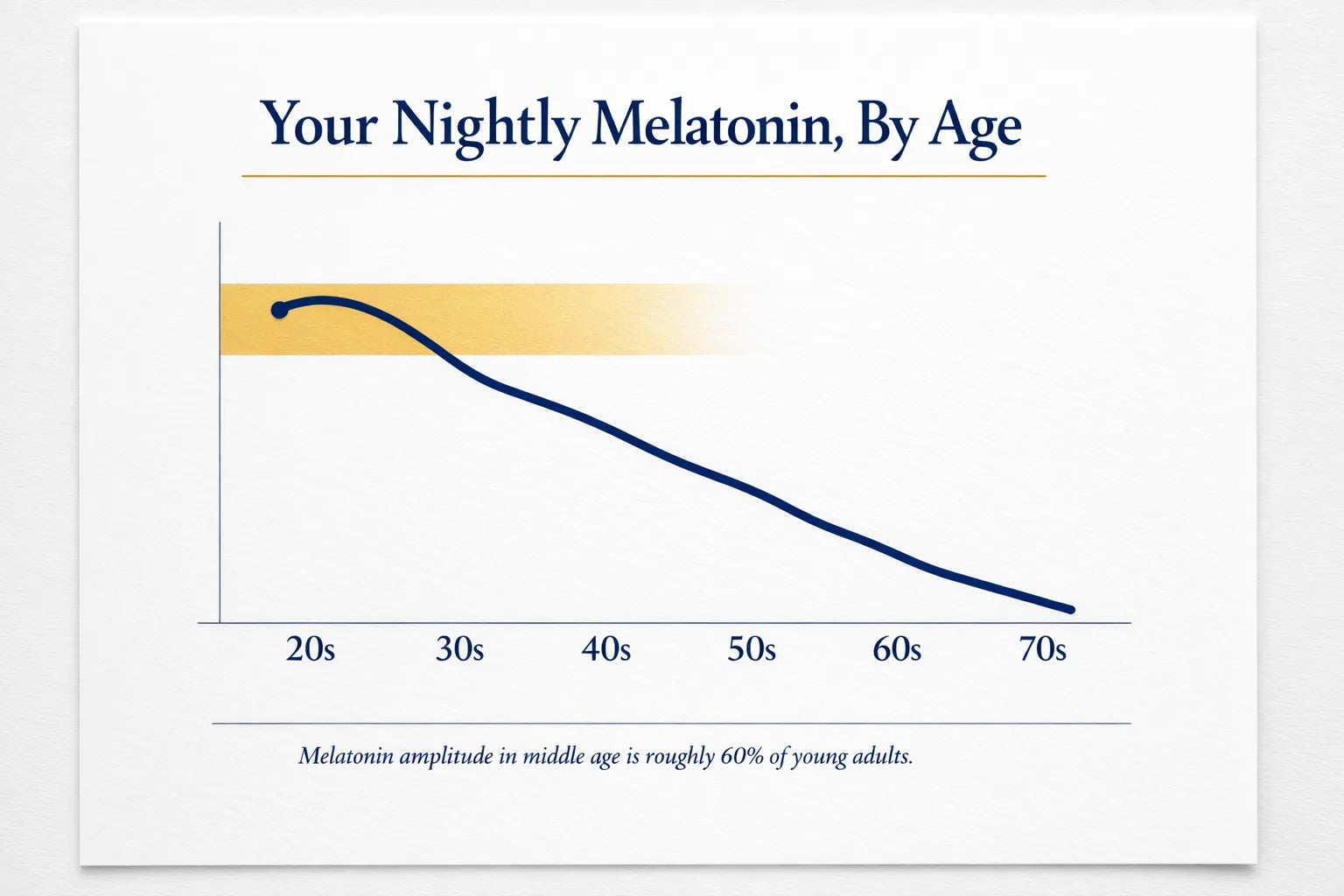
Melatonin output starts dropping step by step at around age 40.
By middle age, the nightly peak is only about 60% of what a young adult produces, and it keeps falling from there.2
Roughly a 40% pay cut on the hormone that runs your night, and nobody sent you a memo.
Then researchers went one step further and asked whether the sand is actually the cause.
A team of German scientists compared how calcified people's sleep glands were against how much melatonin those people actually made.
Their conclusion in plain English: the age-related drop in melatonin can be sufficiently explained by the calcification of the gland.3
The more of the gland has turned to brain sand, the less melatonin it puts out.
A 2018 review in the journal Molecules put it more bluntly.
Pineal calcification, they wrote, jeopardizes the gland's ability to make melatonin, and it tracks with sleep disturbance.4
And when researchers looked specifically at people over 55 who sleep badly, they found something that should be on the front page.
Those poor sleepers had LOWER melatonin than healthy older adults who sleep fine.2
Same age, different supply.
That last finding is the one that should change how you think about yourself.
The problem isn't that you turned 60.
It's that your supply fell, and a lot of people your age who sleep like rocks still have theirs.
Why It's The MIDDLE Of The Night, Specifically
This is the question I get asked most, and the well answers it perfectly.
"Mary, I fall asleep fine. So why do I come apart at three?"
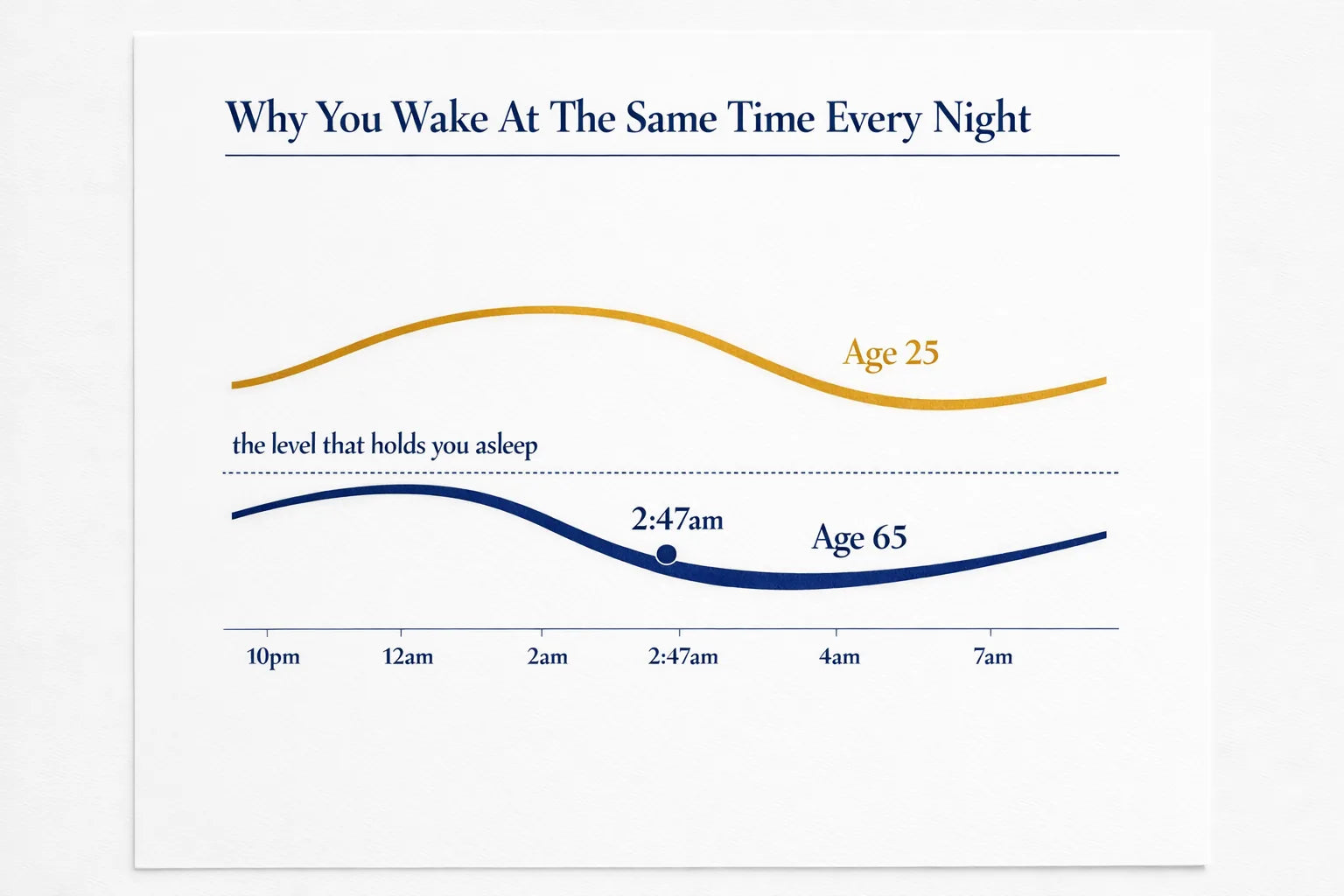
Because melatonin isn't a light switch you flip at bedtime.
It's a pour that has to last you all night.
A full bucket at sundown carries you through to morning.
A half bucket carries you a few hours, and then the level drops below the line that was holding you under.
That's your 2:47.
It isn't your bladder and it isn't your worries, though both will happily volunteer for the job once you're already awake.
You surface at the hour your supply runs out, which is why it happens at nearly the same minute every night.
The clockwork is the tell.
Worry has never once been that punctual.
Six Things That Are NOT Keeping You Awake At 2:47
You've been handed a lot of explanations over the years.
Every single one of them quietly put the blame on you.
Let's bury them one at a time.
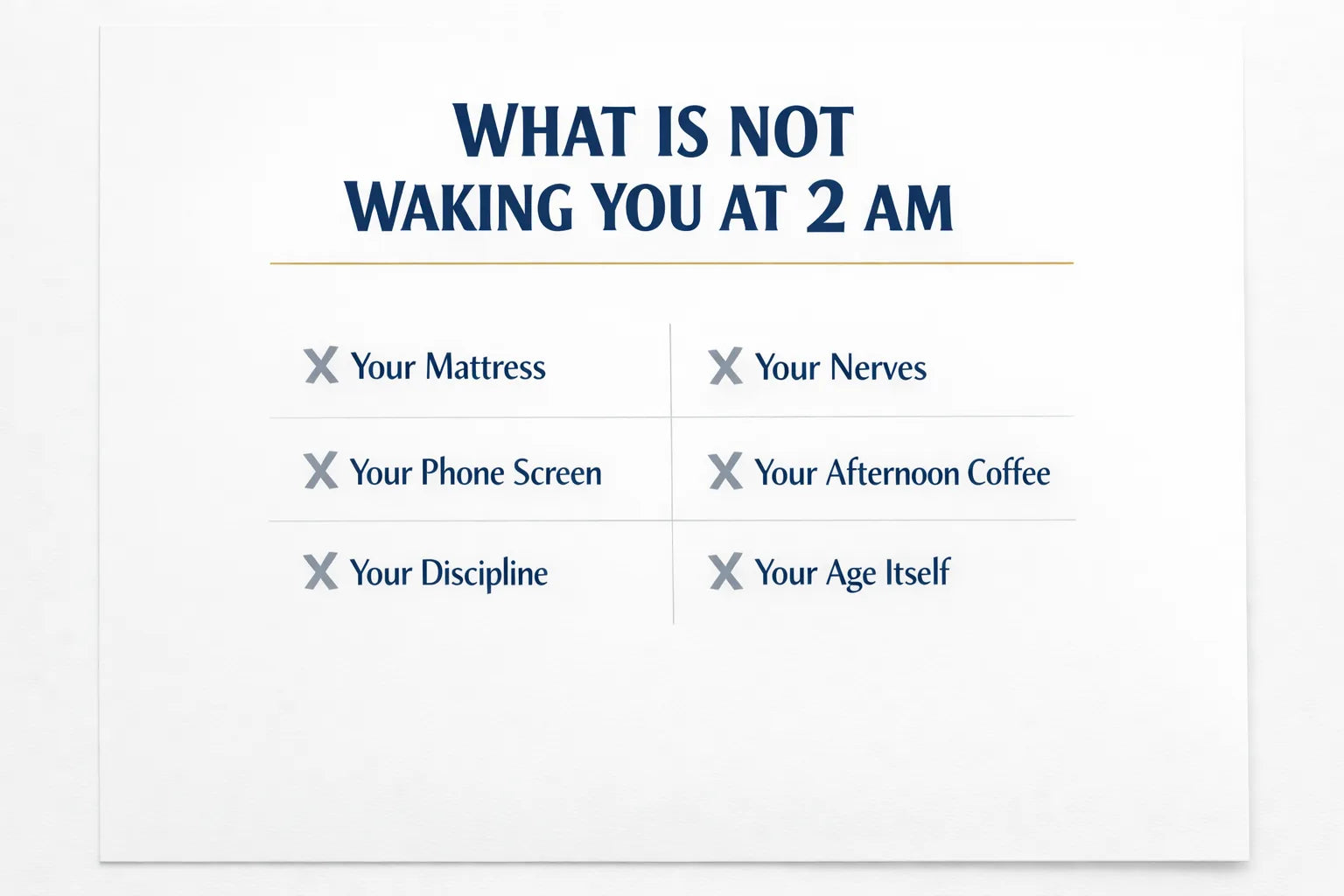
It isn't your mattress
You may have already spent real money testing this one.
A mattress decides how comfortable you are when you lie down.
It has no say whatsoever in how much melatonin your gland releases at 10pm.
Which is why people buy the new mattress, love it for a week, and still meet the ceiling at 2:47.
It isn't your phone
Screens at night can push your body clock later, and that part is real.
Turning them off an hour before bed is a decent habit.
But a habit adjusts the TIMING of a signal.
It cannot manufacture more of a hormone that a silted-up gland is no longer making.
It isn't discipline
This is the cruelest one, because you've been trying so hard.
You do the decaf, and you read instead of watching the television.
You go to bed at the same hour every night like a good soldier.
And you still wake up at 2:47, and then you feel like a failure about it.
Nobody wakes up at 2:47 because they lack willpower.
You can't willpower a hormone back.
It isn't "your nerves"
Worry keeps people from FALLING asleep.
That's not your pattern.
Your pattern is that you fall asleep fine and then surface in the middle of the night like clockwork, which is the signature of a signal that ran out, not a mind that wouldn't settle.
It isn't the coffee you gave up in 2019
You already ran that experiment.
You quit the afternoon coffee, you switched to herbal tea, and your 2:47 didn't move by five minutes.
And it isn't "just age"
This is the big one, and it's the one that made you stop looking.
Age is not a mechanism. Age is a calendar.
Something physical has to happen inside a body for its nights to change, and in this case we can name it, measure it, and see it on a scan.
The sand is the mechanism. Your birthday is just when it got noticeable.
Now Here's The Part Nobody Warned You About
If it were only about being tired, you could live with tired.
You've done hard things before.
But bad sleep doesn't stay in the night.
It sends you a bill the next day, and if you're one of the millions of people over 55 who already ache, the bill comes due in your joints.
In 2019, researchers at UC Berkeley took healthy adults, kept them up for one night, and slid them into a brain scanner.
Then they applied a gradually increasing heat to their skin and asked them to say when it became painful.
Two things happened, and both are worth reading twice.
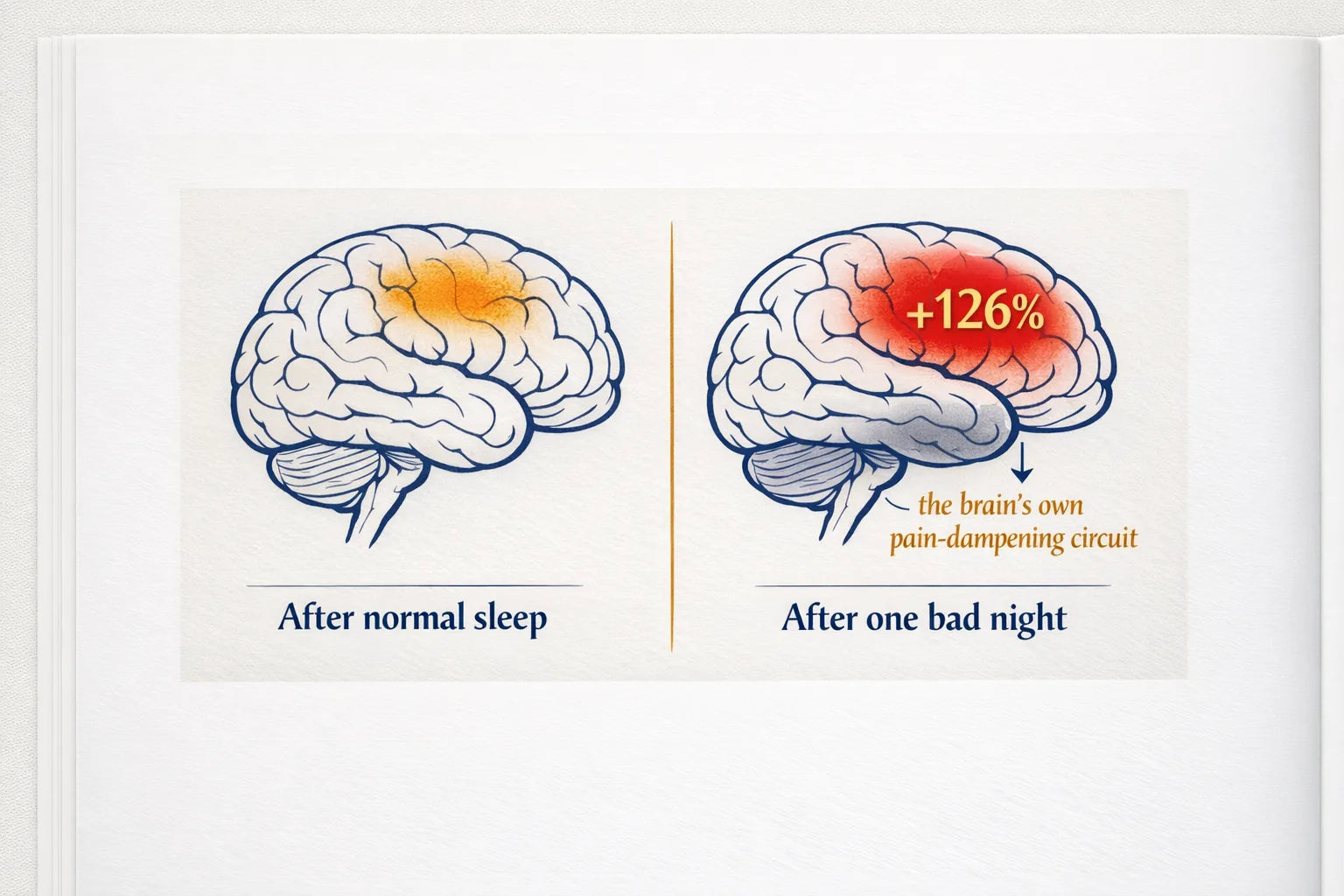
First, the pain-sensing part of their brain, the somatosensory cortex, fired 126% harder after one night of lost sleep.5
Not 12%. One hundred and twenty six percent.
Second, and this is the part that keeps me up, the region that runs the brain's own natural pain relief went quiet at the same time.5
So the volume knob got turned up and the muffler got switched off.
Their pain threshold measurably dropped.
Heat that felt merely warm when they were rested felt painful when they weren't.5
One night.
Now think about what a whole season of 2:47s does.
Your Pain Problem And Your Sleep Problem Are One Problem
Here's the finding that reorganized how I think about all of this.
In 2013, three researchers published a landmark review in The Journal of Pain looking at how sleep and pain feed each other.
Everyone assumed the arrow pointed one way. You hurt, so you can't sleep.
The evidence says the stronger arrow points the OTHER way.
Sleep disturbance predicts pain more strongly than pain predicts sleep disturbance.6
Poor sleep raises the risk of NEW pain in people who had none, and it drives the day-to-day flare-ups in people who already ache.6
Read that again if you've spent years assuming your bad nights were a symptom of your knees.
It's at least as true the other way around.
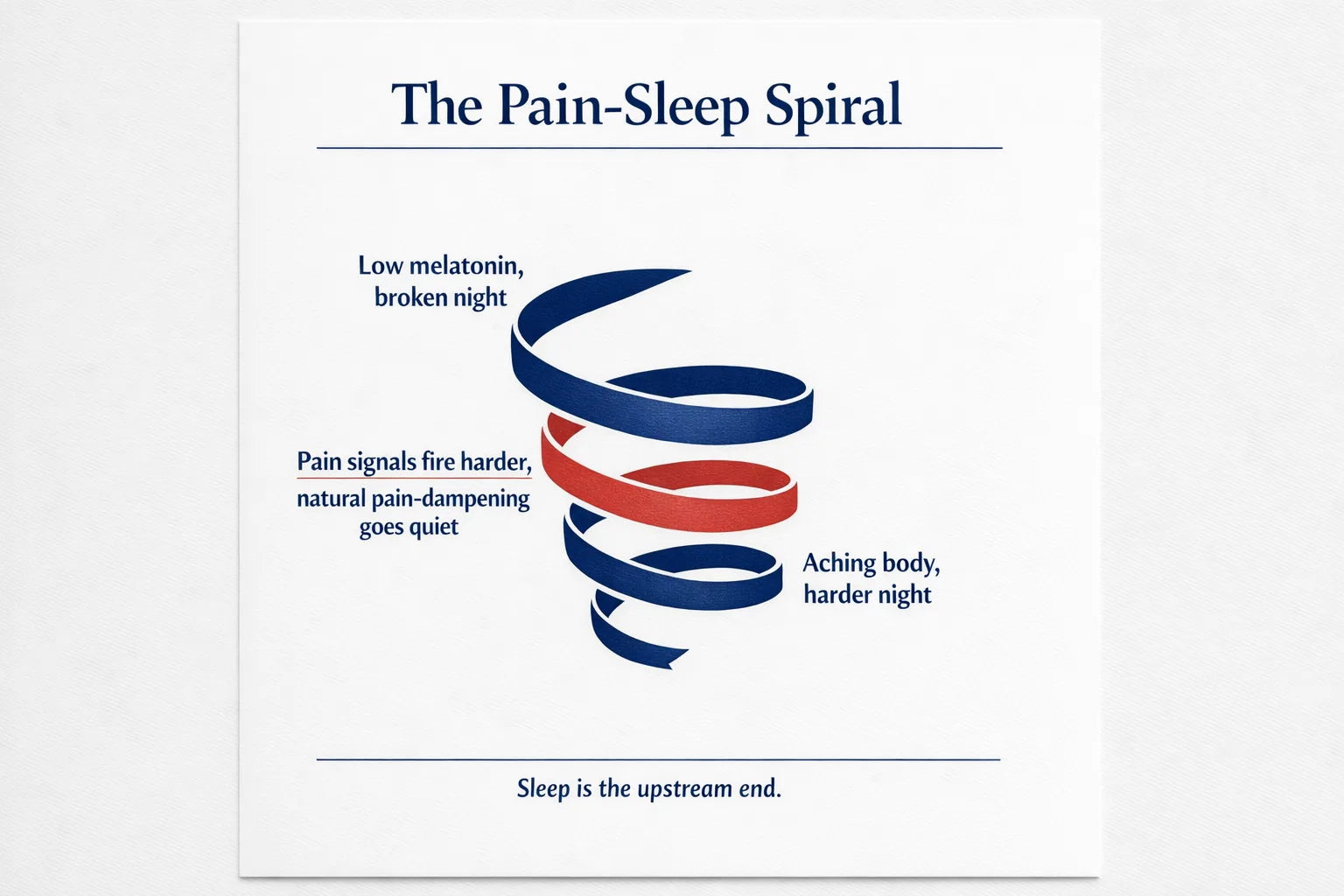
I call it the Pain-Sleep Spiral, and if you live it, you already knew it before I said it.
The morning after a rough night, everything is louder.
Getting out of the chair takes two tries instead of one.
You blame the weather, or the gardening you did on Saturday.
Then that louder day makes for a rougher night, and around you go, one notch tighter every time.
Brain sand is what starts the spiral, because brain sand is what took the sleep.
And that means your pain problem and your sleep problem are one problem.
Sleep is the upstream end of it.

The Old World Noticed This Long Before Anyone Could Explain It
Here's what pulls me into this work.
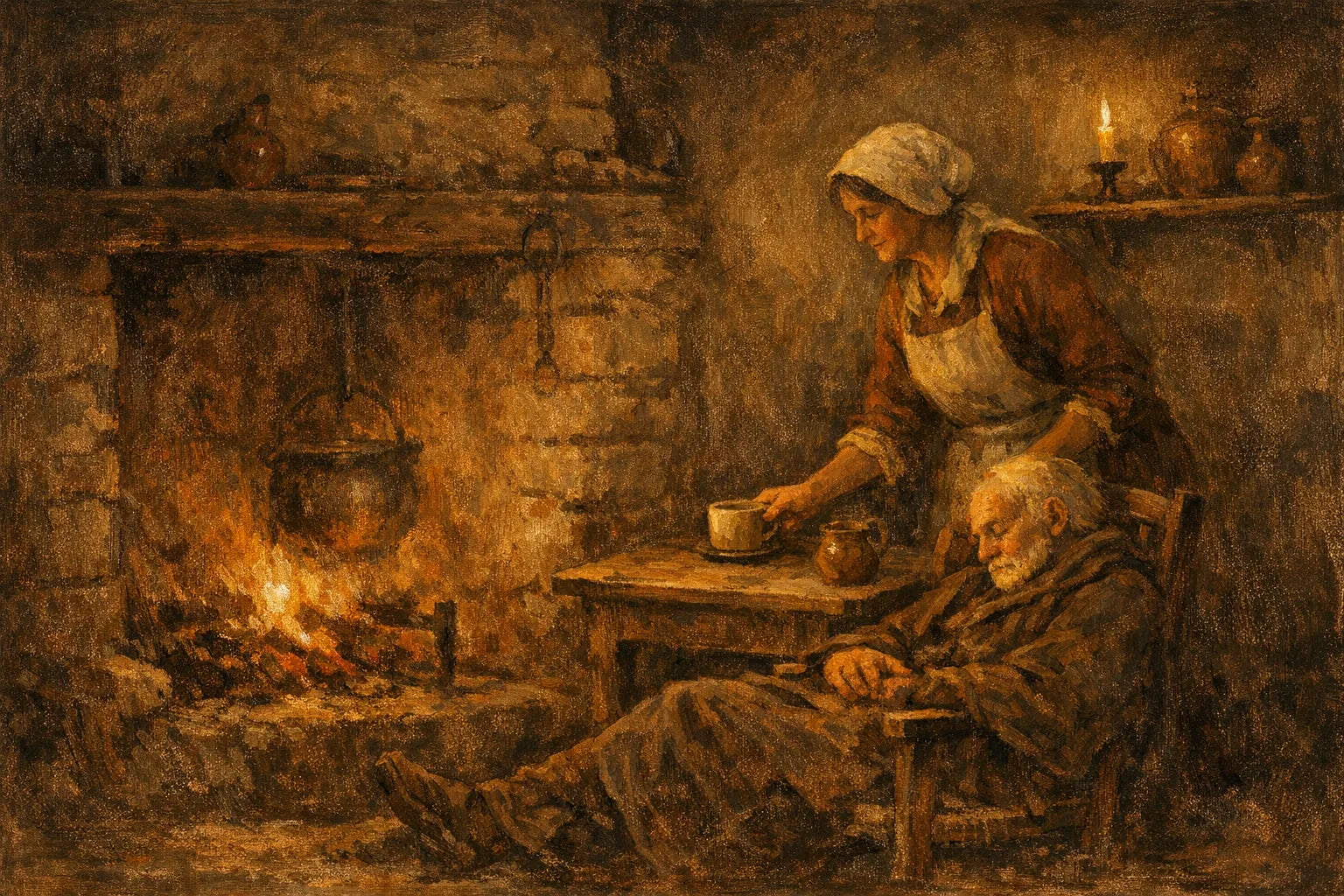
For most of human history, the people who cared for elders noticed a pattern they could not account for.
The old ones who slept poorly ached more, and they healed slower after a fall.
They faded faster than the neighbors down the road who slept sound.
Every healing tradition I have ever read has some version of that observation written down.
None of them knew why, because none of them had a word for melatonin or a scan that could see a pea-sized gland.
They just watched it happen for a few hundred years and made a note of it.
Now we know what they were looking at.
Sleep is when the body does its overnight work.
The hormone that opens that window comes from a gland that fills with sand as we age.
The old world had the pattern.
Modern research found the mechanism.
And unlike most of what ages in a body, this one has an unusually direct answer.
You can't shovel the sand out of the well.
But you can pour the water in from somewhere else.
In Europe, They Don't Call It Insomnia After 55
This is the fact that made me sit back in my chair.
In 2007, European regulators approved a prescription melatonin, sold as Circadin, specifically for patients aged 55 and older.7
Not for jet lag. Not for shift workers.
For older adults whose sleep had broken down.
And read the stated reasoning, because the reasoning is the whole story: the approval rests on the age-related decrease in the body's own melatonin production, and the medicine is described as replenishing the deficiency in the body's sleep-regulating hormone.7
That's a regulatory body, in writing, calling poor sleep after 55 a shortage to be refilled.
I want to be careful and honest with you here, because that matters more to me than a sale.
Circadin is a prescription medicine in Europe and Old World Sleep is not a drug.
I'm not telling you they're the same thing.
I'm telling you what the science underneath BOTH of them says, which is this: after 55, poor sleep is commonly a supply problem, and supply problems get answered by putting the supply back.
That idea is the Old Sleep Secret.
Everything else on this page is just how it works and how to use it.
The Old Sleep Secret: Replacement, Not Sedation
A sleeping pill and a melatonin replacement are not two versions of the same idea.
They're opposites.
A sleeping pill overrides your brain.
A sleeping pill pushes you under whether your body was ready or not, which is why people say they wake up feeling switched off instead of rested.
Replacement does the opposite.
Replacement hands your body back the message it used to send itself at sundown, and then gets out of the way.
That's the difference between being knocked out and going to sleep.
Here's what happens across a night when the signal comes back, in three beats.
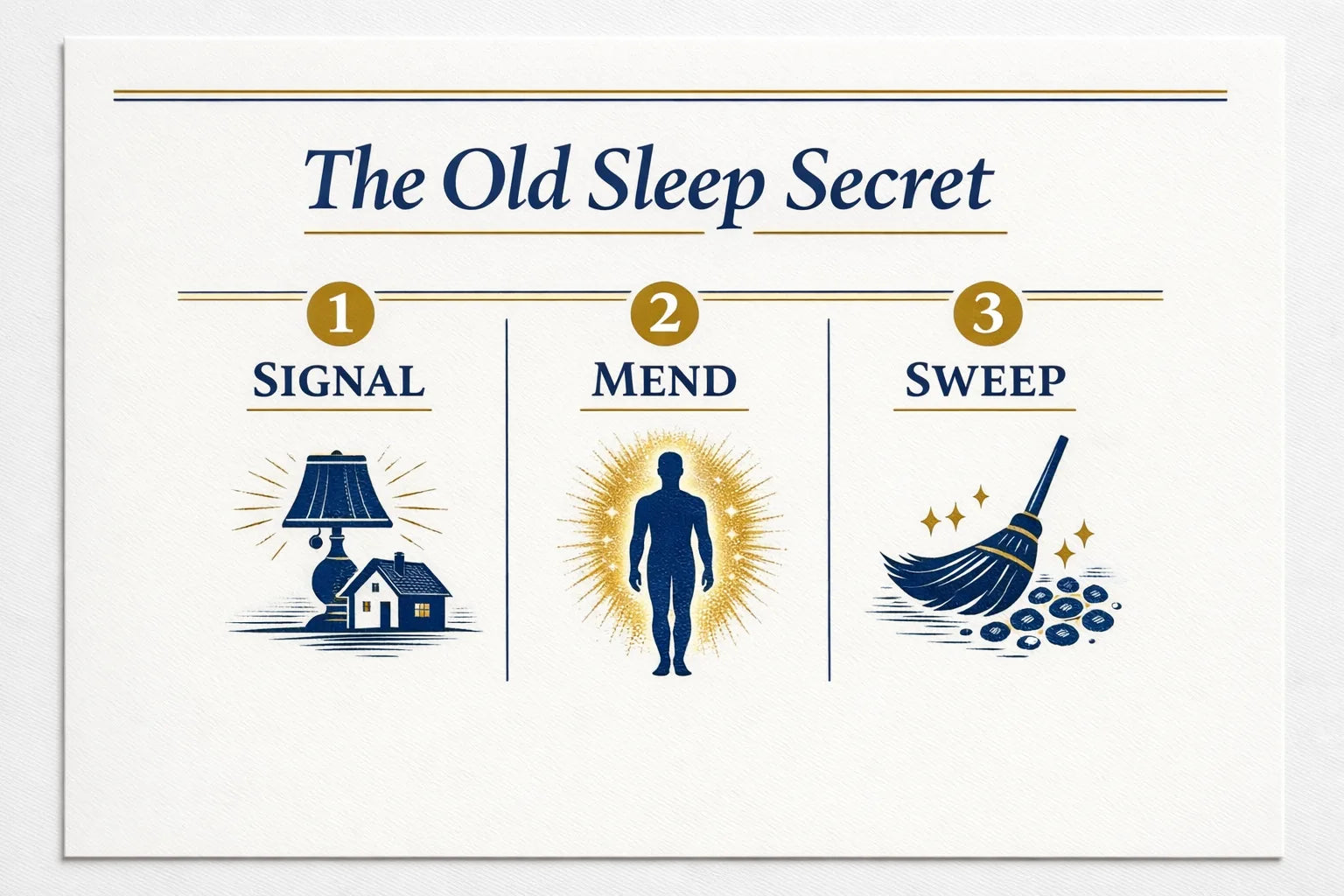
1. SIGNAL
Melatonin is the body's "lights out" messenger.
When the level rises, every system you own gets the same instruction, and your body starts the handoff into sleep the way it did at 30.
This part isn't a theory. It's been tested to death.
A 2013 analysis pooled 19 randomized, placebo-controlled trials covering 1,683 people, and found melatonin shortened the time it took to fall asleep, increased total sleep time, and improved overall sleep quality.8
Nineteen gold-standard trials.
That's not a supplement-aisle promise, that's a stack of receipts.
2. MEND
Now the useful part, and the part that matters most if you ache.
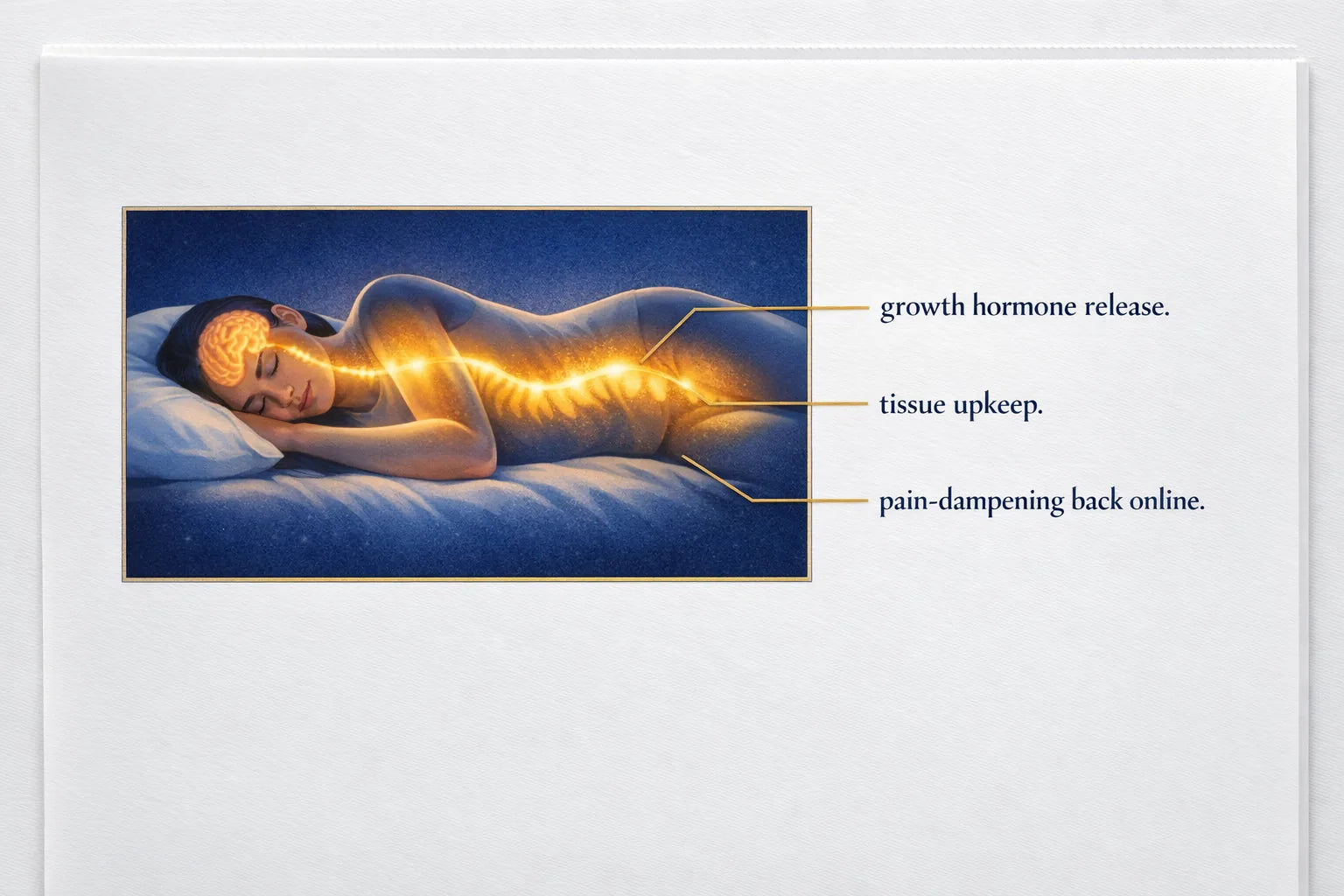
Deep sleep is not idle time. It's the body's night shift.
Slow-wave sleep is when your body runs its peak release of growth hormone and does its tissue upkeep, the whole rest-and-restore side of your physiology.9
That's why the old world saw slow healing in poor sleepers. Poor sleepers were skipping the shift.
And remember what the Berkeley scans showed.
Sleep is also when your brain's own pain-dampening circuit comes back online.5
Give the night back and both of those come back with it.
3. SWEEP
Melatonin has a second job that most people have never heard about.
It's one of the body's most versatile antioxidants, and an unusual one.
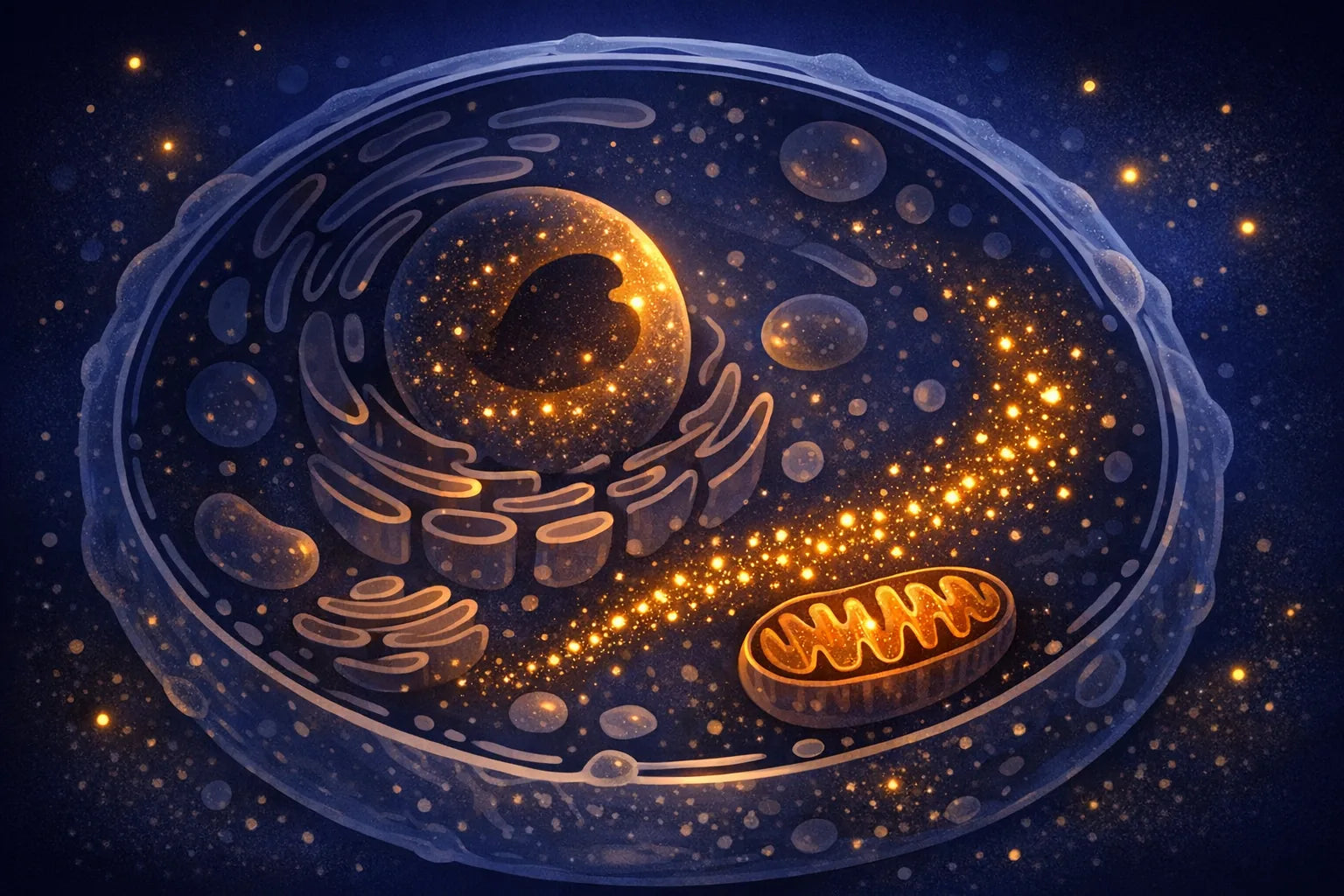
It slips through every cell membrane and concentrates inside the mitochondria, the tiny engines where most of your cellular exhaust is made in the first place.10
So while the body is doing its overnight work, melatonin is moving through the house with a broom.
Aging quietly runs a scissors on you here: cells make more of that exhaust every decade, while the nightly melatonin supply that helps mop it up keeps falling.
Restore the signal and you're not only buying sleep.
You're buying back the conditions your body does its overnight maintenance in.
"But Won't I Get Hooked On It?"
This is the fear I hear most, and it's a good instinct, because it comes from watching what happened to somebody.
Nearly everyone over 60 knows a person who got tangled up with prescription sleep aids and never got untangled.
So let me put the two side by side.
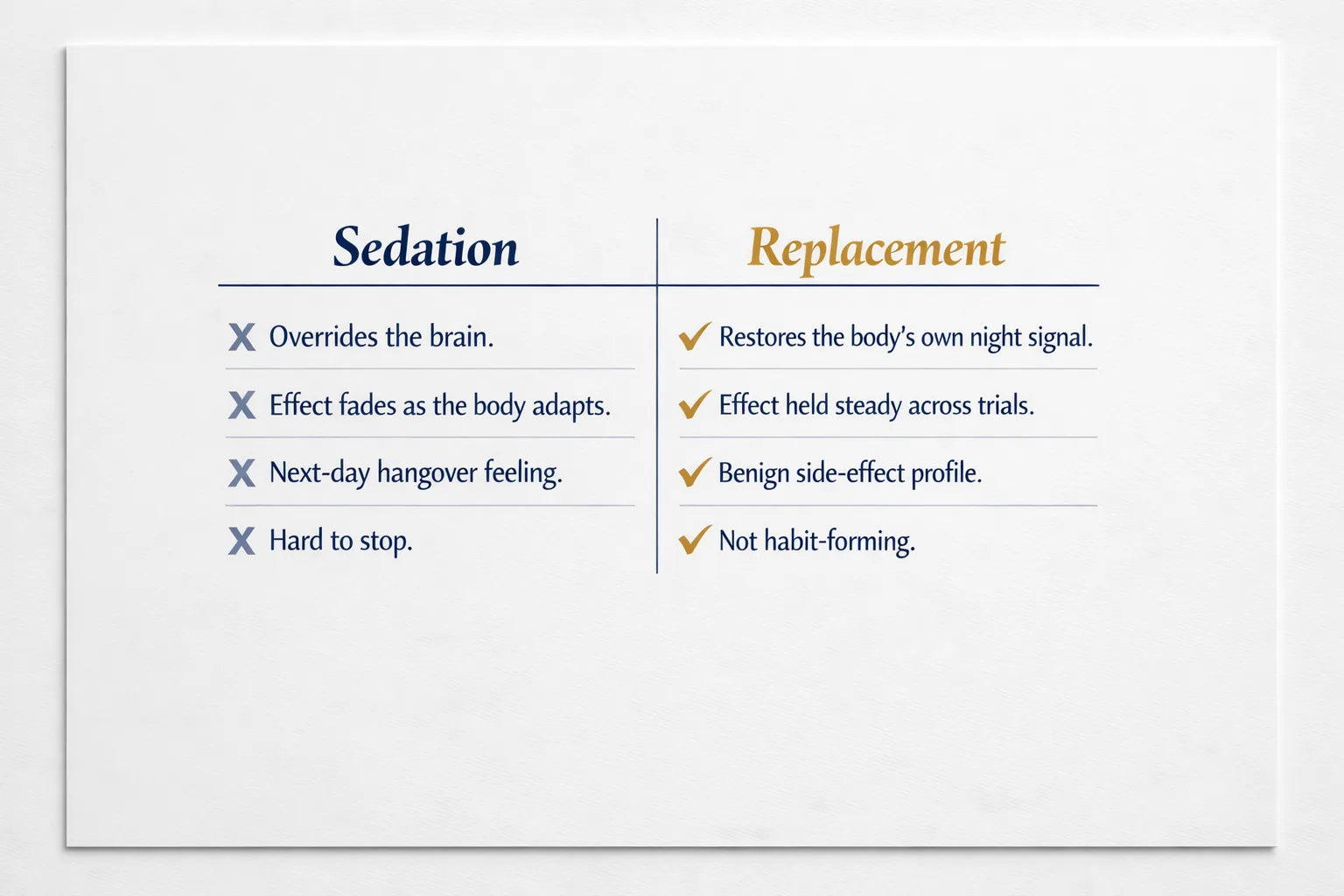
The same analysis of those 19 trials looked at exactly this question.
The effects did not fade with continued use, and the side-effect profile was benign.8
That is the single most important sentence on this page for anyone who has watched a friend chase a bigger and bigger dose.
Replacement isn't a treadmill, because you aren't overpowering a system.
You're topping up a tank.
A sleeping pill knocks you out.
Melatonin lets your body put itself to sleep, the way it did at 30.
If You Tried Melatonin Once And Nothing Happened, Read This Part Twice
I know a lot of you are sitting there thinking it.
"Mary, I bought melatonin. It did nothing."
You're my favorite person to talk to, because I think you were failed by the instructions, not by the molecule.
Here's what usually happened.
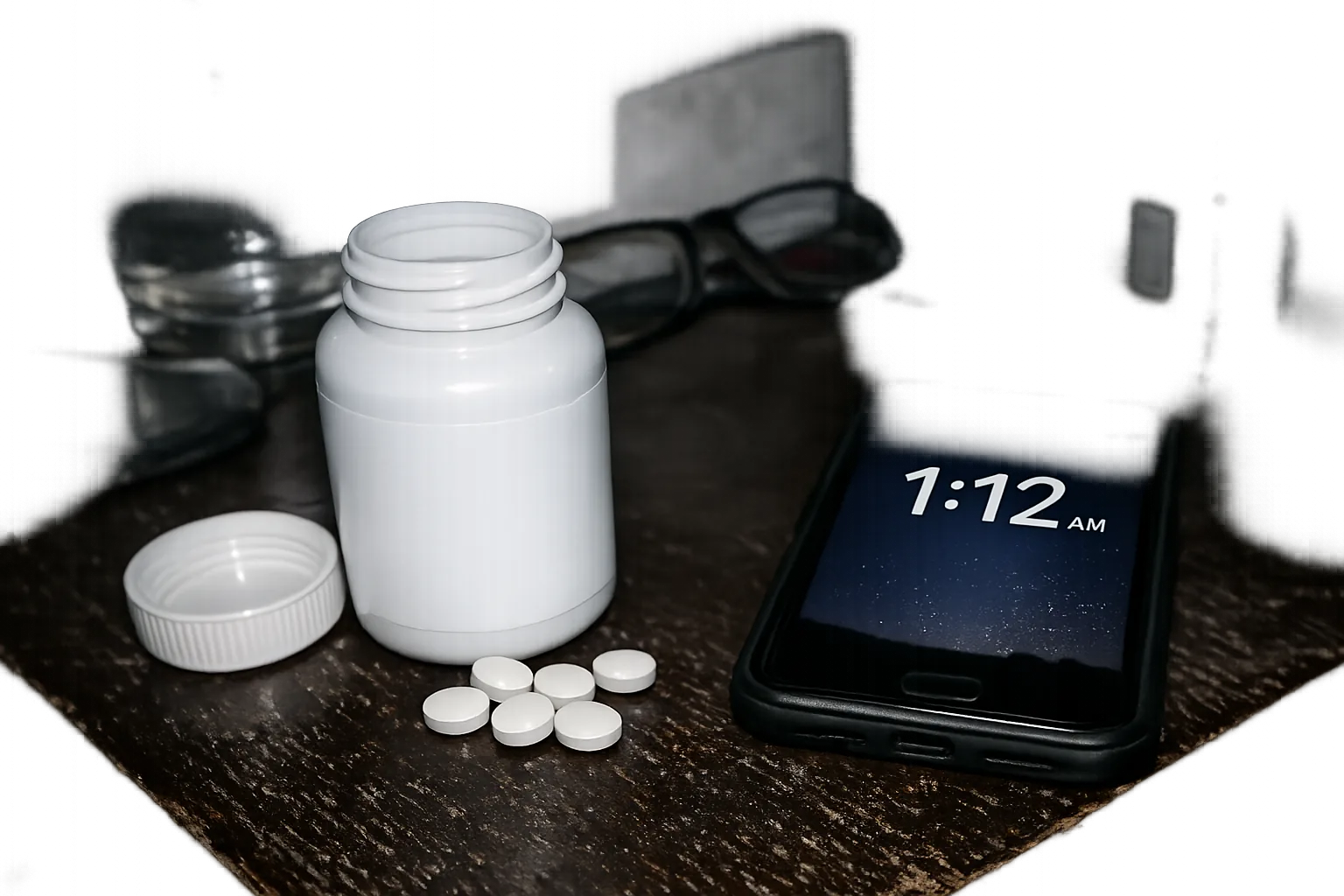
You bought a bottle because someone mentioned it.
You took one at random, often in the middle of the night when you woke up, because that's when you wanted to sleep.
You gave it four or five days.
You felt nothing, or you felt foggy the next morning, and you decided melatonin doesn't work for you.
Nobody ever told you three things.
Melatonin is a sundown signal, so it goes in 30 to 60 minutes before bed, not at 1 in the morning when your body is hours behind schedule.
You're refilling a supply that has been low for years, and a supply gets refilled on a schedule, not on a whim.
It is not proof that melatonin is too strong for you.
You weren't fixing a bad habit.
You were topping up a shortage, without ever being told that's what you were doing.
So Why Has Nobody Told You Any Of This?
I'm not interested in conspiracies, so let me give you the dull answer.
The dull answer costs you just as much.
Melatonin is a hormone your own body makes, which means nobody can own it.
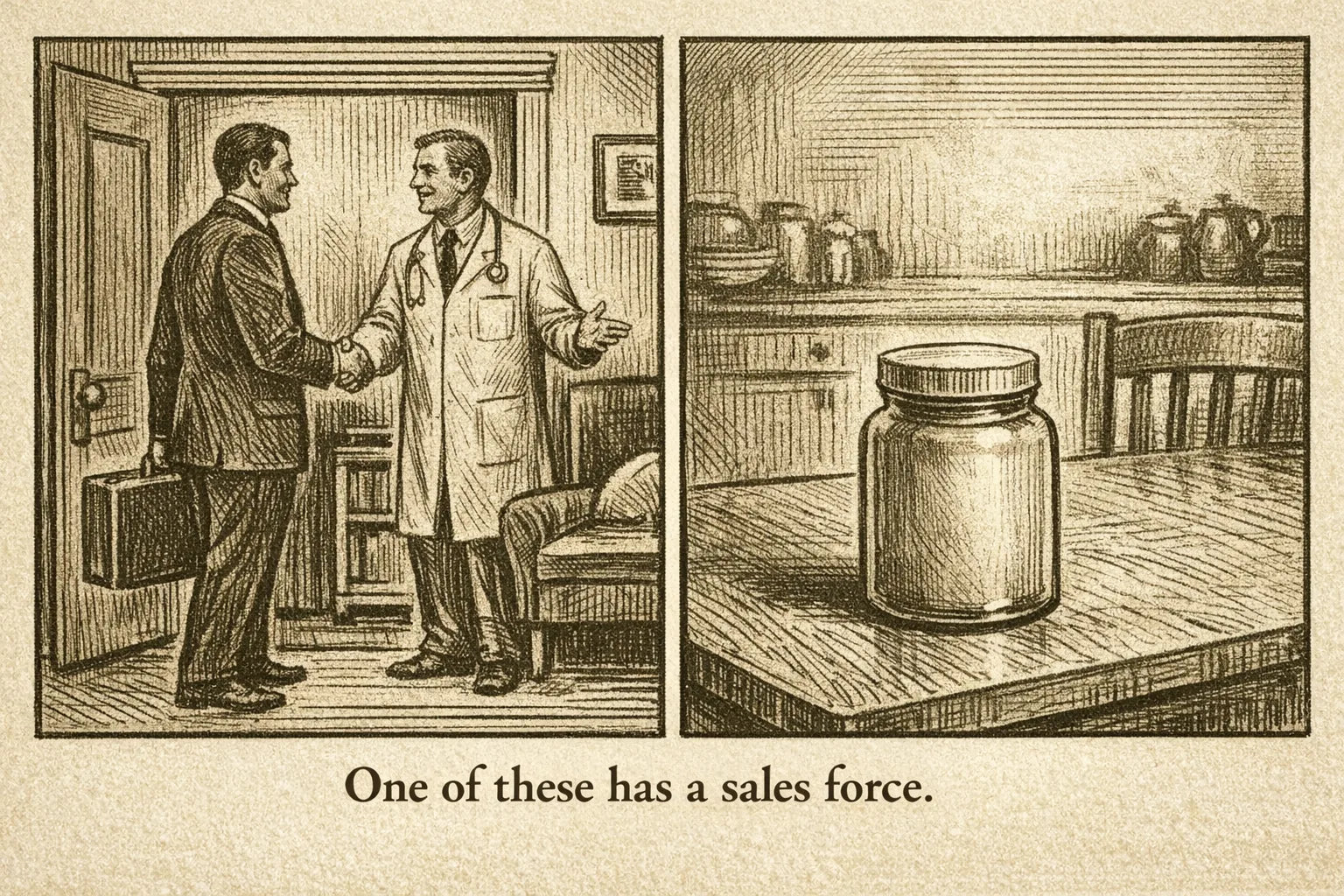
No company can patent it, so no company will ever spend a fortune sending representatives out to educate doctors about it.
Now compare that with a prescription sleep aid, where there's a sales force, a marketing budget, and a very good reason to knock on the door.
Second, your doctor has ten minutes with you.
Ten minutes covers the blood pressure and the medicine list, and "sleep gets rough at your age" is a complete sentence that gets everybody to the door on time.
Third, the supplement aisle didn't help either.
A drugstore bottle hands you a number on the front and nothing else.
No timing, no consistency, no explanation of what you're refilling or why the supply ran low in the first place.
That's how a whole generation came to believe melatonin doesn't work.
What they actually got was a molecule with no instructions.
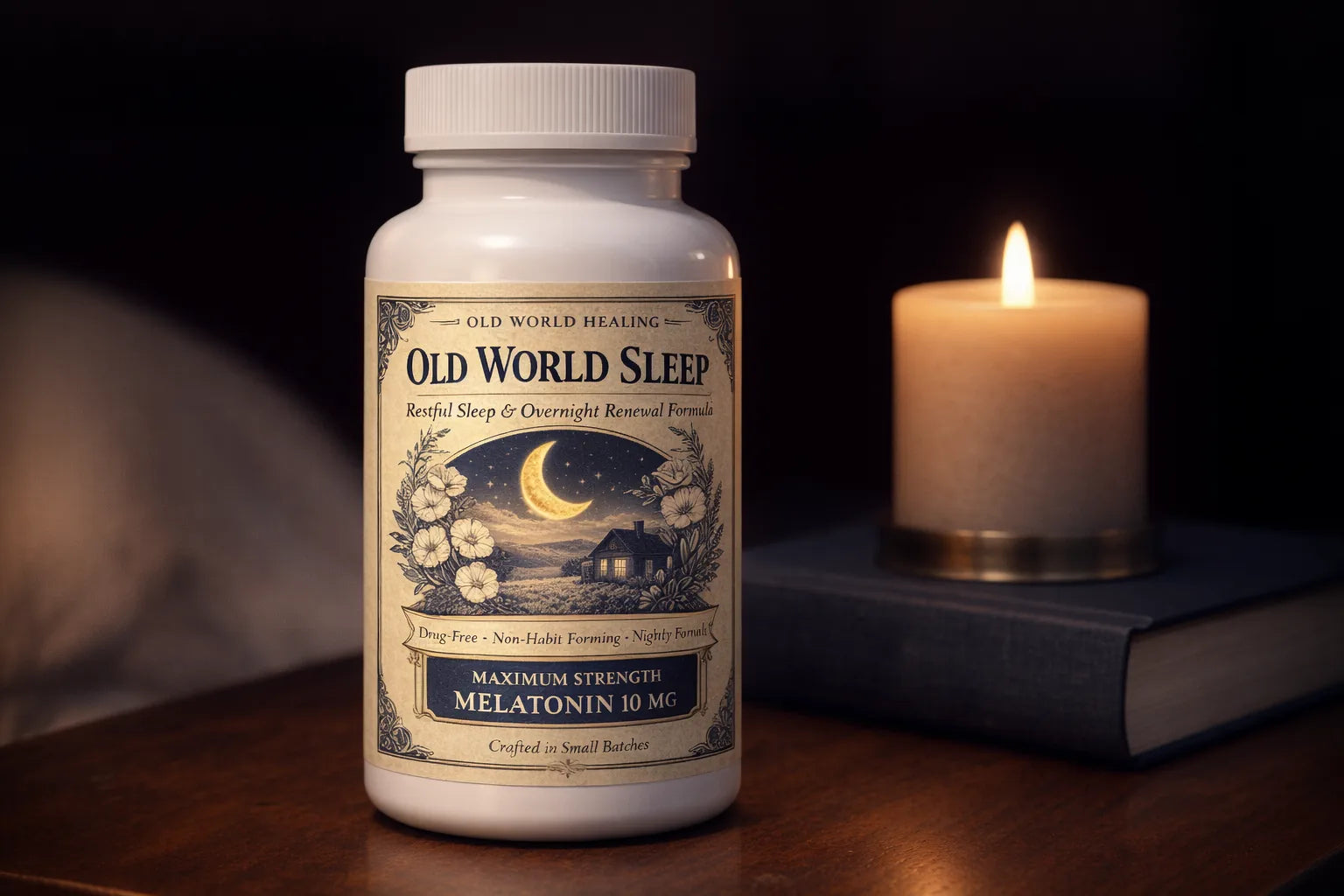
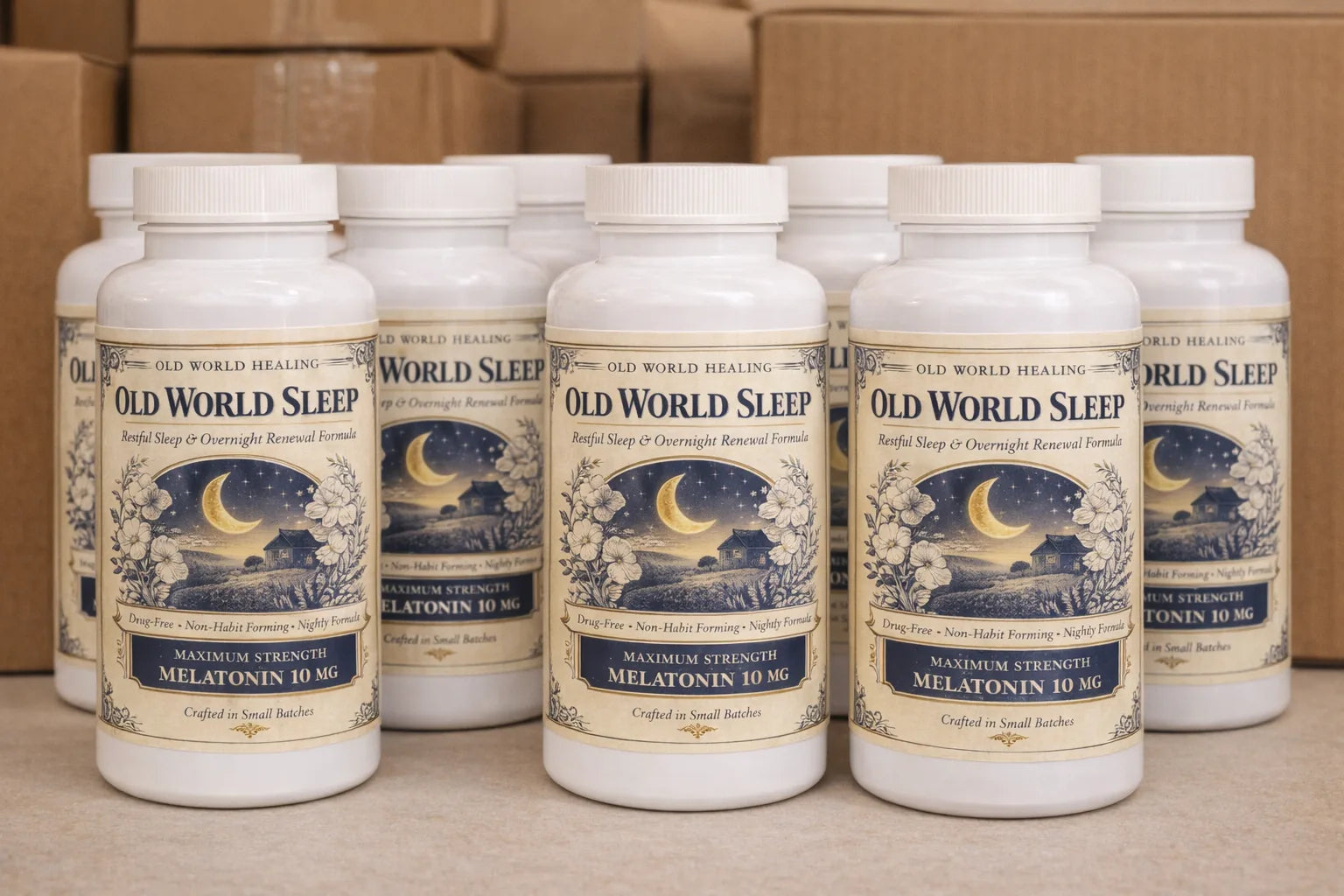
Old World Sleep
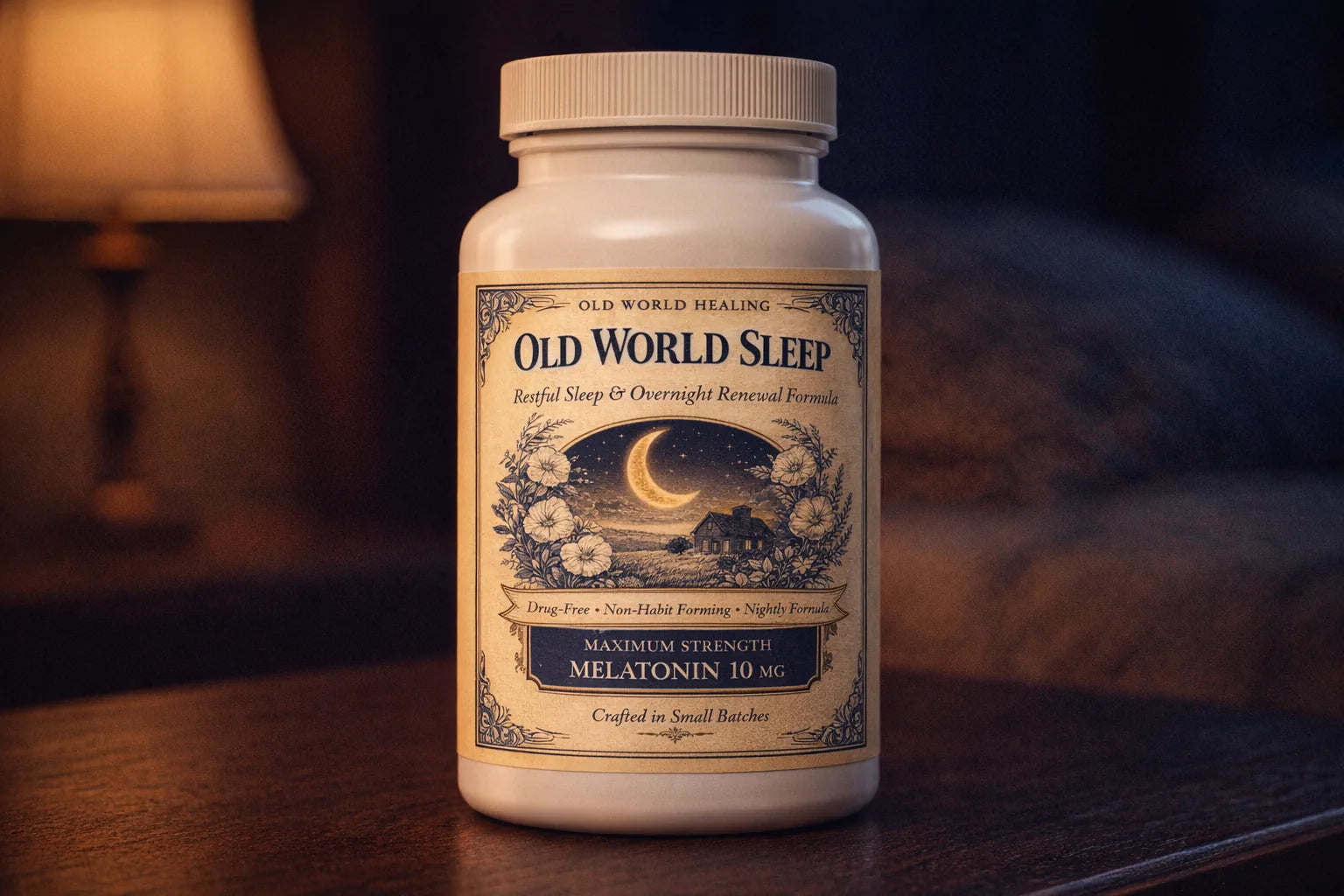
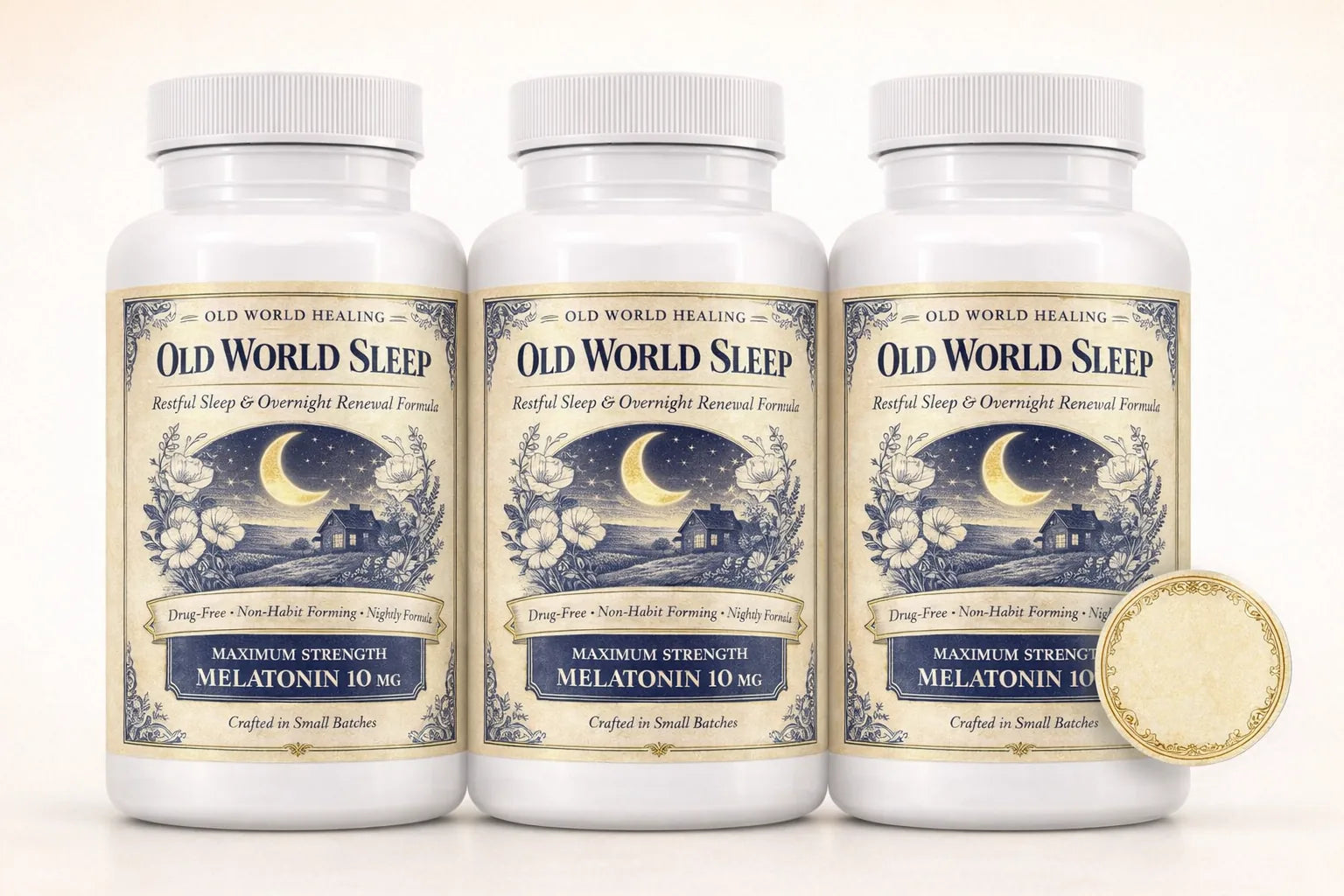
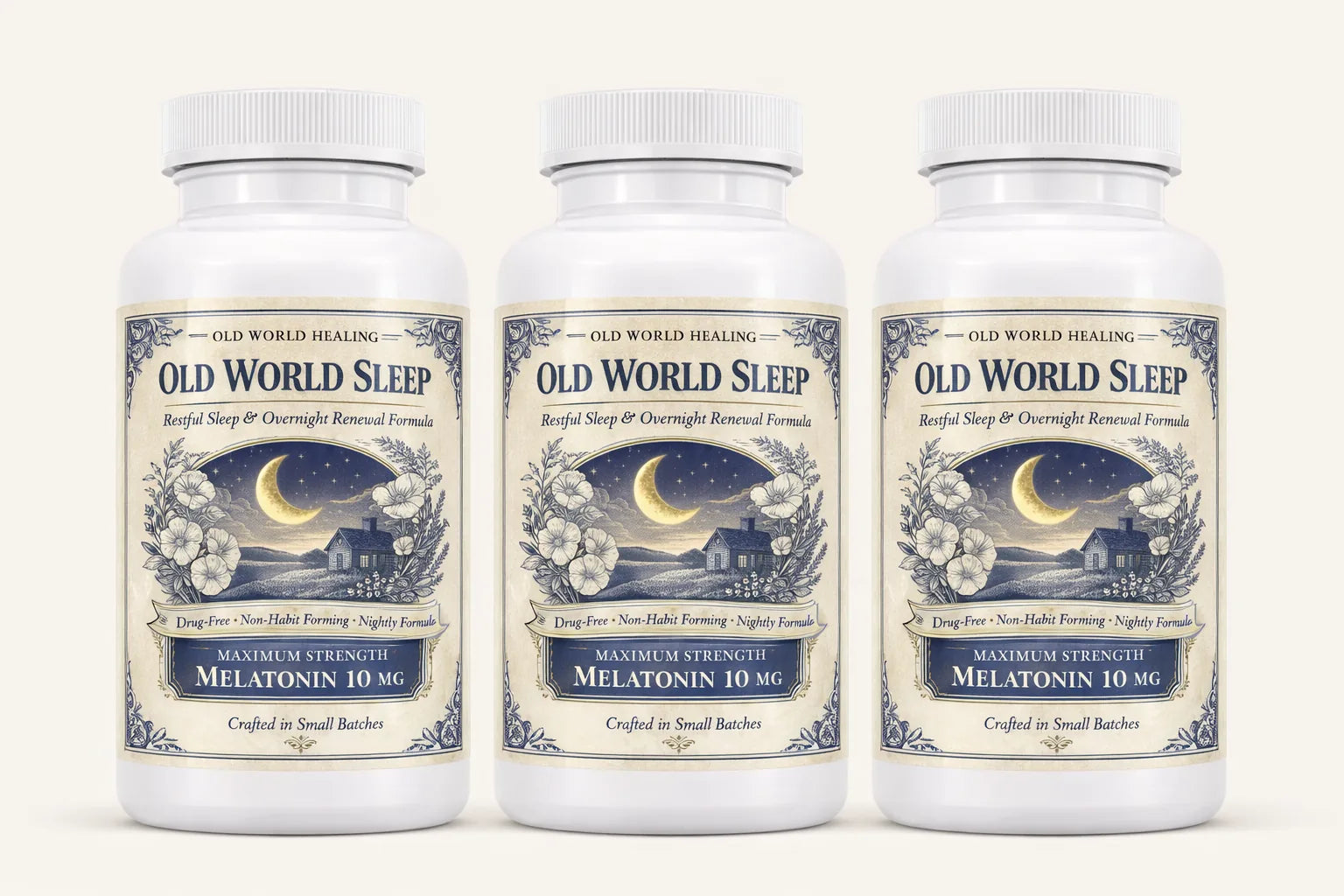
This is Old World Sleep.
It's maximum-strength melatonin, made by the same people who make the Old World Relief you may already have in your cabinet, and it exists for one reason.
To put back the night-time signal your sleep gland has been running short on for twenty years.
That's it. That's the whole product.
It isn't a sedative. It isn't a blend of nine herbs hoping one of them lands.
It's the actual hormone your body has been under-producing since your forties, taken at the hour your body used to release it.
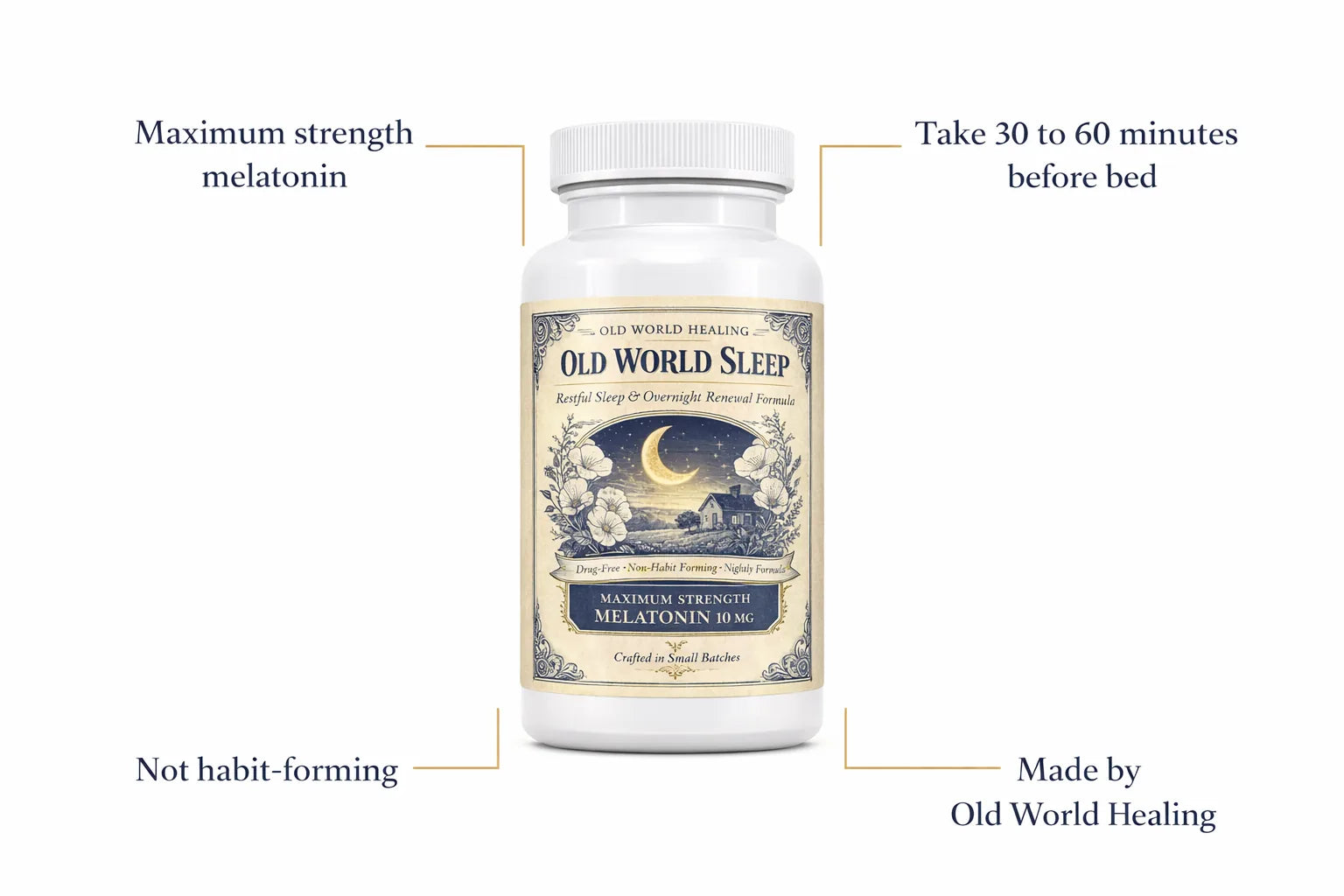
About The Dose, Straight
I'm going to tell you something most supplement companies would edit out of this page.
More milligrams is not the mechanism.
Researchers at MIT tested melatonin in adults over 50 and found that a very small physiological dose, three tenths of a milligram, was enough to restore sleep efficiency and bring night-time melatonin back to young-adult levels.11
The prescription version in Europe is 2mg.12
Old World Sleep is 10mg, which is maximum strength and sits at the top of the range American shoppers are used to buying.
So here is my honest guidance, the same thing I'd tell my sister.
The number on the front of the bottle is not what does the work. The timing and the consistency do.
If you're sensitive, ease in by taking it every other night at first, and judge it on how your mornings feel before you go nightly.
Nobody should be selling you a hormone by the milligram, and I'm not going to start.
How To Take It
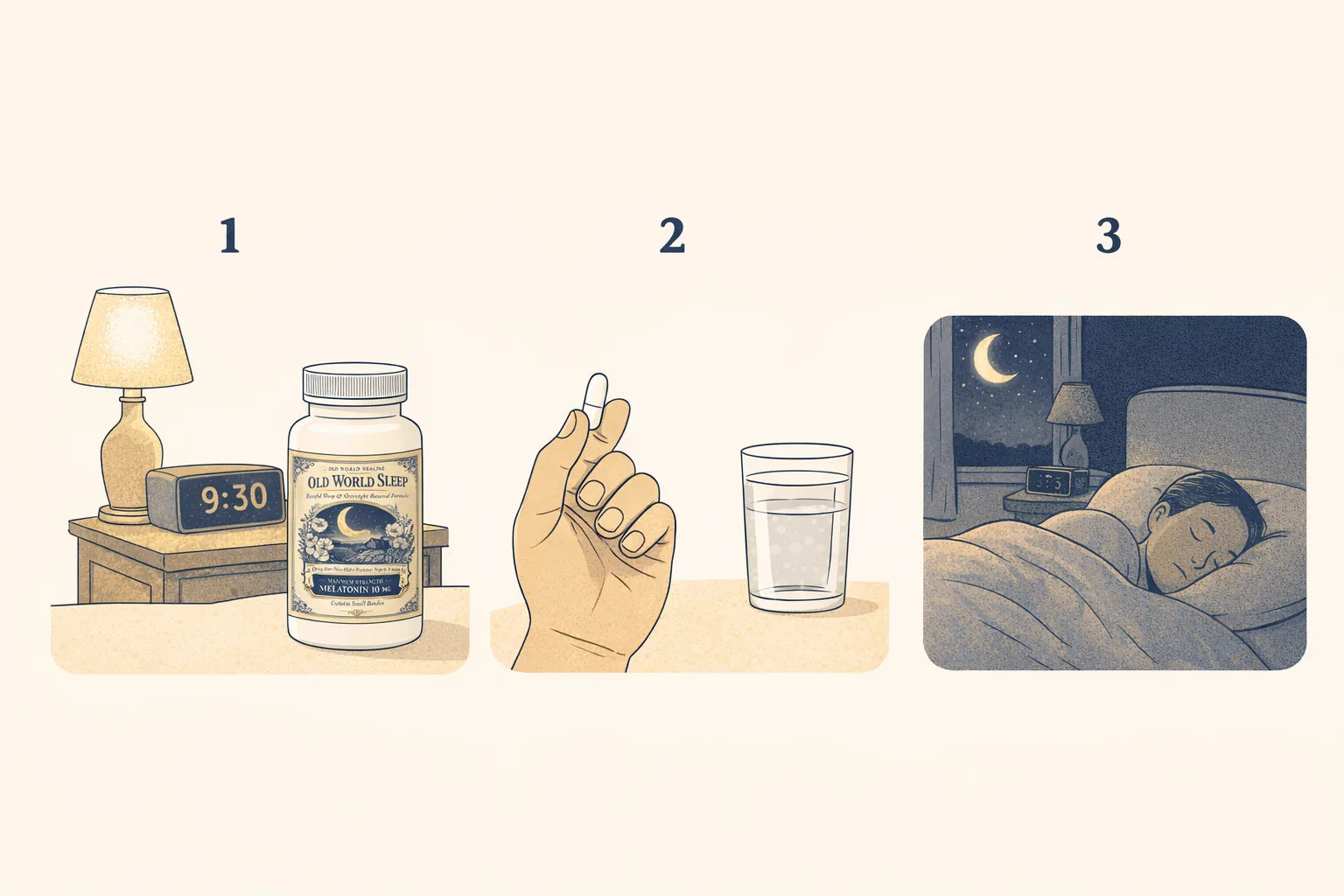
Not at midnight, and not when you wake up in the night.
You're rebuilding a rhythm, and rhythms need repetition.
You just sent your body the sundown message, so don't argue with your body using a bright screen.
That's the entire routine.
It takes about ten seconds and then you stop thinking about it.
What The First Few Weeks Usually Look Like
I won't promise you a specific result, and you should be suspicious of anyone who does.
But I can tell you the shape of what people describe, and it follows the mechanism, which is exactly what you'd want.
The first few nights are usually about getting under.
The most common thing people notice first is that the drop-off happens faster and feels more like it used to, less like waiting.
The first week or two is where the middle of the night starts changing.
Not perfect, but quieter.
The 2:47 stops being an appointment you keep.
Weeks three and four are where the compounding shows up, and this is the part I care about most.
Every night your body gets to run a full night shift is a night of overnight upkeep you weren't getting before.
Stack up enough of those and mornings start having something in them again.
And here's the thing people describe when it finally lands, which is never what you'd expect.
It isn't a dramatic morning.
It's the absence of one.
You open your eyes, there's light behind the curtains, and you reach for the clock out of pure habit to find out how badly the night went...
Then you stop, because you already know.
You never woke up to check it.
That's the whole moment, and people remember it for years.
Then the afternoon comes and you're still standing.
You say yes to the park, and you still have enough left over to cook dinner instead of falling into the chair at four.
Small, quiet, and completely unlike the last eight years.
(Individual results may vary.)

A Note On Proof
You may already know us.
Old World Healing started with Old World Relief, our topical cream.
More than 47,000 jars have gone out the door, with a 4.8 rating and over 2,800 five-star reviews.
Old World Sleep is new, so the accounts below are illustrative rather than customer reviews.
Three Nights That Started The Same Way
I could always fall asleep. Staying asleep is what I lost. I'd surface around three like somebody flipped a switch, and then I'd lie there listening to my husband breathe and feel completely alone. The third week was when I noticed I'd stopped checking the clock at all.Ruth, 71
I'm a stubborn old carpenter and I don't like taking anything. What sold me was that it isn't a knockout drug, it's the stuff my own body used to make. I take it at nine, I'm out by ten, and the mornings don't feel like wading through wet sand anymore.Dale, 68
My knees are worse the day after a bad night. I've known that for years and every doctor I mentioned it to just nodded. Reading that sleep is the upstream end of it made more sense to me than anything I've been told in a decade. My nights came back first. The mornings followed.Marianne, 63
(Individual results may vary.)
Get Old World Sleep
Here's what's available right now.
You can buy Old World Sleep once, or you can put it on a subscription and save $10 every month.
You're refilling a supply that has been falling since your forties, and a supply gets refilled on a schedule.
So pick the supply that suits you, and the bottles arrive before the last one runs out.
The big price on each card is the subscription price, and the struck price beside it is what the same supply costs bought once.
Subscribing saves $10 every month, from the very first order, and a longer supply saves again on top of that.
Subscriptions ship every 30, 60 or 90 days at the same price, and you can cancel anytime before the next ship date with no fee and no phone call.
Shipping is free on every order, subscription or one-time.
Most people order more than one bottle, for the simple reason that consistency is how a refill works, and running out in week three is the most common way people talk themselves out of something that was starting to help.
Our Guarantee
Take Old World Sleep for 90 nights.
If it isn't doing what this page told you it would, email us inside those 90 days and we'll refund you in full.
You don't need to send the bottle back.
Ninety nights is deliberate, because that's the window this page told you to judge it on, with room to spare.
What I can tell you is the standard we hold ourselves to.
We would rather you try it, decide it isn't for you, and stay on our list, than feel stuck with a bottle you regret.
Two Versions Of Next Winter

If nothing changes.
Tonight the well comes up half full again, and you meet the ceiling at 2:47.
Tomorrow your joints are louder, the way they always are after a night like that.
Which makes tomorrow night worse, which makes the day after that worse.
The spiral gets one more turn, the way it's been turning for years.
And a year from now you say "nobody my age sleeps" at the coffee table, and this time you actually believe it.
If you put the signal back.
Your body gets the sundown message again, close to the hour it used to get it.
You go under faster, and the middle of the night stops being an appointment you keep.
Your body gets its night shift back, one night at a time, and the overnight work it's been skipping starts happening again...
Then one morning you get up and realize you never looked at the clock once...
And then, a few weeks later, you're the one at the coffee table saying "actually, I sleep well now," and watching the whole table lean in.
You don't get a younger gland.
You get the same body, with the signal put back.
Questions People Ask

You're the person this page was written for.
Almost every time, the story is the same.
The bottle got opened at random hours, often in the middle of the night, and then abandoned after four or five days.
Melatonin is a sundown signal, so it goes in 30 to 60 minutes before bed, at about the same time each night.
You're refilling a supply that's been low for years, and that takes repetition, not a four-day trial.
No, and this is the difference that matters most to people who have watched a friend get stuck.
In the pooled analysis of 19 randomized trials, the effects did not fade with continued use and the side-effect profile was benign.8
You aren't overriding a system that then adapts to you.
You're topping up a hormone your body already runs on.
The next-day fog people report is nearly always a timing issue.
Take it too late, or take it when you wake at 2am, and the level is still high when the alarm goes off.
Take it 30 to 60 minutes before bed and the fog mostly takes care of itself.
If you're sensitive, start by taking it every other night.
10mg is maximum strength and sits at the top of the range American shoppers commonly buy.
I'll say again what I said above: the milligram number is not the mechanism, and more is not the goal.
Take it every other night at first if you'd rather ease in, keep the timing consistent, and judge it on how your mornings feel.
Old World Sleep works from the inside on the night, and something like Old World Relief works on the surface where you ache.
They're doing different jobs at different hours.
I'm an herbalist, not your doctor, and I'm not going to guess about your medicine cabinet.
If you take prescription medication of any kind, talk to your doctor before adding anything new.
That isn't a legal line, that's what I'd tell my own family.
Most people say the first few nights feel different at the falling-asleep end.
The middle of the night usually takes a week or two to start changing.
The part I'd actually watch for shows up around weeks three and four, once you've stacked up enough full nights for your mornings to notice.
Results vary from person to person.
The opposite, and the distinction is the whole point of this page.
A sleeping pill overrides your brain to force sleep.
Old World Sleep hands your body back a message it used to send itself every evening, and then your own sleep does the rest.
Honestly, because a ten-minute appointment doesn't have room for it, and because "it's your age" is a complete sentence.
The research isn't hidden, and Europe built a prescription medicine on it back in 2007.7
The research just never made the trip from the journals to your kitchen table, and that gap is why we started Old World Healing.
Don't Give Away Another Night
Tonight is either another 2:47 or it isn't.
That's honestly the whole decision.
Every night the signal stays low, the spiral gets one more turn, and tomorrow inherits it.
Every night the signal comes back, your body gets a shift of overnight work it has been missing for years.
You have given away enough hours staring at a dark ceiling doing arithmetic.
A note from Old World Healing:
Since this article went up, the question we get asked most is about the offer itself, so here it is in one place.
You can buy one supply on its own, or subscribe and save $10 every month on the same supply.
One-time is $59, $109 or $159 for a 1, 2 or 3-month supply, and on a subscription those are $49, $89 and $129.
Shipping is free on every order, and you can cancel a subscription anytime before your next ship date.
Every order is covered by the 90-day money-back guarantee.
This is a standing offer, and there is no countdown attached to it.
The third week was when I noticed I'd stopped checking the clock at all.Ruth, 71
It isn't a knockout drug, it's the stuff my own body used to make.Dale, 68
My nights came back first. The mornings followed.Marianne, 63
(Individual results may vary.)
P.S. The one thing to carry away from all of this is the difference between a decline and a shortage.
A decline only goes one direction, and that's what you were told you had.
A shortage is a level, and levels can be topped up.
Your well didn't break, it silted up.
And you can pour the water in from somewhere else.
P.P.S. If you take nothing else from this page, take the timing.
Thirty to sixty minutes before bed, at about the same hour every night, including the nights you stay up for something good.
That single habit is the difference between the people who say melatonin did nothing and the people who quietly stopped setting an alarm for 2:47.