"My feet were on FIRE at three in the morning, and my doctor told me to try a warm bath."
The 1965 Discovery That Explains Why Your Feet Get Louder The Second You Lie Down
Why the burning and buzzing that you outran all day comes back the moment the house goes quiet.
 By Mary Miller, Herbalist and Natural Health Researcher, Old World Healing
There's a gate inside you, and it's supposed to close at night.
You can't feel it and you've never been told it exists.
But it's the reason your feet are quiet at two in the afternoon and screaming at two in the morning.

That picture isn't a metaphor.
It's a mechanism, it was published in 1965, and one of the leading pain researchers of the last century called it the most important advance in the history of the field.2
Almost nobody who lives with this has ever had it explained to them.
My Name Is Mary Miller

I'm an herbalist, and I spend most of my week reading research papers written for people with three letters after their name.
I do that because we started Old World Healing on a simple bet.
The bet was that the remedies our great-grandparents swore by were not superstition, they were unfinished science.
Nothing has tested that bet harder than the question I'm about to answer for you.
Here's the question, and I want you to notice how strange it is.
Why does a nerve that behaved itself all day turn on the instant you stop using it?
If the trouble were in your feet, resting them would help.
Resting them makes it worse, and that single fact tells you the trouble isn't where you think it is.
First, The 3 A.M. Part Nobody Says Out Loud
It's a little after three.
Tonight it started in the left foot, which is new, because last month the left foot was the good one.
You're not standing on it.
You're not walking on it.
You're lying perfectly still in a dark room doing absolutely nothing, and that's exactly when it turns on.
The burning across the top of the foot.
The hot wire running up the back of the calf.
The crawling that makes you want to move your legs, and then makes moving them no better at all.
So you lie there and you do the arithmetic.
If I fall asleep in the next twenty minutes I can still get five hours.
The arithmetic never works, and you already know it never works, and you do it anyway.
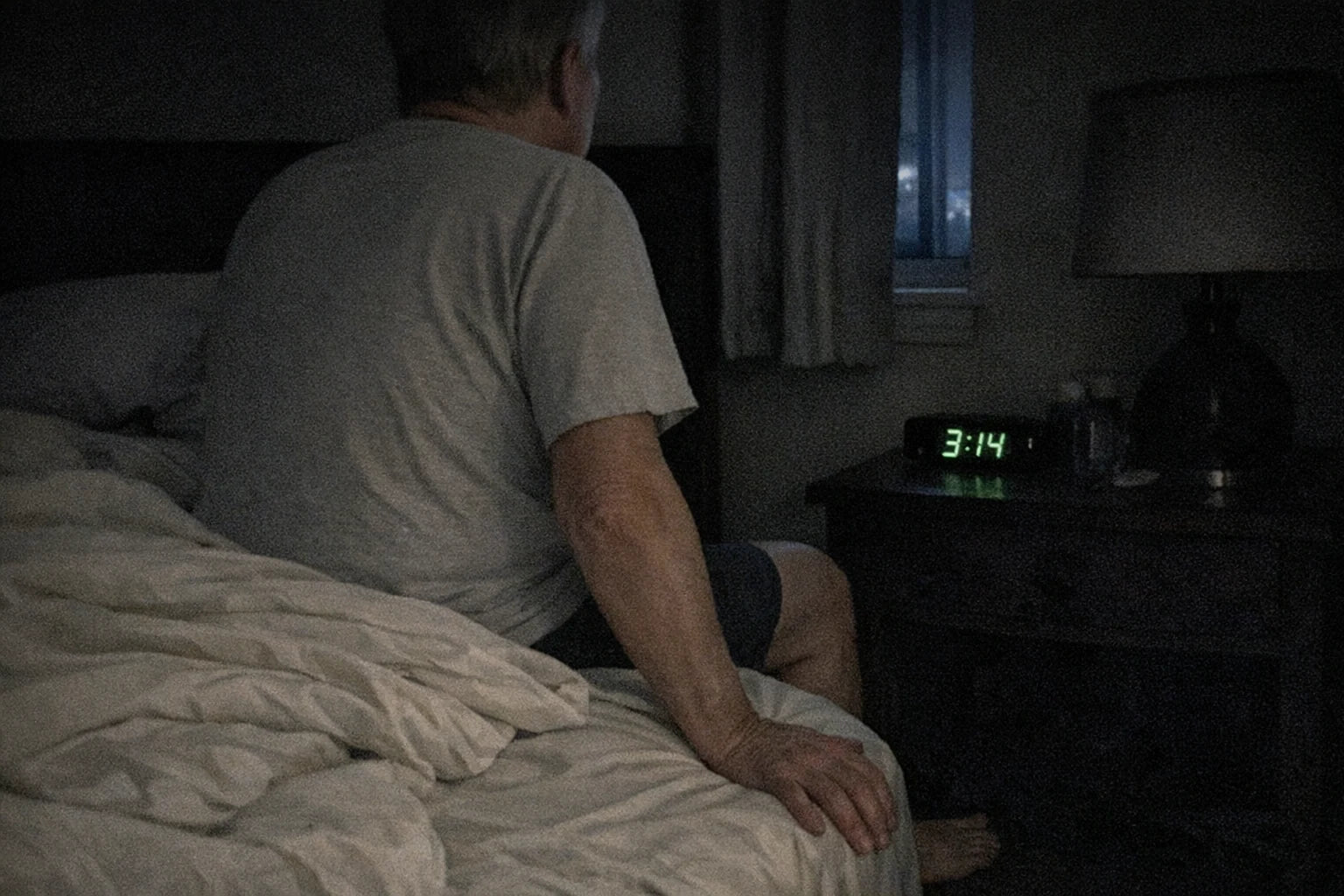
Here's the part that makes no sense to anyone who hasn't lived it.
It's worse when you're doing nothing.
All day you were on your feet and you coped.
You sat down to rest and it came alive.
For a long time I couldn't explain that to anybody.
Now I can, and the explanation is sixty years old.
The 1965 Discovery
In November 1965, two researchers named Ronald Melzack and Patrick Wall published a paper in the journal Science.1
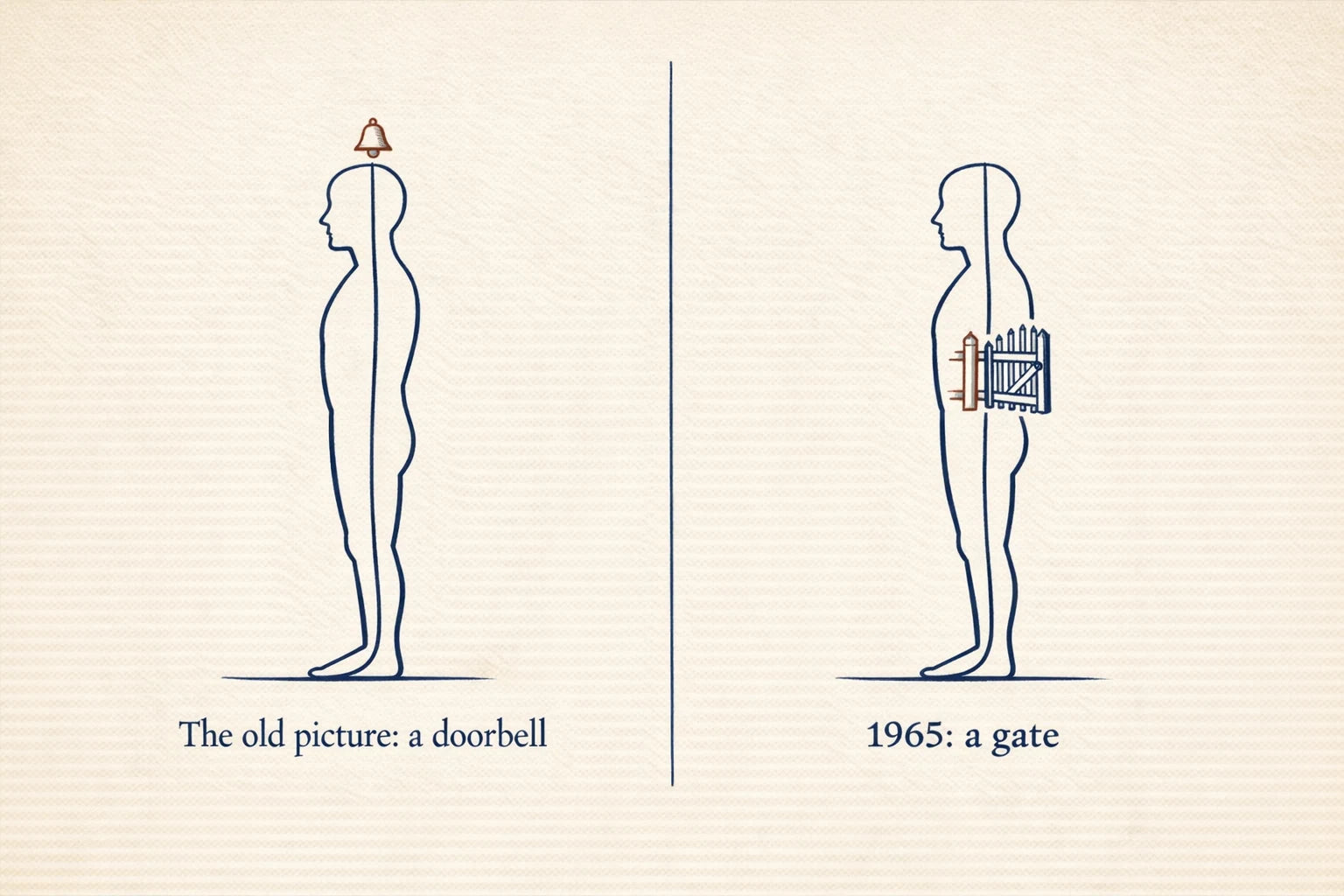
Before that paper, almost everyone pictured pain like a doorbell.
Something happens at your foot, a wire carries the message up, your brain hears the bell ring.
The size of the ring matches the size of the problem.
Melzack and Wall said that picture is wrong.
They proposed that before any signal reaches your brain, it has to pass through something in your spinal cord that behaves like a gate.
And the gate isn't a hole in a wall.
It opens and it closes.
It can let a signal through loud, turn it down to almost nothing, or turn it up.
At the theory's fiftieth anniversary the field's assessment was that its conceptual components remain as relevant as they were in 1965.2
I'll be straight with you, because you'll find this if you go looking.
Modern pain scientists don't think Melzack and Wall drew the wiring exactly right, and the specific spinal circuit has been revised since.
What survived is the idea itself, and nobody serious argues with it.
Pain isn't just delivered. It's decided. How loud you feel it isn't settled at your foot. It's settled at the gate.
The Stuck Gate
Here's the picture I give people, and it's the one they remember.
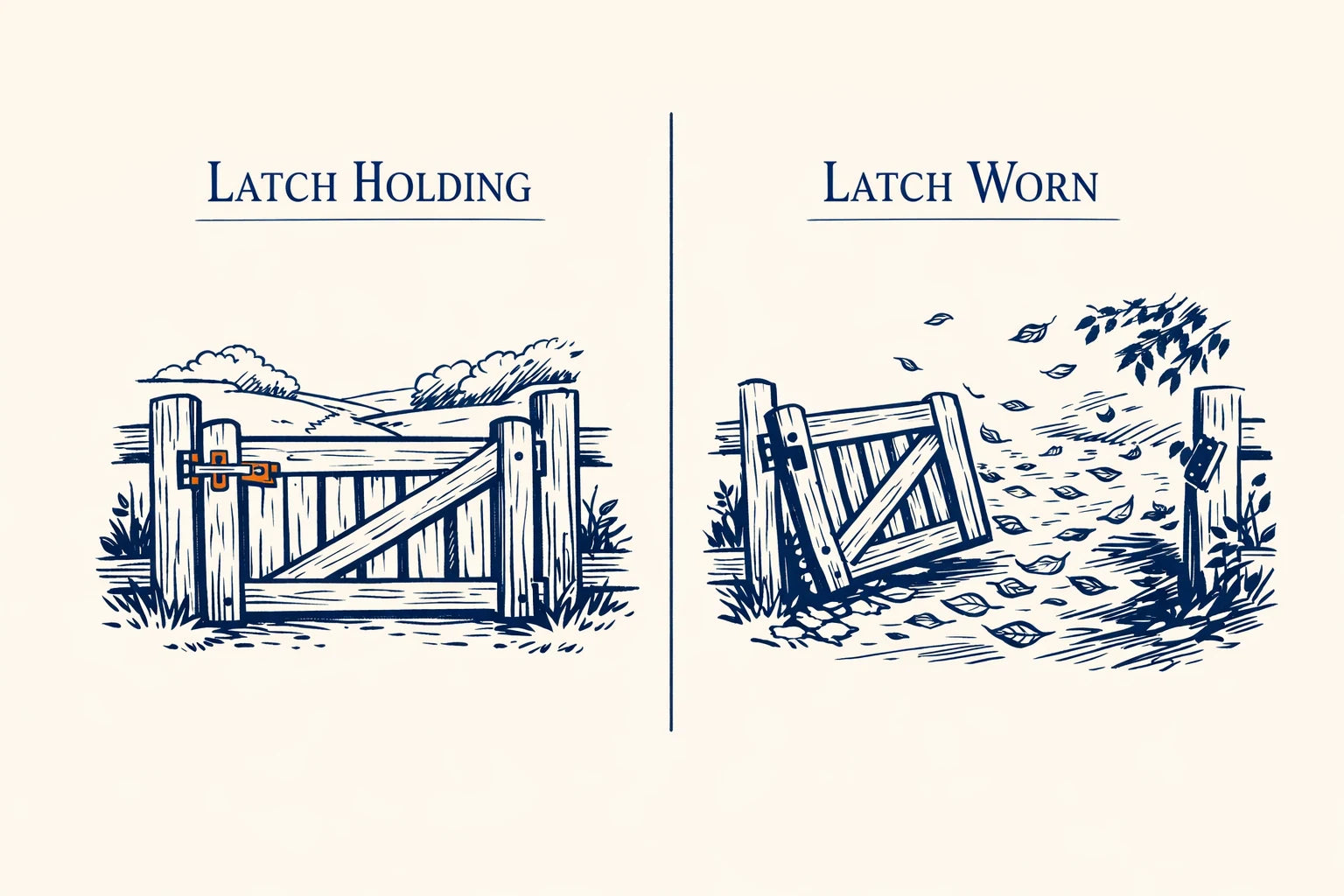
Think of an old garden gate at the bottom of a path.
For years the latch worked.
The gate swung shut behind you, and the yard stayed quiet.
Then the latch wore out.
Now the gate hangs open, and every stray dog and gust of wind comes straight up the path to your door.
Nothing new arrived in your yard.
The gate just stopped closing.
In your body, the thing holding that gate shut is the quiet chemistry, the signalling whose entire job is to say enough.
The main one is called GABA.
If your nervous system has a brake pedal, GABA is it.
A nervous system that has been dealing with discomfort for years doesn't settle into neutral.
It gets touchier, not calmer.
The gate that used to sit closed starts sitting open.
And once it does, things that should register as nothing at all arrive as burning, buzzing and crawling.
So Why Does It Get Louder At Bedtime?
Because of what leaves the path.
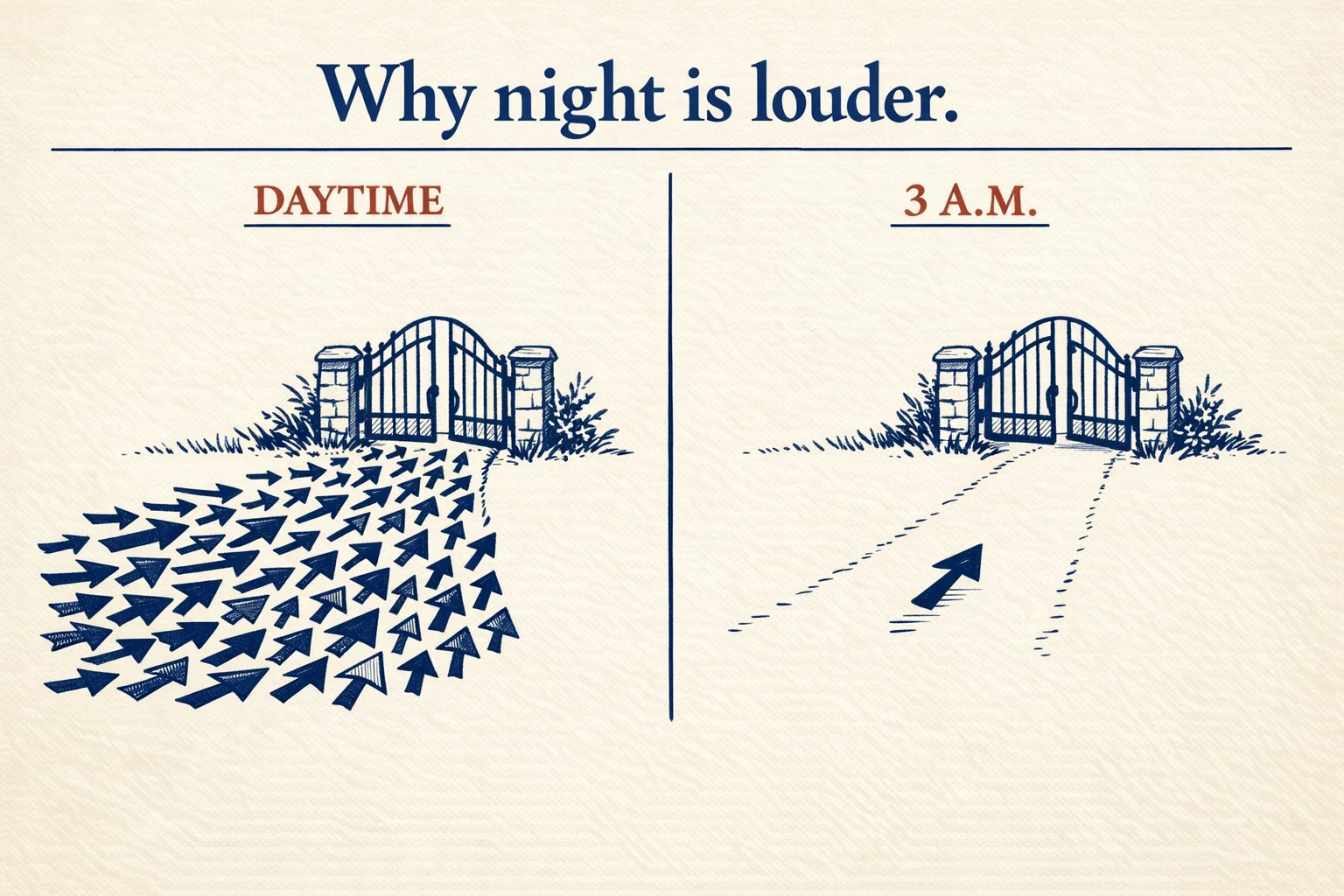
All day you're flooded with competing traffic.
Weight through your feet, movement, the temperature of the floor.
All of it competes at the gate, and competition at the gate is exactly what Melzack and Wall described.1
It's also why rubbing a banged elbow genuinely helps, and why you've been doing that your whole life without knowing why.
Then you lie down in a dark, silent room.
The competing traffic goes home.
The gate is still hanging open.
And the only thing left walking up that path is the signal you've been outrunning since breakfast.
Your nerves didn't get worse at bedtime.
They got louder because everything else went quiet.
I've watched people's faces change when they hear that.
Years of being told it was their age, and it turns out there's a mechanism with a name and a date on it.
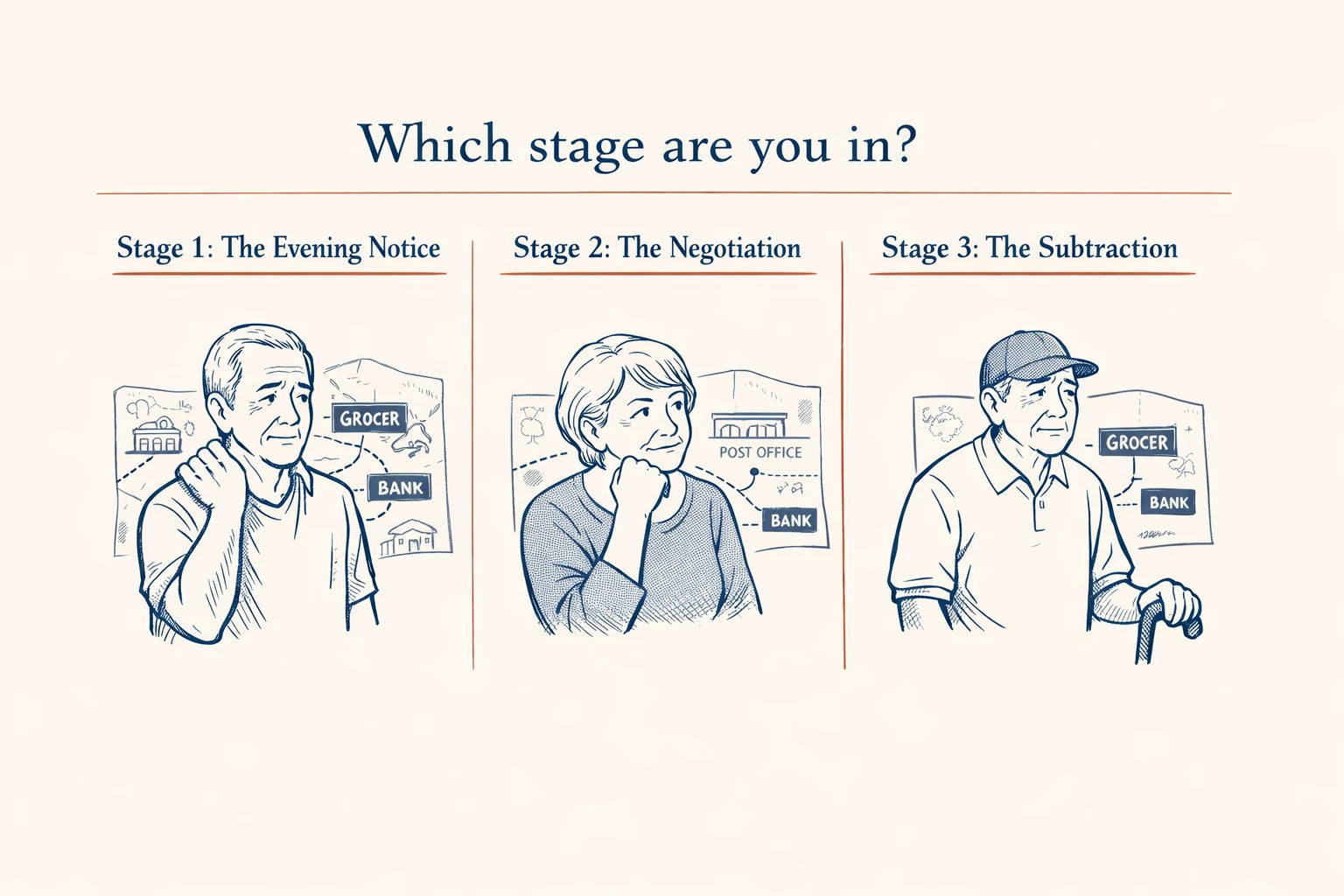
Which Stage Are You In?
This doesn't arrive all at once, and most people can place themselves within about ten seconds.
It shows up after you sit down and you can still talk yourself out of it.
You blame the shoes, the weather, the day you had.
You've started arranging your evening around it.
You're doing the arithmetic at three in the morning, and you've begun turning down the things that happen early the next day.
This is the one nobody warns you about, because it doesn't look like pain from the outside.
It looks like a person who has quietly stopped doing things.
The market, the school run, the stairs.
You didn't decide to give any of it up, you just kept trading one more thing for the chance of a few more hours.
I want to be careful here, because this matters more than a page of copy.
Losing sleep for years isn't a small thing, and driving on ninety minutes of sleep is genuinely dangerous.
If that's where you are, that's a conversation for your doctor.
I mean that literally, not as a legal line at the bottom of the page.
Why The Usual Answers Keep Missing
Once you can see the gate, the frustration starts making sense.
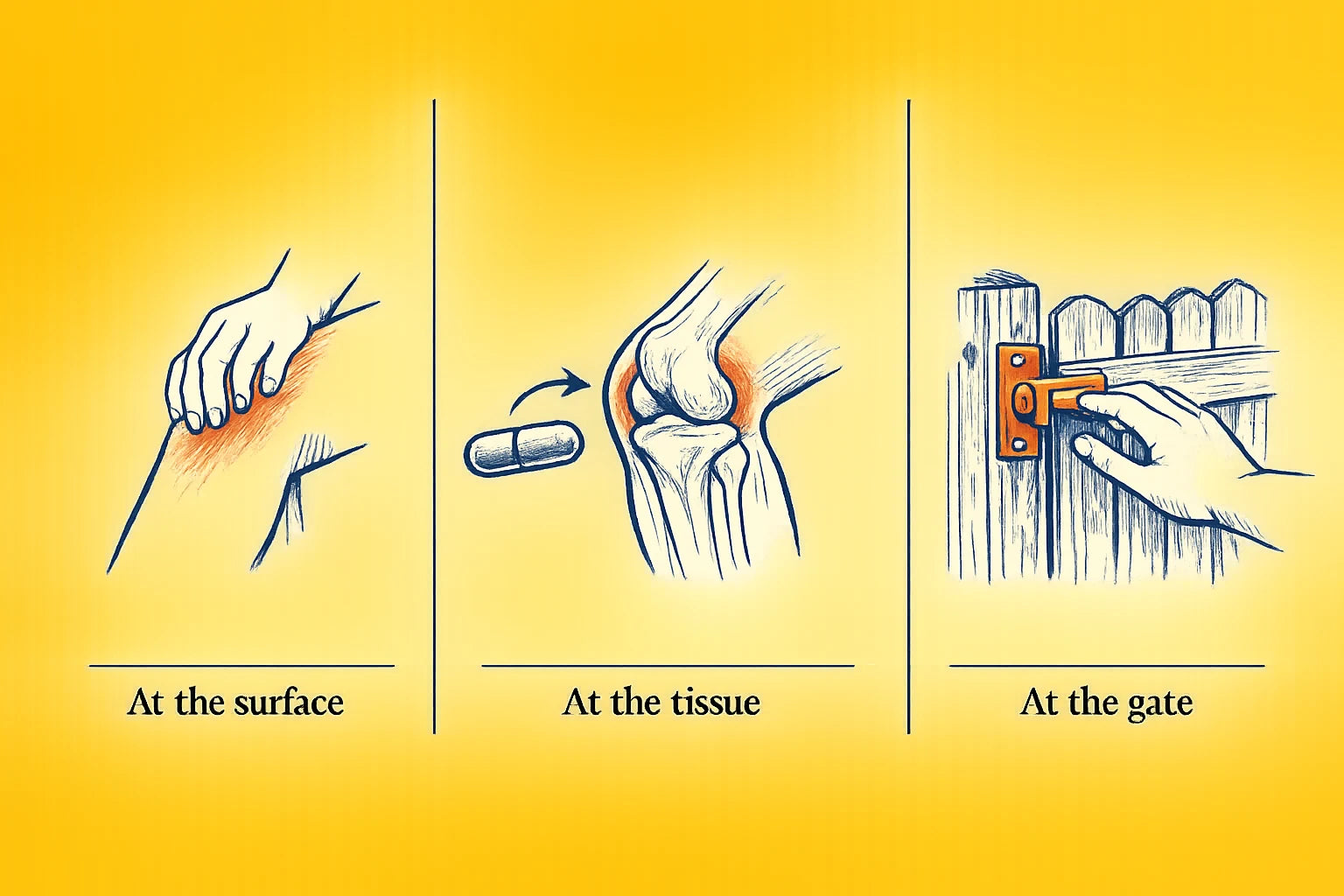
There are three things people reach for, and each of them is aimed somewhere other than the latch.
Things you rub on work at the surface.
They put competing sensation into the skin, which is genuinely the right idea, and against a sore muscle it's often exactly right.
But a latch that has worn out in your spinal cord isn't at the surface, and skin isn't how you reach it.
Ordinary painkillers are mostly aimed at swelling in tissue.
If the tissue isn't where the trouble is, you're knocking on the wrong door.
That's why people describe taking more and more for less and less.
Sedatives don't settle the gate at all.
They remove you from the room.
That's what people mean when they say I wasn't asleep, I was just gone.
The gate was still hanging open all night.
They simply weren't there to hear it.
None of those are stupid choices.
They're all aimed at the tissue, and the latch isn't in the tissue.
"That's Just Age"
I want to name the appointment, because almost everyone reading this has had a version of it.
You describe the burning, the buzzing, the hours.
Somebody looks at your feet for about forty seconds.
Then you're told that at your age some nerve noise is normal, and that you might try a warm bath before bed.
A warm bath.
I have no interest in being rude about doctors, and there are things on this page I'll tell you to take straight to one.
But I'd like whoever says that to try sleeping two hours a night for four years, and then review their own advice.
Here's what nobody said in that room.
Your nerves aren't broken, and you aren't imagining it.
There's a gate, it's real, and it has a published mechanism with a date on it.
The latch has worn out at exactly the hour when nothing else is loud enough to crowd the path.
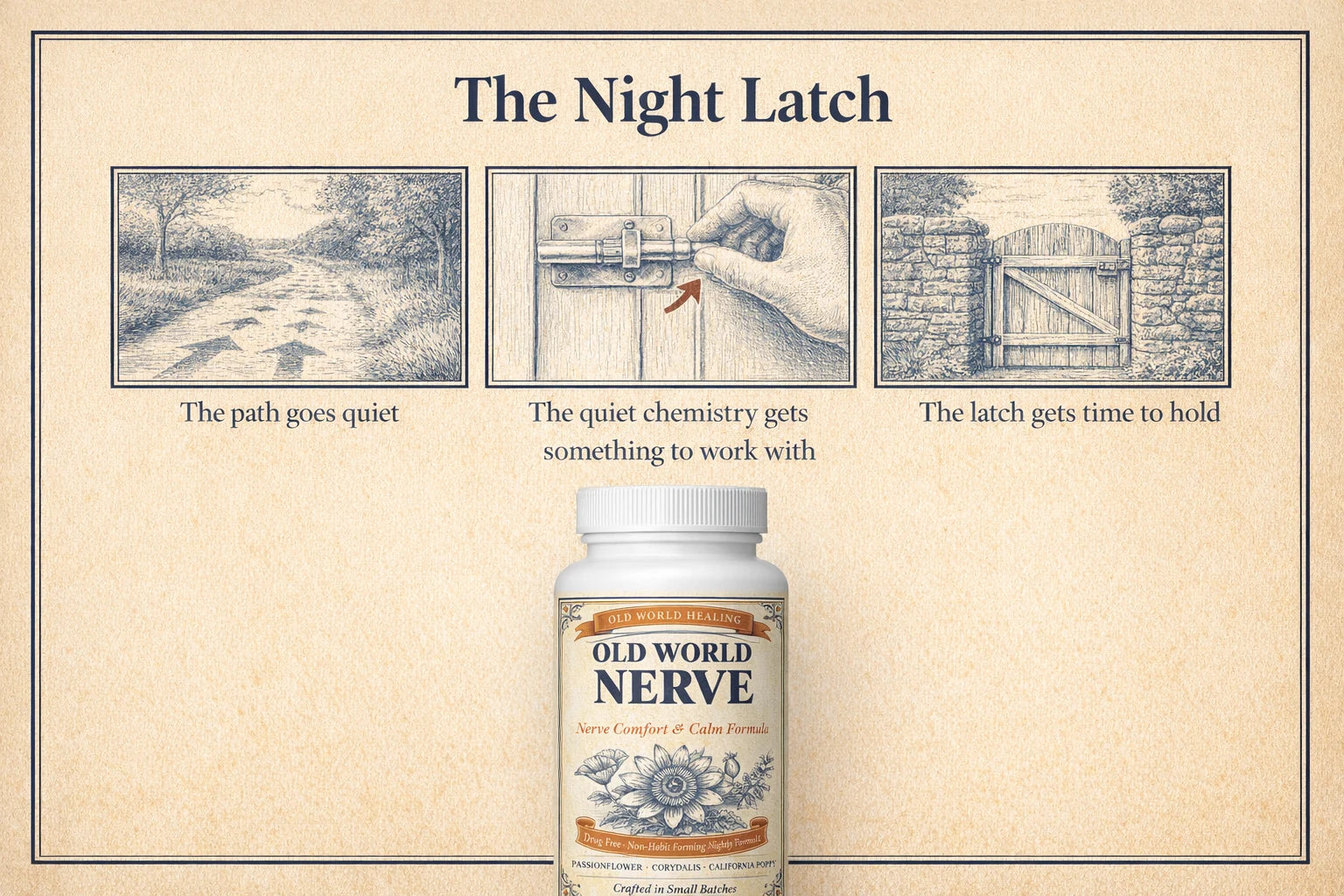
The Night Latch
Now I'll tell you what sent me into the old books.
Historical apothecary formularies are surprisingly well organised, and once you've read enough of them a pattern jumps out.
The formulas fall into two completely different families, and the good apothecaries never mixed them up.
For aching joints: warming things, rubbed in, external.
For people who couldn't settle at night: something else entirely.
Taken by mouth, bitter, built around a small handful of plants that show up again and again across centuries and across countries that had never met.
Those night formulas are where the name comes from.
I call it the night latch, because that's what it was for.
Putting the latch back on the gate, so the yard could stay quiet.
Five plants, and that's the whole thing.

Those apothecaries had no idea about spinal gates.
They wrote down what settled people, and centuries later a laboratory worked out why some of it did.
That's the whole bet Old World Healing is built on, and this formula is the clearest example of it I've ever worked with.
The Five Plants, Honestly
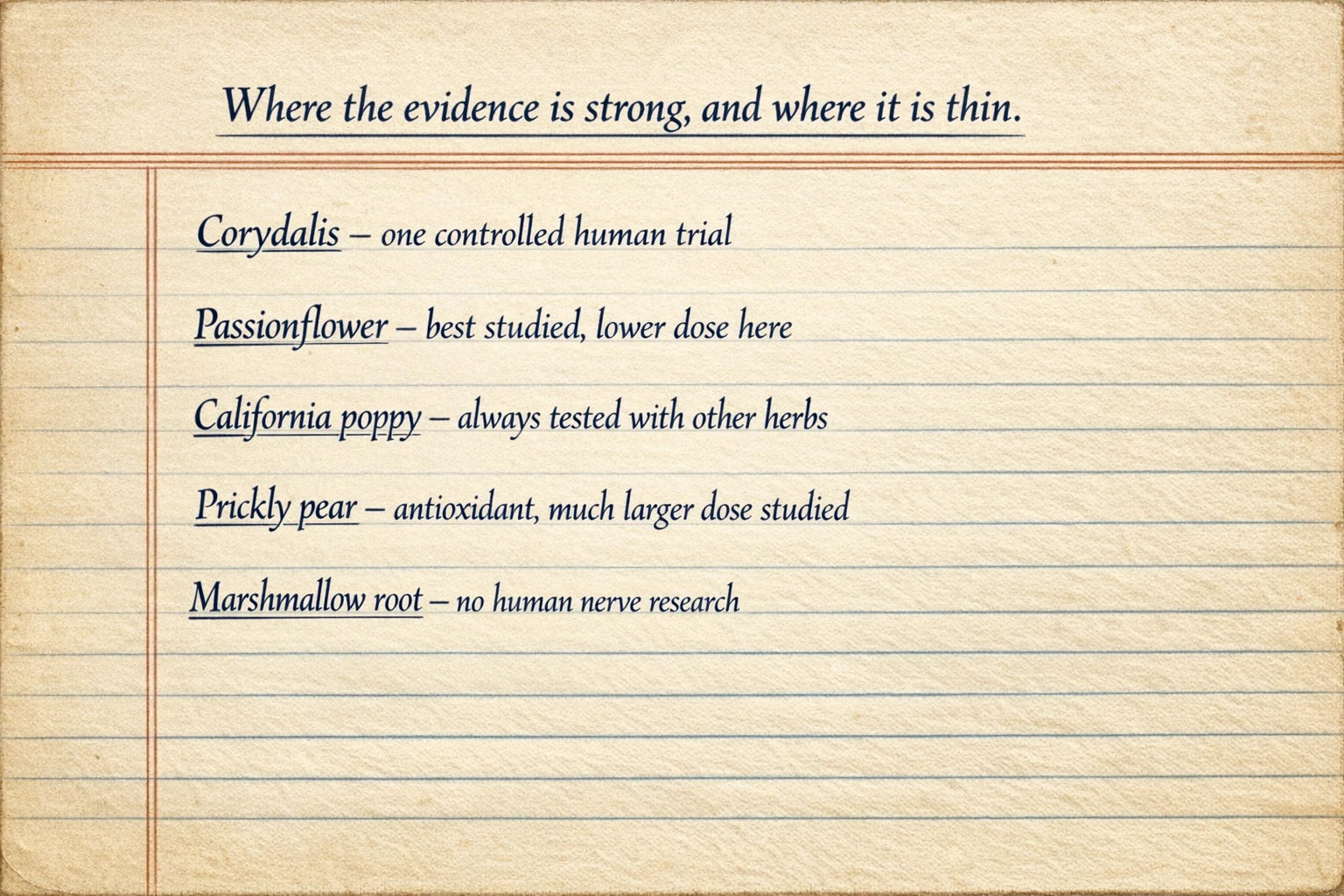
I'm going to tell you where the evidence is strong and where it's thin, because you're an adult and you can weigh it yourself.
I'm also going to tell you, for every single one of these, how our dose compares to the dose in the study.
Almost nobody selling supplements does that.
I'd rather you heard it from me than found it yourself and wondered what else I left out.
Corydalis, the one doing the heavy lifting.
Corydalis yanhusuo is a small plant with a knobbly yellow root, used in traditional Chinese medicine for centuries.
If I could only keep one of the five, I'd keep this one.
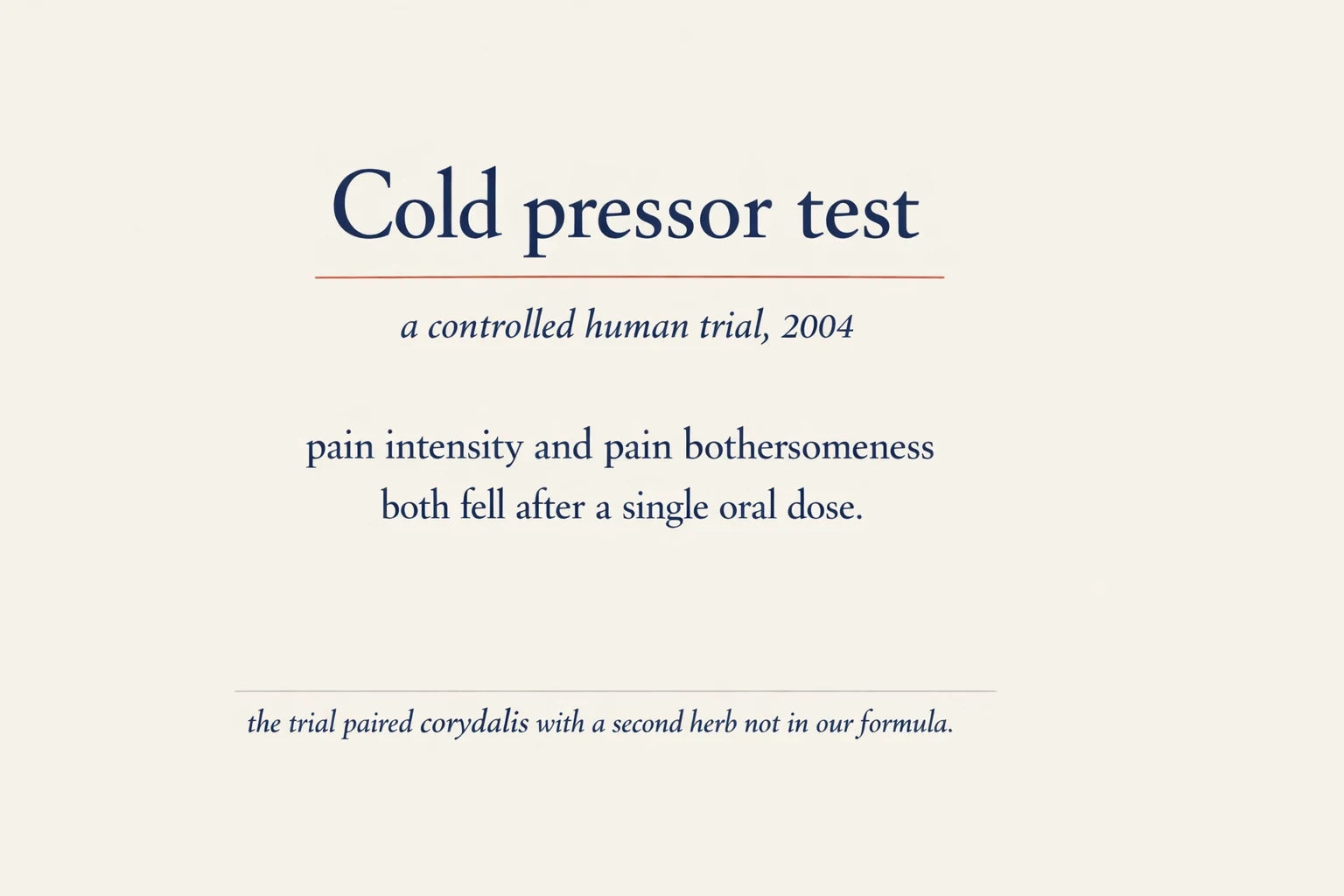
In 2004, researchers connected with the University of Chicago ran a controlled human trial using the cold pressor test.3
That's a standard, validated way of producing real pain in a laboratory, which means the result is measured rather than reported.
After a single oral dose of a Corydalis extract, pain intensity and pain bothersomeness both dropped significantly against control.
The effect was dose related, which is one of the things that makes a finding believable.
Later work at UC Irvine isolated a compound from the root called dehydrocorybulbine.
In animal research it quieted several different kinds of pain signalling, including the nerve-related kind.4
And unlike morphine, the animals didn't build tolerance to it across repeated dosing.5
Now the two caveats, and they're real.
That human trial paired Corydalis with a second herb that isn't in our formula, so its own contribution was never isolated.
And animal findings are animal findings, so I won't dress them up as human proof.
Passionflower, the brake pedal.
Passiflora incarnata is the one with the extraordinary geometric flower.
It works in the lane of GABA, the quiet chemistry, the latch itself.
It's the best studied plant we use.
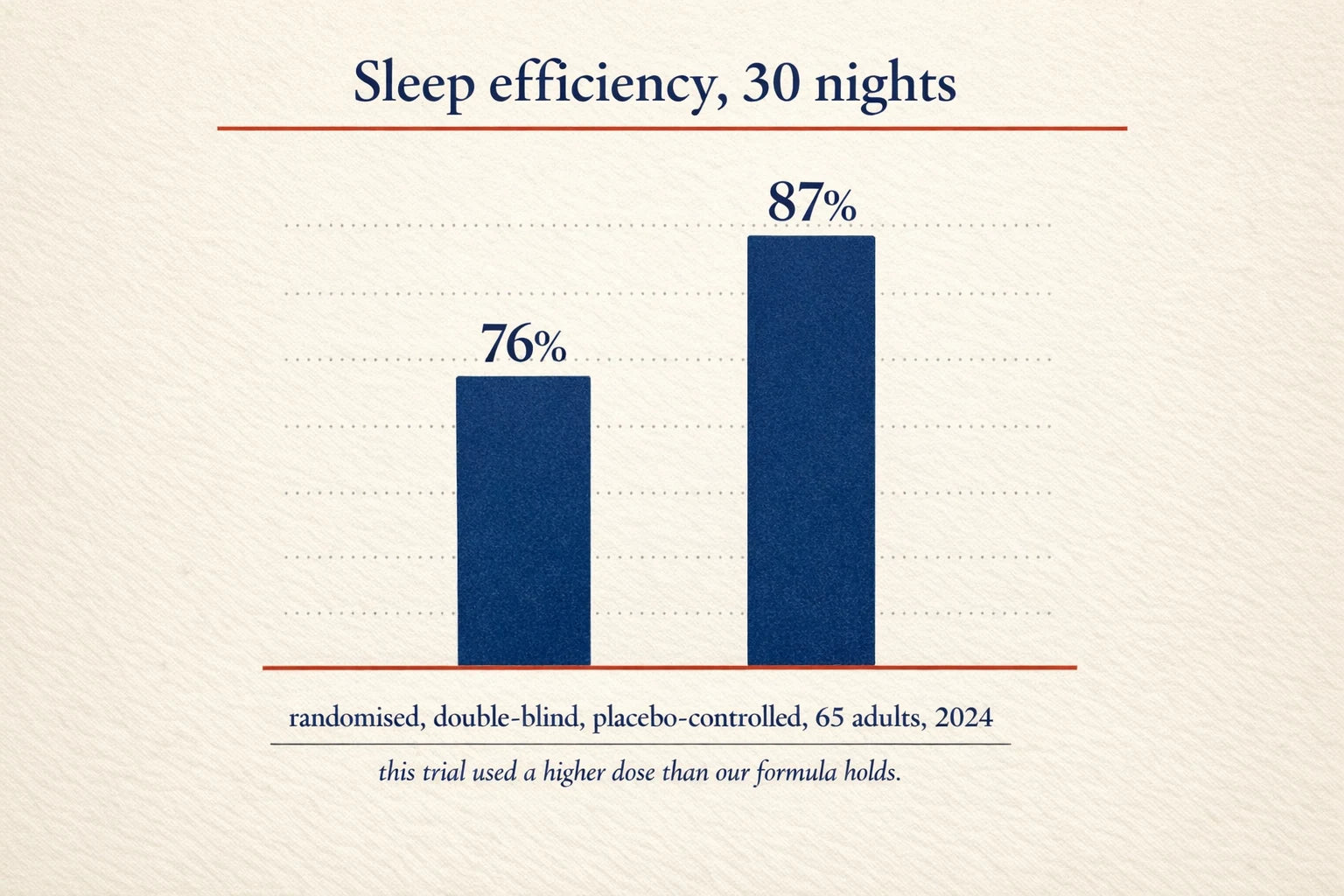
In a randomised, double-blind, placebo-controlled trial published in 2024, sixty-five adults with stress and poor sleep took passionflower at bedtime for thirty days.6
Against placebo: total sleep time up, time to fall asleep down, insomnia severity down.
Sleep efficiency improved from roughly 76% to 87%.
No adverse events in either group.
Now the straight talk on dose.
That trial used considerably more passionflower per day than our formula holds, and it used an extract rather than whole herb powder.
So that's a finding about the plant, and it's not a finding about our capsule.
California Poppy, passionflower's old partner.
Eschscholzia californica is not the opium poppy, it's a different genus, and it contains no opiates.
It works in the same lane as passionflower.
Laboratory work shows its compounds interact with the same receptor system GABA acts on, which is why the two have been paired for a very long time.7
Now the honest part, and there are two pieces of it.
The human research on California poppy has always been run alongside other herbs, so its own contribution has never been cleanly separated.
And the studied preparations use the flowering tops, while our label says seed.
It's in this formula on tradition and partnership, not on a trial with its name alone on it.
I'd rather flag that than let you assume more than it can carry.
Prickly Pear, the antioxidant.
Concentrated twenty to one from the fruit of the Opuntia cactus.
Its pigments, called betalains, are genuine antioxidants.
In a crossover study in healthy volunteers, cactus pear fruit meaningfully lowered markers of oxidative stress, in places outperforming vitamin C.8
That study used fruit by the kilo, not a capsule.
The 20:1 concentration is the most honest number on our label, and I won't stretch it past that.
Marshmallow Root, the soother.
Here's the one where I'll simply tell you the truth.
Althaea officinalis is a demulcent.
Its polysaccharides form a soothing film, and laboratory work shows calming and antioxidant activity.9
What it doesn't have is human research showing it does anything for nerves.
It's in the formula because it has been in the night formulas for as long as those books go back.
If somebody tells you marshmallow root settles your nervous system, they're making it up.
What We Made: Old World Nerve
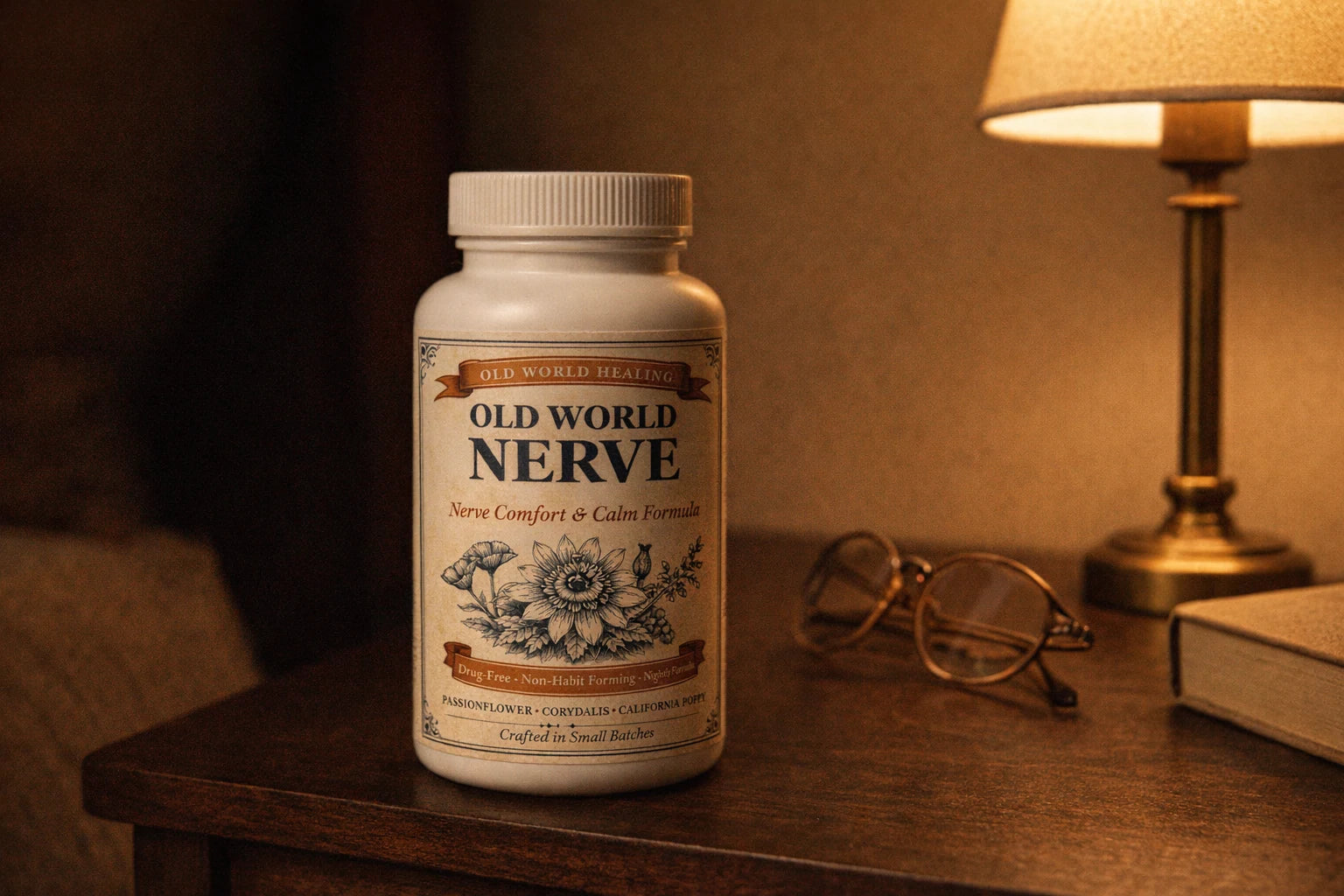
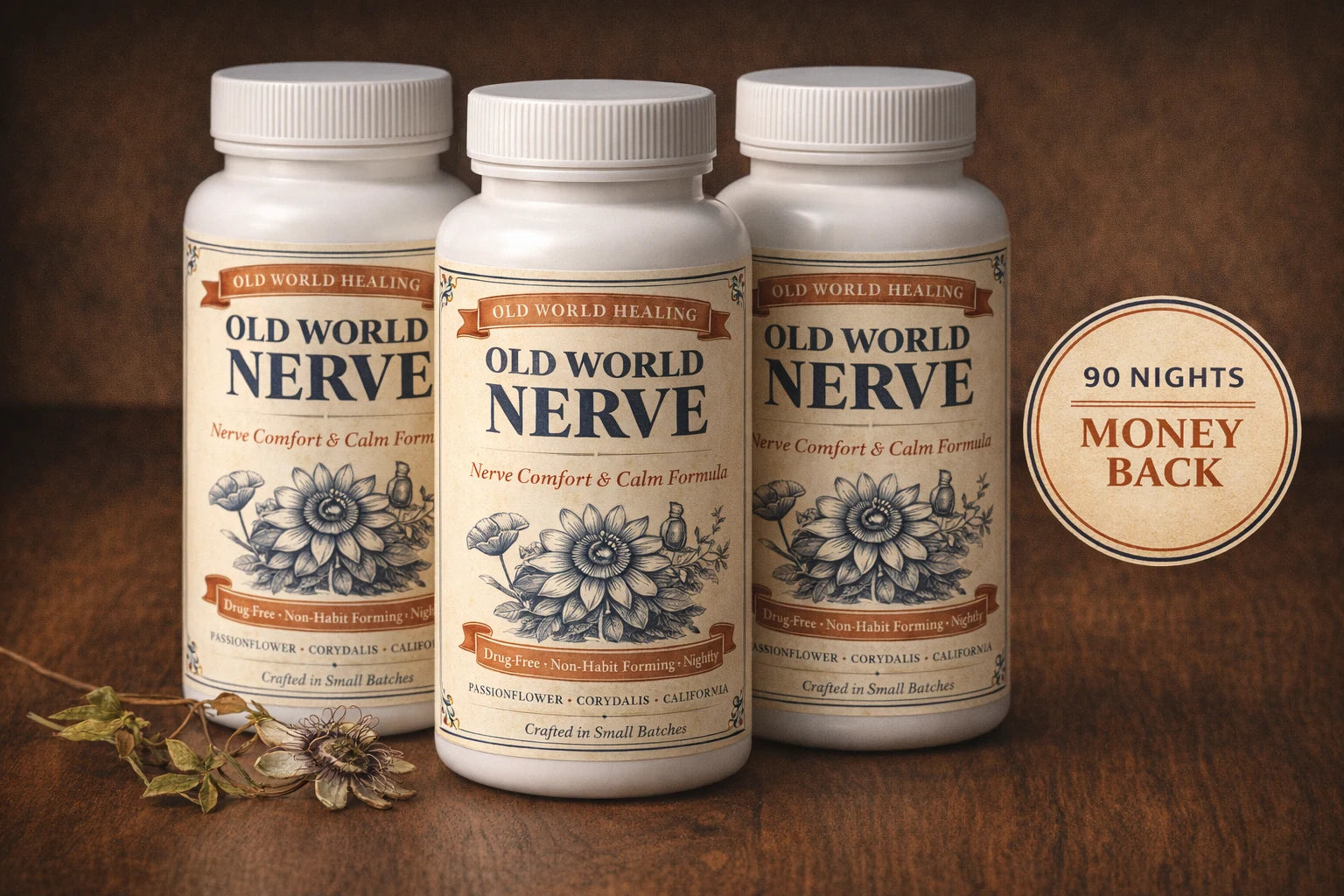
I put the five together the way the old formularies had them.
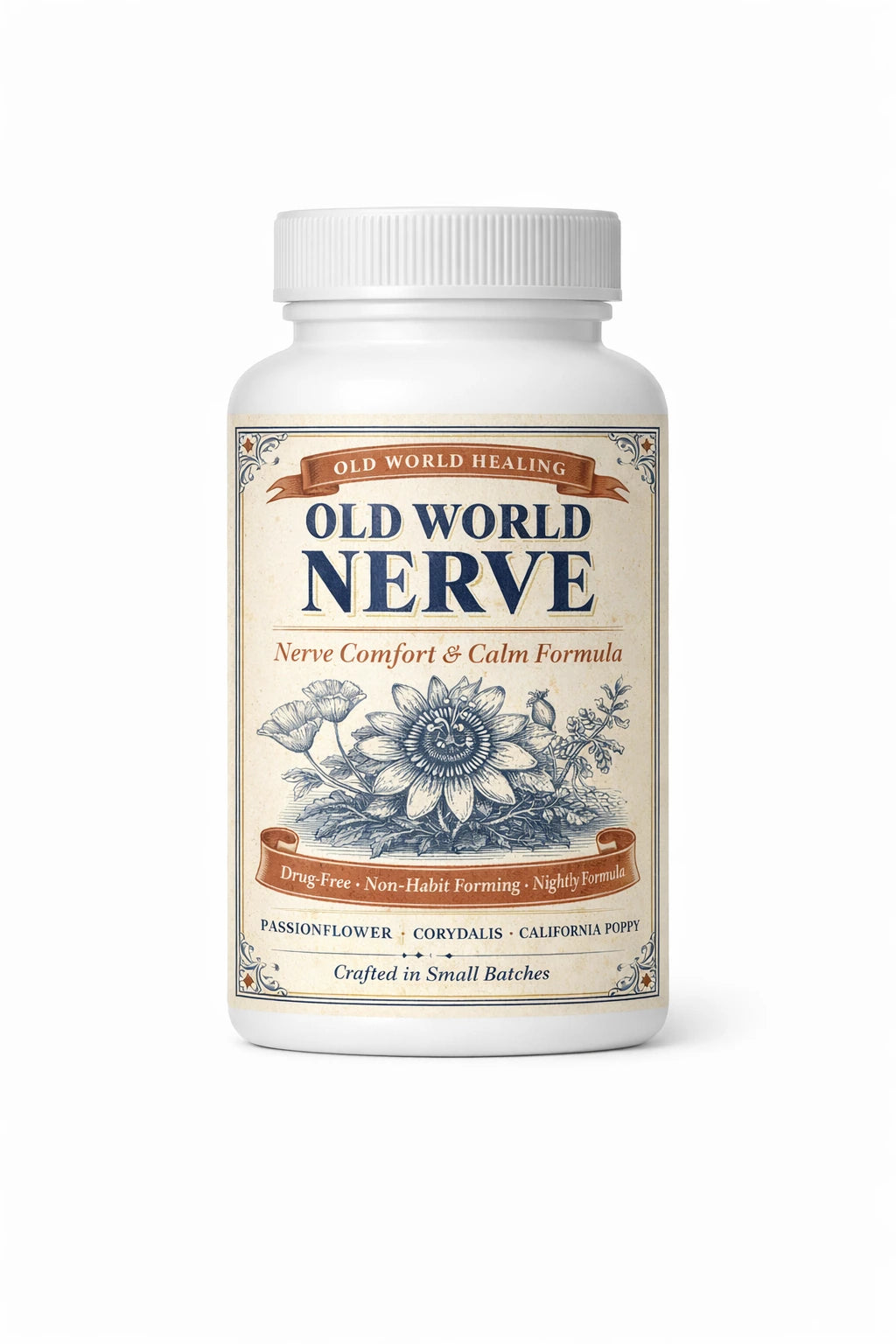
Small batches, a vegetable capsule, and almost nothing else in it.
Sixty capsules, thirty nights, two with a glass of water in the evening.
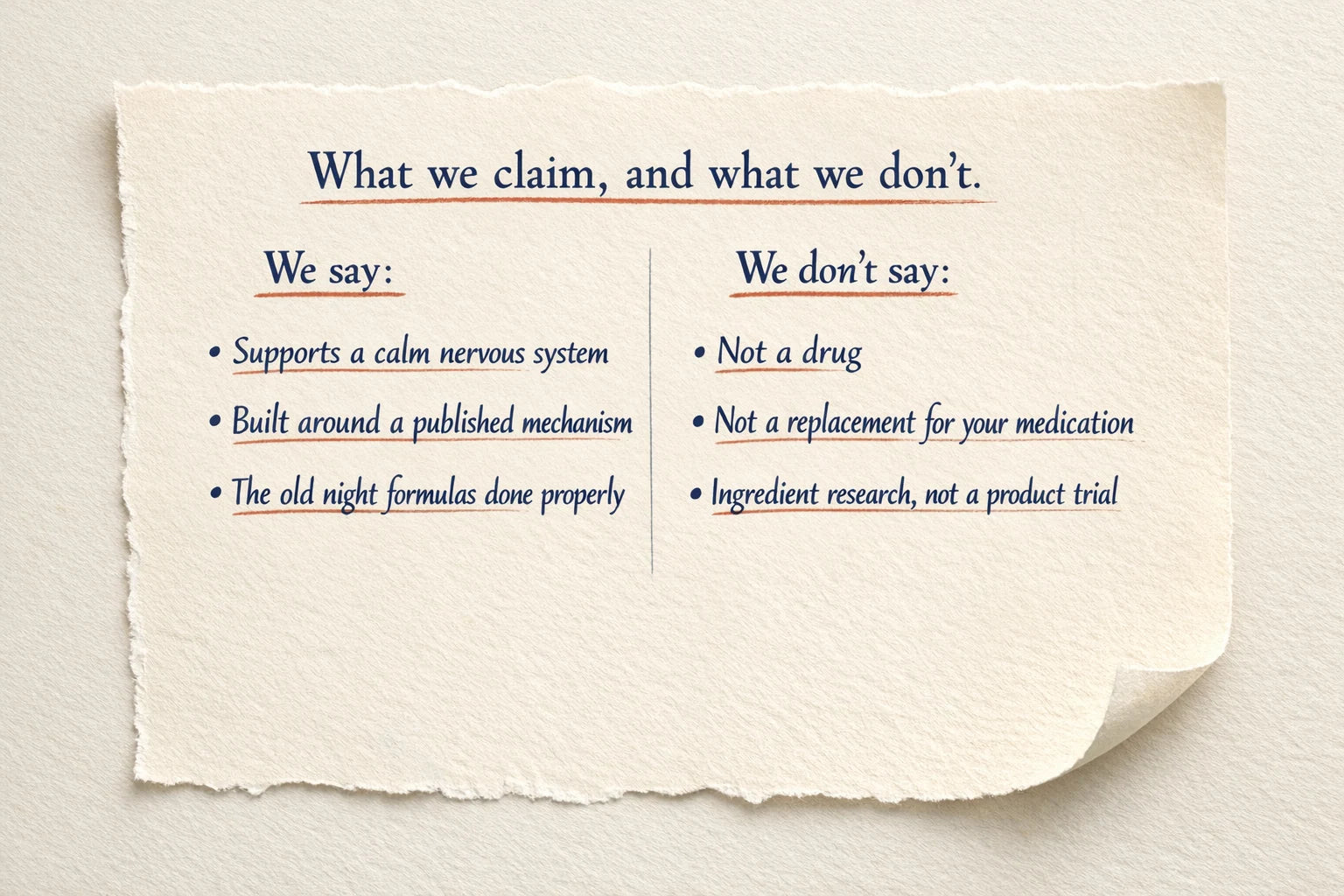
It's a dietary supplement, and it's not a painkiller and not a medicine.
What it's built to do is support the quiet side of your nervous system.
The side that's supposed to be holding that latch shut while you sleep.
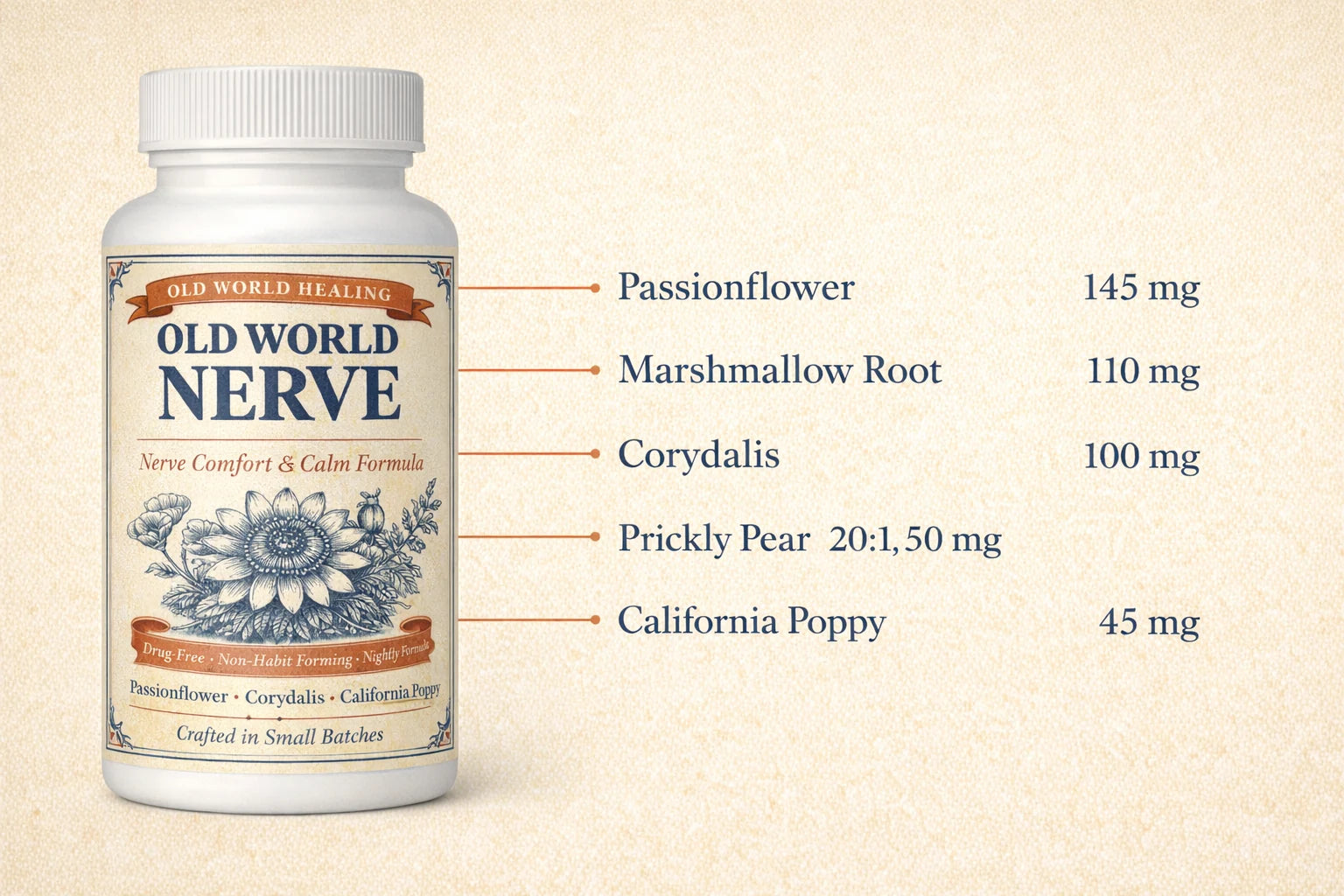
The best studied plant in the bottle, working in the lane of GABA.
A traditional demulcent, here on the strength of the old formularies rather than nerve research.
The one with a controlled human pain trial behind it.
Concentrated twenty to one from the cactus fruit, for its betalain antioxidants.
Passionflower's old partner, working in the same receptor lane.
The Three Things That Have To Happen, In Order
This is the part I'd want explained to me, so here it is in the order it has to happen.
One. The competing traffic has to be gone.
That isn't something we do, that's bedtime doing it.
It's also why this is a nightly formula and not a lunchtime one.
Two. The quiet chemistry has to have something to work with.
Passionflower and California poppy both act in the GABA lane, which is the lane the latch runs on.6 7
Three. It has to be given long enough to matter.
The trials that produced the numbers on this page ran for thirty days, not one night.6
That's why I talk in weeks on this page and never in minutes.
What I Won't Tell You
I'm going to be blunt, because the alternative is you finding this out later and deciding I hid it.
This is a gentle formula.
The doses are modest, and in several cases they sit below what the research studies used.
You shouldn't expect it to hit you like a sleeping tablet, because it won't.
It's built for nightly use, not for rescue.
The people who get on best with it take it every night and let it build.
It has never been tested as a finished formula.
Every study on this page is a study of an ingredient, and I've told you the dose gap on every single one.
It's not a treatment for any medical condition.
It hasn't been evaluated by the FDA.
If you've been given a diagnosis, that's a conversation for your doctor, not for me.
Most people who get on with it describe something in the two to four week range, not the first night.
If you want something that hits immediately, this is the wrong formula, and I'd rather you knew that now than after you'd paid.
A Note On Proof
I'd rather handle this part myself than let you wonder about it.
Old World Nerve is new, and it has no customer reviews yet.
So you won't find a star rating on this page, or a review count, or a wall of five-star badges.
What you'll find below are four accounts written to show how the formula is meant to be used, and they're labelled as exactly that.
When there are real ones, I'll swap them in and tell you I did.
What This Actually Looks Like For People
I want to set your expectations honestly before you read these.
The research timelines on this page run in weeks, not nights.6
You're putting a latch back on, not taking a painkiller, and that's slower and better.
Illustrative accounts, not customer reviews
"The arithmetic was the worst part of it.
Working out how much sleep I could still get if I dropped off this exact second.
I take the two after dinner now and I've mostly stopped doing that sum.
I couldn't tell you the night it stopped. That's the honest version."
"I expected to feel something the first night and I didn't.
What I noticed was about three weeks in, when I realised I hadn't been standing in the kitchen at four in the morning.
My wife noticed before I did, which tells you how gradual it was."
"I didn't want to be knocked out.
I'd tried the over-the-counter sleep things and I hated the fog the next day.
This is not that. I still wake up if the dog barks, I just settle again."
"What sold me was the page telling me the doses were lower than the studies.
I have never had a supplement company do that.
I am about ten weeks in and the evenings are quieter than they were in the spring."
Getting Started With Old World Nerve
Old World Nerve comes in three supplies, and you choose how you buy it.
On subscription: $49 | $89 | $129
The struck figure is what the same supply costs bought once, and it's the only comparison price on this page.
- Free shipping on every order, whichever way you buy.
- Your subscription bills the same price from the very first month, with no introductory rate to expire.
- Cancel anytime before your next ship date, with no fee and no phone call.
- 90-day money-back guarantee on both ways to buy, in full, with no need to send the bottle back.
A subscription saves you $10 every month against the same supply bought once.
The longer the supply, the more you save on top of that $10.
And I'm not going to hook you with a cheap first month, then quietly double the price on you in week five.
There's no introductory rate here to expire, so your subscription bills the same in month one and month twelve.
One bottle is sixty capsules, which at two a night is exactly one month.
I'll tell you plainly why most people don't start with one.
The timelines on this page run two to four weeks before anything is worth judging, and a single bottle gives you barely one look at that window.
People who start with the smallest option tend to run out at precisely the point where it was starting to be interesting.
Our Guarantee
You have 90 days, and you get all of your money back.
If Old World Nerve isn't working for you, write to us within 90 days of your order for a full refund.
You don't need to send the bottle back.
The refund holds whether you bought it once or started a subscription.
Ninety days is deliberate, and it's roughly three bottles.
A thirty-day window would ask you to judge this formula before the timelines on this page say there's anything to judge.
What I can promise you right now is the part that doesn't need a policy document.
I'll show you the studies that undercut us alongside the ones that support us.
I'll tell you the dose gap every single time I cite a trial.
And I'll never tell you to stop taking something your doctor gave you.
How To Take It
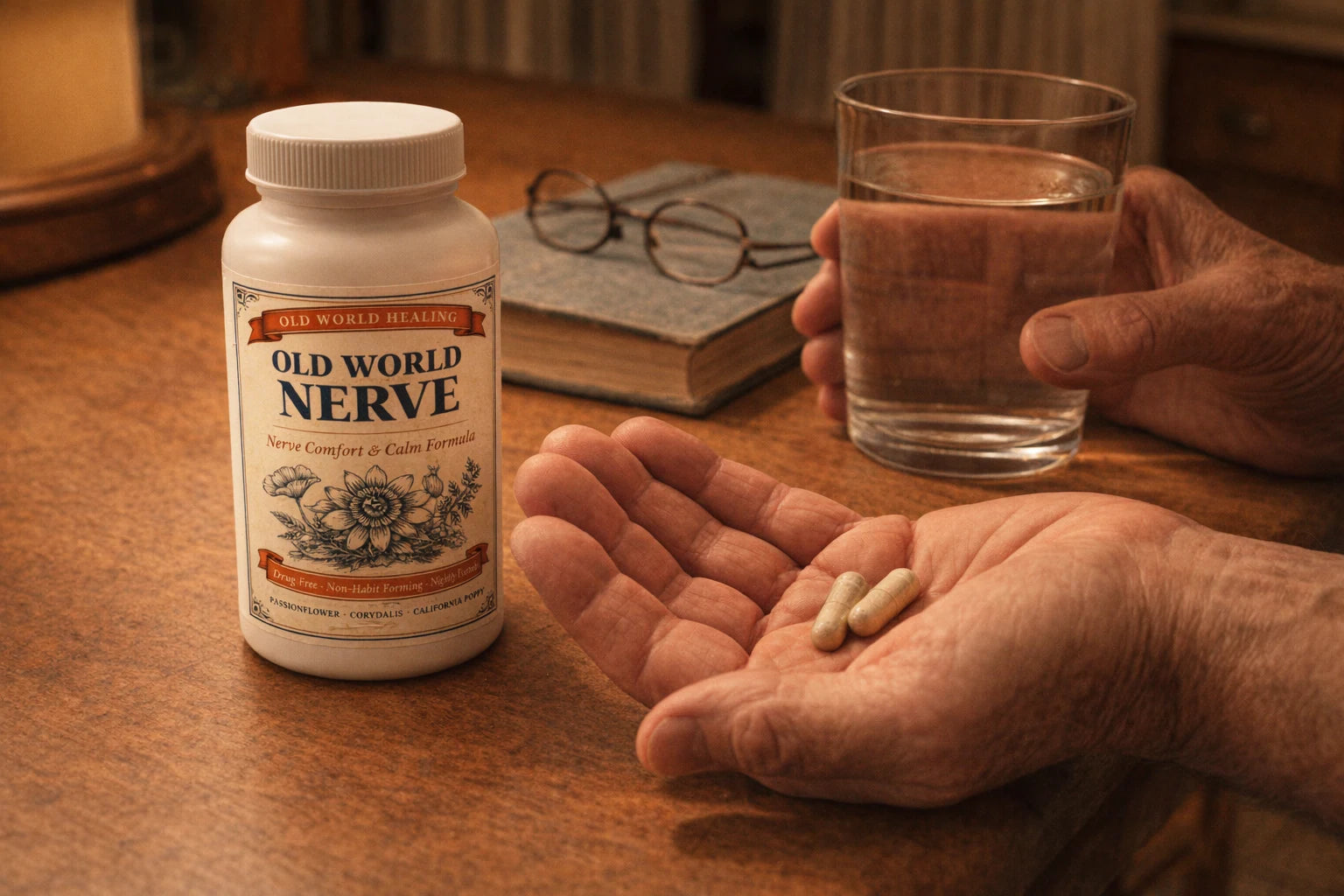
Two capsules in the evening, with an 8 oz glass of water.
Two capsules is the whole serving, and a bottle holds sixty of them, so one bottle is one month.
There's no loading week and no second dose in the morning.
Best taken in the evening, which isn't a marketing line, it's the mechanism.
The whole argument of this page is that the path goes quiet at night, so that's when a nightly formula has anything to work with.
One more thing, and it's the important one.
This can cause drowsiness, which is rather the point of taking it at night.
Don't drive or operate machinery after taking it, and don't combine it with alcohol, sedatives or sleep aids.
Two Versions Of Next Spring
I want you to picture two Marches, because this is the decision, stripped of everything else.
The first version.
Nothing changed.
You're still doing the arithmetic at three in the morning.
The list of things you have quietly stopped doing is one or two items longer than it is today, and you won't be able to say exactly when any of them fell off.
That's the thing about the subtraction. Nobody announces it.
The second version.
You did the ninety nights.
I'm not going to tell you what happened, because I don't know, and anybody who tells you they know is selling you something worse than a capsule.
What I can tell you is that you'll have an answer instead of a question.
You'll know whether this belongs in your house, and you'll have found out for the cost of three months and none of the risk.

A Note On Availability
I'd rather be straight with you than clever.
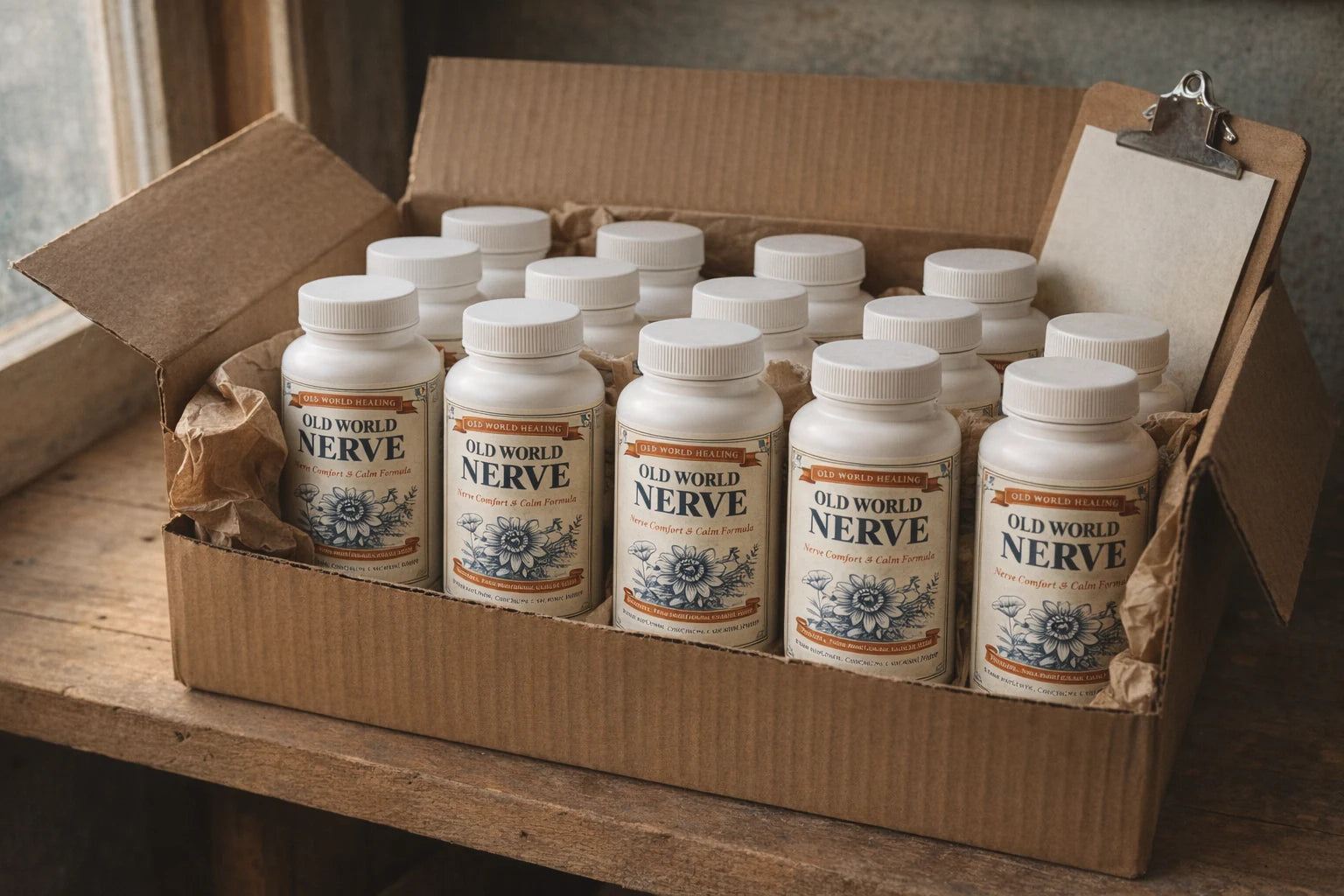
We make this in small batches, which is a real constraint and not a sales tactic.
There's no countdown clock on this page and there's no stock warning, because I don't know what next month looks like and I'm not going to pretend I do.
If it's available when you read this, it's available.
Questions People Ask Me
A: Because of what leaves, not what arrives.
All day, weight and movement and temperature crowd the gate and compete with the signal, which is the effect Melzack and Wall described in 1965.1
Lie down in a dark quiet room and that competing traffic goes home.
The only thing left walking up the path is the signal you outran all day.
A: It isn't designed to, and the whole reason I keep calling it gentle is that the doses are modest.
That said, it can cause drowsiness, which is rather the point of taking it at night.
Don't drive or operate machinery after taking it.
A: Two to four weeks for most people who get on with it, and not the first night.
The trial behind the sleep numbers on this page ran thirty days.6
I'd rather under-promise here than have you quit at day twelve.
A: No. Different plant, different genus, no opiates.
A: Passion flower herb powder 145 mg, marshmallow root 110 mg, corydalis powder 100 mg, prickly pear 20:1 at 50 mg, and California poppy seed 45 mg.
That's 450 mg of active blend across two capsules, in a vegetable capsule.
I've published the dose gap on every one of them above.
A: Because five plants at honest doses don't fit in one capsule.
I'd rather ask you to swallow two than quietly cut the formula in half.
A: No.
A: Ask your doctor first, and mean it.
Corydalis can interact with how your body processes medication, and it has been linked to liver effects in some reports.
If you have a liver condition, glaucoma, or you take an MAOI, don't take this without medical advice.
It isn't suitable in pregnancy or while nursing, and it isn't for anyone under 18.
A: No, and I'd be lying if I said otherwise.
That's the entire reason the guarantee is ninety days and the refund doesn't need the bottle back.
A: Ninety days, full refund. That's the whole answer.
You don't need to send the bottle back, and it holds whichever way you bought it.
The Last Thing I'll Say
The old formularies don't promise anything.
That's the first thing you notice reading them.
No claims in the margins, no exclamation marks.
Just names, weights, dates, and now and then a short note about whether it helped.
I've tried to write this page the same way.
Your nerves aren't broken, and you aren't imagining it.
There's a gate, it's real, and the latch has worn out at exactly the hour when nothing else is loud enough to crowd the path.
This is five plants, put together the way the old night formulas put them together, aimed at the quiet side of that problem.
Ninety nights will tell you whether it belongs in your house.
The question I'm asked most about this formula is whether it will knock you out.
The short answer is no, deliberately, and the doses are modest enough that I say so on the page rather than hiding it in the small print.
To see the three supplies, and both ways to buy them, use the button below.
P.S. If you take one thing from this page, take the mechanism, even if you never buy anything from us.
It gets worse when you rest because resting removes the competing traffic, not because you're getting worse.1 2
Knowing that is worth something on its own, at three in the morning.
P.P.S. The guarantee is ninety days, it covers both ways of buying, and you don't send the bottle back.
If you're on the fence, the three-month supply is the one that actually answers the question, because it's the only one that outlasts the timeline the research sets.6
The four accounts on this page are illustrative, written to show how the formula is meant to be used.
They are not customer reviews, they carry no star ratings, review counts or verified-buyer framing, they are not attributed to real purchasers, and individual results vary.
No customer testimonial of any kind appears anywhere on this page.