"Twenty years of vitamins every single morning, and I'm STILL wiped out by three o'clock... and it turns out they already knew."
Harvard Researchers Gave 21,442 Seniors A Daily Multivitamin. The Results Explain Why You're STILL Dragging By 3pm.
Your vitamins aren't weak. They're NAKED...
And the thing that got stripped off them is the exact thing your body has been starving for since the day your plate turned beige...
Here's what the medical journals found when they finally tested the pills against the plants... and how to get your afternoons back.

It's 3:07 in the afternoon.
You're at the kitchen table with a mug of coffee you don't even want.
The second wind isn't coming.
It hasn't come in years.
And ten feet away, right next to the coffee maker, sits the big bottle you've opened every single morning since your kids were in school.
You did everything they told you to do.
So let me tell you what the researchers did with that bottle, because it's going to make you furious, and then it's going to make you feel a whole lot better.
21,442 People. Three And A Half Years. One Envelope.
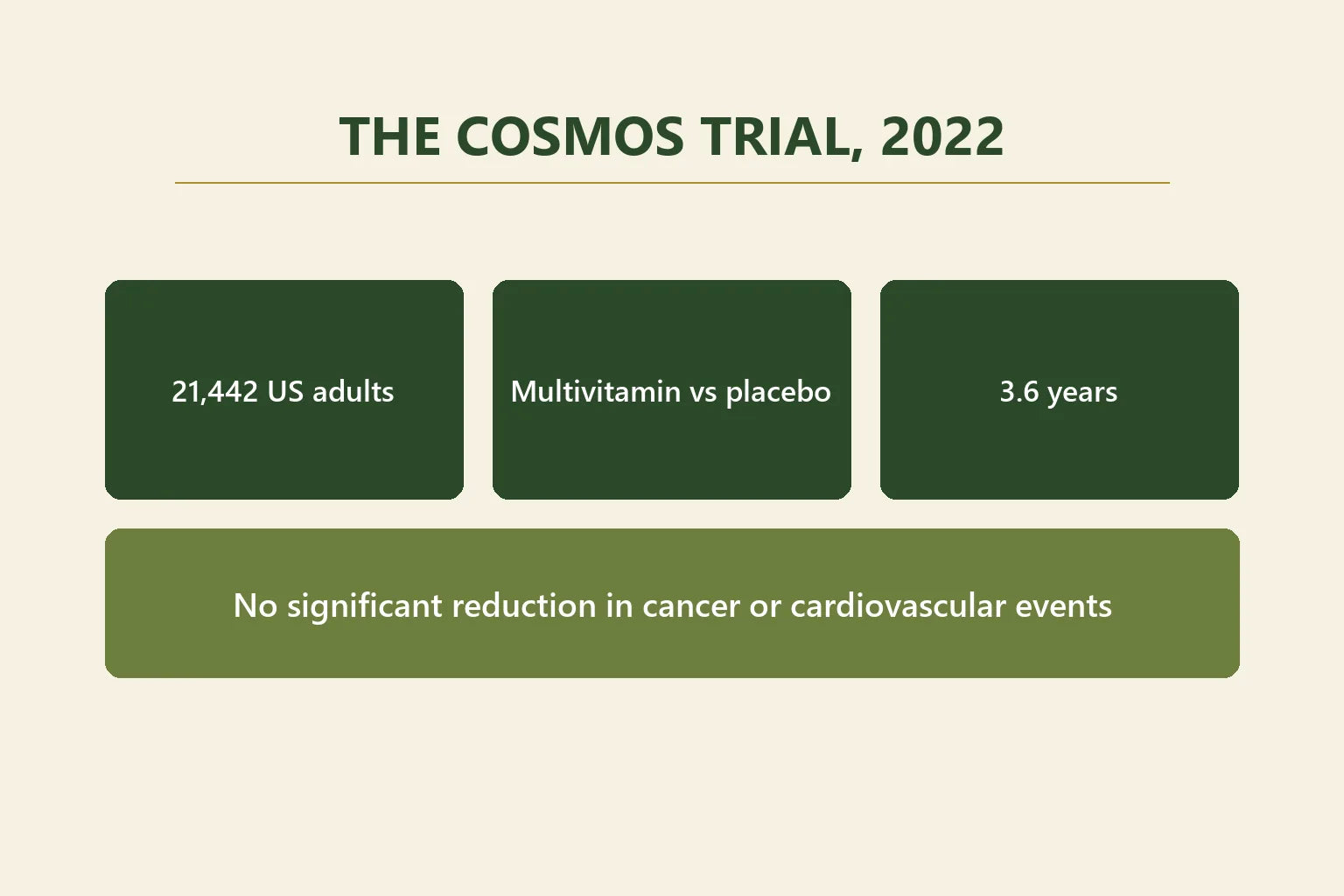
In 2022, researchers at Brigham and Women's Hospital, a Harvard teaching hospital, finished the biggest test of a daily multivitamin ever run on people your age.
They enrolled 21,442 American adults.
Women 65 and older, men 60 and older.
Half of them took a real, ordinary daily multivitamin.
The other half took a fake pill that looked exactly the same.
Nobody knew who had which one, not the participants and not the doctors, for three and a half years straight.
Then they opened the envelope.
The multivitamin group did not have significantly fewer cancers than the fake-pill group.1
The multivitamin group did not have significantly fewer heart attacks or strokes either.1
Same result, on twenty-one thousand people.
Now I want to be straight with you, because I'd rather you trust me than be impressed by me.
That trial measured cancers and heart events.
It didn't measure how you feel at three in the afternoon.
So I'm not going to claim science proved your vitamin does nothing for your energy, because that isn't what they tested.
What they proved is narrower than that, and honestly it's worse.
They proved that on the outcomes that actually matter to your life, the pill you've trusted for twenty years didn't move the needle.
And this wasn't some rogue finding.
A Top Medical Journal Published An Editorial Called "Enough Is Enough."
That's the real title.
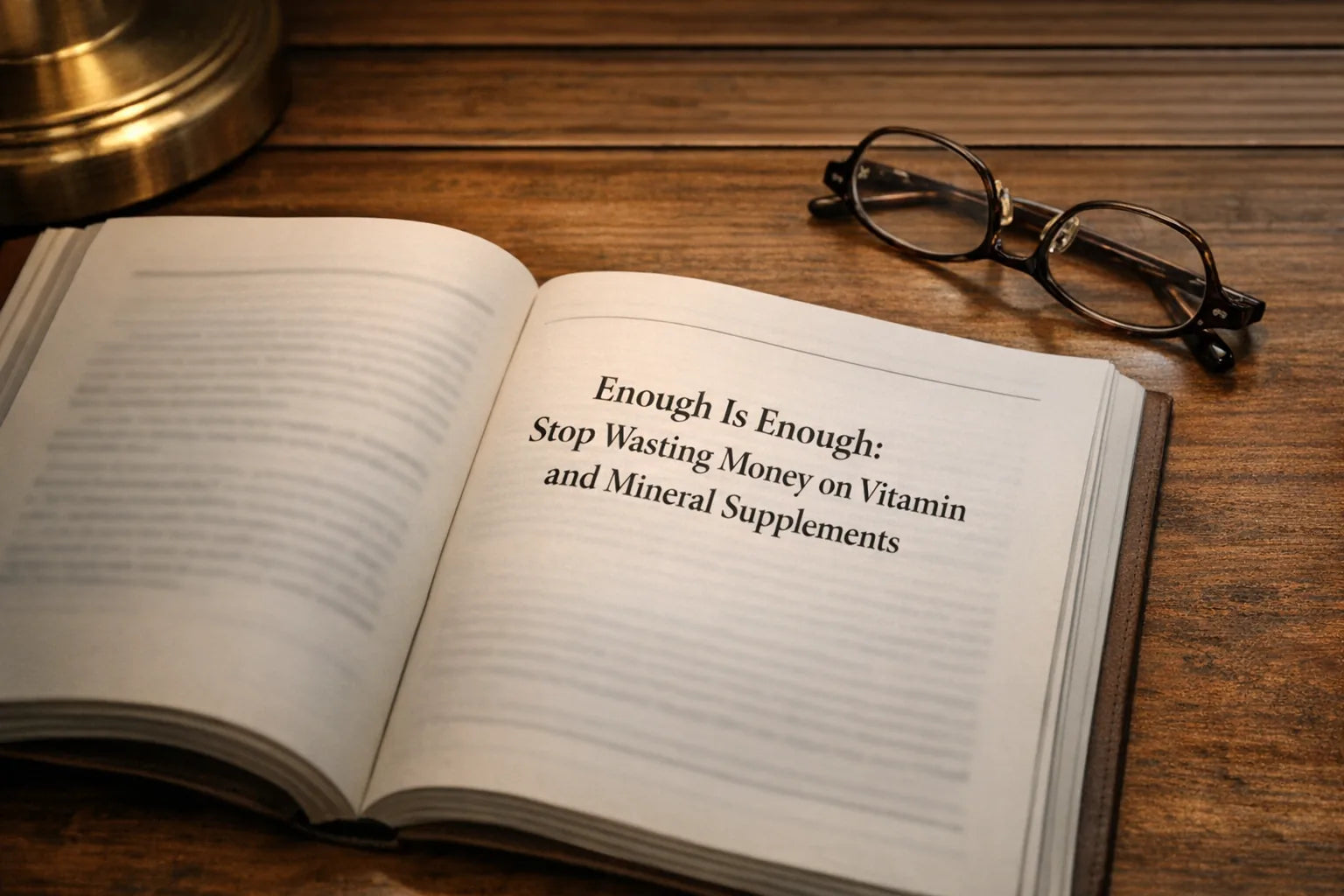
"Enough Is Enough: Stop Wasting Money on Vitamin and Mineral Supplements," in the Annals of Internal Medicine.2
The line inside it that stopped me cold was "the case is closed."2
Closed. Meaning doctors have known this for over a decade while you kept refilling the bottle.
And before that, the Physicians' Health Study II followed more than fourteen thousand men taking a daily multivitamin for over eleven years.3
It found no significant effect on major cardiovascular events either.3
So here's my question, and I've been asking it in a fairly loud voice for a while now.
If the case was closed in 2013, who exactly told you?
Did the vitamin aisle shrink?
Did anybody call the millions of Americans over fifty who were still buying that bottle every ninety days?
Nobody said a word.
Go stand in the vitamin aisle at your pharmacy this week and count the bottles.
Every last one of them is still sitting there, priced like it works.
The bottles got prettier and the labels got bigger numbers on them and everybody kept quiet.
Thirteen years of your mornings have gone by since that editorial ran, and not one person in that industry picked up a phone.
I've studied old-world remedies for thirty years, and I've never once watched an industry sit on a result like that and keep right on selling.
I want you to hear the next part clearly, because this is the part people get wrong.
None of this is your fault.
You weren't gullible.
You did the sensible thing with the tool you were handed, every single morning, for two decades.
Nobody handed you a better one.
I'm going to hand you one now.
Who I Am, Quickly, So You Know Why I'm The One Telling You
I'm Mary Miller, an herbalist and natural health researcher.
We started Old World Healing to bring back the remedies our great-grandparents used before any of this came in a bottle with a barcode.
In thirty years of studying those old remedies, one thing kept nagging at me: the healthiest old people I ever studied never took a vitamin in their lives.
They ate out of gardens.
And when modern science finally sat down and tested the pills against the plants, the pills lost.
I can show you the studies, and that's what the rest of this page is.

The Real Reason The Pill Never Worked: Your Vitamins Are Naked
Here's the whole thing in one picture.
Imagine ripping a single key out of a piano.
Just the C key, pulled out and carried around in your pocket.
Now try to play music with it.
You can hammer that one key all day long, as hard as you want, and you will never get a song out of it.
The music only happens when the whole instrument plays together.
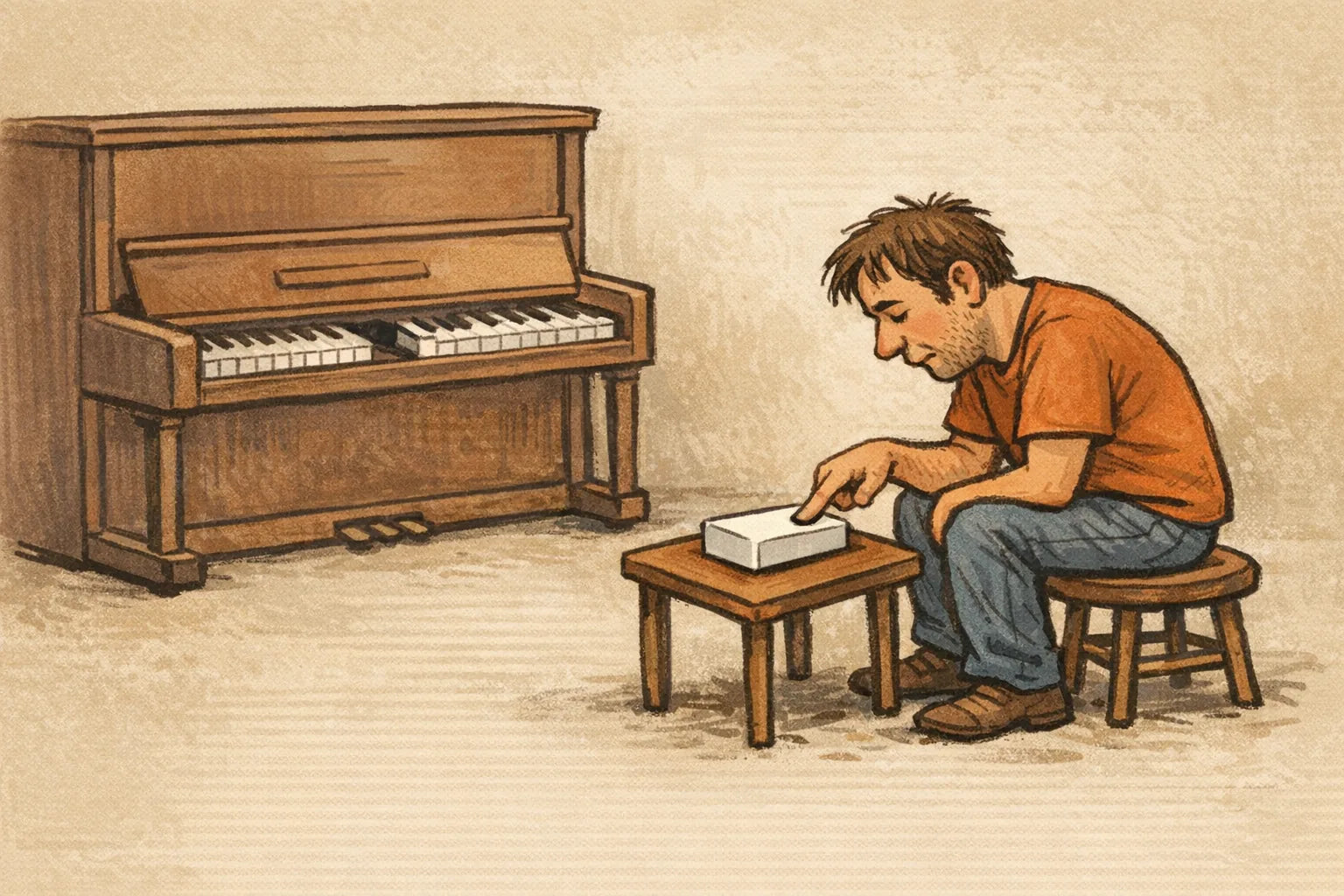
That's your multivitamin.
It's a handful of piano keys pulled out of the plant they came from.
I call the problem Naked Vitamins, because that's exactly what happened to them. They got stripped.
In nature, a vitamin never travels alone.
It arrives inside a plant, wrapped in hundreds of other compounds that grew right alongside it.
Pull the vitamin out of the plant and rebuild it in a factory, and you're left with the key without the piano.
Layer 1: Stripped vitamins don't always behave like the real thing
This isn't a hunch, it's measurable.
Natural vitamin E, the kind that comes out of a plant, is roughly twice as available to your body as the synthetic version made in a lab.4
In a randomized pilot trial, a food-derived B complex outperformed the synthetic version on people's actual blood markers.5
Now here's where I'm going to be honest with you again, because a lot of natural-health folks won't be.
Vitamin C is vitamin C.
When researchers compared vitamin C from kiwifruit against synthetic vitamin C in real people, absorption came out about the same.6
So "everything natural absorbs better" is not the claim, and anybody selling you that line is stretching.
The real claim is much bigger than absorption.
It's that the pill is missing the company the vitamin was supposed to arrive with.
Layer 2: The thing you're actually short on isn't a vitamin at all
This is the part that changed how I think about all of it.
The CDC looked at hundreds of thousands of American adults and found that only 10% of us eat enough vegetables.7
One in ten.
Read that again, because it means the odds are nine to one that you are one of the other nine.
And a national analysis found 8 in 10 Americans falling short in every color category of plant food, from the greens right through to the purples.8
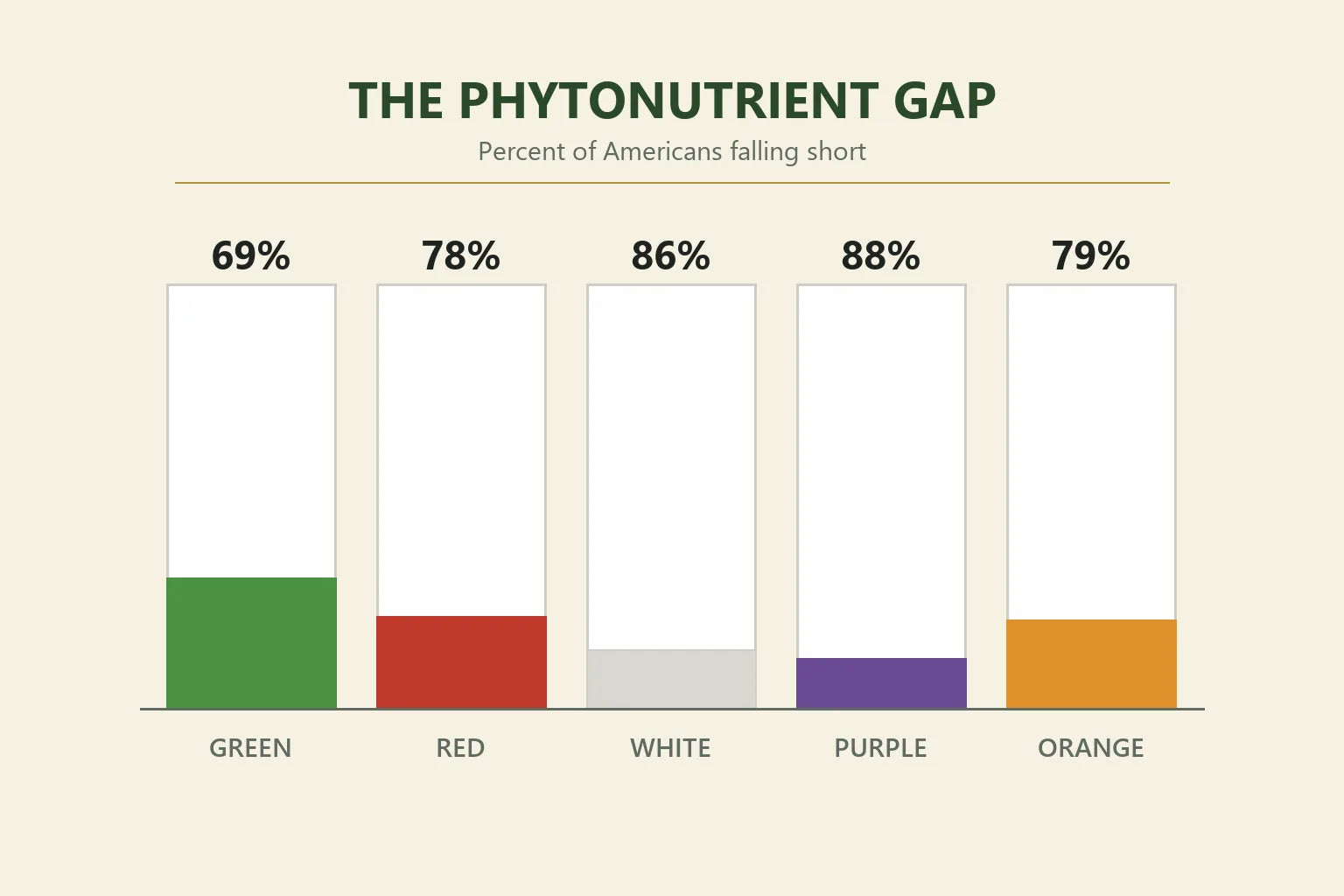
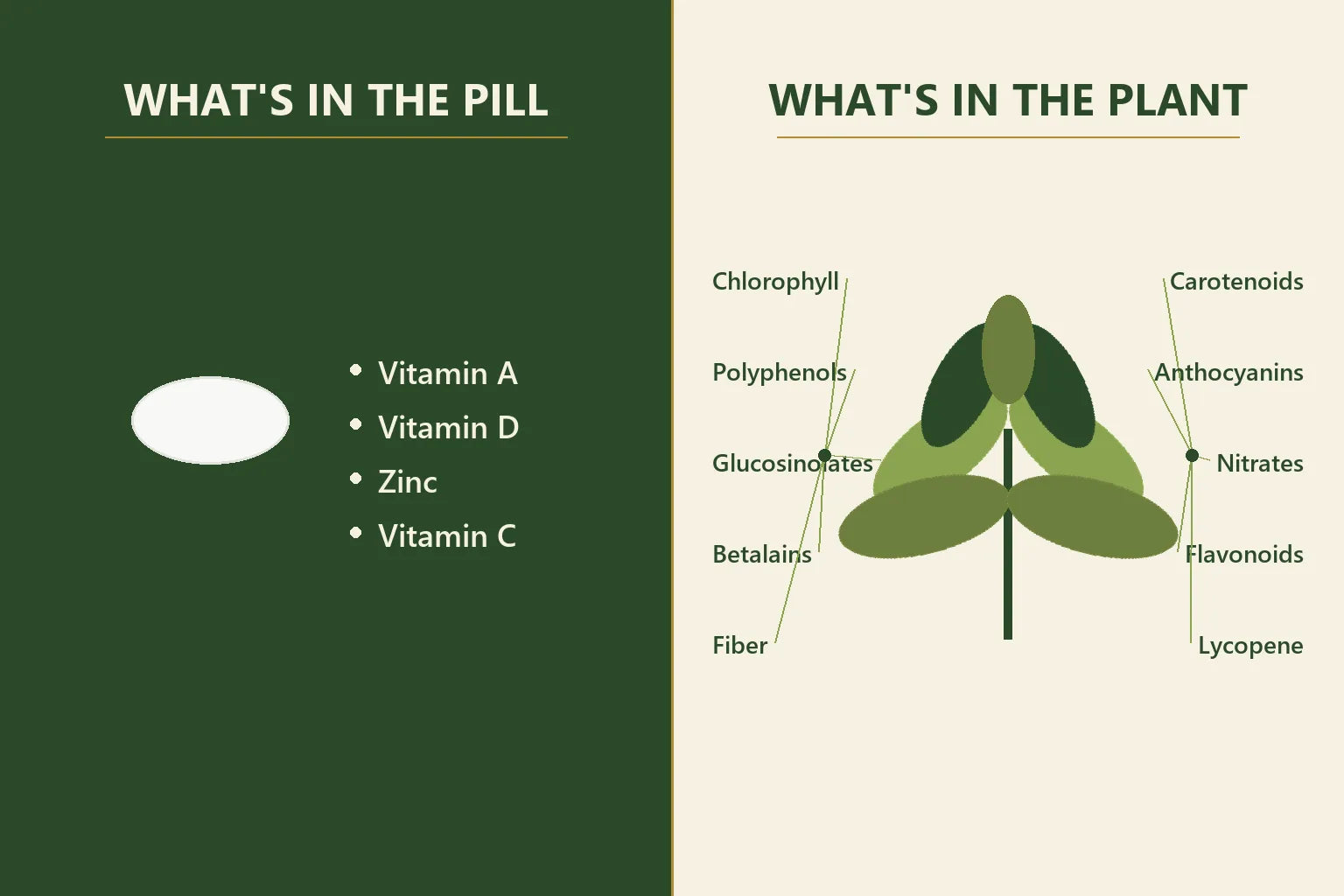
Now go look at the back of your multivitamin bottle.
You'll find a tidy column of chemical names with percentages beside them.
Vitamin A, vitamin D, zinc, and so on down the list.
Now go looking for the plant compounds.
The nitrates your body turns into the signal that opens up your blood vessels.
The glucosinolates from the cabbage family that flip on your body's own defense enzymes.
The polyphenols, the carotenoids, the chlorophyll.
They are not on that label.
Not a milligram, not one of them.
They can't be, because those compounds only exist inside plants, and a multivitamin is vitamins with the plant taken out.
Layer 3: This is why "my labs are fine" and "I'm exhausted" are both true
Your doctor isn't lying to you.
Your blood work checks for the things blood work checks for, and yours comes back clean every year.
But nobody runs a panel on your plant compounds.
There's no line on that printout for the things a garden used to put in you every single day.
So you can take your pill every morning, hit 100% of every number on the label, and still be running on empty at the level where your energy actually gets made.
You're not vitamin-deficient. You're plant-deficient.
And no pill of isolated chemicals can fix that, no matter how many zeroes are on the potency claim.
The 3AM Version Of This, Which You've Never Said Out Loud
I've read thousands of letters from people over fifty, and this part comes back almost word for word every time.
It's a little after three in the morning.
You're awake again, and you're doing the math on your own body.
You take the vitamins, the good brand, the big bottle, every morning since the kids were in school.
You eat better than half the people you know.
You walk, you go to your appointments, and you do what you're told.
And you are so tired.
Not sleepy tired. Heavy tired, the kind that sits on your chest by two in the afternoon and never lifts.
Then the thought comes, the one you'd never say out loud at a dinner table.
"Either something is wrong and they can't find it, or this is just what sixty-three feels like and nobody warned me."
"And I don't know which one scares me more."
And then there's the one you heard out loud at the park last month, from a five-year-old who had no idea it would land the way it did.
"How come you're always tired?"
You laughed it off in front of everybody and thought about it for three days.

Then you think about your grandmother.
Out in the garden until she was eighty-five, snapping beans on the porch at ten at night.
Never took a pill in her life that you ever saw.
And here you are with perfect labs and a vitamin bottle, asleep in front of the television at 8:30 like clockwork.
That gap right there is not a character flaw.
It's a clue, and it's the biggest one you've got.
Everything You've Already Tried, And Why Each One Missed
You haven't been passive about this, so let's walk the graveyard.
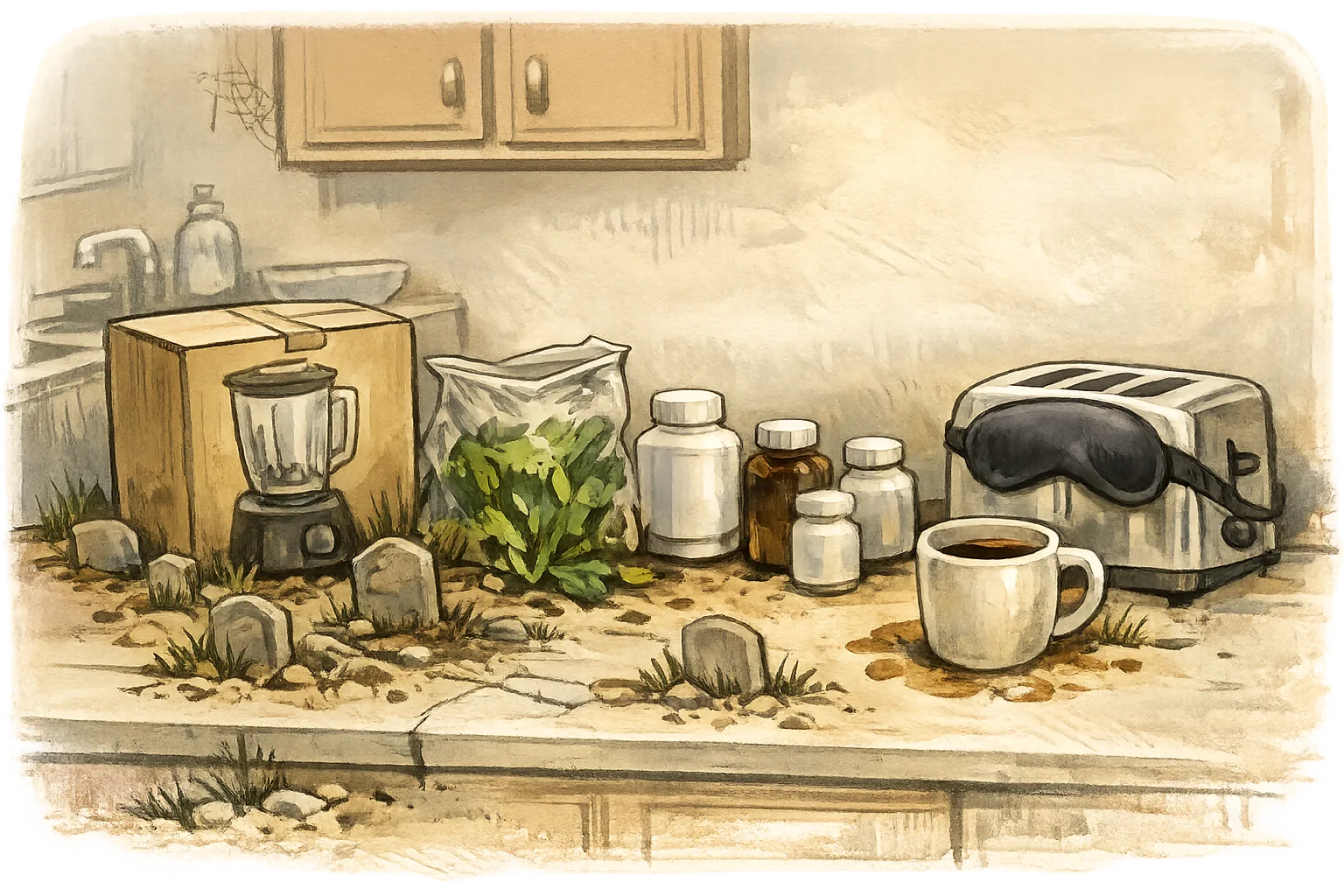
Borrowed energy with a 3pm invoice attached. It moves the crash, it doesn't cancel it.
More of the same naked chemicals. If one piano key didn't make music, a louder piano key won't either.
Single keys again, one at a time, hoping one of them turns out to be the song.
You genuinely tried, and the salad kit turned to soup in the crisper drawer while the blender stayed in its box. That isn't laziness. Nine out of ten adults land in exactly the same place.7
Earlier bedtime, no screens, the whole routine. You get your eight hours and you still wake up flat.
Look at that list and you'll notice something.
Every single one of them was aimed at the wrong target.
You were adding chemicals and minutes and habits, when the thing missing from your body was plants.
The Old-World Turn: What The Healthy Elders All Had In Common
For thirty years I've gone looking for the people who aged well without medicine.
Amish kitchens, village grandmothers, farm families still working the fields in their eighties.
I kept expecting to find a secret herb, some rare root nobody had heard of.
That isn't what I found.
What I found was breadth.
Their food wasn't exotic, it was WIDE.
Greens and roots and cabbages and berries and herbs, all of it, every day, in small amounts, out of a garden thirty feet from the door.
They never got a megadose of anything.
They got a little bit of everything, constantly, for eighty years.

That's the thing modern nutrition kept trying to bottle one key at a time.
And it's the thing we built Old World Greens around.
The Full-Garden Effect
This is the mechanism, and it runs in three steps.
I named it the Full-Garden Effect, because that's the honest description of what happens when you stop taking pieces of plants and start taking whole ones.
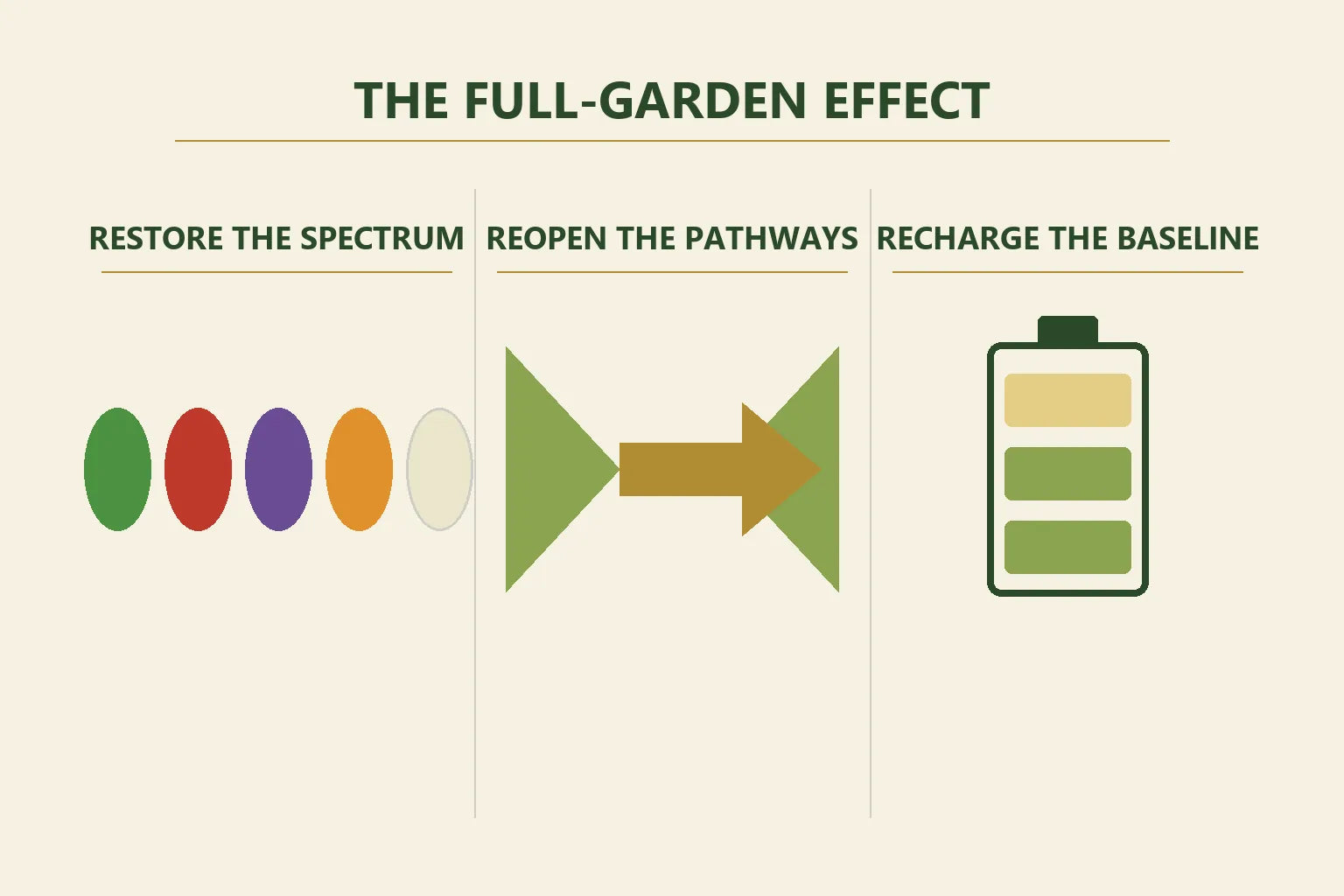
Step 1: RESTORE THE SPECTRUM
Your body doesn't run on one plant, it runs on the whole color wheel.
Greens carry chlorophyll and the cabbage-family compounds.
The reds and purples bring lycopene and anthocyanins, and the oranges bring the carotenoids.
Each color family does a different job, which is exactly why the shortfall shows up in every color category.8
So step one isn't a hero ingredient, step one is coverage.
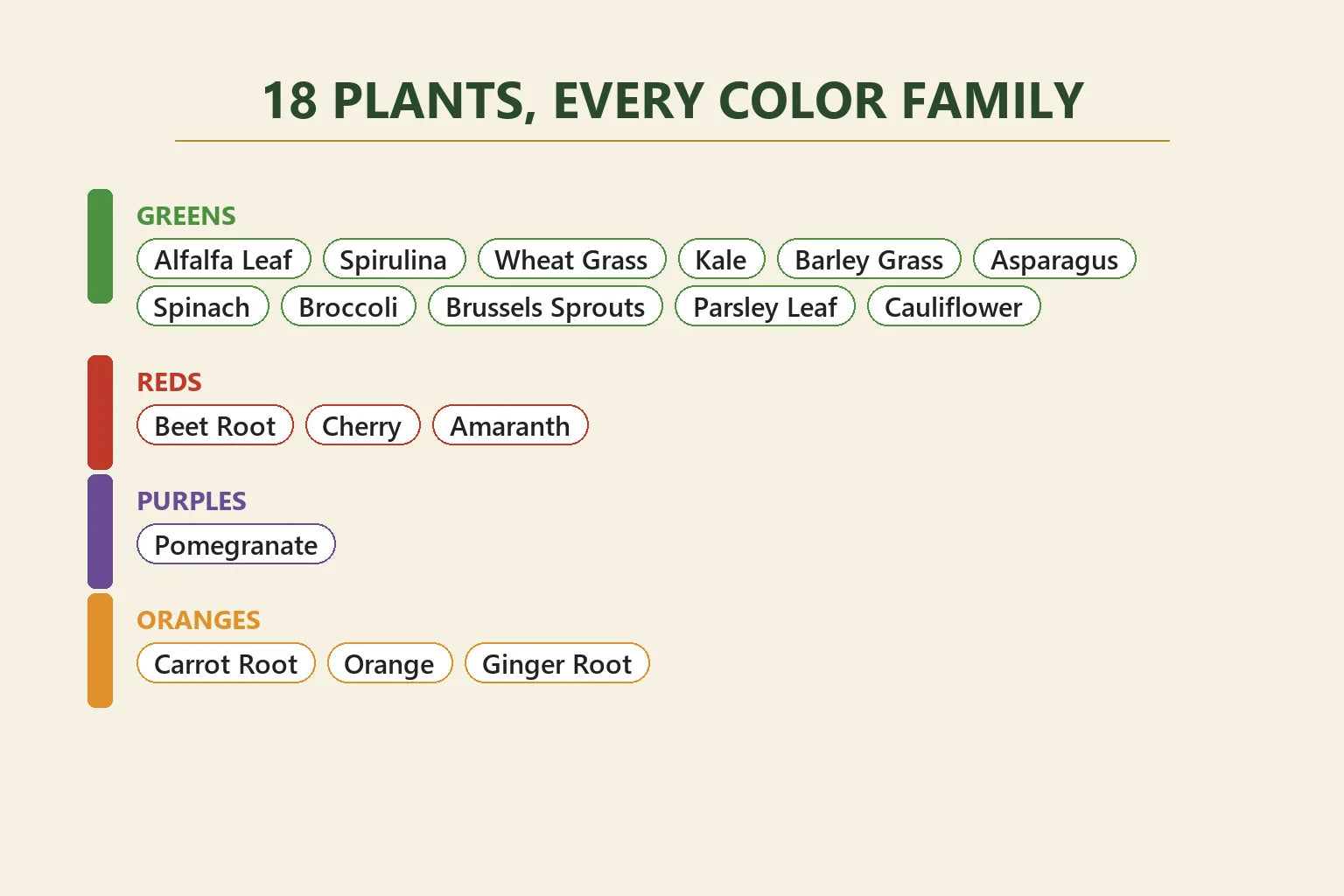
Eighteen whole plants, dried and concentrated, across every color family, with the plant left on.
And the reason coverage matters isn't philosophy, it's mortality data.
Researchers followed more than 100,000 adults and backed it up with a meta-analysis covering 1.89 million people.9
Eating about five servings of fruits and vegetables a day instead of two was linked to 13% lower total mortality.9
Linked to, not caused by.
That's an observation and not a promise, and I'll always tell you which one I'm handing you.
Step 2: REOPEN THE PATHWAYS
This is my favorite part, because it's the one nobody tells you about after fifty.
Your body makes a signal called nitric oxide, and its job is to tell the walls of your blood vessels to relax and open up.
Open vessels means more oxygen reaching more muscle and more brain.
Here's the catch.
Your body makes less of that signal every decade you live.
You don't feel that as a symptom. You feel it as "I just don't have the get up and go I used to."
Where does the raw material come from?
Nitrate-rich plants like beet root and spinach.
In sixteen randomized trials pooled together, concentrated beet nitrate lowered systolic blood pressure by about 4.4 points.10
A later analysis across 34 studies found the same effect, plus better blood vessel function.11
Read that number as research, not as a promise about a jar.
Those trials used concentrated beet doses far above anything in a greens blend.
I'm showing you why the plant family matters, not claiming your daily scoop does what a research dose does.
I'd rather lose the sale than blur that line.
Then there's the second pathway, and this one a multivitamin structurally cannot touch.
Broccoli, kale, brussels sprouts and cauliflower carry compounds called glucosinolates.
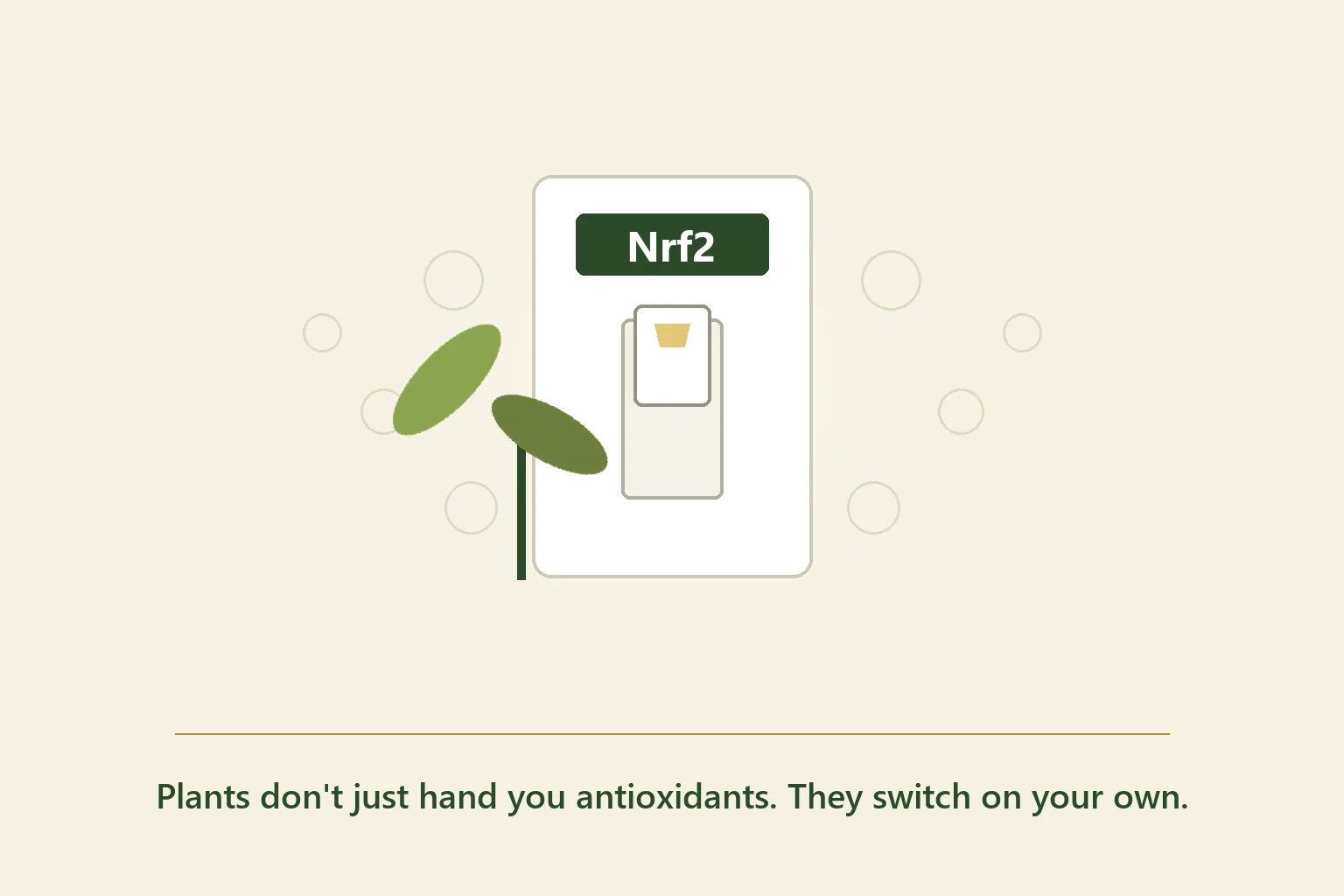
Your body converts them into sulforaphane, which flips a switch called Nrf2.
And Nrf2 is not an antioxidant.
Nrf2 is the switch that tells your body to build its OWN antioxidant and defense enzymes.
More than twenty clinical trials of broccoli-sprout preparations show that switch getting flipped.12
Think about what that means for a second.
A vitamin pill imports antioxidants one at a time, in whatever amount the label says.
A plant hands your body the instruction to make its own, on its own schedule, for as long as you keep eating plants.
That's not a small difference.
That's the difference between being handed a fish and being handed the boat.
Step 3: RECHARGE THE BASELINE
The best-studied plant in the blend is spirulina.
In a randomized, double-blind, placebo-controlled trial, people taking spirulina performed better on a mental fatigue test within four hours, and again at eight weeks.13
An umbrella review pulling together twelve separate meta-analyses of randomized trials found effects across blood fats, blood pressure and immune measures.14
A separate dose-response meta-analysis found lower triglycerides and lower total cholesterol.15
Same rule as before, because I'm not going to move the goalposts halfway down the page.
Those trials used gram-level doses, and this is a blend rather than a spirulina megadose.
Which brings me to the objection you should be shouting at your screen right now.
"Fine. But How Much Of Each Plant Is Actually In There?"
Good.
Ask that question of every greens brand you ever look at.
Here's my straight answer.
Old World Greens is a 2410mg blend across 18 plants.
That's a concentrated foundation of whole plants.
It's not a megadose of any one of them, and I'll never tell you it is.
So the fair question is this: can a modest amount of many whole plants actually do anything inside a real human body?
That's been tested, and it's the single most important piece of evidence on this page.
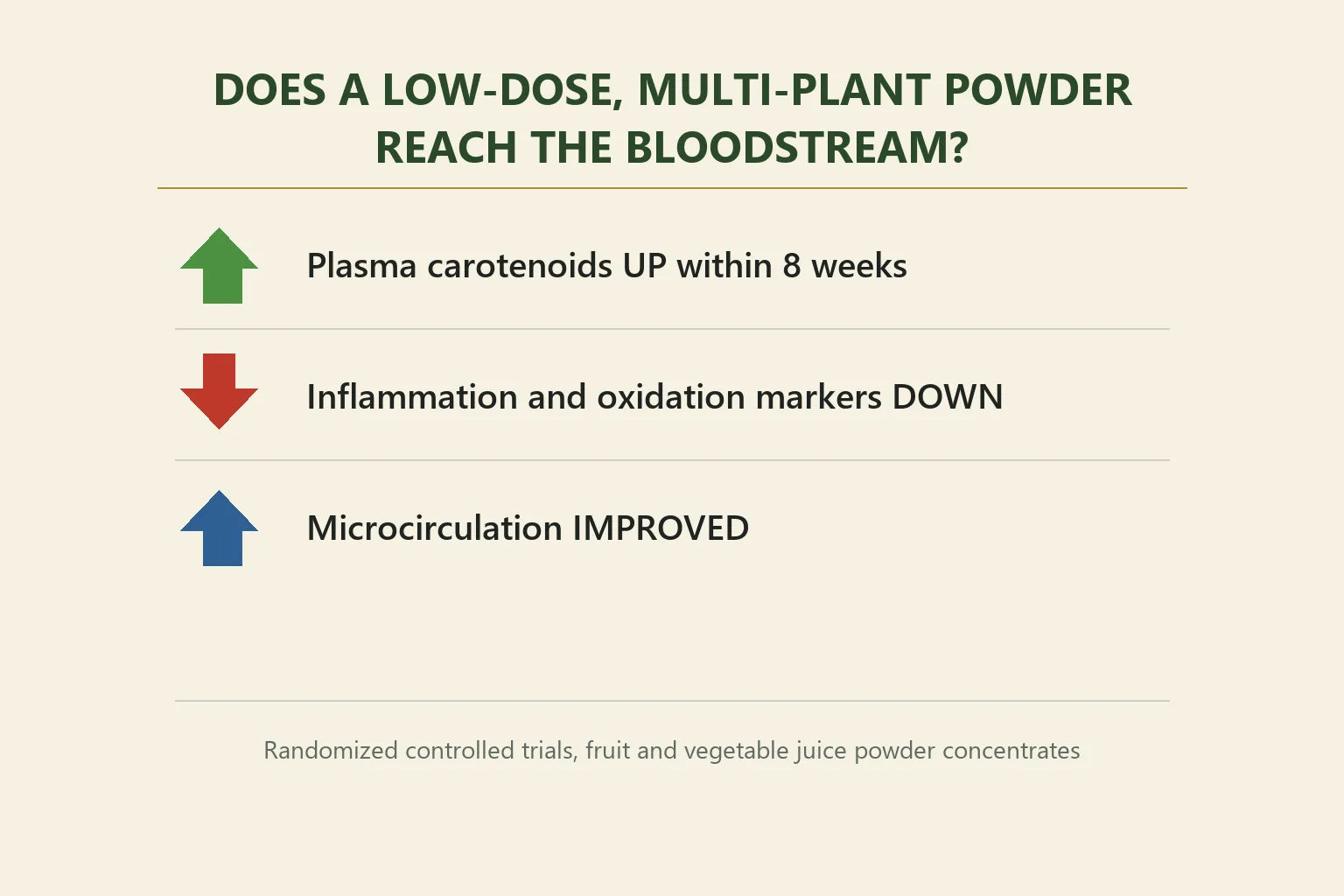
Researchers took encapsulated fruit and vegetable juice powder concentrates and ran them in randomized controlled trials.
Same product class as this one: low dose, multi-plant, powdered.
Blood carotenoid levels rose within eight weeks.16
Inflammation markers came down, along with LDL and markers of oxidation.17
And in separate trials, the tiny vessels that feed your muscles worked measurably better.18
That's the whole ballgame.
Whole-plant concentrate, in modest amounts, showed up in people's blood and changed what was measurable there.
The isolated pill, at 100% of every RDA, ran for three and a half years on 21,442 people and didn't move the outcomes that count.1
Breadth beat potency.
Which, if you'd asked my great-grandmother, was never really in question.
So Here's What We Made
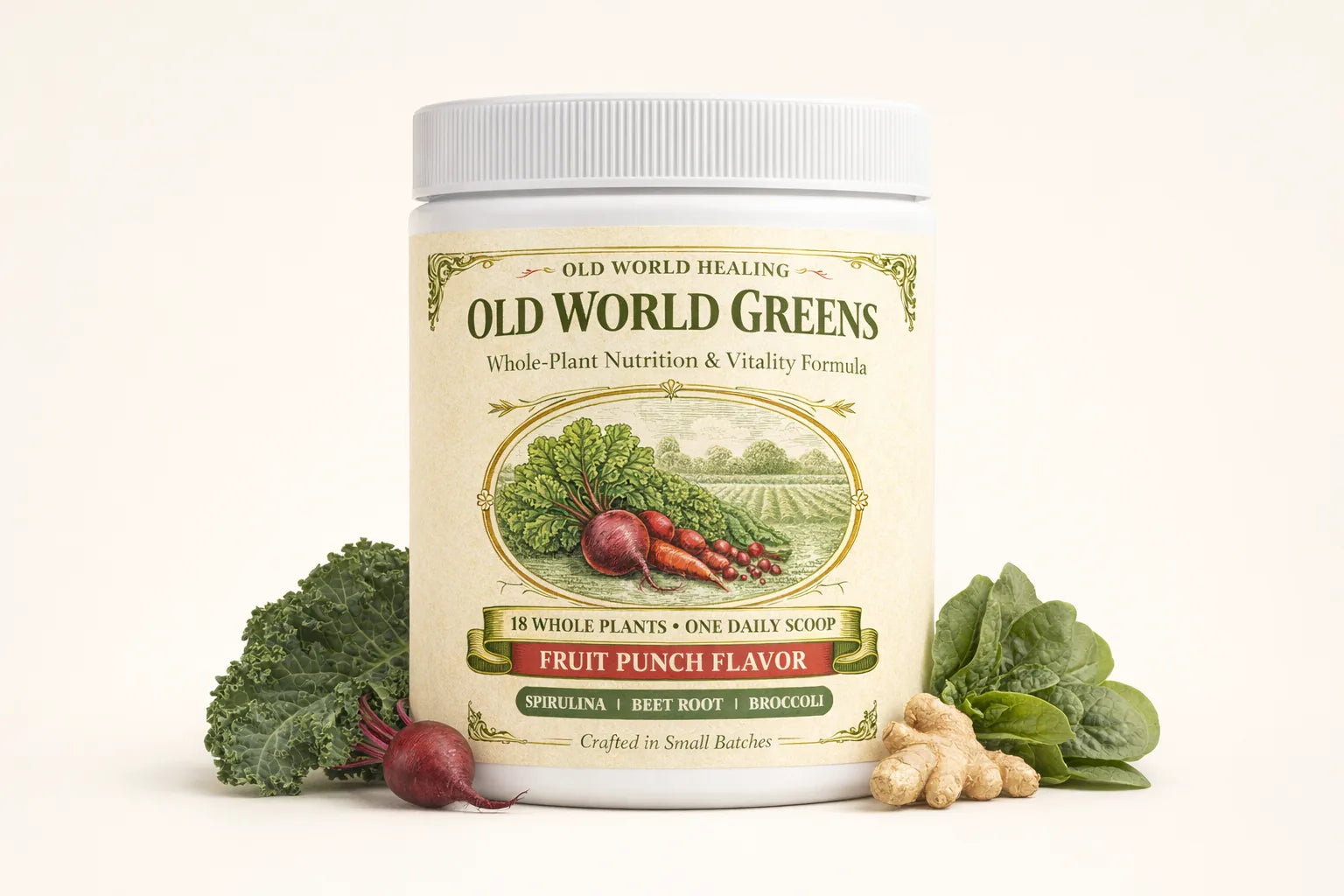
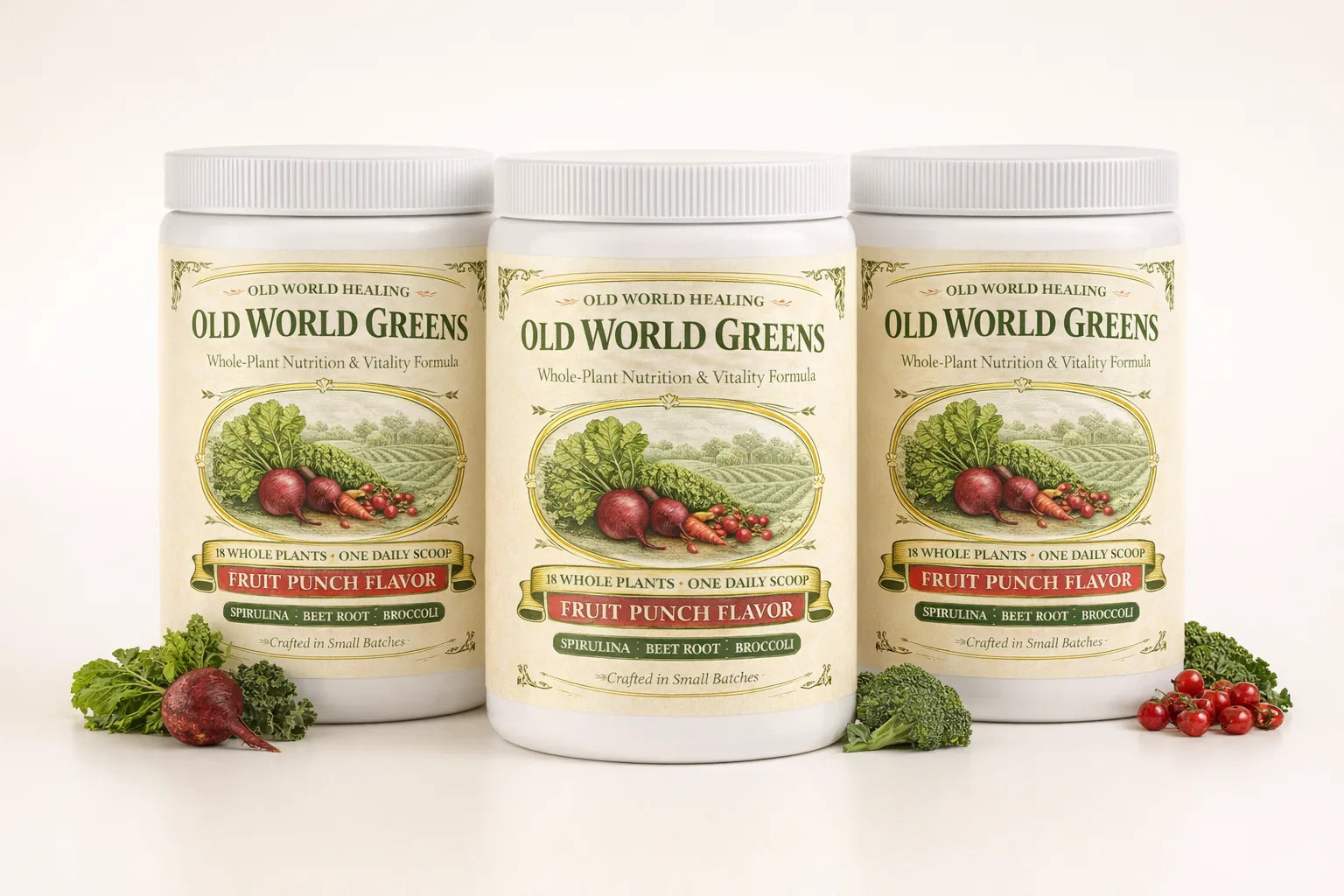
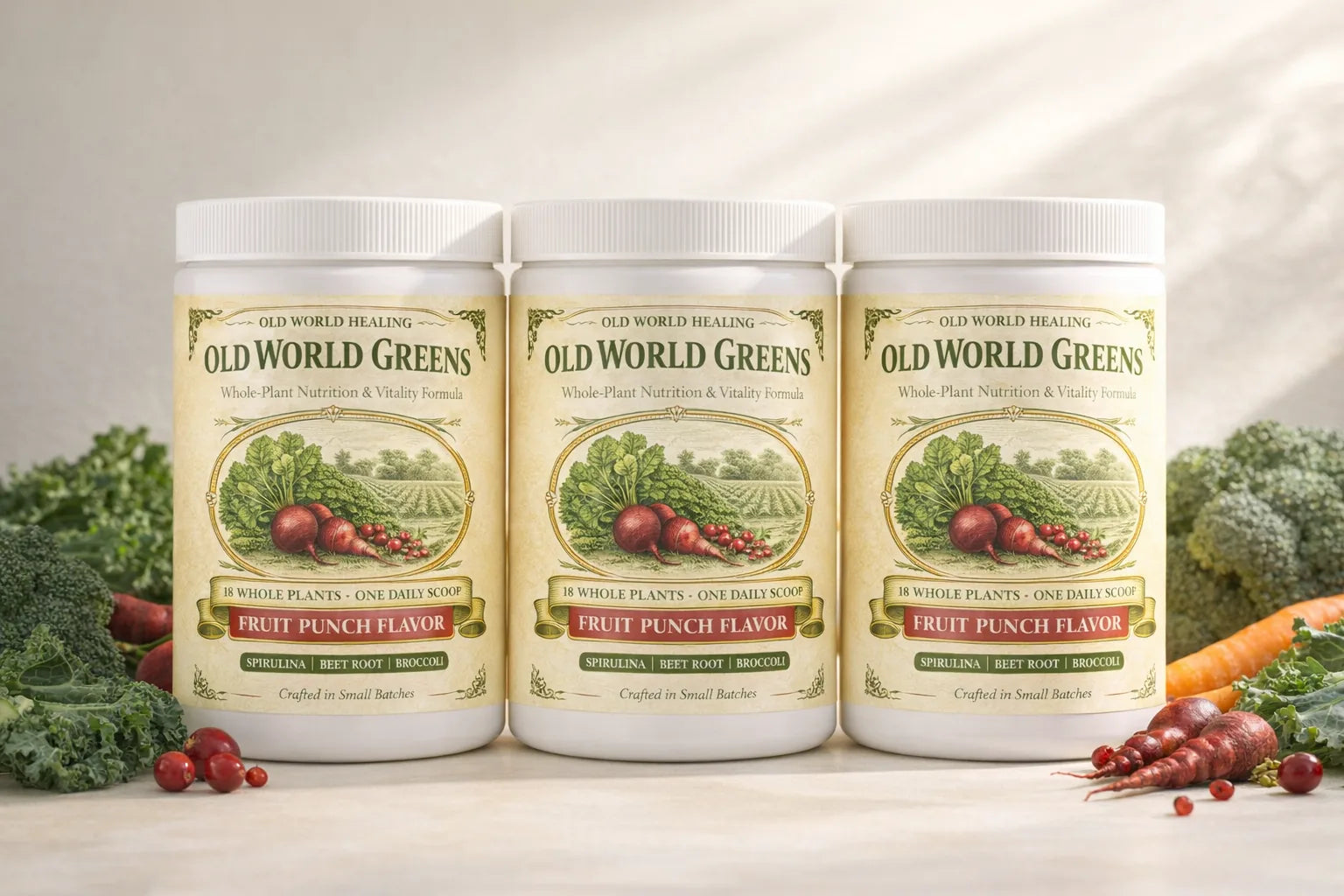
Old World Greens.
Eighteen whole plants in one daily scoop.
Alfalfa leaf, spirulina, wheat grass, kale, barley grass, asparagus, spinach and broccoli.
Organic beet root, cherry fruit, carrot root, pomegranate juice powder and orange fruit.
Amaranthus spinosus, parsley leaf, brussels sprouts, cauliflower and ginger root.
Greens, reds, purples and oranges.
The whole color wheel, cofactors intact, with the plant left on.
This isn't another exotic superfood list with a mushroom nobody can pronounce.
It's built to do one specific job.
It's what your multivitamin was supposed to be.
And it takes the exact spot on your counter the vitamin bottle used to hold.
Same morning, same routine.
We're not asking you to build a new habit at sixty-three, we're asking you to swap what's in the old one.
One scoop, 3.4 grams, stirred into a glass of cold water.
It's fruit punch flavored, so it doesn't taste like a lawn clipping.
Same counter, same ninety seconds, and you're done.
Multivitamin vs Old World Greens
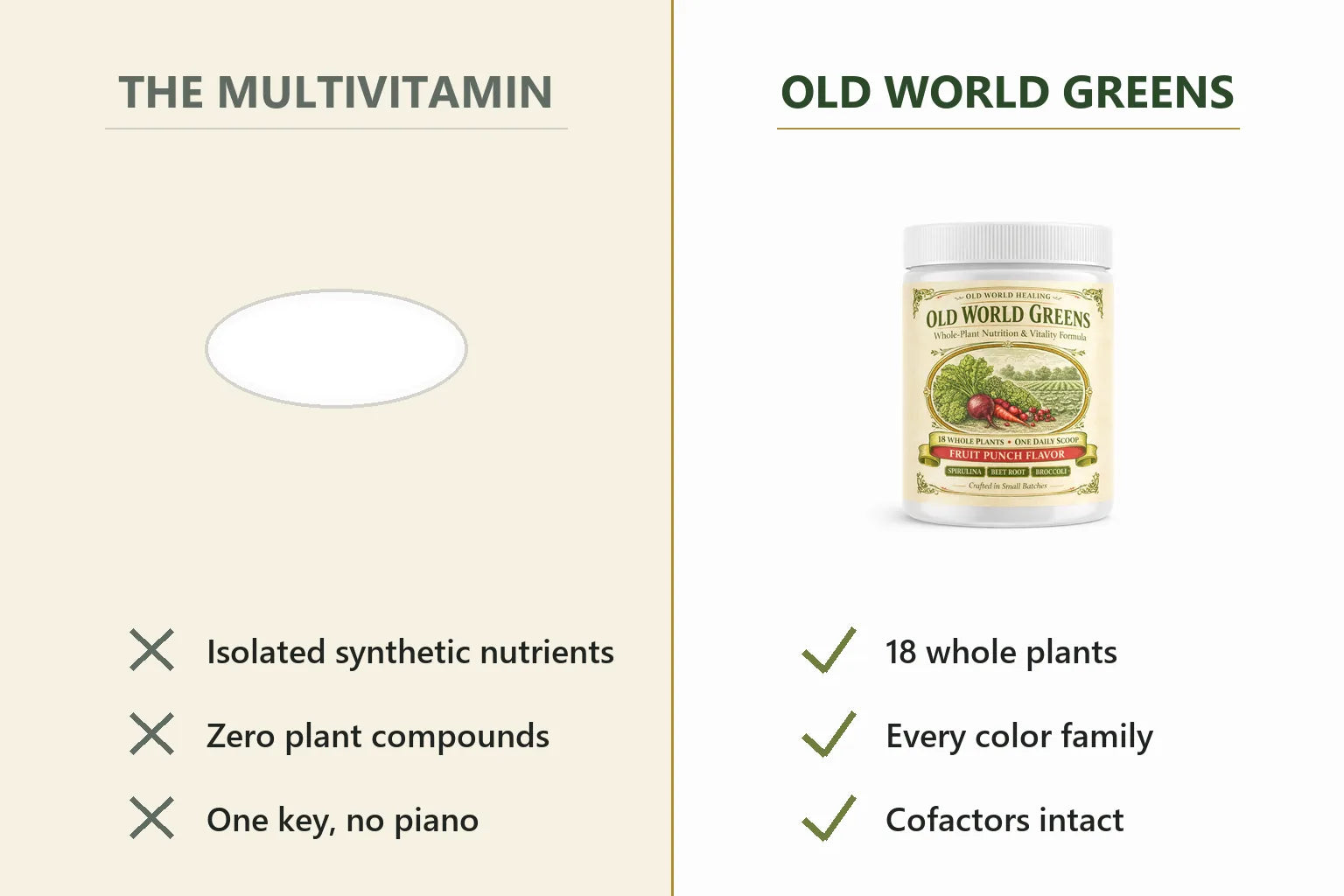
The multivitamin was built to fill in numbers on a chart.
Old World Greens was built to fill in the plants.
Those are two different jobs, and only one of them is the job your body has actually been asking for.
"But I Should Just Eat More Vegetables, Shouldn't I?"
Yes, please do.
I'm an herbalist, so I'm never going to tell you to skip the garden.
But let's be adults about it.
You've tried, and nine out of ten adults don't hit the target, year after year, survey after survey.7
Getting eighteen different plants into a real week, at a real price, with real cooking, is close to a part-time job.
This is eighteen plants in about ten seconds, on the mornings when the garden isn't going to happen.
Which, if you're honest, is most mornings.
"Aren't All Greens Powders The Same? I've Seen The Ads."
You've seen a lot of them, and they're mostly selling the same thing: a long exotic ingredient list and a vague promise about gut health.
That's a fine product category. It's just a different job.
Old World Greens was built for a specific person: someone over fifty who takes a multivitamin every morning, does everything right, and is still worn out by mid-afternoon.
It exists to replace the naked pill, not to sit next to it as supplement number seven.
"My Doctor Never Mentioned Any Of This."
Fair, and important.
But notice who my witnesses are on this page.
My witnesses here are the Annals of Internal Medicine,2 JAMA3 and a Harvard teaching hospital's own trial.1
I'm not standing against your doctor here. I'm quoting the journals your doctor reads.
And to be perfectly clear: nothing on this page replaces anything your doctor has you on.
No plant on earth is a substitute for medical care, so keep your appointments and keep your prescriptions.
What This Actually Looks Like In A Real Week

Nobody wakes up on day three feeling twenty-five, and I'd be lying if I promised that.
What people describe is quieter and, frankly, more useful.
The wall at three o'clock stops arriving on schedule.
The evening stops ending at 8:30 on the couch by default.
And you say yes to the afternoon thing instead of doing arithmetic on whether you'll have the battery for it.
One evening you look up and the light's nearly gone and you've been out in the garden for two hours.
And not once in those two hours did you think about how tired you were.
That's the whole promise, and it's a big one. Your afternoons, back in your hands.
A Note On Proof
You may already know us.
Old World Healing started with Old World Relief, our topical cream.
More than 47,000 jars have gone out the door, with a 4.8 rating and over 2,800 five-star reviews.
Old World Greens is new, so the accounts below are illustrative rather than customer reviews.
A Few Stories From People Who Made The Swap

Illustrative accounts, not reviews from verified purchasers.
"I kept the bottle on the counter for a month after I stopped taking it, like a little monument. Twenty-two years of mornings. The part that got me wasn't the tiredness, it was finding out the case had been closed in a journal back in 2013 and nobody thought to mention it. I'm on my third month of the greens now. My afternoons are mine again, and I'm still a little sore about the twenty-two years."
Carol H., 63, Ohio
"My wife ordered it and just put it in front of me, which is how most things get into my routine. I'm not the type to read the studies. What I noticed is I stopped falling asleep in the chair after supper. My daughter asked me what I was doing different, so I guess that's something."
Dale W., 68, Missouri
"I've got a pill organizer the size of a tackle box, and what I wanted was fewer things on the counter, not more. This is the one I actually kept, and it's the only one where I can tell you what it's for and why. Eighteen plants. My mother would have called that supper."
Frank L., 72, Pennsylvania
"I'm still working at 58 and the workday was outlasting me by about two hours. Not dramatic, just done. The change has been gradual and I almost didn't notice until my husband pointed out I'd been out in the garden until dark three nights running. I hadn't done that in years."
Roberta S., 58, Oregon
Individual results may vary.
Your Offer Today
You can subscribe to Old World Greens, or you can buy it one time.
A subscription takes $10 off every single month, and a longer supply takes off more on top of that.
| Supply | One-time | Subscribe & Save | Per month subscribed |
|---|---|---|---|
| 1 month One tub, 30 scoops, ships every 4 weeks |
$79 | $69 | $69.00 |
| 2 months Two tubs, ships every 8 weeks |
$148 | $128 | $64.00 |
| 3 months Three tubs, ships every 12 weeks |
$213 | $183 | $61.00 |
Free shipping on every order, subscription and one-time alike.
A subscription ships every 30, 60 or 90 days at the same price you started on.
Cancel anytime before your next ship date, with no fee and no phone call.
Here's the comparison I'd want you to make before you decide.
Take whatever you've been spending on that multivitamin every ninety days for the last twenty years, and add it all up.
Then add what a separate greens habit would have cost you on top of it.
Then decide what eighteen actual plants are worth to you.
And you get ninety days to decide.
If it isn't working for you, email us inside those 90 days and we'll refund you in full.
You don't need to send the tub back.
Two Versions Of Next Spring
I want you to picture both of them honestly.

The first version: you close this page.
The bottle stays on the counter and you keep opening it every morning, because it's what you've always done.
Nothing gets worse quickly, and that's the trap.
It just keeps going the way it's been going, one quiet notch at a time, and next spring you decline the trip because the walking sounded like a lot.
Then you tell yourself it's just age, which is the sentence that ends the conversation every single time.
The second version: you swap what's in the ritual.
Same counter, same ninety seconds.
Except now eighteen plants go in instead of a handful of stripped chemicals.
You give it a real run, and you find out what your afternoons feel like when your body isn't running a plant deficit.
Next spring, you're the one organizing the trip.
The decision isn't dramatic, it's just which bottle sits on the counter.
A note from Mary:
Since this article went up, the same two questions keep landing in my inbox.
Yes, you can buy a single tub on its own without signing up for anything.
And yes, subscribing takes $10 off every month, with free shipping and the same 90-day guarantee either way.
Questions People Ask Me

The blend is 2410mg across 18 plants, and I'm not going to dress that up.
It's a concentrated foundation of eighteen whole plants, not a megadose of any one of them.
The reason I think that's the right design is the research on this exact product class.
Low-dose, multi-plant powdered concentrates raised blood carotenoid levels in randomized trials within eight weeks.16
Breadth is the point. If you want a gram of one plant, buy a gram of one plant.
That's a conversation for you and your doctor, and I mean that.
What I'd say is this: most people take a multivitamin to cover their bases, and the evidence that it covers them is thin.1 2
Old World Greens covers a different set of bases entirely, the ones no multivitamin can reach.
Most people describe a gradual change over two to four weeks rather than a switch flipping.
In the product-class research, blood carotenoid levels had risen by the eight-week mark.16
I'd give it a full month before you judge it, and results vary from person to person.
You should, and I hope you do.
But only about 1 in 10 adults actually hits the vegetable target.7
This is for the other nine mornings out of ten.
Ask your doctor or your pharmacist before you start.
That goes double if you're on a blood thinner, because leafy green plants naturally carry vitamin K.
I'd rather you make one phone call than guess, and nothing here replaces anything you've been prescribed.
Most of them are sold as exotic superfood lists.
This one was built for a specific person with a specific problem: you take a multivitamin every morning and you're still worn out by three.
Different job, different design.
It's fruit punch flavored.
One scoop, 3.4 grams, stirred into a glass of cold water in the morning.
That's the whole routine, and it takes about ten seconds.
You have 90 days.
If it isn't doing anything for you, email us inside that window and we'll refund the order in full.
You don't need to send the tub back, and there's no processing fee.
You can also cancel anytime before your next ship date, in your account, without a phone call.
One Last Thing Before You Go
You've taken care of yourself for a very long time.
You did the appointments and the walks and the sensible breakfast and the morning pill, all of it, without much thanks.
The only thing you got wrong was trusting a tool that had already been tested and quietly failed.
And you got that wrong because nobody told you.
Now you know.
P.S. If you remember one sentence off this whole page, make it this one.
You are not vitamin-deficient. You are plant-deficient.
Every dead end you've hit for the last five years makes sense the second you accept that, because every fix you tried was aimed at the wrong shortage.
P.P.S. The 21,442-person trial took three and a half years to hand back its answer.1
You don't have to wait three and a half years for yours.
Give the garden one month in the spot on the counter where the pill used to sit, and see what your afternoons do with it.