"I stirred that giant tub of collagen into my coffee every morning for a month and got nothing. Turns out my own body was throwing most of it in the trash."
After 50, Your Broken Collagen Starts Shutting Down The Cells That Make More
University of Michigan researchers watched it happen under a microscope, and it finally explains why your nails, your hair and your knees all changed inside the same two years.
That same discovery also explains why one type of collagen was never going to be enough...
And why, without ONE cheap nutrient that most powders leave out completely, you pee the collagen you paid for straight into the toilet...
Get all three right and you're working toward nails that grow past your fingertips again, hair with some weight back in it, and stairs you take without reaching for the rail.
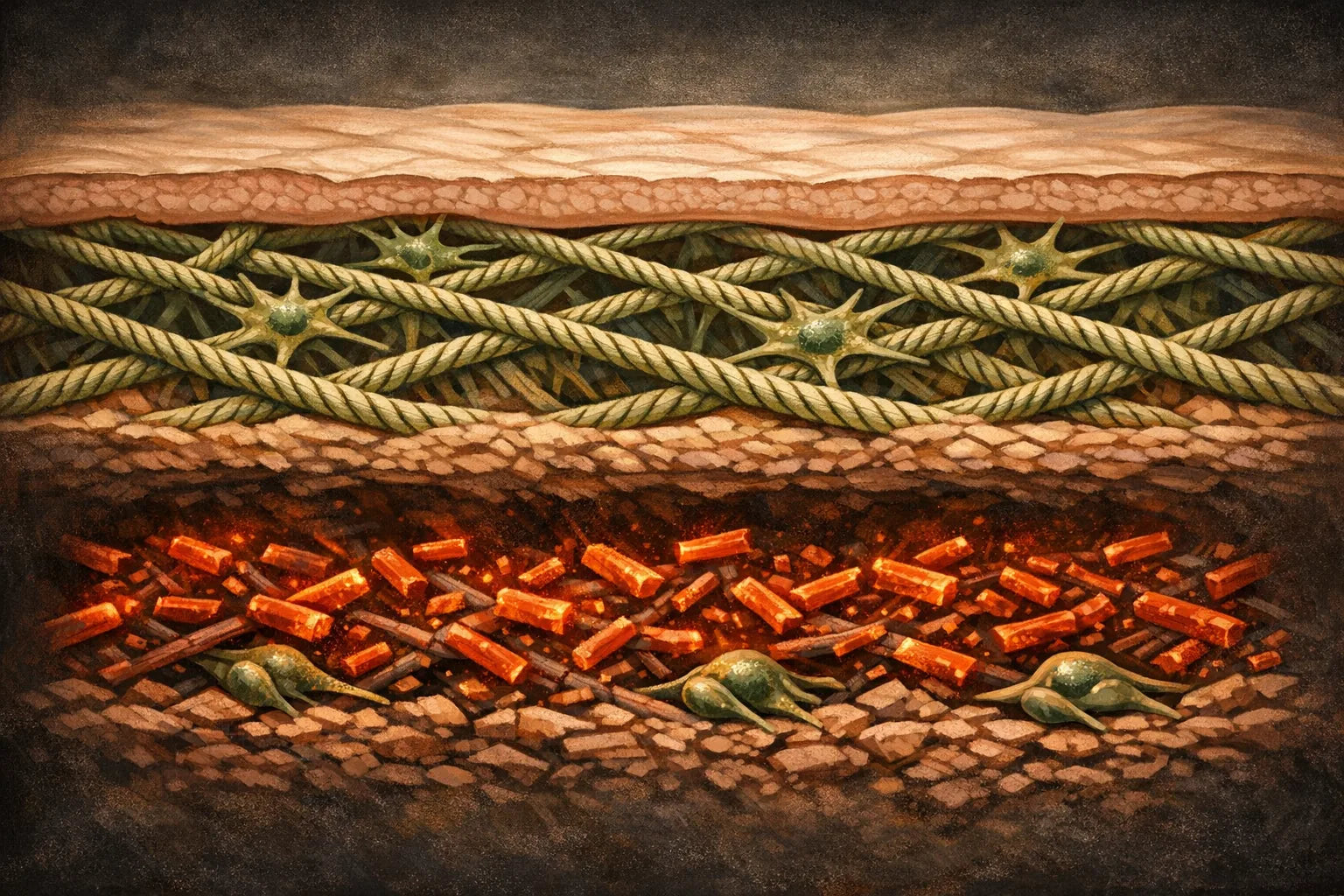
Your body doesn't just make less collagen after 50.
The collagen you already have starts breaking into fragments.
And the fragments are the real problem.
Here's the part almost nobody has been told.
The cells that build your collagen don't float around loose in there.
They hold onto the collagen fibers around them like a worker gripping a rope.
That grip is the whole thing.
It's what keeps the cell stretched open and switched on and building.
So what happens when the rope snaps?
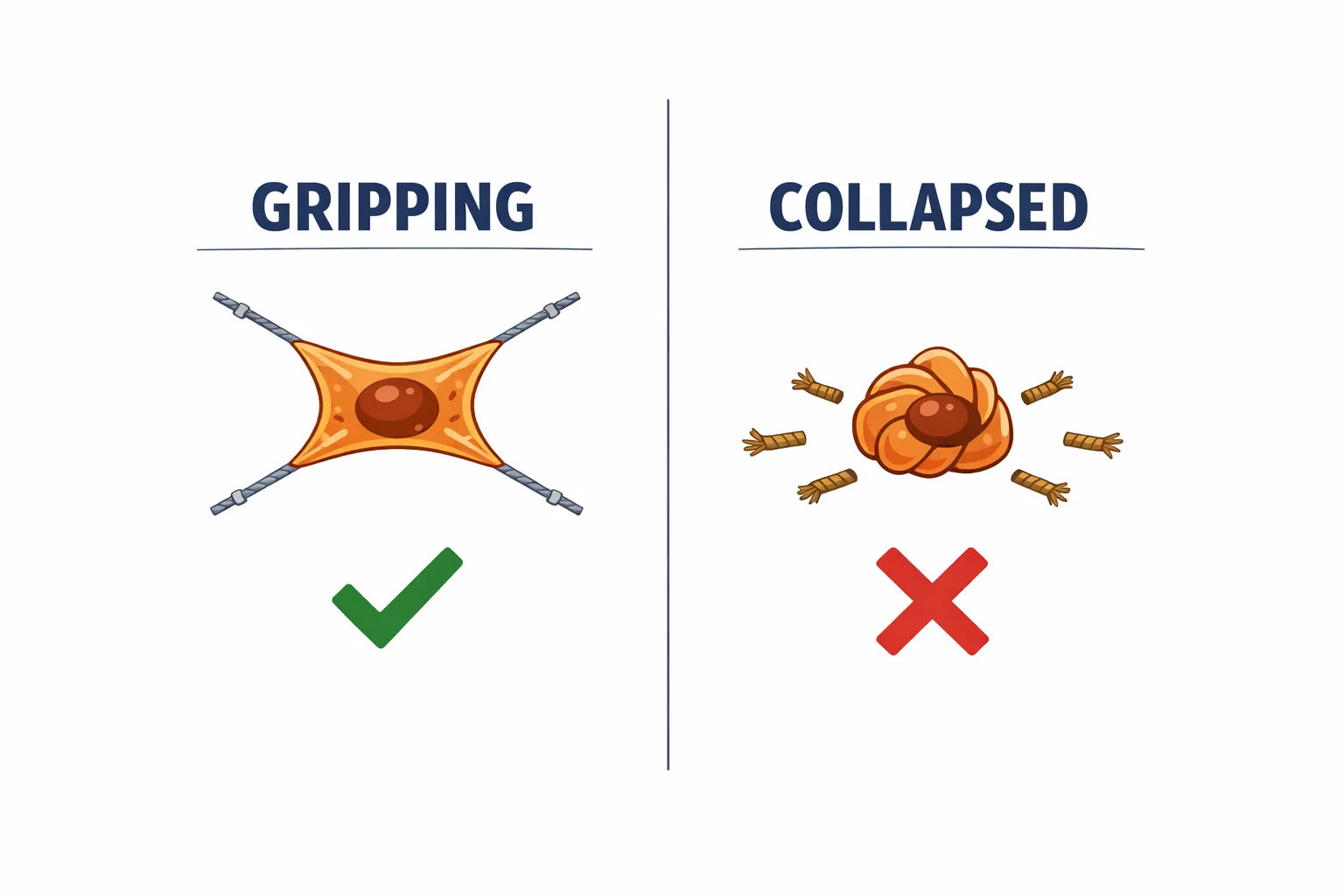
The cell lets go.
Then it folds in on itself, like a hand closing.
And a folded cell does two things that should make you angry.
It nearly stops making new collagen.
Then it starts pumping out MORE of the enzymes that chew the old collagen apart.
Read that again.
The damage starts making more damage.
The dermatology researchers at the University of Michigan who documented this called it "a self-perpetuating, never-ending deleterious cycle."3
In plain English: the less collagen you have, the less your body can make.
That's why waiting has been the worst possible move.
Every year you left it alone, the base you'd have to rebuild from got smaller.
I'm going to give this problem its name in a minute, and then show you the three-part system that interrupts it.
But first you need the second half of the story, because on its own it made me want to throw something.
Most Of The Collagen People Swallow Never Becomes Collagen
My name is Mary Miller.
I'm an herbalist and a natural health researcher, and we started Old World Healing to bring back the remedies that worked long before anybody could explain why they worked.

I've spent the last two years buried in collagen research, and I'm going to be blunt with you about what I found.
Most collagen supplements on the shelf right now are set up to fail before you ever open them.
Not because collagen doesn't work.
Because of what they leave out.
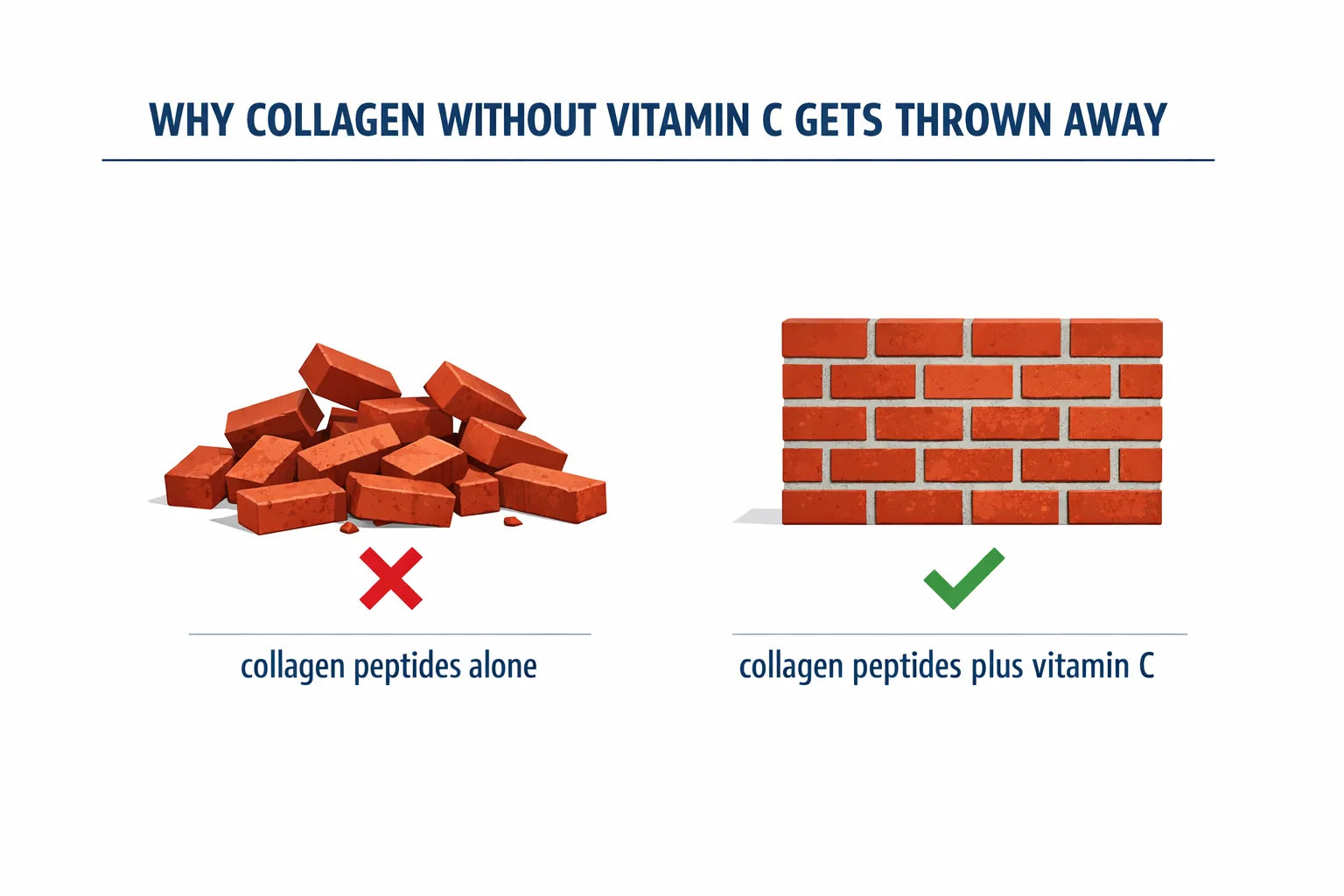
Your body doesn't install collagen the way a bricklayer stacks bricks.
Every strand has to be folded into a three-strand braid, and then those braids have to be welded to each other.
Two enzymes do the folding and the welding.
And neither enzyme will start without vitamin C.
No vitamin C, no braid.
No braid, and your body flags the half-built strand as junk and gets rid of it.
You bought the collagen.
You drank the collagen.
Then you peed the collagen into the toilet.
That's not a metaphor I made up to sell you something, by the way.
That's exactly what scurvy is, taken to its extreme: a body full of protein that can't finish a single strand of collagen.
There's a 1981 study out of PNAS that made my jaw drop when I read it.
Researchers gave human collagen-making cells a steady supply of vitamin C.
Those cells produced roughly EIGHT TIMES more collagen than the ones without it.4
Eight times.
And it came from a nutrient that costs pennies.
Now go look at the back of whatever collagen you have in the cupboard right now.
I'll wait.
Most of them contain zero vitamin C.
Not a little. None.
So the tub you gave up on may have worked perfectly well as a raw material, and your body still binned most of it, because you never gave it the one thing it needed to finish the job.
You didn't fail collagen. The formula failed the biochemistry.
It Wasn't Gradual, And You Know It Wasn't
Let me say out loud the thing you've only said to the mirror.
It didn't creep up on you.
It felt like a switch got flipped.
Two or three years ago you looked like yourself, and then one afternoon you caught your forearm in the sunlight and the skin on it looked like crepe paper.
When did THAT happen?
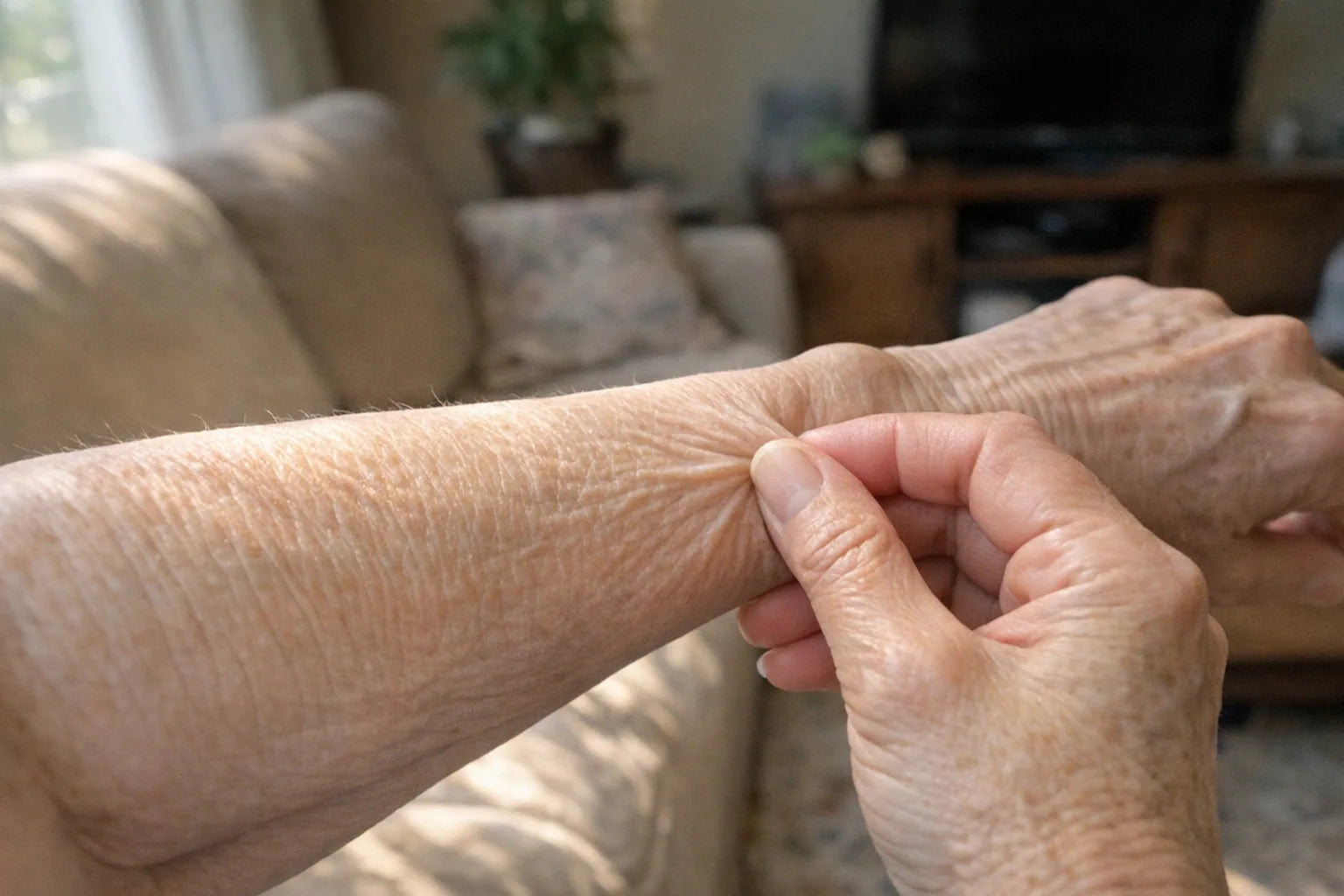
Your nails started coming off in layers instead of growing.
Your hair lost its weight, and the drain started catching more of it than your brush does.
And the stairs started having opinions.
You hold the rail now.
You never used to hold the rail.
Then, because you're a reasonable person, you told everybody the reasonable thing.
"Oh, I'm just getting older."
But that is the daytime version of you talking.
The 3am version tells a different story.
Because at 3am your hands wake you up first, that dull ache down in the knuckles, and you lie there in the dark waiting for it to settle.
And while you're waiting, you start doing the math.
You're fifty-eight.
Your mother's hands looked like this when she was seventy.
So you run the numbers forward and you land on a year, and the year is a lot closer than you'd like, and your mouth goes dry.
Then you think about the reunion in June, and who exactly is going to be there.
You've started choosing sleeves without ever admitting to yourself that's what you're doing.
And there's that photo from the christening you deleted off your phone without telling a single person why.
And the thought underneath all of it, the one you would never say out loud at a dinner table, is not "this hurts."
It's "this only goes one way now."
Hold onto that thought, because further down this page I'm going to show you why it's wrong.
Here's what I need you to hear before we go one step further.
It isn't your imagination, and it isn't neglect, and it isn't that you drank too little water in 1998.
It's a specific, measured, documented process.
It has three stages, and once you can see all three, you can see exactly where to interrupt it.
The Problem Has A Name: Collagen Collapse
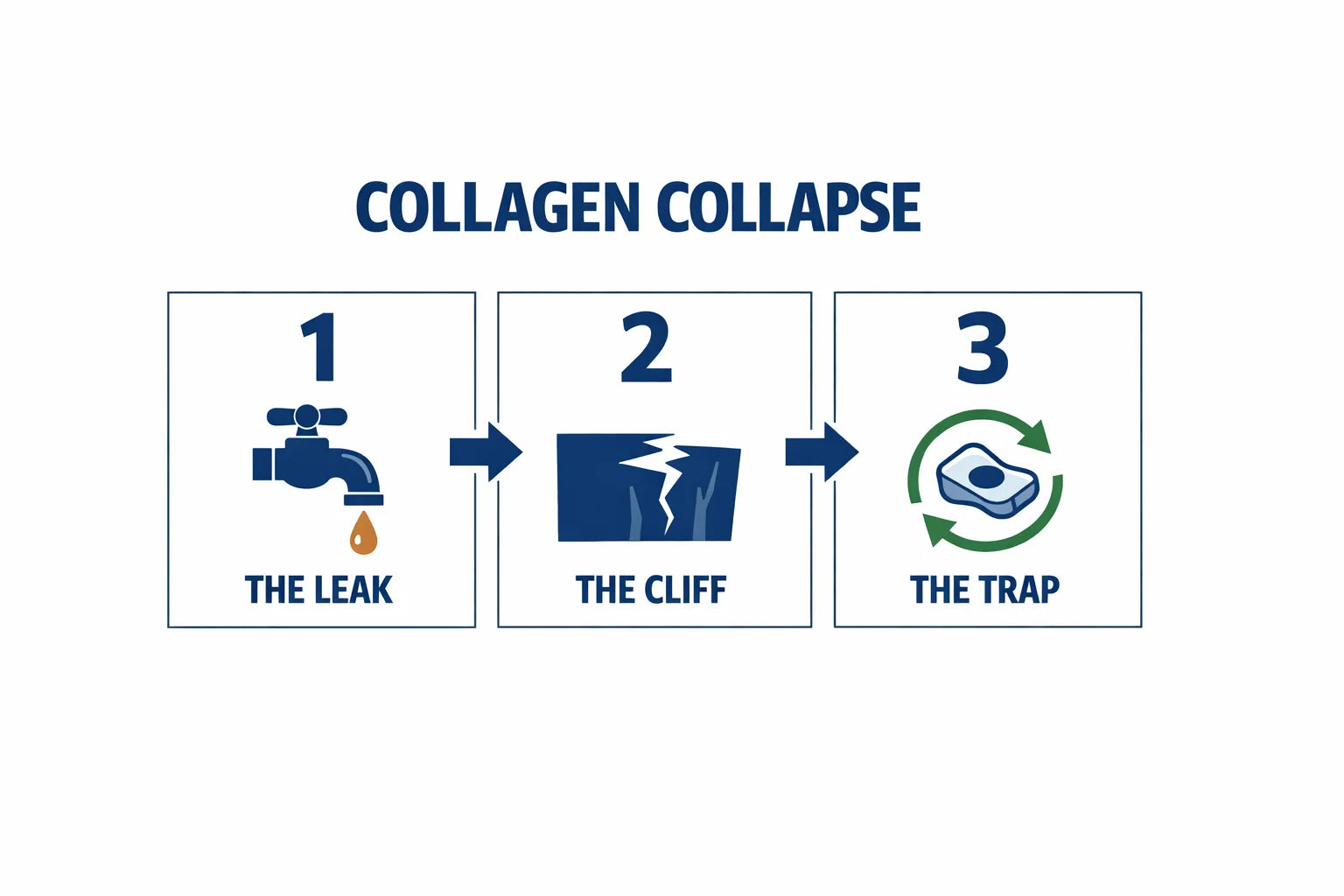
Three beats, and they get worse in order.
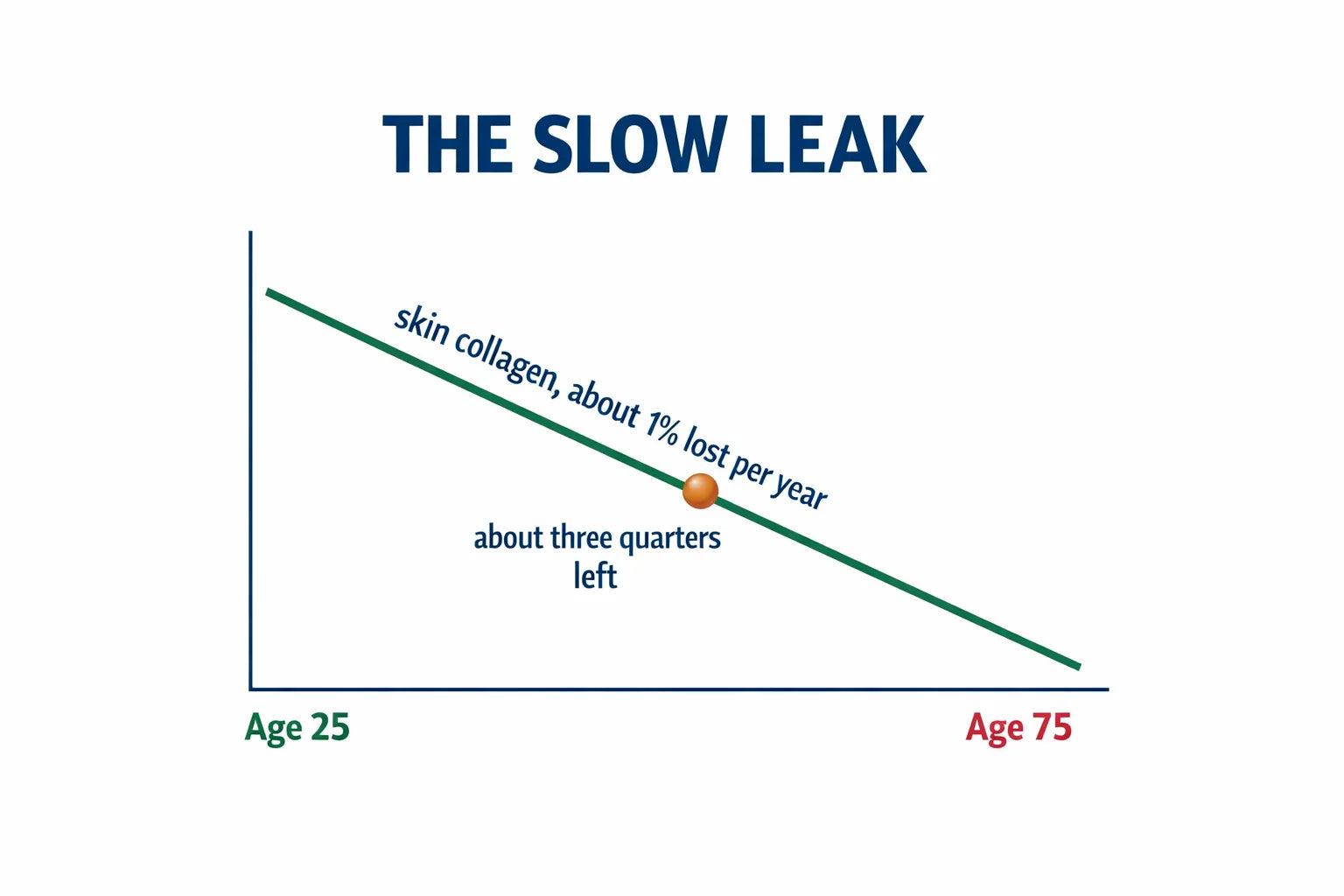
Beat one: the slow leak
Starting in your mid-twenties, your body makes about 1% less collagen every year.
That number comes from a 1975 study that measured skin collagen in 148 people between the ages of 15 and 93, and found the decline ran in a straight line.1
One percent sounds like nothing.
Run it from your mid-twenties to your fiftieth birthday and you're operating on roughly three-quarters of the collagen you were born to have.
That's the thinning skin, the fine lines that stopped bouncing back, and the knees that started narrating the stairs.
Silent, and happening to every single person reading this.
Beat two: the cliff
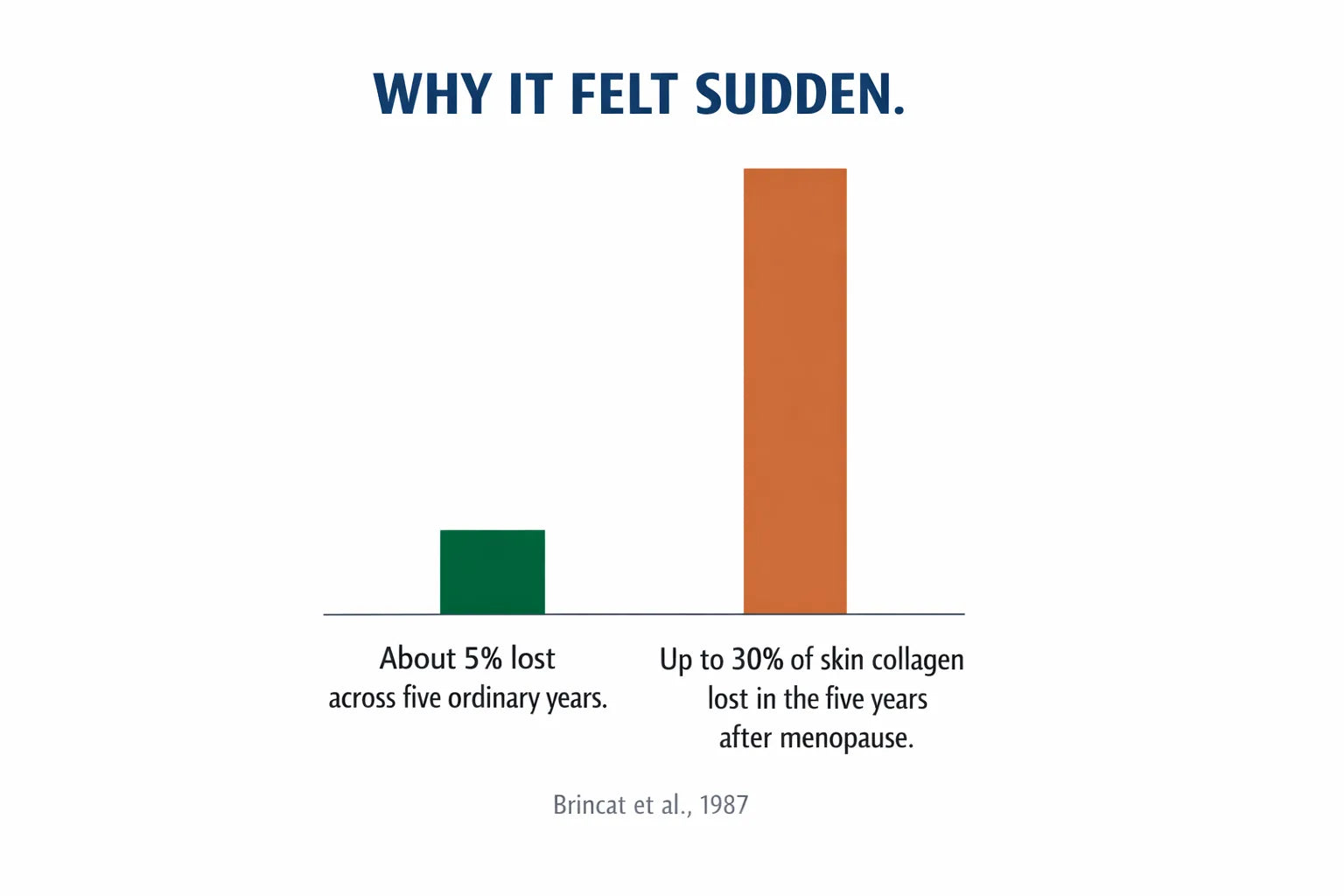
For women, menopause turns that slow leak into a rupture.
A 1987 study found that up to 30% of skin collagen is lost in the first FIVE YEARS after menopause.2
Thirty percent. In five years.
Compare that to one percent a year and you can see why the change felt like a switch instead of a slope.
If that's you, this is the sentence I most want you to read today: you did not do this to yourself.
That's documented biology, and it isn't a character flaw.
Beat three: the trap
This is the beat almost nobody knows, and it's the one that changes what you do next.
We already covered it up top, so I'll keep it short.
Old collagen doesn't politely fade away.
It shatters, and the cells that build your collagen lose their grip and collapse.
Collapsed cells build less and destroy more.3
The leak sets up the cliff, and then the trap starts feeding itself.
Leak, cliff, trap.
That's Collagen Collapse, and now you know why the phrase "it's just age" has been costing you actual years.
Collagen Collapse also explains something that has bothered you for years.
Why nothing you tried ever moved the needle.
Why Every Fix You've Tried Was Aimed At The Wrong Floor
The cream
You bought the jar with collagen in the name.
It felt lovely going on, and it changed nothing that lasted.
Here's why, and it's almost funny once you see it.
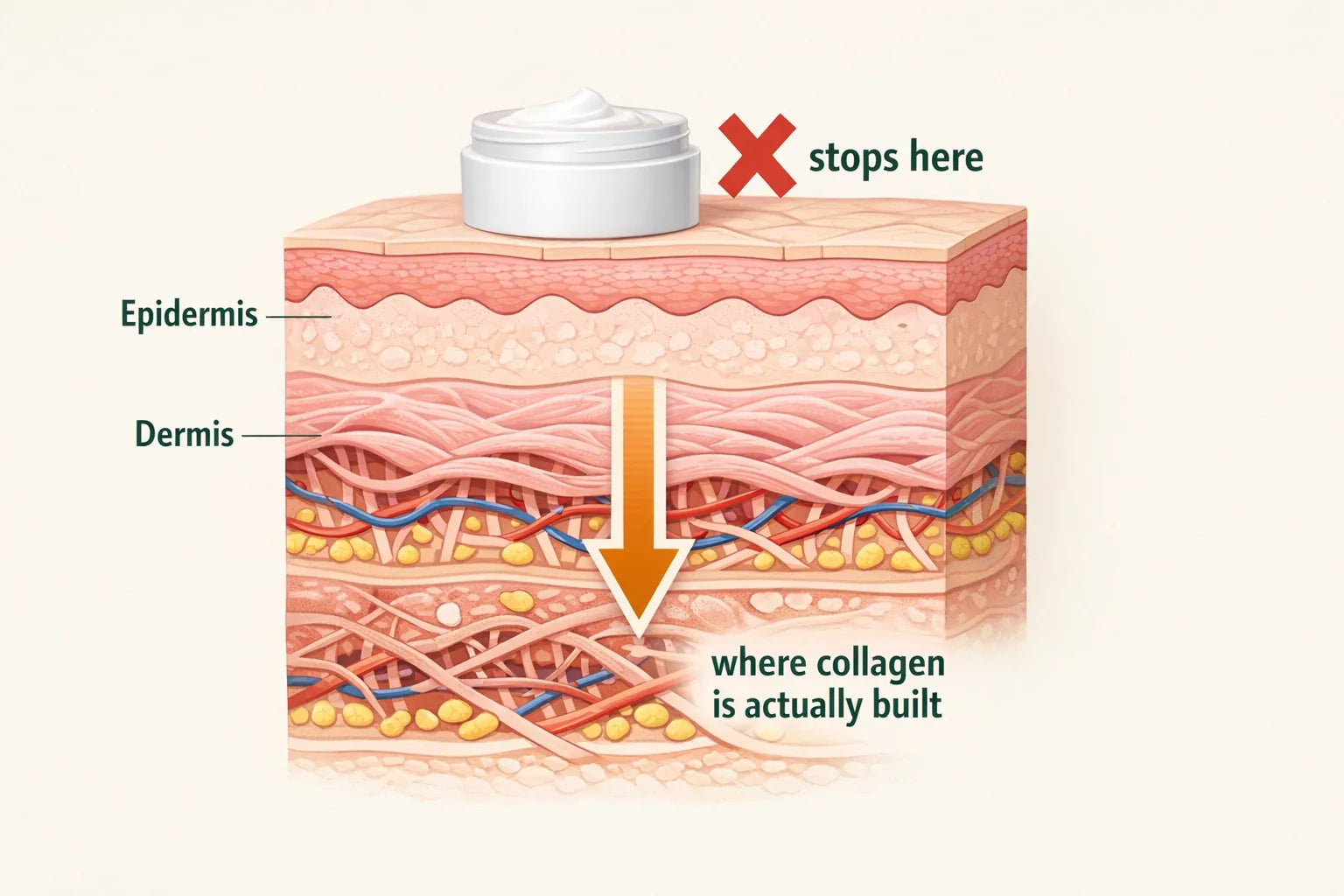
Collagen is made down in the dermis, the deeper layer.
A collagen molecule in a cream is far too big to travel down there, which means it sits on the top layer looking pretty.
You were putting a fresh coat of paint on a house with a cracked foundation.
The giant tub from the warehouse store
This is the one that did the most damage, because it's the one that made you decide collagen doesn't work on you.
Two things were wrong with that tub.
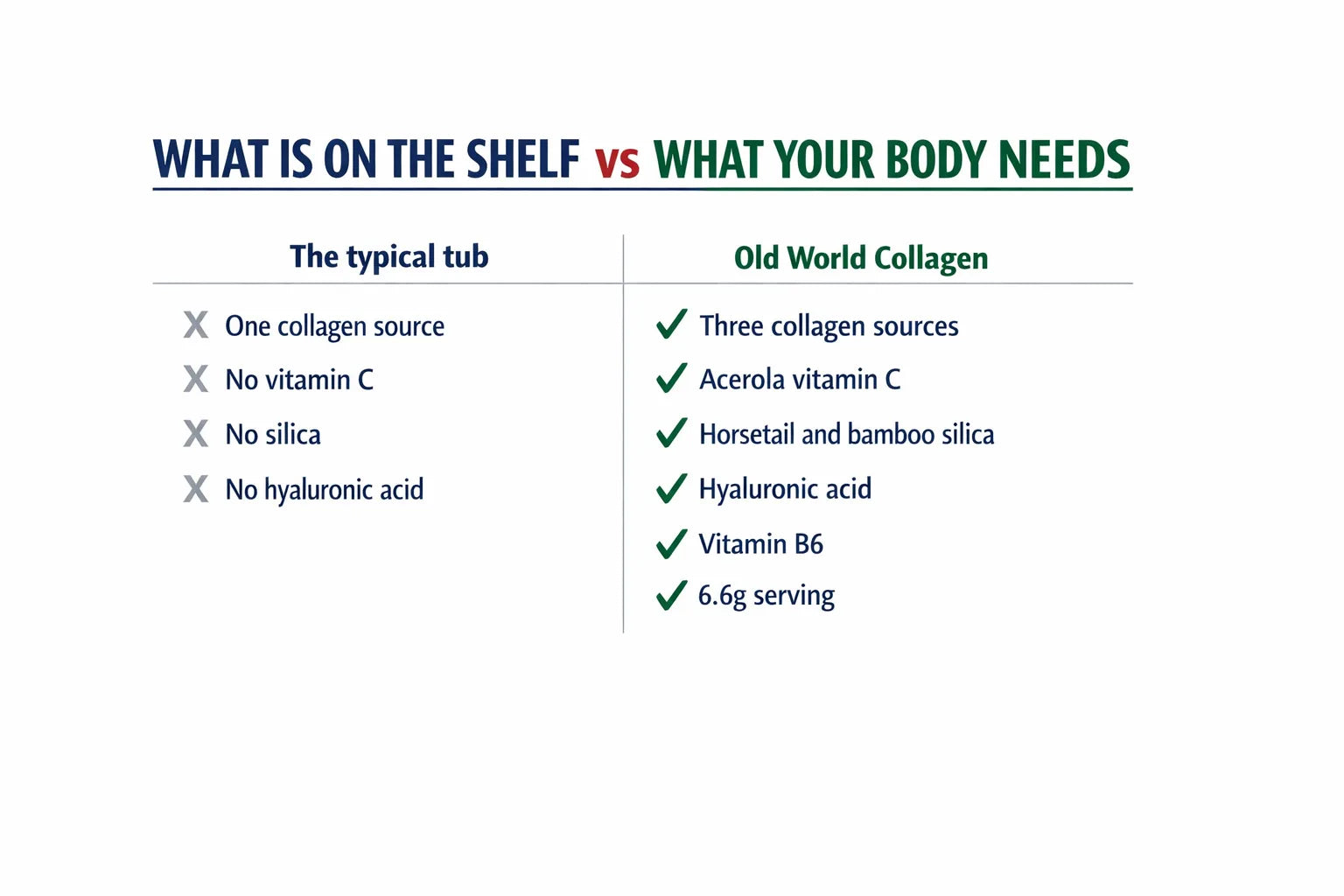
It had one collagen type in it, almost always bovine hide, because bovine hide is the cheapest raw material in the category.
And your body doesn't run on one type.
Your skin, your hair and your nails are built mostly from types I and III.
The cartilage in your knees is built from type II, which is a different protein doing a different job.
Feeding one type and hoping it lands everywhere is like buying a truckload of roof tiles and wondering why the plumbing didn't improve.
Then the second problem, the big one: no vitamin C in the tub, so a good chunk of what you drank got thrown away unfinished.
One tissue's raw material, and no way to install it.
The gummies
I want you to do something for me.
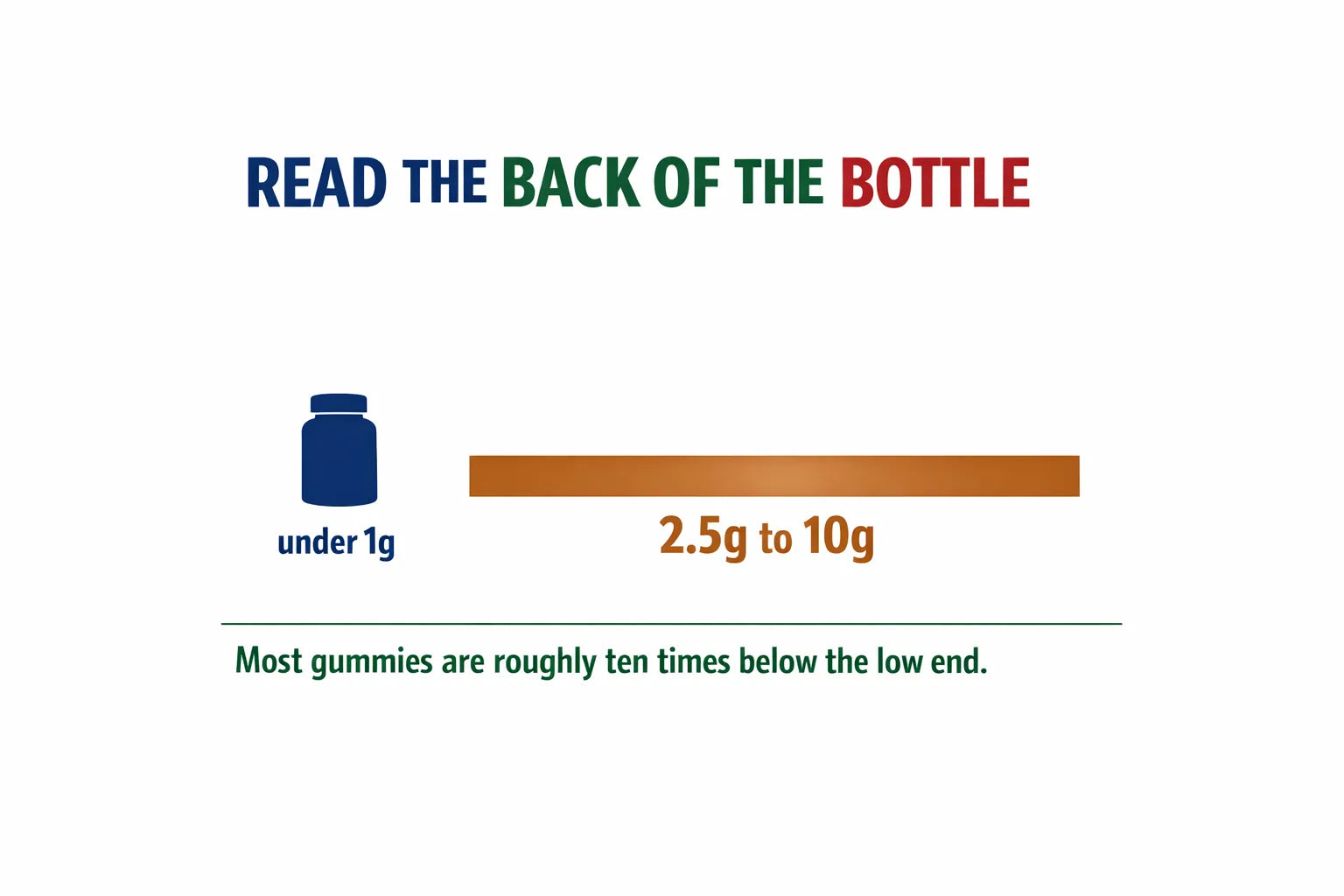
Find a collagen gummy or capsule bottle, turn it around, and read the actual collagen number.
The clinical research on hydrolyzed collagen runs from 2.5 grams a day up to 10 grams a day.6 10
Most gummies deliver under 1 gram.
You would need to eat a small bucket of them to reach the low end of the studied range.
You weren't taking a supplement.
You were eating candy with a clinical costume on.
And "just wait and see"
Now that you know about the trap, you know why this one is the most expensive of all.
Waiting isn't neutral.
Waiting is the one option that actively makes the ground you have to rebuild on smaller.
Every birthday you spend waiting, you hand the trap another year of compound interest.
Here's the pattern I hope you're seeing.
Every single failure points at something that was missing.
The cream never got deep enough, and the tub only ever carried one of the three types you lost.
Then the one nutrient that installs any of it was absent from all of them.
Which brings me to the strangest part of this whole two-year research project.
The complete version of this already existed.
It existed a hundred and fifty years ago, and it wasn't in a laboratory.
It was in a kitchen.
The Old World Ran A Complete Collagen System By Accident

Your great-grandmother never used the word collagen.
She simmered a pot of bones and joints for two days on the back of the stove, because throwing them out would have been insane when there was food in them.
That broth carried types I and III.
She cooked the whole bird, and the family picked the knuckles and the soft joint ends clean.
That's type II, the exact protein your cartilage is made of.
The fish came to the table whole, with the skin and the small bones, and nothing got filleted into a neat rectangle first.
That's marine collagen.
She rinsed her hair with horsetail, a roadside weed that European women had used for hair and nails for centuries, and horsetail happens to be the richest silica herb in the whole European tradition.
And every one of those meals arrived next to something sour and bright with vitamin C, because that was simply what grew.
Nobody wrote it down.
Nobody called it a protocol.
It was just how food worked when you couldn't afford to waste any of it.
Then the modern supplement industry came along and did something remarkable.
It took that whole system and kept the single cheapest fragment of it.
Then it ground that one fragment into a tub the size of a paint can and sold it back to you.
Then it let you conclude that YOUR body was the problem.
That's the part that made me angry enough to spend two years on this.
So we did the obvious thing.
We put the whole system back together, and we built it at the serving sizes the modern trials actually used.
Old world completeness, modern science doses.
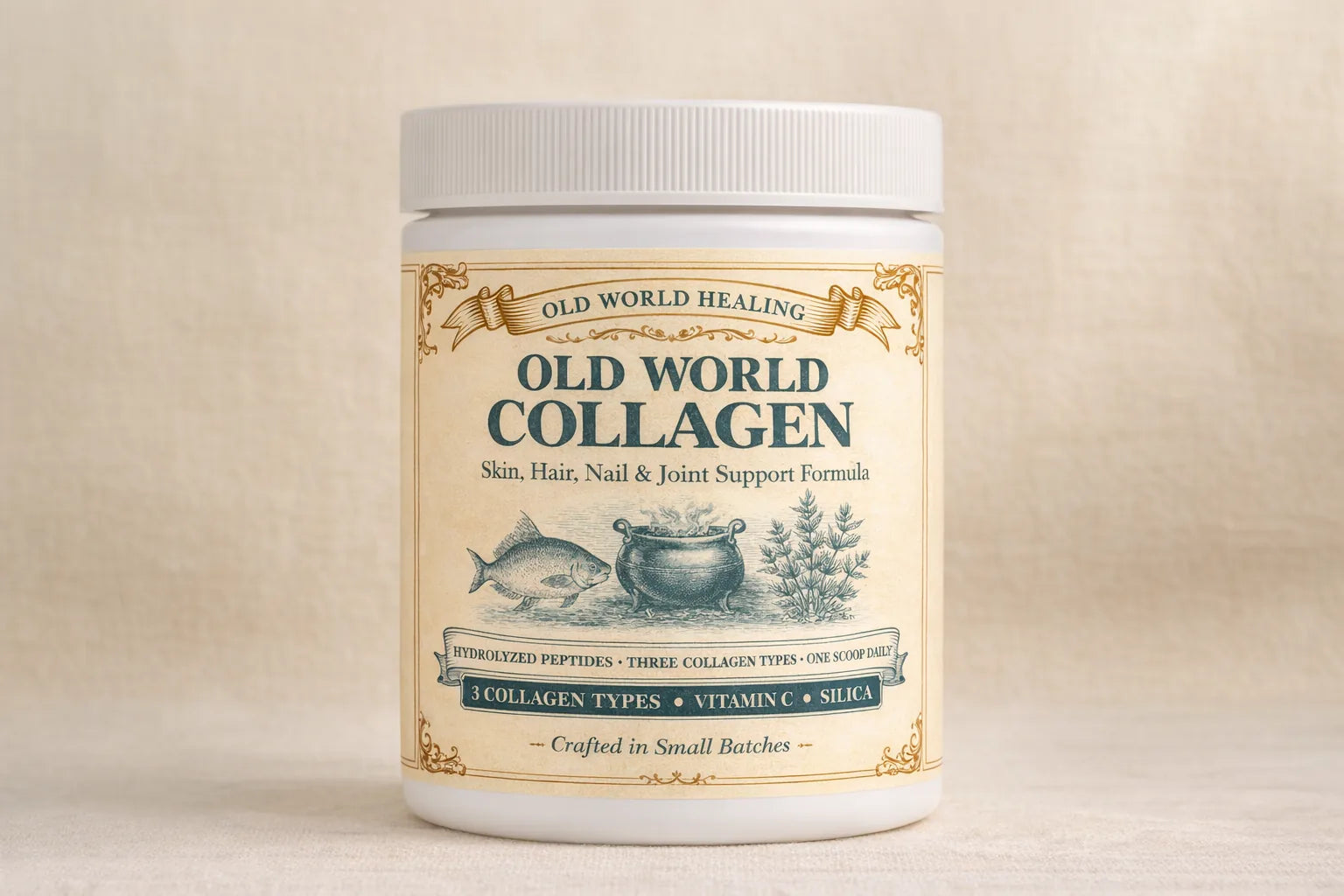
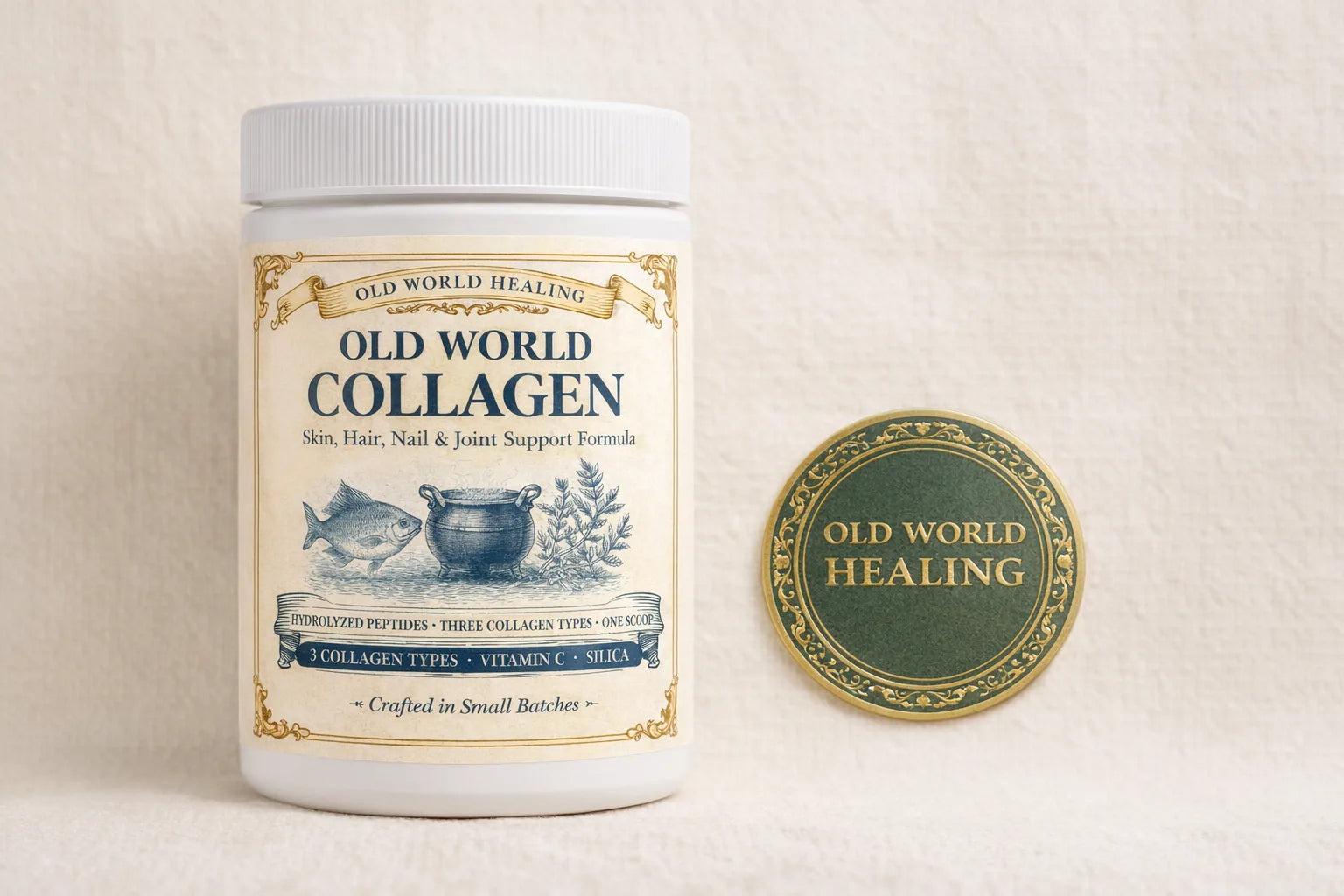
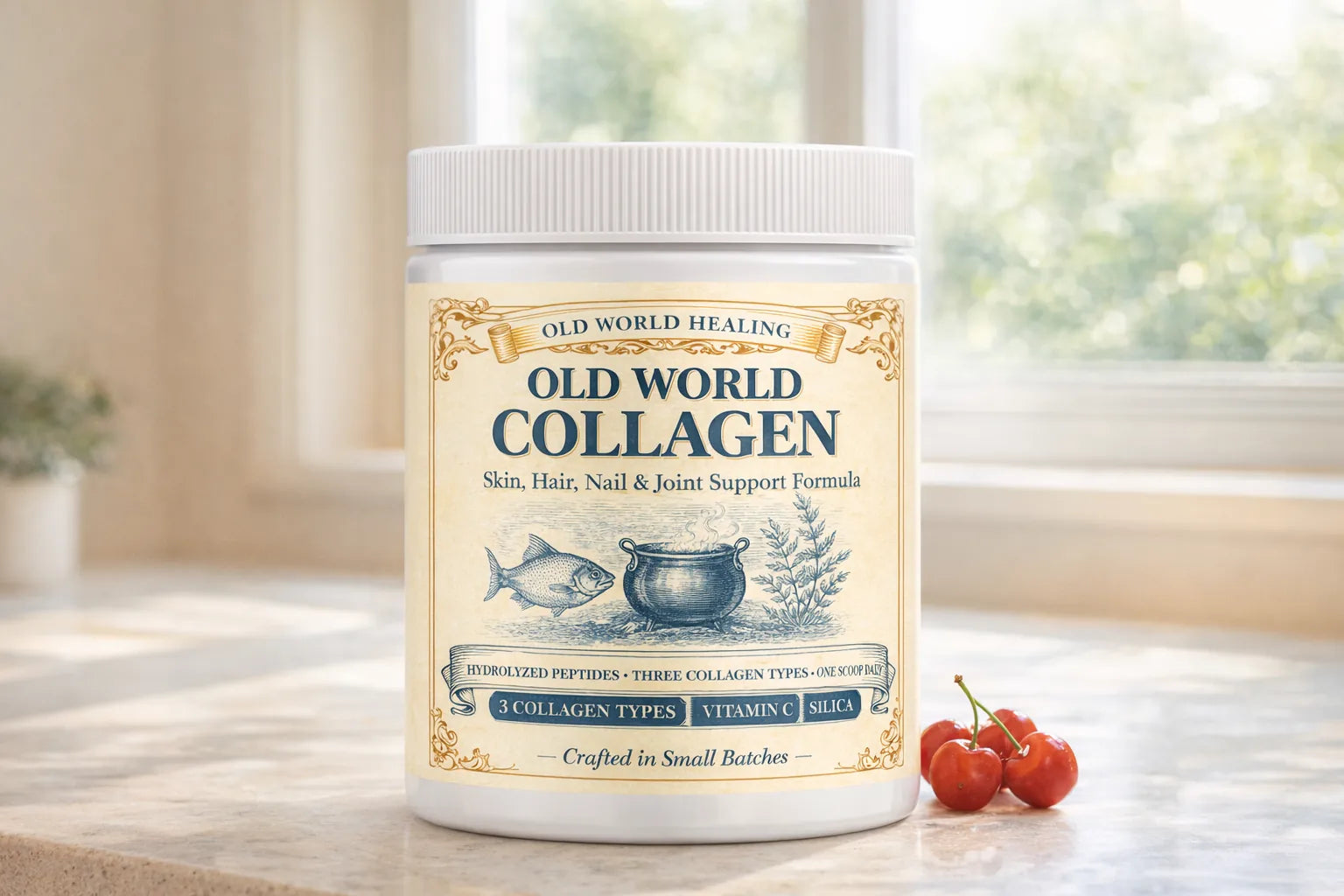
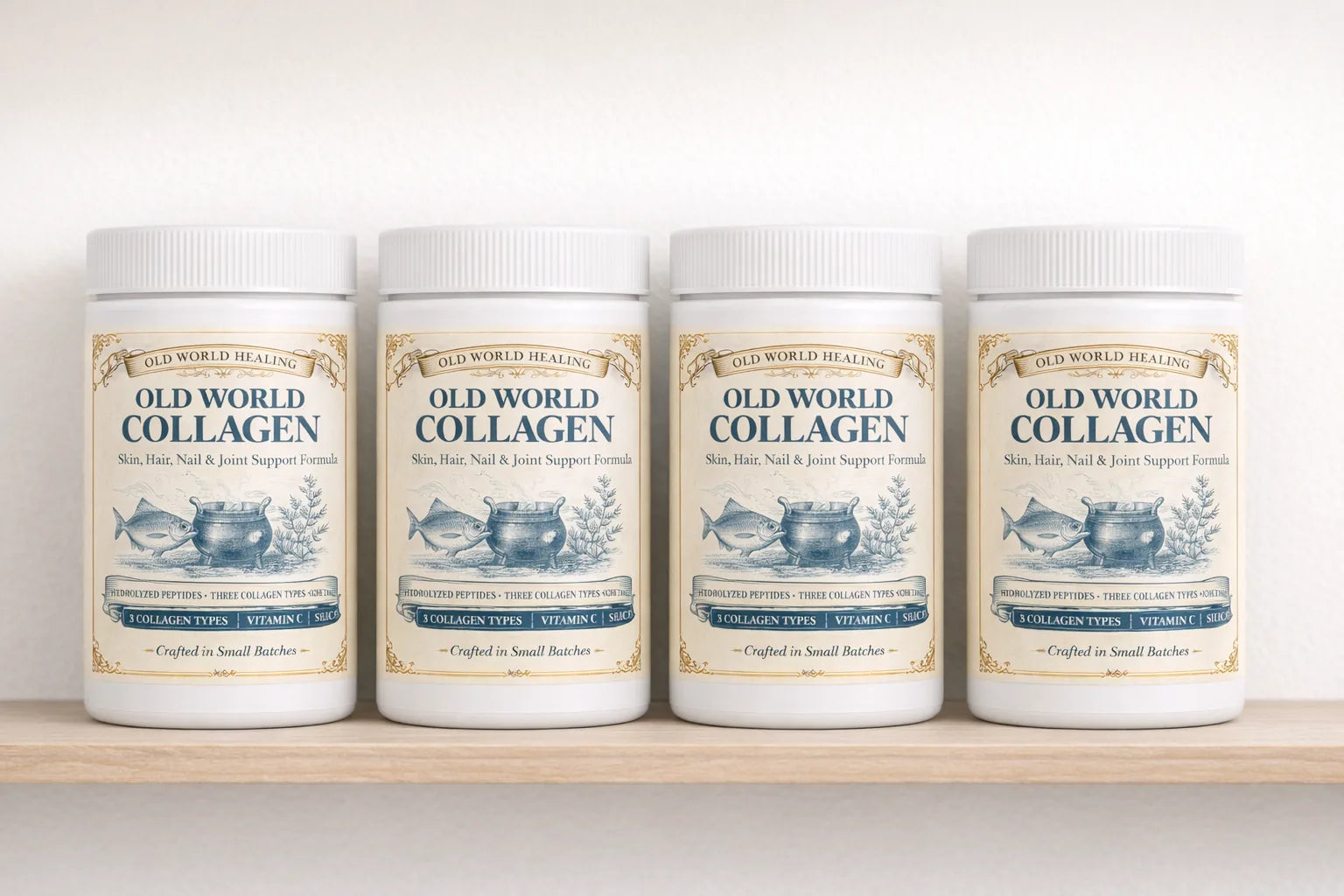
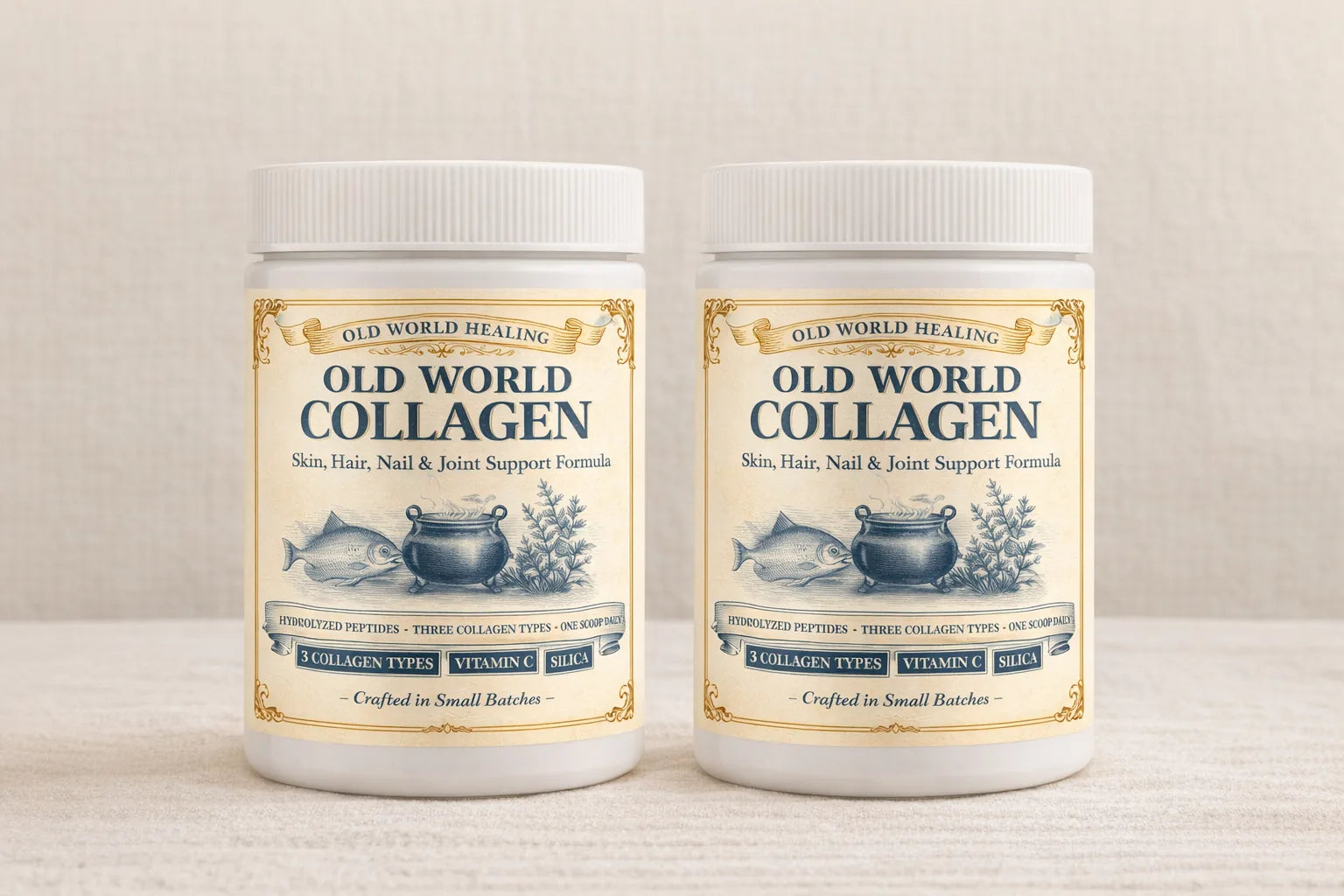
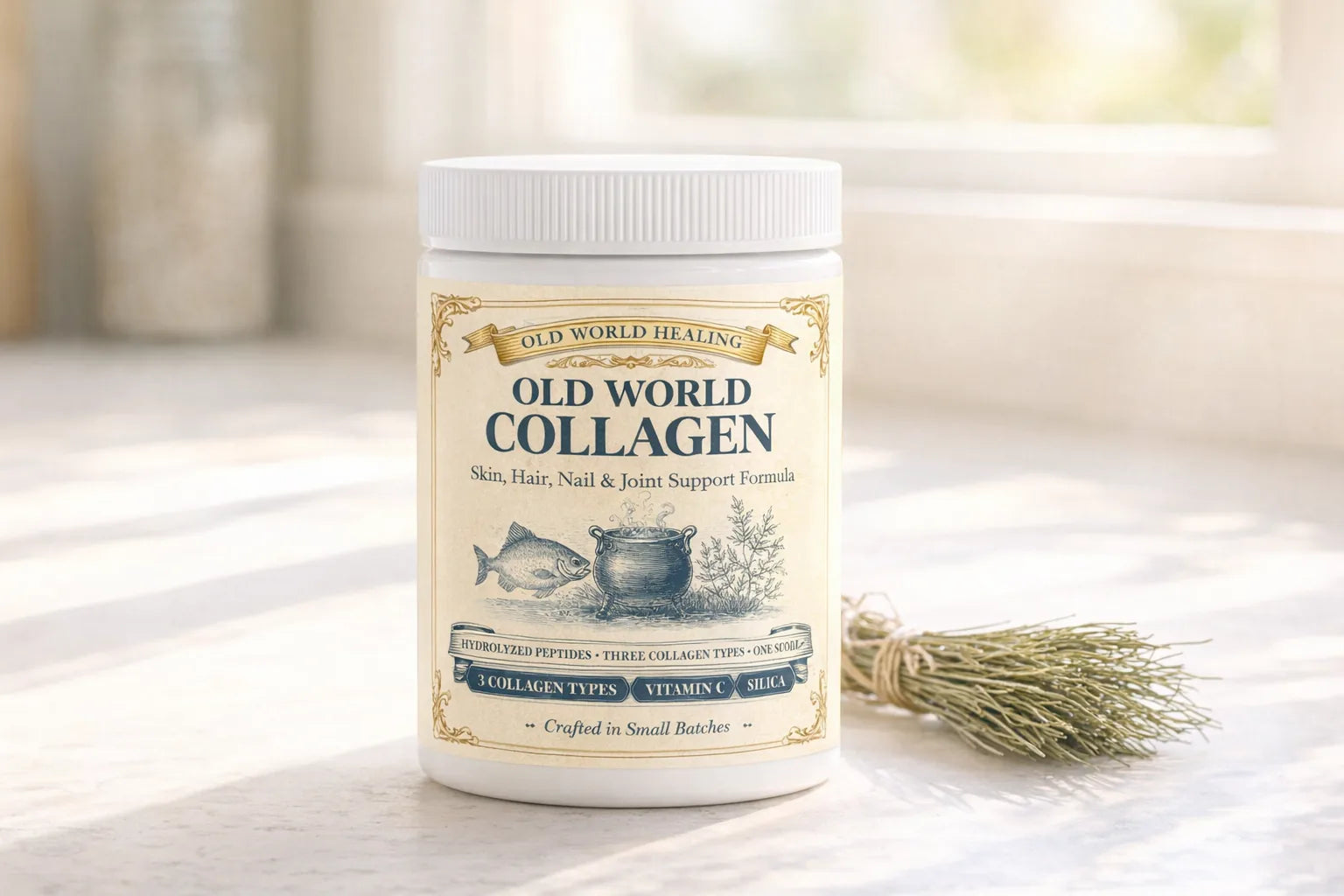
We call it Old World Collagen.
Old World Collagen: Signal, Supply, Stitch
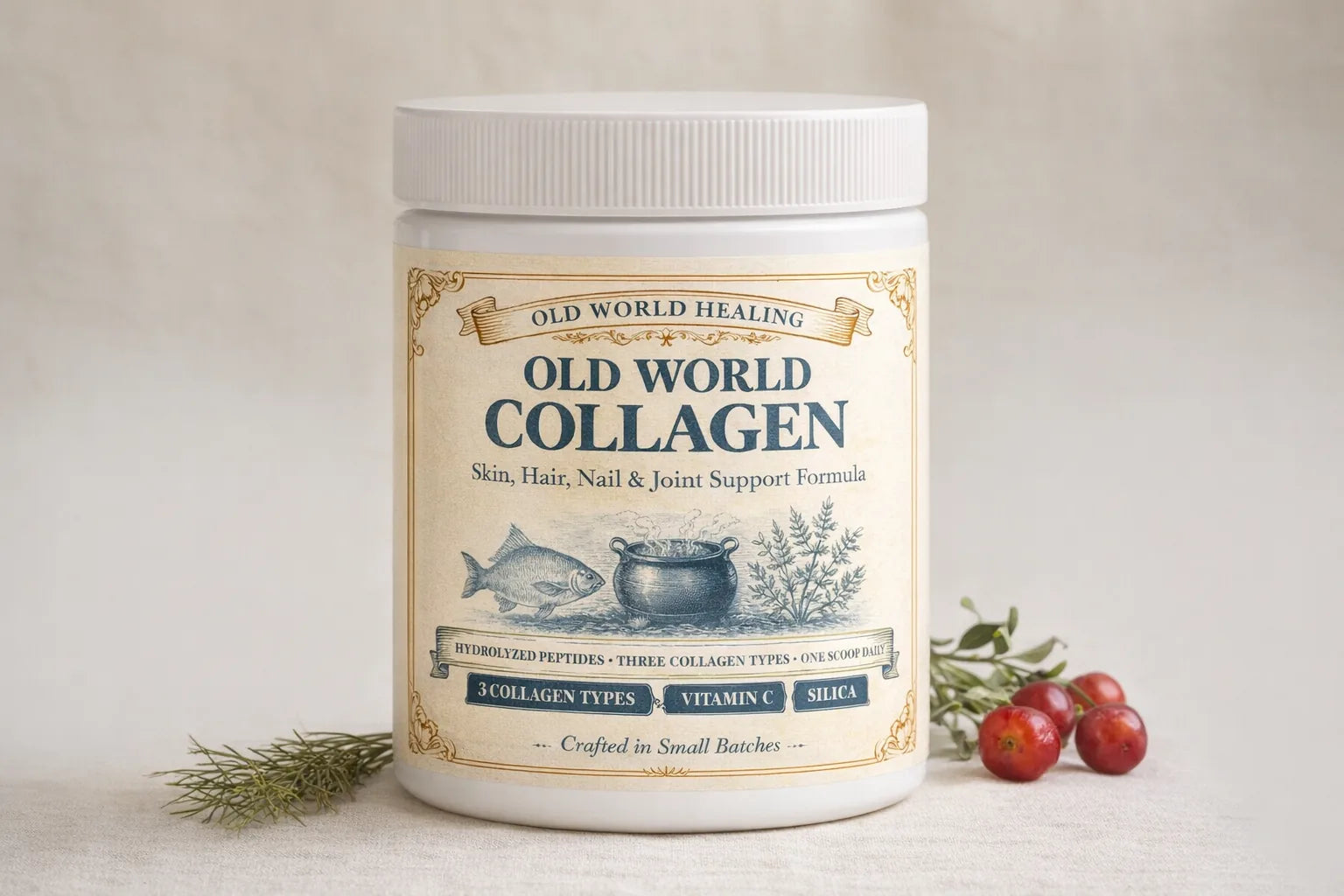
Old World Collagen isn't a collagen powder with a nicer story on the front.
It's a complete collagen system, and it works in three steps that map exactly onto the three things Collagen Collapse takes away from you.
Signal, Supply, and Stitch.
Step one: SIGNAL, waking up the collapsed cells
Let's deal with the objection first, because if you're a reader who checks things, you've already met it.
"It all just gets digested into amino acids anyway."
That sounds smart, and it's wrong, and we have the data.
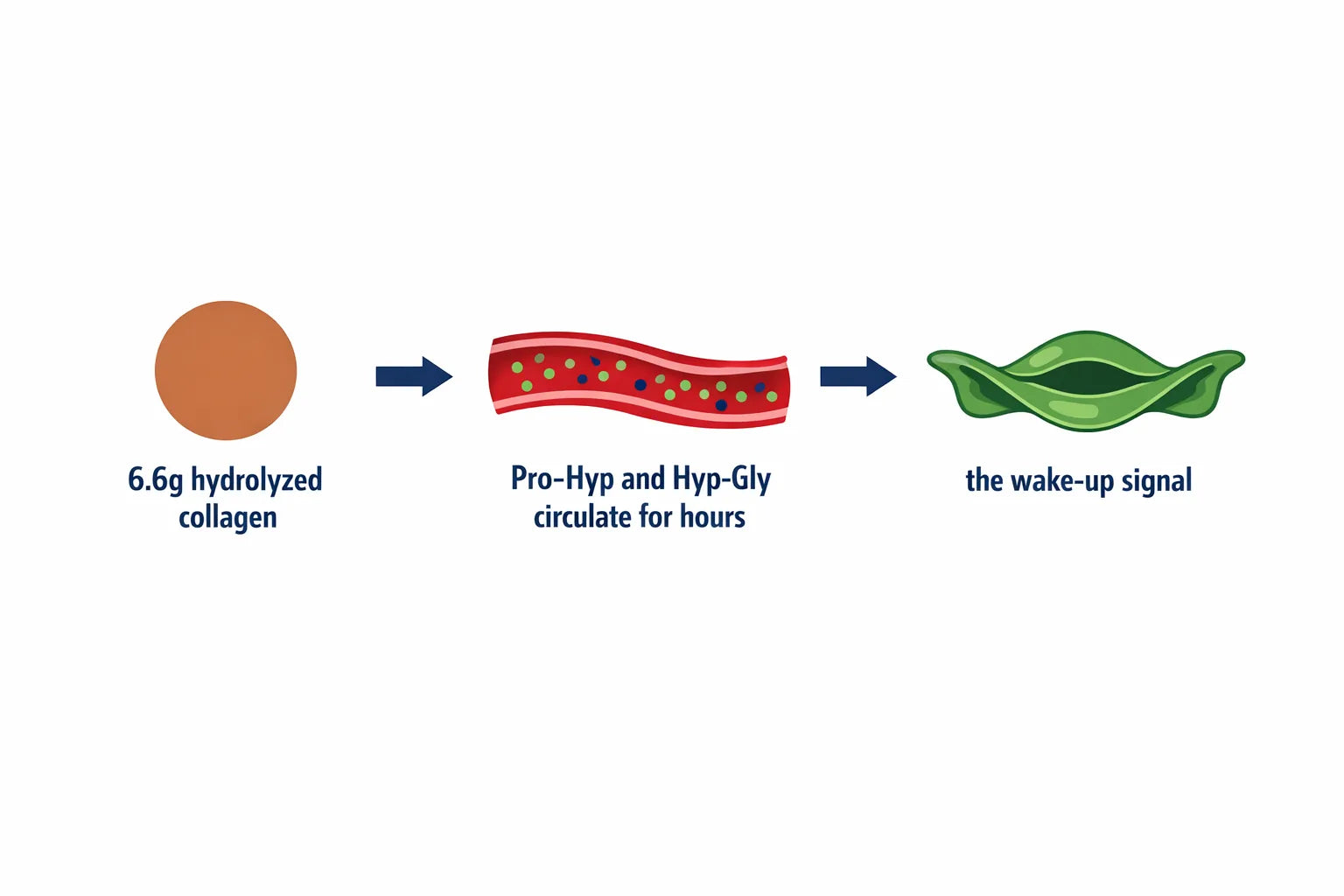
When hydrolyzed collagen breaks down, it doesn't only break into single amino acids.
It releases short two and three-piece fragments with names like Pro-Hyp and Hyp-Gly.
Those fragments survive digestion, get into your bloodstream, and stay in circulation for hours.17
Then they arrive at your collagen-making cells and act like a message.
Broken collagen in the blood reads to your body as damage that needs answering.
In the research, the cells respond by multiplying, moving, switching their collagen genes back on, and turning DOWN the enzymes that were chewing through your old collagen.17
So the fragments aren't the leftovers.
The fragments ARE the message.
Now go back to that thought you were having at 3am, the one that said this only goes one way from here.
Here's the sentence that answers it.
A collapsed cell is not a dead cell.
It let go of a rope, and it can be handed another one.
That's why the SIGNAL step comes first.
There's no point handing bricks to a crew that's asleep on the floor.
Step two: SUPPLY, all three types, every tissue
Once those cells are awake and asking for materials, they need the right ones.
This is where nearly every product in the category quietly gives up.
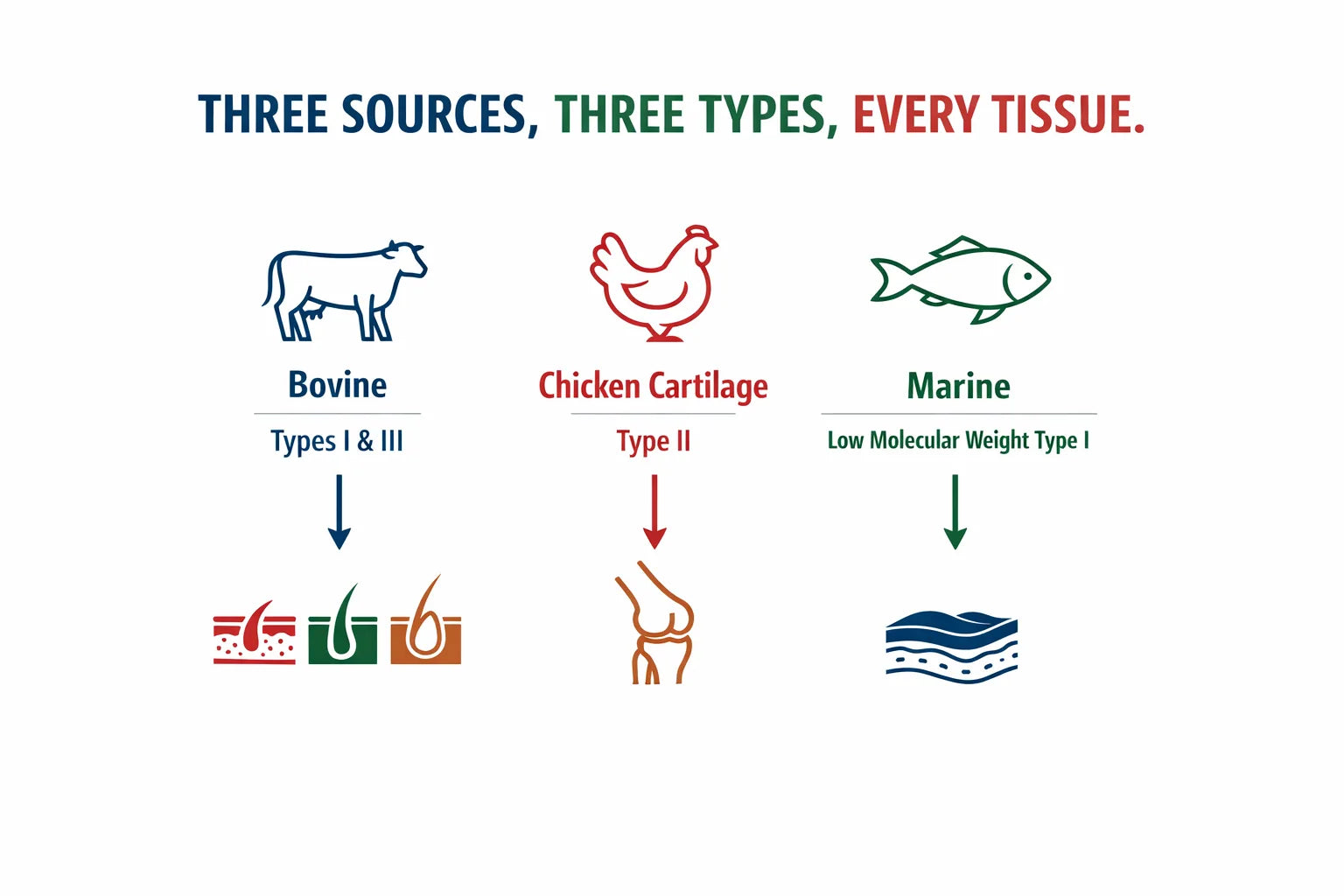
Old World Collagen carries three separate collagen sources, on purpose.
Hydrolyzed bovine collagen peptides bring types I and III, the raw material for your skin, your hair and your nails.
Hydrolyzed chicken cartilage brings type II, the type your joint cartilage is actually built out of.
Marine collagen brings low molecular weight type I, the small, quick-absorbing kind.18
Three sources, three types, and every tissue you've been watching change gets the material it specifically needs.
Compare that to the single-source tub, which ships one type and lets you assume it goes everywhere.
One type feeds one tissue.
That's not marketing. That's just what those proteins are.
Step three: STITCH, the activators that make it stay
This is the step the industry skips, and it's the reason your last attempt drained away.
New collagen has to be folded, welded and locked into place, or your body throws it out unfinished.
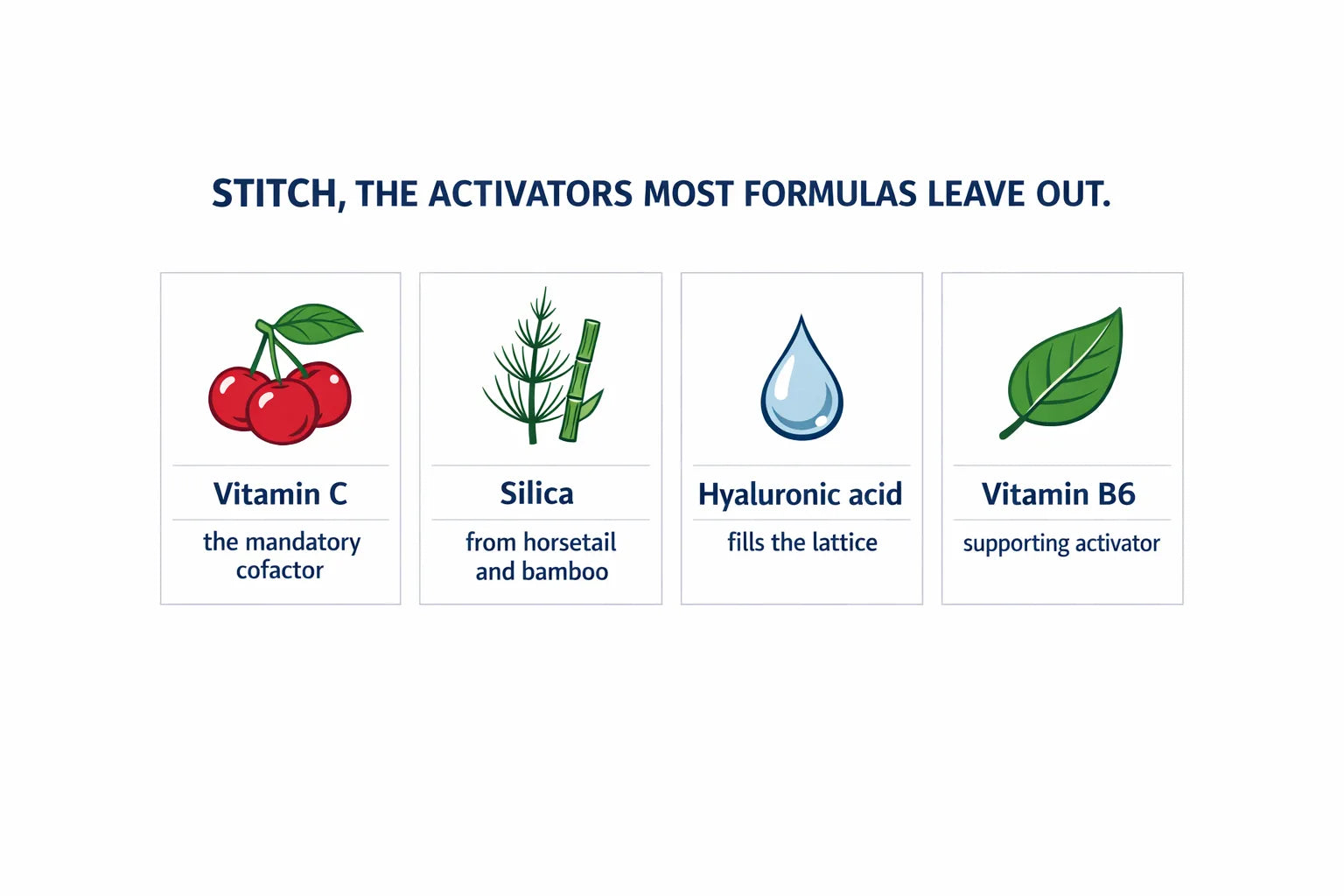
Acerola cherry, for natural vitamin C.
The two enzymes that fold and weld collagen can't run without it, full stop.4
This is the ONE nutrient.
Without it, you're paying for raw material your body isn't allowed to install.
Horsetail and bamboo, for silica.
Silica is the mineral behind the framework that collagen gets laid into.
In one randomized trial, 48 women with fine hair took 10mg of silica a day and came out with measurably thicker hair strands after nine months.14
In another, hair and nail brittleness dropped significantly against placebo.13
Now let me be precise with you, because this is where other brands get sloppy.
Those trials used a purified form of silica rather than the herbs themselves.
So the mineral is what carries the research, and horsetail and bamboo are its traditional botanical home.
Hyaluronic acid.
Collagen builds the lattice, and hyaluronic acid is what fills it with water.
Taken by mouth at 60mg to 120mg a day, it improved hydration, elasticity and the look of wrinkles against placebo in randomized trials.15 16
Vitamin B6.
A supporting activator, nothing more, and I won't oversell it to you.
B6 helps your body handle the amino acids that collagen is built from.
Here's the one-line version you can repeat to your spouse tonight.
Signal the cells to build again, supply all three collagen types they build with, and stitch it into place with the activators your body can't work without.
That's the whole mechanism.
That's Old World Collagen.
The Number On The Back That Settles The Argument
I'd rather hand you something you can check than something you have to believe.
So here it is.
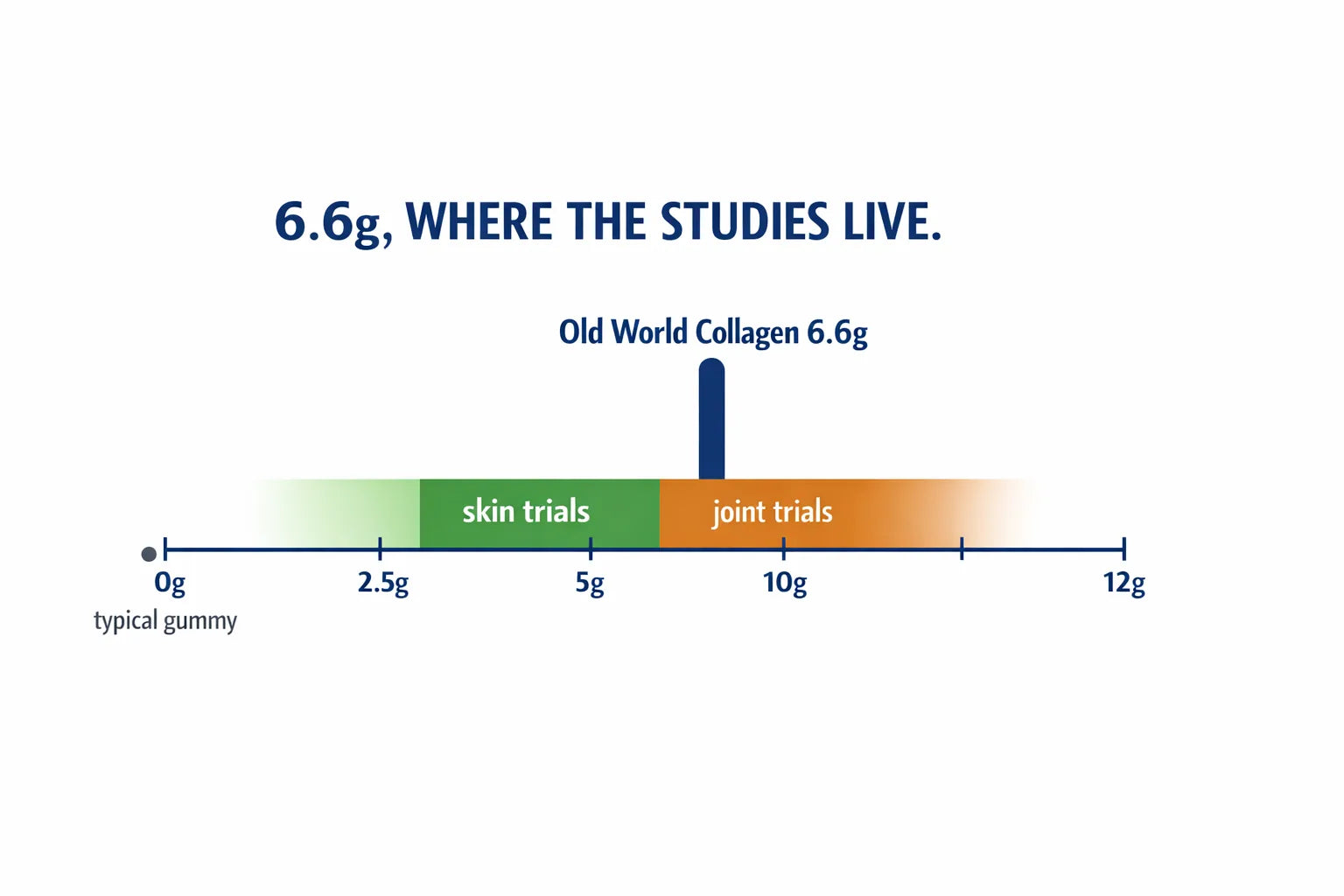
One serving of Old World Collagen delivers a 6.6 gram Collagen Complex Blend.
Now put that next to the research.
The skin trials that got results used 2.5 to 5 grams a day.5 6
The joint trials used 5 to 10 grams a day.10 11
6.6 grams sits above the skin floor and inside the joint band at the same time, which is exactly why the number is what it is.
And there's one study I want to name specifically, because it's the closest published work to what we built.
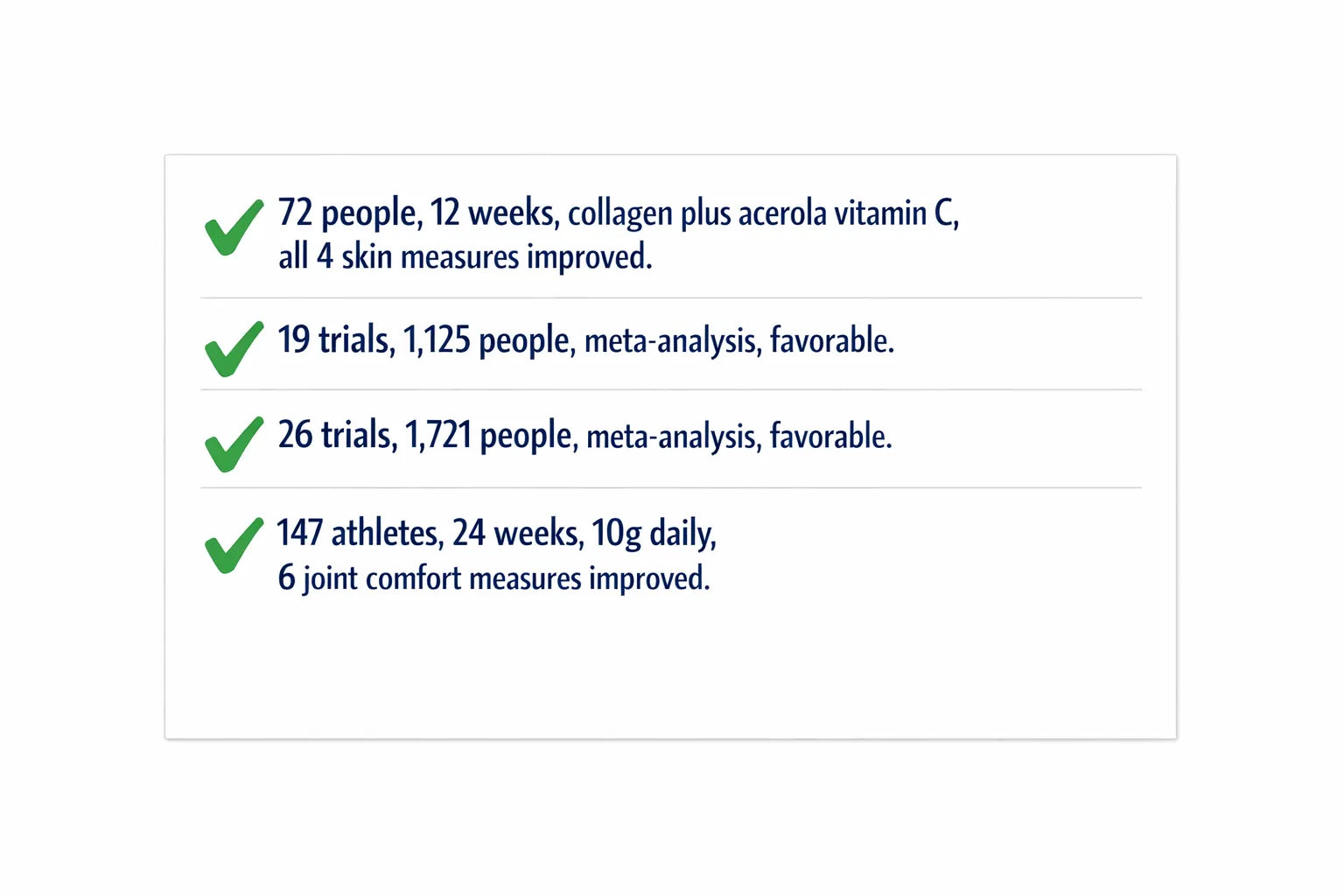
In 2019, researchers ran a randomized controlled trial on 72 women aged 35 and over.
They didn't test collagen alone.
They tested collagen peptides combined with acerola-derived vitamin C, as one system, for 12 weeks.
Every single one of the four skin measures they tracked improved significantly against placebo: hydration, elasticity, roughness, and the density of the deeper skin layer.5
Four out of four.
That's the system idea, tested, published, and holding up.
Two meta-analyses back the wider picture: one pooling 19 trials across 1,125 people, another pooling 26 trials across 1,721.8 9
Both came out favorable for hydration, elasticity and wrinkles against placebo.7
This is not a category running on hope.
It's a category running on formulas that were built badly.
And Yes, The Same Protein Is Disappearing From Your Knees
If you came here about your skin, this next part is a bonus you weren't expecting.
If you came here about your knees, this is the main event.
The cushion inside your joints is built out of collagen, and the type it's built from is type II.
Same protein, same collapse story, just happening somewhere a mirror can't show you.
You only get to feel it, on the stairs, and in the first ten minutes after you stand up.
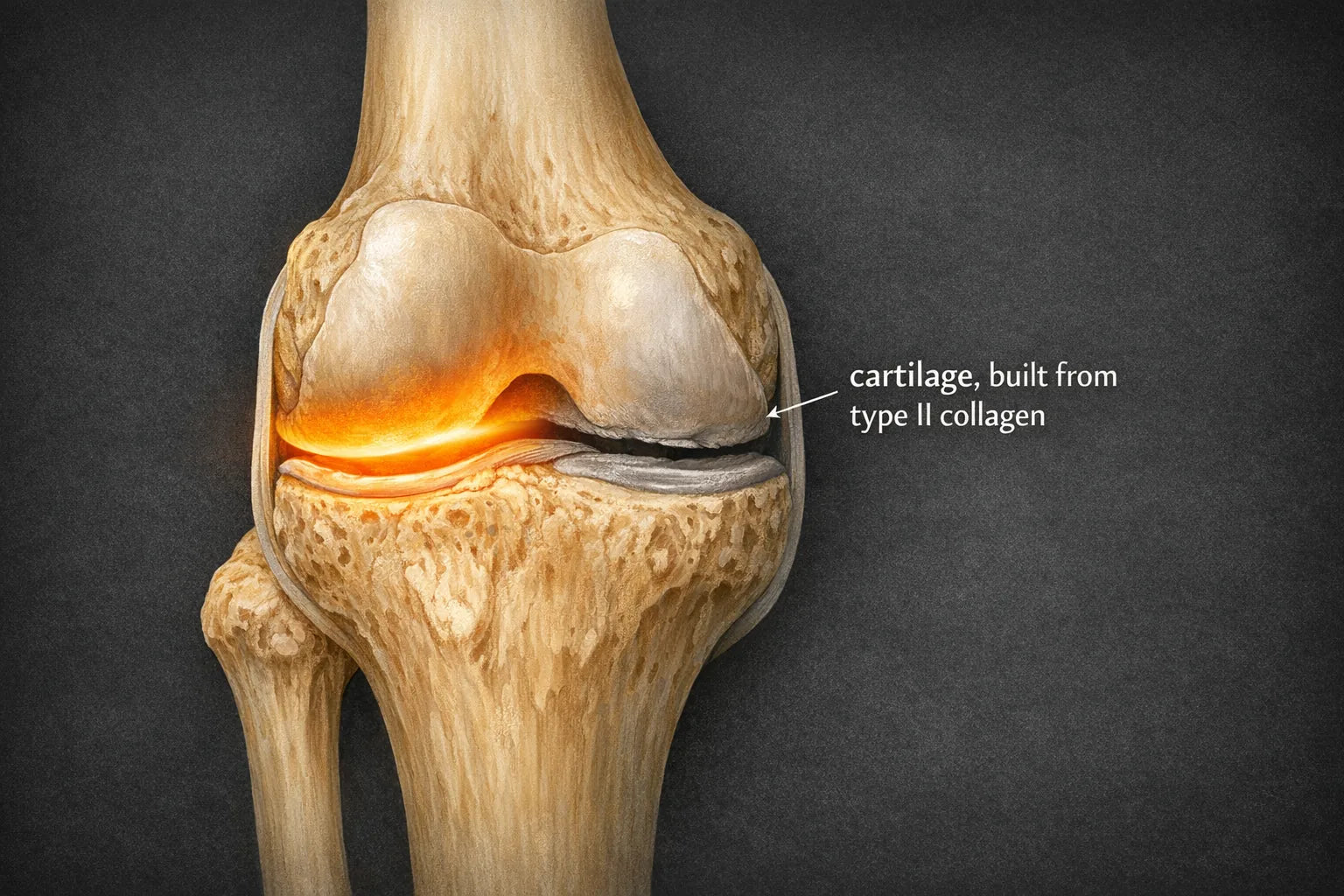
Penn State ran the trial that gets quoted most.
147 athletes with activity-related joint pain took 10 grams of hydrolyzed collagen a day for 24 weeks.
Six separate measures of joint pain improved significantly against placebo, including joint pain at rest.10
A later randomized trial put 180 active adults with knee pain on 5 grams a day for 12 weeks and saw significantly greater pain reduction than placebo.11
And a meta-analysis pooling five placebo-controlled trials across 519 people found significant improvement on the two standard joint scoring systems.12
I'll be honest with you about the fine print, because you'd find it anyway.
A 2021 review of this same literature urged caution, because the studies vary a lot and much of the funding comes from industry.19
So I'm not going to tell you this fixes a diagnosis.
I'm telling you it supports joint comfort and recovery, that's the claim the evidence carries, and that's the claim we'll make.
If you're already using Old World Relief on your knees and hands, here's the simplest way I can put the difference.
The cream calms things down on the outside.
This works on the cushion underneath.
How Long This Actually Takes, Told Straight
Now the part where most brands lie to you.
I'm not going to.
Collagen rebuilds on collagen time, and here's the pacing the trials actually reported.
This is usually the first thing people notice, and it's the one that convinces them to keep going.
That's where most of the skin trials took their final measurements.
The Penn State trial ran a full 24 weeks for a reason.
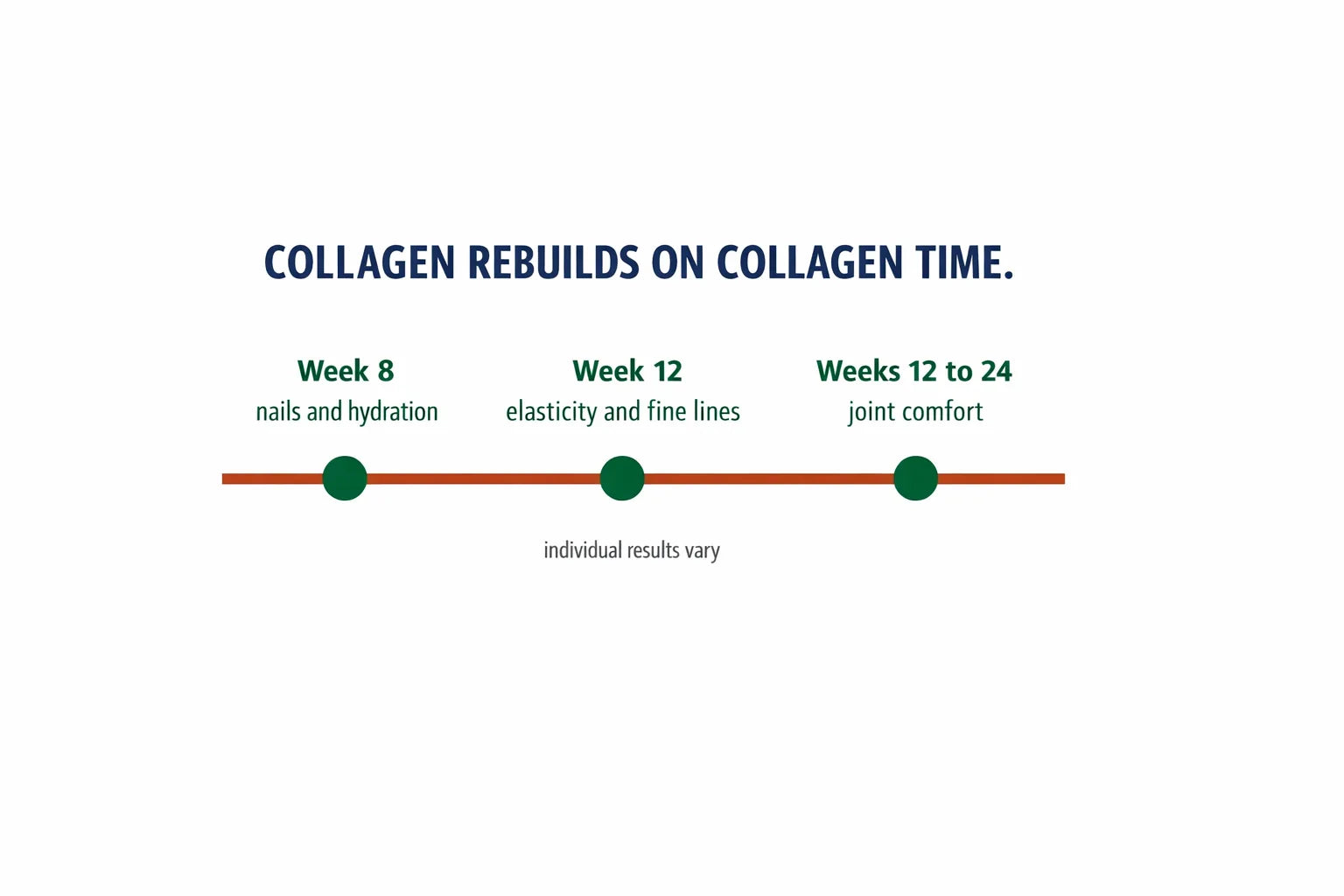
I know that's not the answer you wanted.
But look at what that timeline tells you about who's being straight with you.
Any brand promising you a visible change in seven days is either selling a moisturizer or lying about the biology.
Your body rebuilds collagen on a schedule you can't negotiate with.
The honest version of this promise is the slow one, and slow is the tell of a real mechanism.
That timeline is also why the tub in your cupboard never had a chance.
You gave it three weeks, saw nothing, and quit, which is exactly what anyone reasonable would do.
Except you quit five weeks before the first measurable change was ever due to show up.
What The First Few Months Actually Look Like
Illustrative customer stories
"I'd written the whole category off. Bought the giant tub at the warehouse store, stirred it into my coffee for six weeks, saw nothing and quit. Nobody ever told me that tub had one collagen type in it and not a milligram of vitamin C. I'm on week ten of this one and my nails have stopped coming off in layers for the first time since I turned fifty-four."
Diane R., 54
"The stairs at my daughter's place are the reason I ordered. Twelve stairs, and I'd started counting them. I'm about four months in now and last Sunday I carried the birthday cake up without doing the calculation first. Didn't even notice until my wife pointed it out in the car."
Ray M., 61
"I'm the sceptic in my family. I read the label, then I read the studies the label was pointing at, then I bought it, which is not how I usually shop. What sold me was the vitamin C thing. Once you understand why it has to be in there, you can't unsee its absence on every other bottle."
Priya N., 58
"My hairdresser asked me what I'd changed. That was month three. I hadn't changed anything except this, and I'd honestly half forgotten I was taking it."
Susan T., 66

Why Nobody Has Put This In Front Of You Before
Because complete is expensive and incomplete is profitable.
Bovine hide is the cheapest collagen raw material there is.
One source means one supplier and one line on the label.
Add a second and third collagen source and your cost goes up before you've sold a single tub.
Add the acerola, the silica and the hyaluronic acid and it goes up again.
Then hold the serving at 6.6 grams instead of shrinking it to a gummy, and your cost per serving is a different animal entirely.
Meanwhile the incomplete version sells beautifully.
It's cheap and it's on every shelf.
And when it doesn't work, the customer blames their own body and quietly stops buying collagen.
Nobody asks for a refund on their own genetics.
And that's the ugliest part of this, so let me be plain about it.
An incomplete formula doesn't just fail you.
It teaches you that YOU are the failure, and then you stop looking for the version that would have worked.
That's the part that makes me furious, because it lands hardest on the people who tried hardest.
That's the whole business model.
We just decided not to run it.
Get Old World Collagen
You can buy it once, or you can subscribe and save $10 every month.
There are thirty scoops in the tub and thirty days in the cycle, so a subscription lands the next one about the time this one runs out.
The trials measured at week eight, week twelve and week twenty-four, and the reason people give up on this category is a tub that emptied at week three and never got replaced.
Pick the supply that matches how far ahead you want to be.
| Supply | One-time | Subscribe and save | Per month | Per serving | Ships |
|---|---|---|---|---|---|
| 1 month1 tub | $79 | $69Save $10 | $69.00 | $2.30 | Every 30 days |
| 2 months2 tubs | $148 | $128Save $20 | $64.00 | $2.13 | Every 60 days |
| 3 months3 tubs | $213 | $183Save $30 | $61.00 | $2.03 | Every 90 days |
The subscription price is $10 a month below the one-time price of the same supply, every time.
- Going longer saves again on top of that, so two months saves $10 against buying two single months, and three months saves $24 against buying three.
- Shipping is free on every order, whichever way you buy.
- Cancel a subscription anytime before your next ship date, with no fee and no phone call.
Our Guarantee
90 day money-back guaranteeEvery order is covered by a 90 day money-back guarantee.
If it isn't doing anything for you, email us inside 90 days and we'll refund you in full.
You don't need to send the tub back.
Ninety days wasn't picked because it sounds generous.
We just told you the first real change is around eight weeks and the deeper change is around twelve.
It would be dishonest to then hand you a two week window to judge it in.
So the window is long enough to reach both marks and then think about it.
How To Take It
It's a powder in a tub, with a scoop inside.
Thirty scoops per tub, one for every day of the cycle.
Every scoop carries 6.6 grams of the collagen blend.
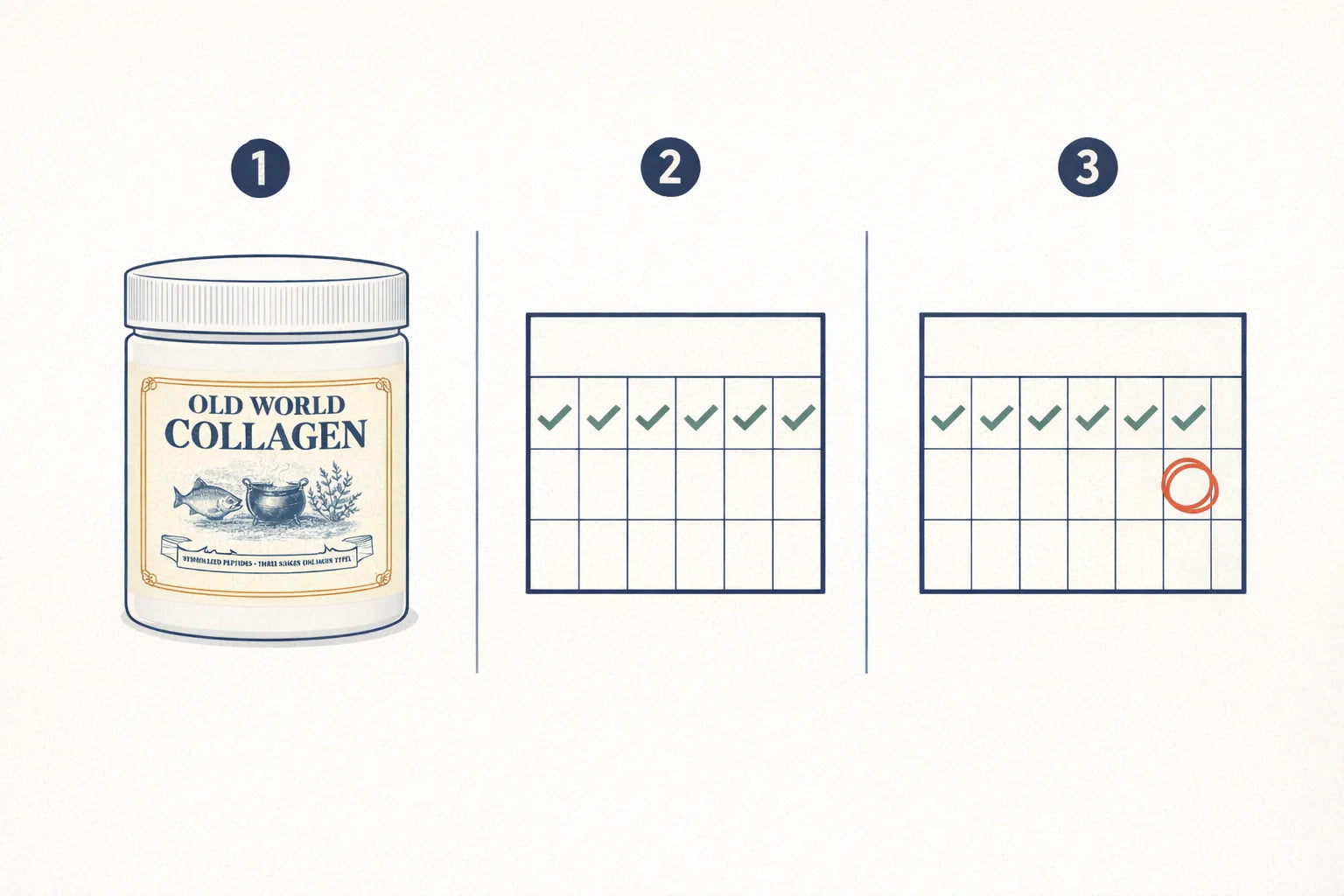
One. Take one level scoop a day, mixed thoroughly into whatever you already drink.
Any time of day works, so pick the one you'll actually remember.
Two. Take it every day, including the days you feel nothing.
The first eight weeks are the stretch everybody quits during.
Three. Put a mark on your calendar eight weeks out, and check your nails then instead of checking the mirror every morning.
Two Versions Of Next Spring

If nothing changes.
The leak keeps running at about a percent a year.
The fragments keep piling up, and the cells that lost their grip keep making more of the enzymes that break down what's left.
The base you'd have to rebuild from gets smaller every single year you leave it alone.
And a year from now you say "it's just my age" to somebody at a party, and this time you actually believe it.
If you interrupt it.
The signal gets sent every day instead of never.
All three collagen types show up, so your skin and your knees both get the material they specifically need.
And the vitamin C is finally there, so the new collagen gets finished and installed instead of flushed.
Around week eight you file a nail instead of tearing a layer off it.
Around week twelve you catch your forearm in the sunlight and don't flinch...
And somewhere in there you get to the top of the stairs and realize your hand never went to the rail.
You don't get a different body.
You get the same body, with the loop running the other way.
Questions People Ask

Almost every time we hear this, the same three things were true of the product that failed.
It carried one collagen type, so it only ever fed one tissue.
It had no vitamin C, so a good share of what you drank got thrown out unfinished.
And if it was a gummy, it was roughly ten times below the low end of the studied range.
Fix those three and you're running the version the trials were actually run on.
Partly, and that's the part everyone repeats.
The part they leave out is that hydrolyzed collagen also releases short fragments called Pro-Hyp and Hyp-Gly, which survive digestion and stay in your bloodstream for hours.17
Those fragments act as signals to your collagen-making cells, not just as food.
It's more than the skin trials used and it's inside the range the joint trials used.5 6 10 11
Compare it to the number printed on whatever you have in the cupboard right now, and you'll have your answer in about four seconds.
No, and the standing science says so plainly.
The 1975 collagen decline study measured people from age 15 to 93 across both sexes and found the same steady loss.1
Skin, hair and cartilage are collagen tissues in every body.
That's the exact belief the trap depends on.
Collapsed cells aren't dead cells, and the SIGNAL step exists specifically because they can be prompted to build again.
Worth noting: in one of the skin trials, the elasticity effect was strongest in the OLDER participants.6
Cartilage is built from type II collagen, which is why we source chicken cartilage alongside the bovine and marine.
The joint claims themselves rest on the hydrolyzed collagen trials at 5 to 10 grams a day.10 11 12
We say it supports joint comfort and recovery, and we don't say anything beyond that.
Good question, and here's the straight answer.
The trials used a purified form of silica, not horsetail or bamboo extract.
So the mineral carries the evidence, and horsetail and bamboo are the traditional botanical sources it comes from in this formula.
Horsetail earned its place in European hair and nail folklore centuries before anybody isolated the mineral out of it.
We don't have interaction guidance to hand you, so we won't pretend we do.
What we can tell you flatly is what's in it.
The label declares fish: cod, tilapia and crimson snapper.
The formula also carries bovine and chicken sourced ingredients.
Neither one is a major allergen under US labeling law, but they're worth knowing about if you avoid them.
As a general rule, talk to your own healthcare provider before starting anything new, especially if you take prescription medication.
Email us inside 90 days of your order and we'll refund it in full.
You don't need to send the tub back.
We set the window at 90 days because the first measured changes land around week eight and week twelve, and anything shorter would be asking you to judge it before the biology has had its say.
No, you can buy any of the three supplies once and that's the end of it.
A subscription is simply $10 a month cheaper for the same tub, and it lands the next one before you run dry.
It renews at $69 every 4 weeks, $128 every 8 weeks or $183 every 12 weeks depending on which supply you picked, at the same price every time.
Shipping is free on every order.
Cancel anytime before your next ship date, with no fee and no phone call.
Don't Give The Trap Another Year
Here's the one line to take away from all of this.
A decline only moves one way, and that's what you were told you had.
A loop keeps running because something keeps feeding it.
Yours has been fed by broken fragments, missing types and a missing nutrient that costs pennies.
Take those away and the loop stops feeding.
You've already spent enough mornings talking yourself out of what you saw in the mirror.
Since this article went up, most of the questions we've had have come from people who finally understood why their last tub did nothing.
So here are the two answers we keep giving.
The vitamin C is in the blend on purpose, and 6.6 grams is the number on the back you can check against the trials.
Illustrative customer stories
"What sold me was the vitamin C thing. Once you understand why it has to be in there, you can't unsee its absence on every other bottle."
Priya N., 58
"Week ten, and my nails have stopped coming off in layers for the first time since I turned fifty-four."
Diane R., 54
"Twelve stairs at my daughter's place, and I'd started counting them. Last Sunday I carried the cake up without doing the calculation first."
Ray M., 61
P.S. If you only remember one sentence from this whole page, make it this one.
The less collagen you have, the less your body can make.3
That's the trap, and it's the reason "I'll deal with it later" has been quietly the most expensive decision on your list.
P.P.S. And if you remember two, make the second one the cheap nutrient.
Collagen peptides without vitamin C are bricks without mortar, and your body doesn't stockpile bricks it can't lay.4
It gets rid of them.
That's the reason a tub with one ingredient and no cofactor was never going to do anything for you, no matter how faithfully you stirred it into your coffee.
Eight Weeks From Today You Will Either Have Started This Or Not
Save Up To 63% (Today Only)The customer stories on this page are illustrative accounts. Individual results may vary.