"My face changed more in two years than it did in the ten before it. And I'd moisturized every single night since 1985."
The 3 Old-World "Tightening Herbs" That Soften The Look Of Deep Lines After 55
Every cream you've ever bought was aimed at the top 0.02mm of skin...
Deep lines start about 2mm below that, in a layer where one gene has been quietly dialing down for years...
Here's what actually reaches that layer, why the old kitchens got there two hundred years before the journals did, and how a face starts looking like the person inside it again...
Your skin didn't age gradually.
It collapsed.
And somewhere in your phone there's a photograph that proves it.
Not the one from ten years ago.
The one from two years ago, where you look like yourself, and then the one from last month, where you don't.
Same haircut, same lighting, completely different face.
You've probably done what everybody does with that pair of photos, which is close the app and decide not to think about it.
But here's the part nobody has ever explained to you, and it's the reason this article exists.
That gap between the two photos wasn't slow decline finally catching up with you.
It was a collapse.
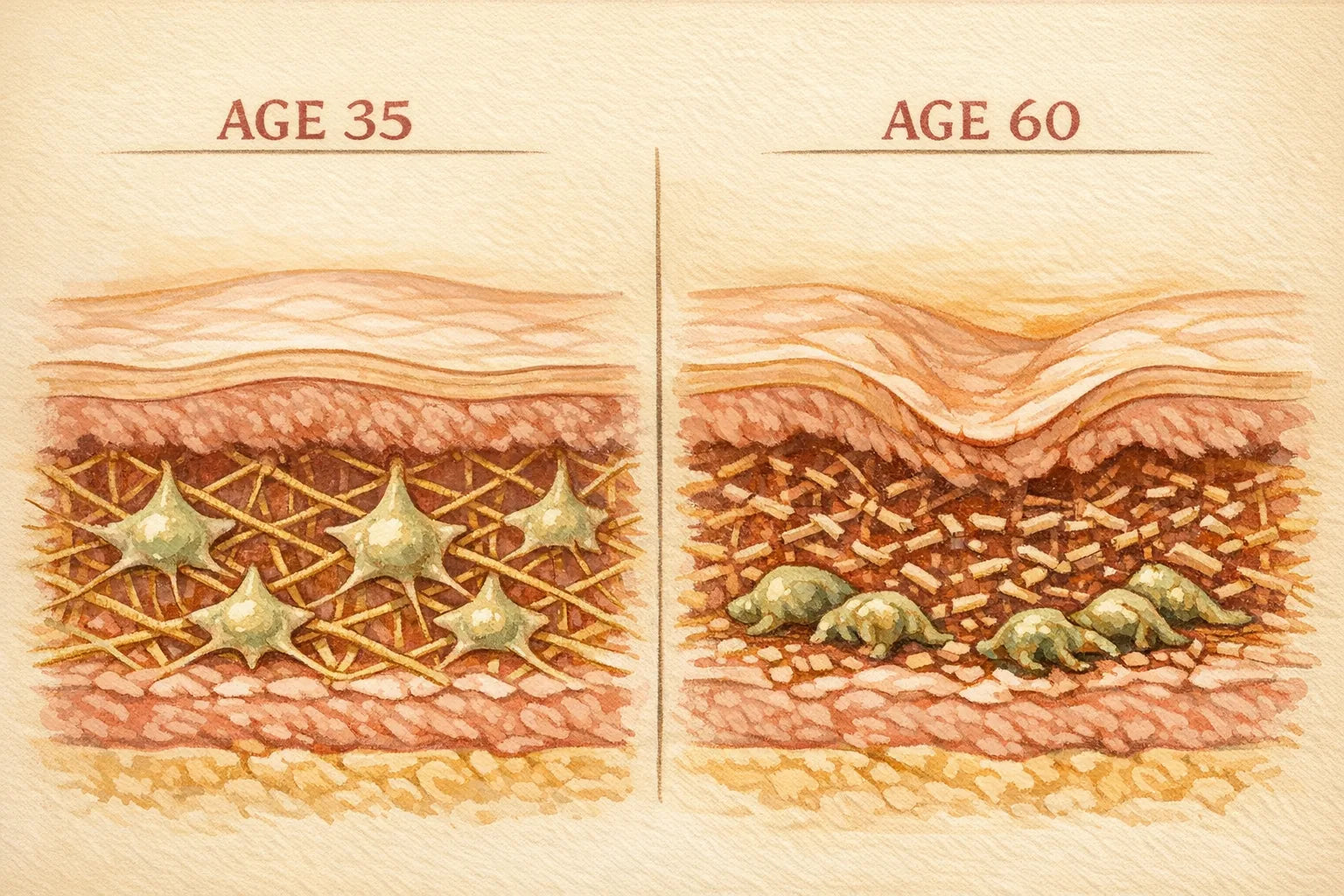
A real, physical, photographed-under-a-microscope collapse, happening about 2mm below the surface, in a layer no cream you own has ever reached.
I'm going to show you exactly what fell over down there.
Then I'm going to show you what researchers watched climb back up over six months, in people aged 55 to 60, when they finally handed that layer the one thing it had run out of.
First, The Two Years. Because The Speed Is The Clue.
Ask anybody over 55 how their face changed and almost nobody describes a slope.
They describe a drop.
"It happened in about two years."
"I looked fine, and then one day I didn't."
"Nothing prepared me for how fast it went."
For decades the beauty industry answered that with a shrug and a nicer jar.
The research answers it with numbers.
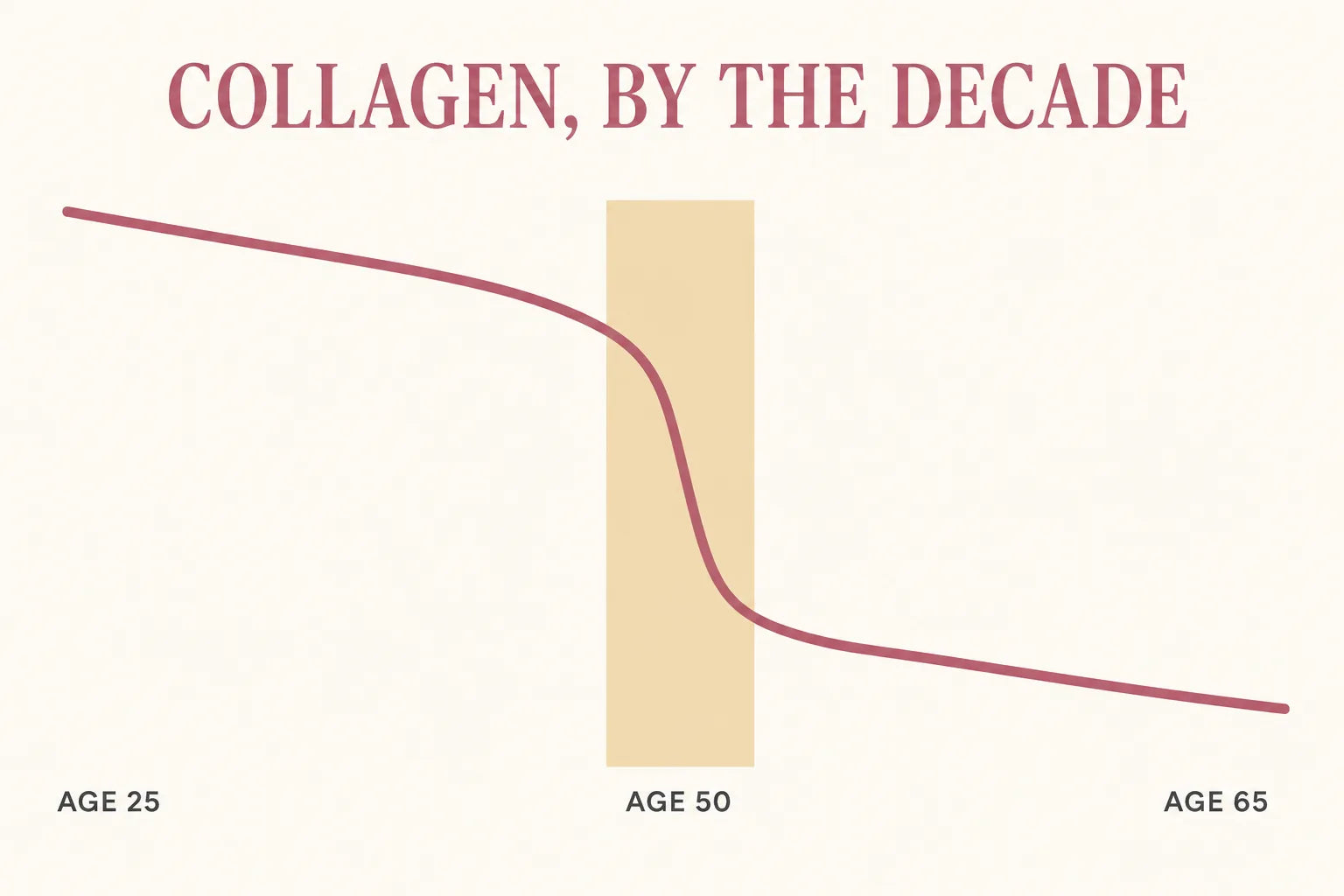
From the mid-twenties onward, the collagen in skin falls by roughly 1% a year.14
That's the slow part, and it's everybody, starting the day you turn 25.
But research into menopause found something far sharper: studies report up to 30% of skin collagen lost in the first five years after it begins, then about 2% a year after that.15
Read that again, because it's the whole reason your mirror felt like an ambush.
Thirty percent of it, gone in five years.
That isn't a slope.
That's a cliff, and plenty of people walk straight off it without ever being told the cliff was there.
Now, that cliff research was done in women, and I'll always tell you exactly who a study was done in.
But the 1% a year is everyone.
Men lose it too, on a longer and flatter runway, which is why a man in his sixties says the exact same thing about his jaw and his eyes that anybody else his age says about theirs.
Nobody in this story gets to skip the mechanism.
The Collagen Gene
Here's what I had wrong for most of my life, and I say that as a herbalist who has been reading about skin for thirty years.
I thought collagen ran out.
I pictured it like oil in a lamp, full at twenty, burning down a little every year.
That is not what happens.
Your skin still has the cells that make collagen, millions of them, right now, at whatever age you are.
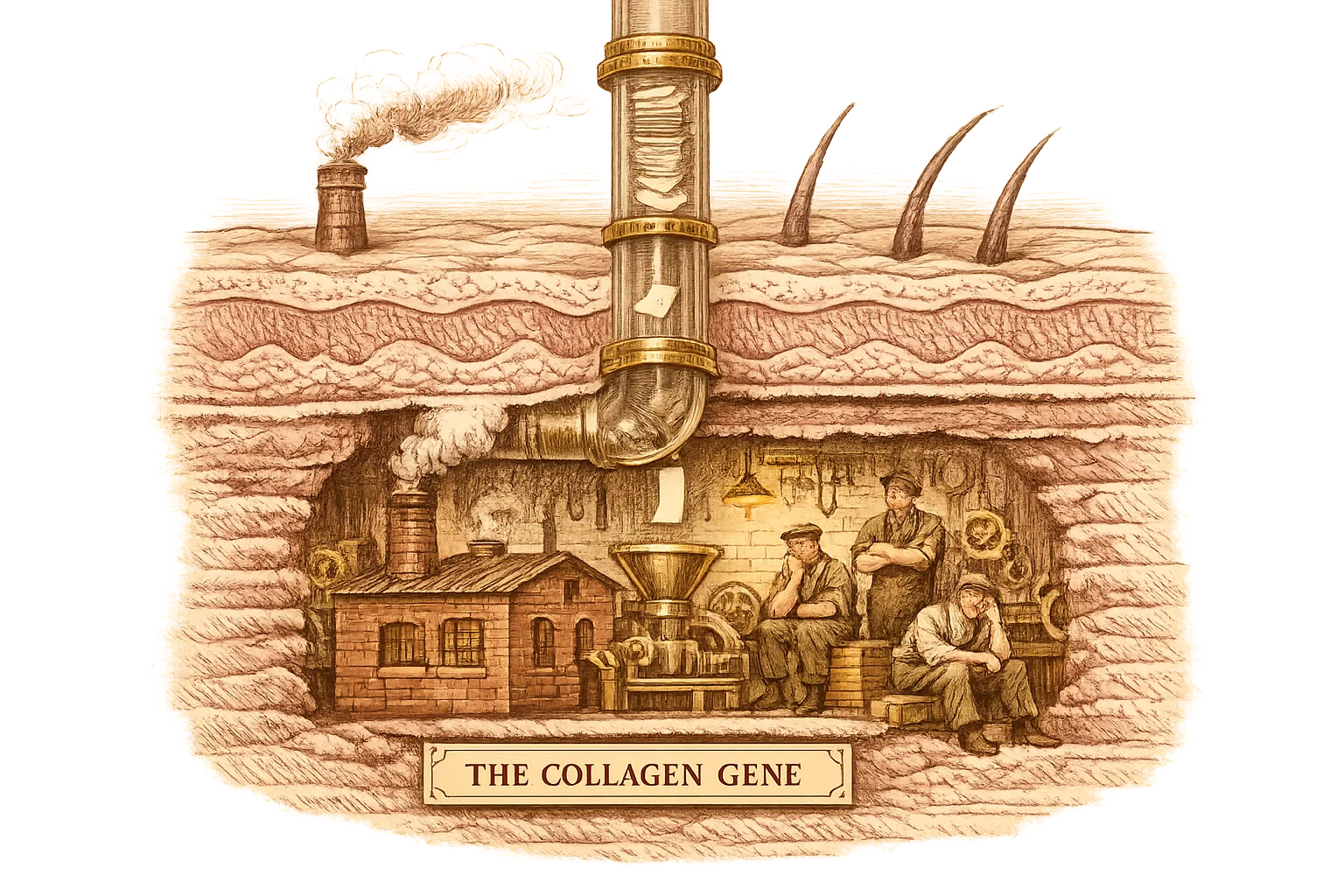
They're called fibroblasts, and they're the little factories in that deeper layer whose whole job is to spin out new collagen and lay it down like scaffolding under your face.
The factory never closes.
What changes is the work order.
There's a gene inside those cells that tells them how much collagen to make.
With age, that gene dials down.1
The building was never demolished.
The instructions just got quieter, year after year, until barely anything was coming off the line.
We call it The Collagen Gene, and once you see the problem that way, every failure in your bathroom drawer starts making sense.
Because if collagen had simply run out, there'd be nothing to talk about.
Nobody refills an empty tank from the outside.
But a factory that's still standing and just isn't getting orders is a completely different situation.
That's not a dead end.
That's a question, and the question is what turns the orders back up.
Hold onto that, because we're coming back to it with a six-month trial and a set of skin biopsies.
Why It Speeds Up: The Collapse Cycle
The dial-down explains the slow 1% a year.
It does not explain the two years.
For that you need what researchers at the University of Michigan found when they looked at aged skin under high magnification, and honestly, it's the most useful thing I've ever read about a face.16
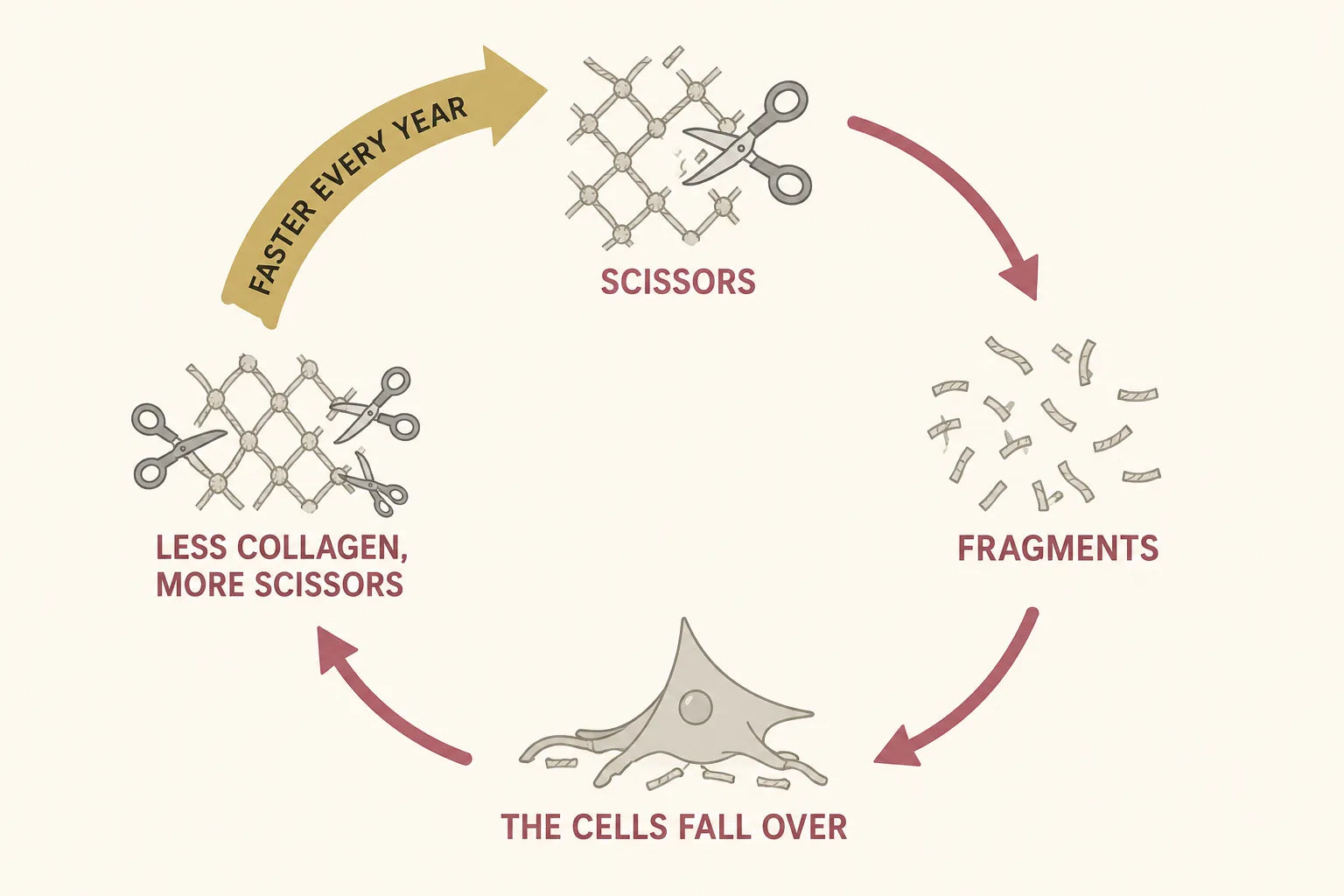
Picture that collagen scaffolding as a taut net stretched under your skin.
Your fibroblast factories don't float in space above it.
They physically grab that net and stretch themselves across it, the way a tent needs its guy-ropes pulled tight before it will stand up.
A stretched fibroblast is a working fibroblast.
Now bring in the villain.
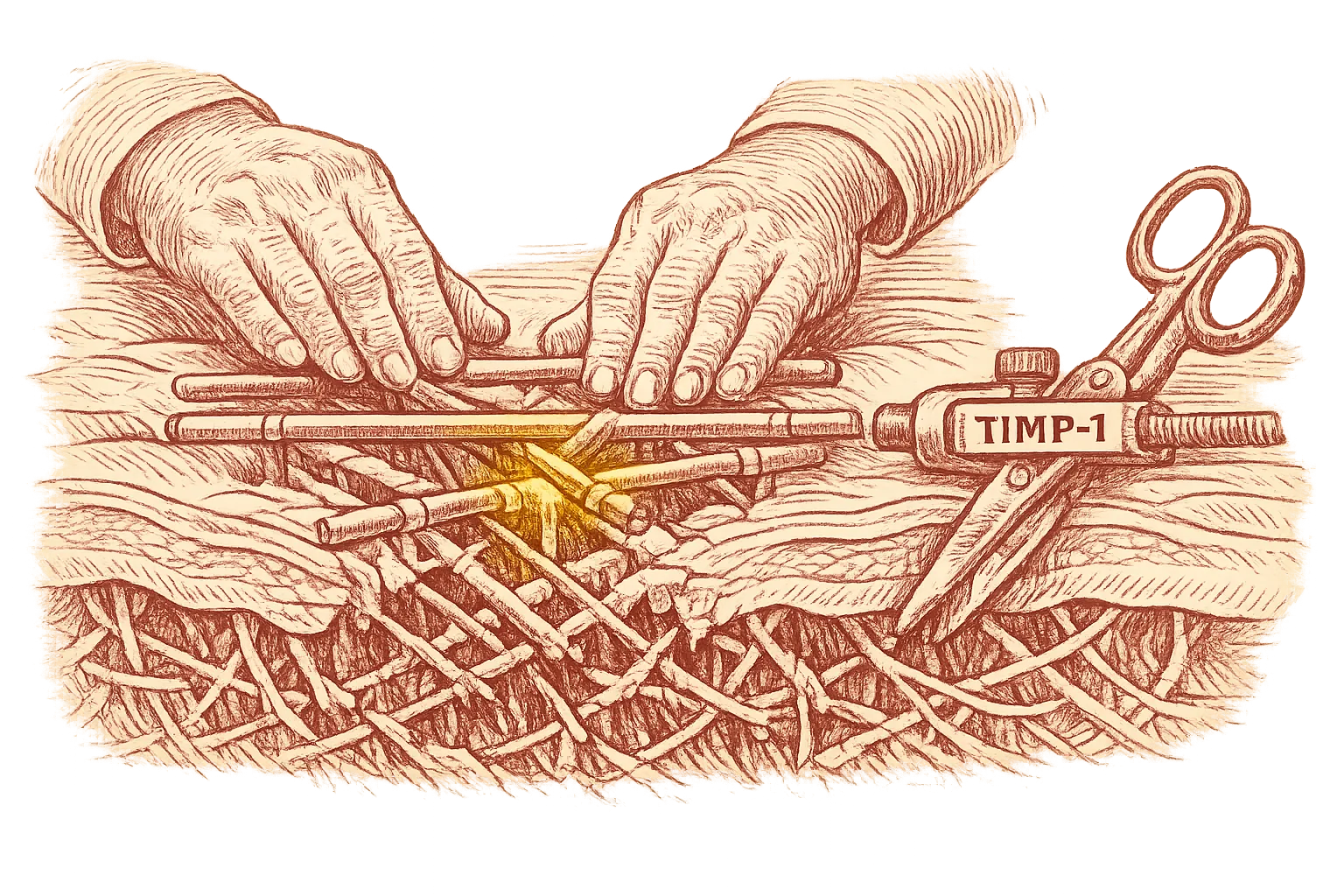
There's a family of enzymes in skin called MMPs.
Think of them as tiny scissors whose job is to snip old collagen so new collagen can be laid in its place.
Useful in moderation, and a disaster when there are too many of them.
Sunlight, and the free radicals that ride in with it, sets those scissors loose.18
It's why photoaging is estimated to account for 80 to 90% of what we call a visibly aged face.
And once the net is snipped into short fragments, the tent has nothing left to hold.
The fibroblast can't grip a fragment, so it lets go, shrivels, and slumps over on its side.
Collapsed.
Here's the sentence that changed how I think about all of this.
A collapsed fibroblast doesn't just make less collagen.
It makes MORE of the scissors.16
Read that one twice, too.
Broken collagen knocks the cells over, and the knocked-over cells break more collagen.
The loop feeds itself.
Researchers found the fragments themselves crank up oxidative stress and scissor activity inside the cells of aged skin.17
That's your two years.
Not a slope that finally got steep, but a loop that finally got loud.
And a loop is very different news from a decline, because a decline only runs one direction, and a loop can be interrupted.
Now The Part That's Going To Make You Angry
Every single thing you have ever bought for your face was aimed at the wrong layer.
I'm not being dramatic. I mean it geographically.
A moisturizer works on the stratum corneum, the outermost sheet of your skin.
That sheet is about 0.02mm thick, which is roughly a fifth of the width of a single human hair.
Hydrating it is a genuinely good thing to do.
Hydrated skin looks plumper, and lines look softer, the same morning you do it.
But the collapse cycle is running about 2mm down.

Two millimetres does not sound far.
For a molecule sitting on a surface film, it might as well be the far side of the moon.
So here's what actually happened over the last thirty years of your life, and I want to say it plainly, because you've been carrying the blame for it.
You did the routine.
You bought the jars, you used them nightly, you didn't skip, and the mirror kept losing ground anyway.
That was never you being lazy, or gullible, or "not taking care of yourself."
That was thirty years of faithful watering, on the roof, while the basement gave way underneath you.
And nobody selling you the watering can ever mentioned the basement.
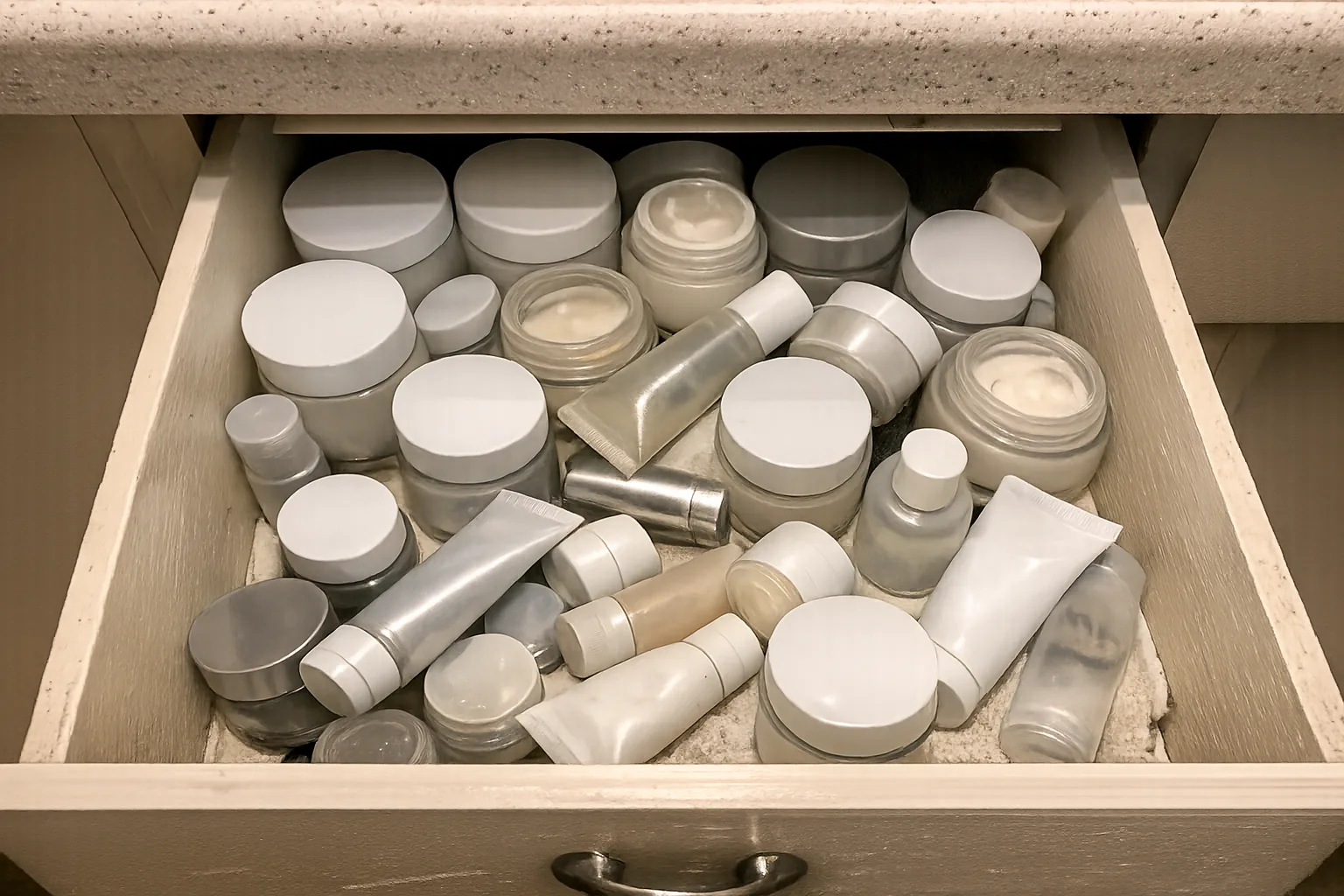
Let's go through that drawer, because every jar in it failed for a reason you can now name.
They wet the top film, and that film looks better for a few hours. Nothing happening in the loop underneath ever hears about it.
Hyaluronic acid is a genuinely good humectant, and it's in what we make. But hyaluronic acid is a moisture story from start to finish, with no answer at all for a collapsed cell or a loose pair of scissors.
Same layer, better packaging, worse price.
That one isn't a product, and it costs the most of all. It's the decision to stop looking, wearing wisdom as a disguise.
That's the drawer.
Four kinds of failure, one single cause: the wrong layer.
Why I Went Looking
I'm Mary Miller, I'm 61, and I'm a herbalist.

We started Old World Healing because the old remedies deserved better than being filed under folklore.
I need to tell you about the small, stupid moment that sent me into the journals, because I think you may have had one of your own.
I was at lunch with my daughter about three years ago.
The waiter came to the table and took her order looking right at her, the whole time, the way people do.
Then he turned to me and asked what I'd like while looking down at his pad.
That's it. That's the whole event.
He was perfectly polite and he did nothing wrong.
There's no complaint to make about a young man writing down a lunch order.
And I sat in my car afterward in a parking lot at two in the afternoon, both hands still on the wheel, and cried like somebody had died.
Then I caught my own eyes in the rearview mirror, red and swollen, and got absolutely furious with myself for crying.
Because I'm not vain. I've never been vain.
And people my age are supposed to be past this.
Here's what I actually wanted, and it's so small it's embarrassing to write down.
I wanted him to look up.
Not to be thirty again, and not to be beautiful.
Just to be registered, for half a second, as somebody who was still in the room.
If you've ever felt that and then felt ridiculous about feeling it, I'd like you to stop feeling ridiculous right now.
That feeling is not vanity.
That's the feeling of being looked past, and it's one of the quietest, lousiest things that happens to people as they get older, and almost nobody ever says it out loud.

So I did the only thing I know how to do when something hurts.
I read.
Months of it, in dermatology journals rather than beauty magazines.
Studies with skin biopsies in them, not before-and-after photos shot under two different lamps.
And here's the thing that stopped me cold, because it made a joke of my whole career.
The answers to the collapse cycle were sitting in the exact plants my grandmother pressed onto her hands and face in a farmhouse kitchen, decades before anybody had heard of a fibroblast.
She never knew why they worked.
The journals do.
The 3 Tightening Herbs
Here's what the old kitchens reached for, and what modern research says was actually sitting in those bowls.

One thing before we go any further, because I'd rather you trust me than be impressed by me.
When I say the three tightening herbs, I'm talking about where these things came from, not about pouring pressed oil into a bottle.
Rosehips are where the tightening vitamin was found.
Wheat germ is where the shield vitamin was found.
What goes in the bottle is the vitamin itself, in the purified form the studies actually used, not the raw oil my grandmother squeezed out through a cloth.
The plants are the receipt. The research is the reason.
Now let me show you all three.
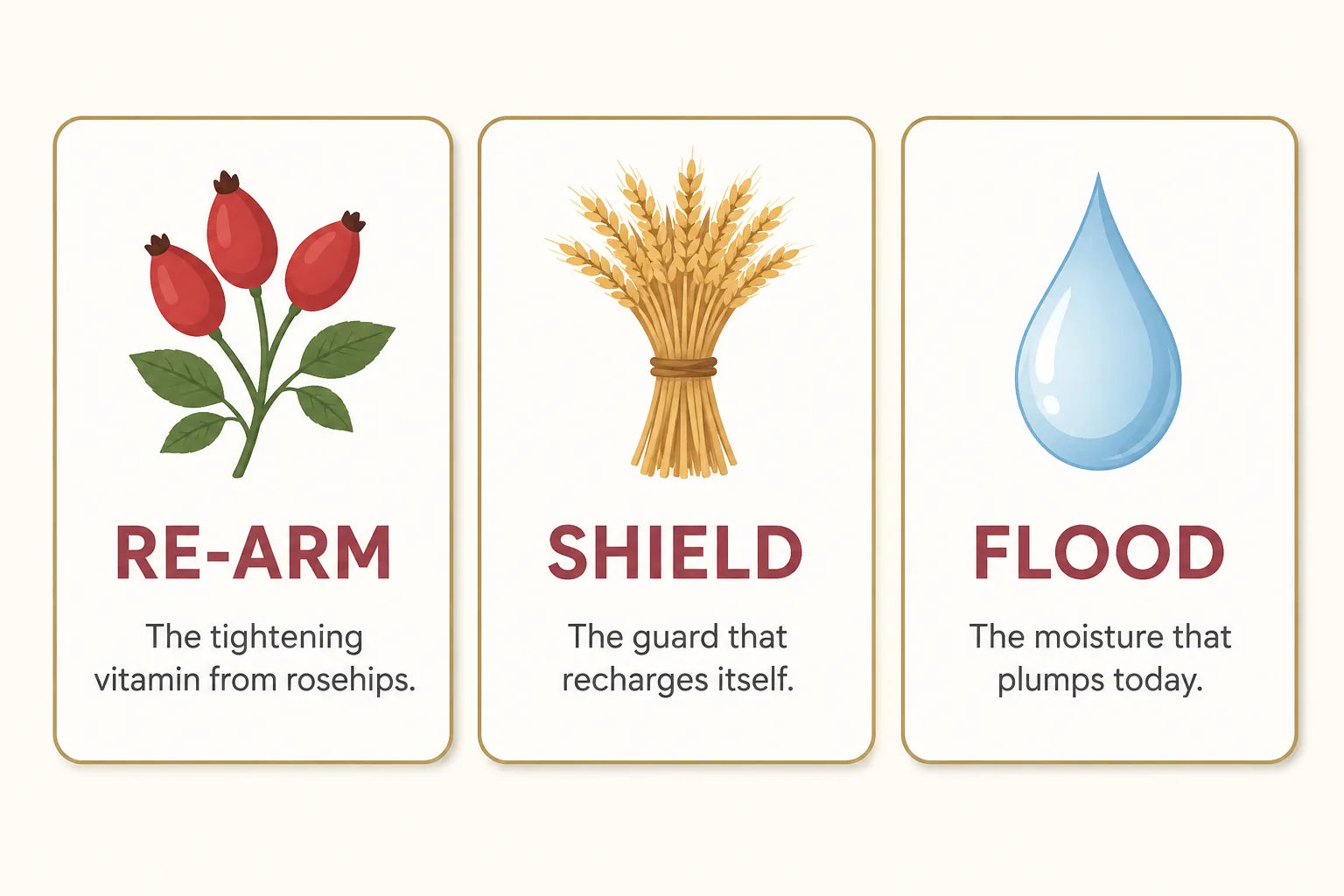
Tightening Herb #1: The Rosehip. The Re-Arm.
Rosehips are the little red fruit left behind on a rose bush after the flower drops.
They're also one of the most concentrated sources of vitamin C in the entire plant kingdom.
Rosa canina has been measured as the highest vitamin C content of any wild edible fruit, at over 1,200mg per 100g of fresh fruit.19
Farm families never knew that number.
They knew the syrup, and they knew what the oil did for a chapped face in February.
Here's what the vitamin was doing.
Your skin cannot physically assemble collagen without vitamin C present.6
Not "collagen works better with vitamin C." Cannot.
The enzymes that lock collagen strands together and hold them locked need vitamin C sitting right there as a required part, every single time.
No vitamin C in the skin, no rivets in the scaffolding.
And the vitamin C stored in your skin drops as you age, and drops harder with sun exposure.
So picture the factory again.
The work order went quiet, and the one part the assembly line can't run without has been getting scarcer for twenty years.
Now, the trial that made me get up and walk around the room.
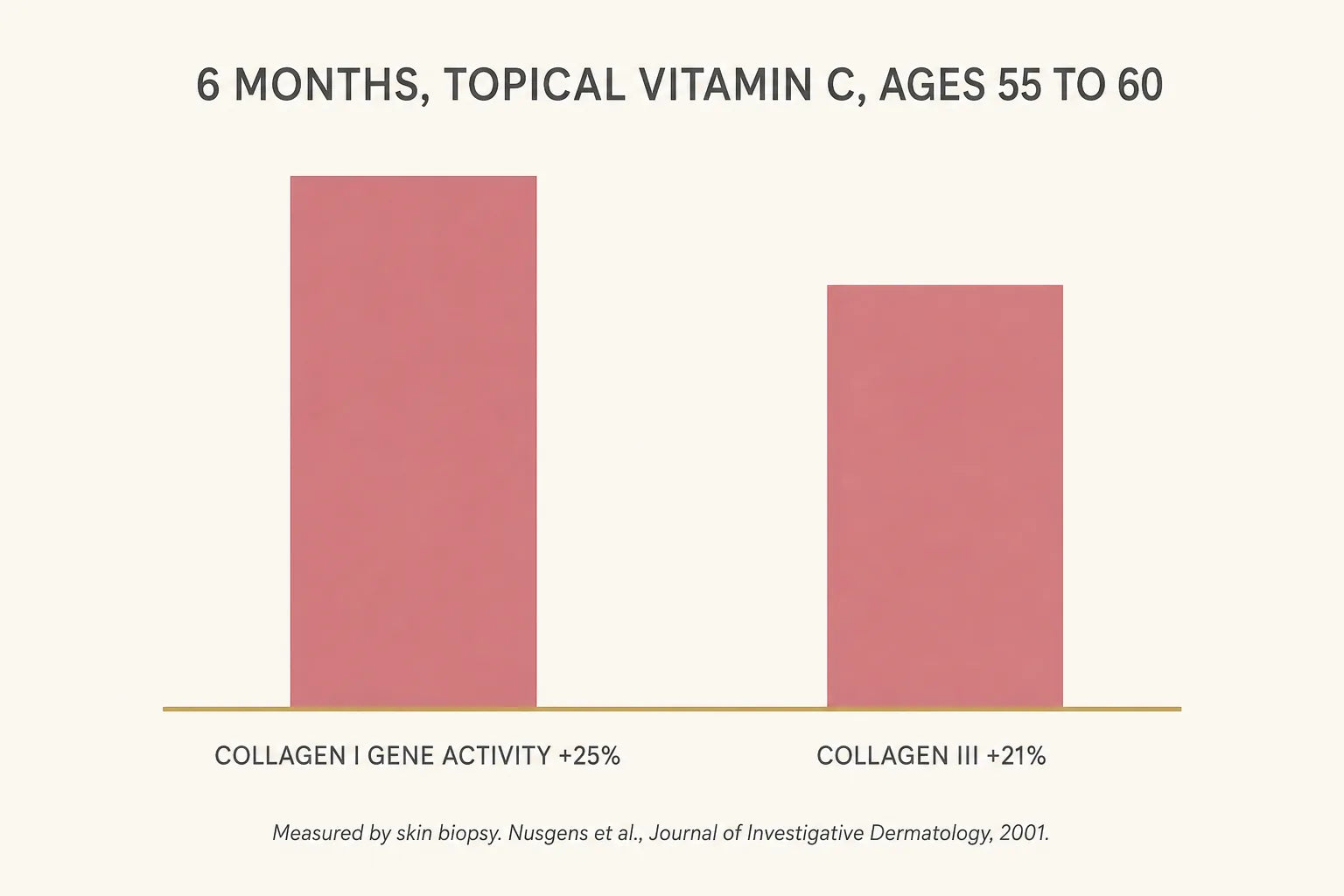
In 2001, researchers ran a randomized, placebo-controlled study of topical vitamin C over six months.1
The participants were postmenopausal women aged 55 to 60, not twenty-somethings and not a dish in a lab.
At the end they took real skin biopsies, because they wanted to see what the gene was doing rather than what the marketing was doing.
Collagen I gene activity: up 25%.
Collagen III: up 21%.
The dial went back up.
I want to be careful with you here, because this is exactly the point where the beauty industry starts lying.
That study was run on an ingredient, not on our bottle.
Nobody has ever put Old World Beauty itself through a clinical trial, and I'll say that as many times as it takes.
So what the study tells us is not "buy this."
It tells us something much better, and much rarer.
It tells us the gene was never broken.
Six months of a vitamin your great-grandmother kept in a jar of rosehip syrup, and cells in people in their late fifties were reading the order sheet again.
There was a second finding in that trial that gets almost no attention, which is a shame, because it's the one that answers the loop.
The vitamin C also raised TIMP-1.1
TIMP-1 is your body's own brake on the scissors.
So it isn't only "make more." It's "make more and snip less," in the same layer, over the same six months.
That is the collapse cycle being pushed backwards.
Tightening Herb #2: The Wheat Germ. The Shield That Recharges.
Wheat germ is the little heart of the wheat kernel, the part the mill strips out.
It's the richest natural source of vitamin E there is.20
Old kitchens rubbed that oil into hands, elbows and faces all winter, with no idea they were handling the best antioxidant on the farm.
Vitamin E does one specific job, and it does it in a place vitamin C can't reach.
Your skin has a watery part and an oily part, and vitamin C only guards the water.
Vitamin E guards the oily membranes of your cells, which is exactly where sun damage does its worst work.
Remember what sets the scissors loose? Free radicals from UV light.
Vitamin E is the guard standing at that door.
But here's the flaw nobody tells you about, and it's why so many serums quietly underdeliver.
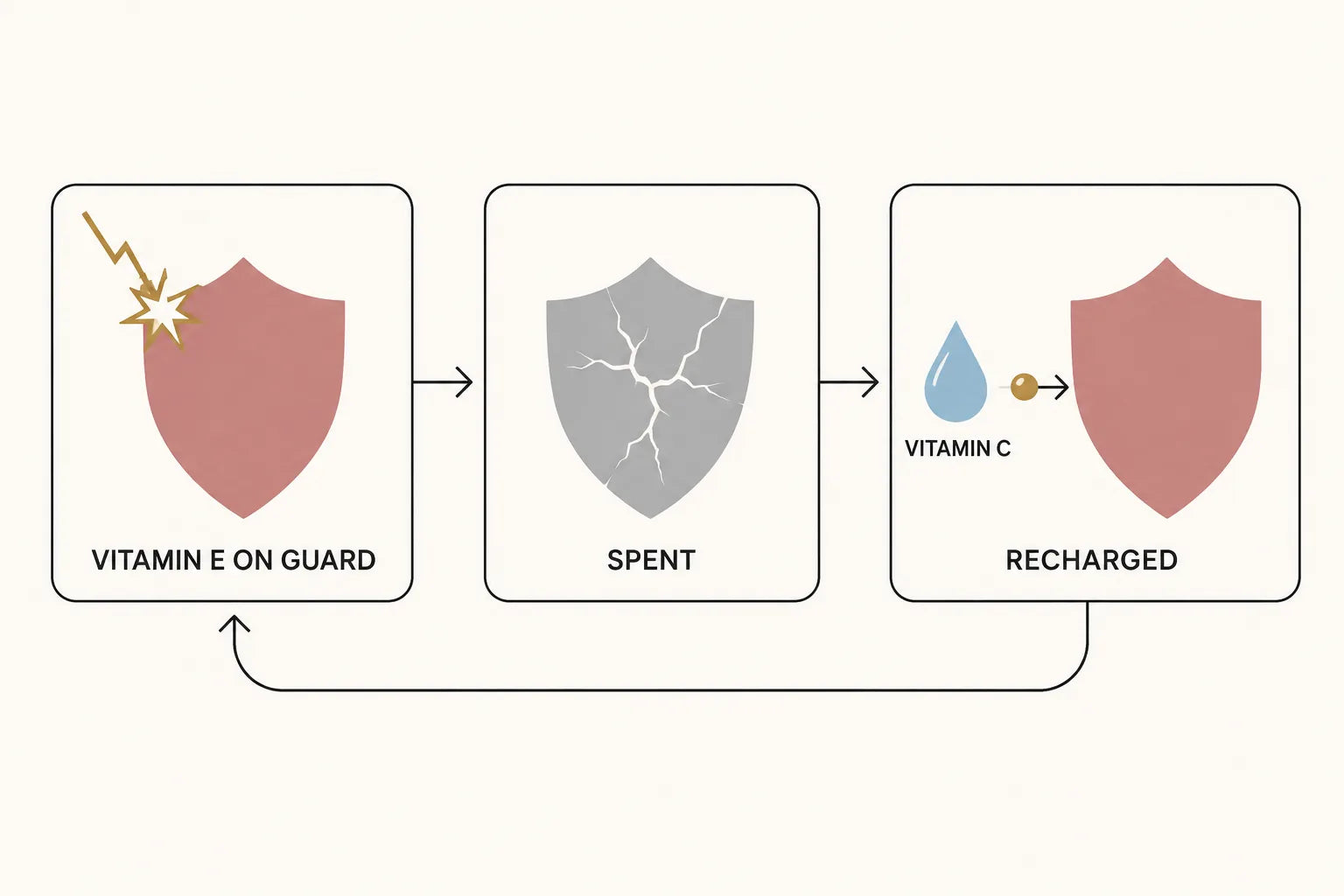
Every free radical vitamin E catches, it pays for.
It neutralizes the radical by giving away an electron, and in doing so it spends itself.
What's left is a guard with an empty rifle, still standing at the door.
By late morning on a bright day, a lot of your vitamin E is spent.
Now the beautiful part, and this is real biochemistry, not a metaphor I invented.
Vitamin C walks up to spent vitamin E and hands it an electron back.8
The guard reloads and goes back to work.
One vitamin recharging the other, electron by electron, all day long.
This is not a small effect.
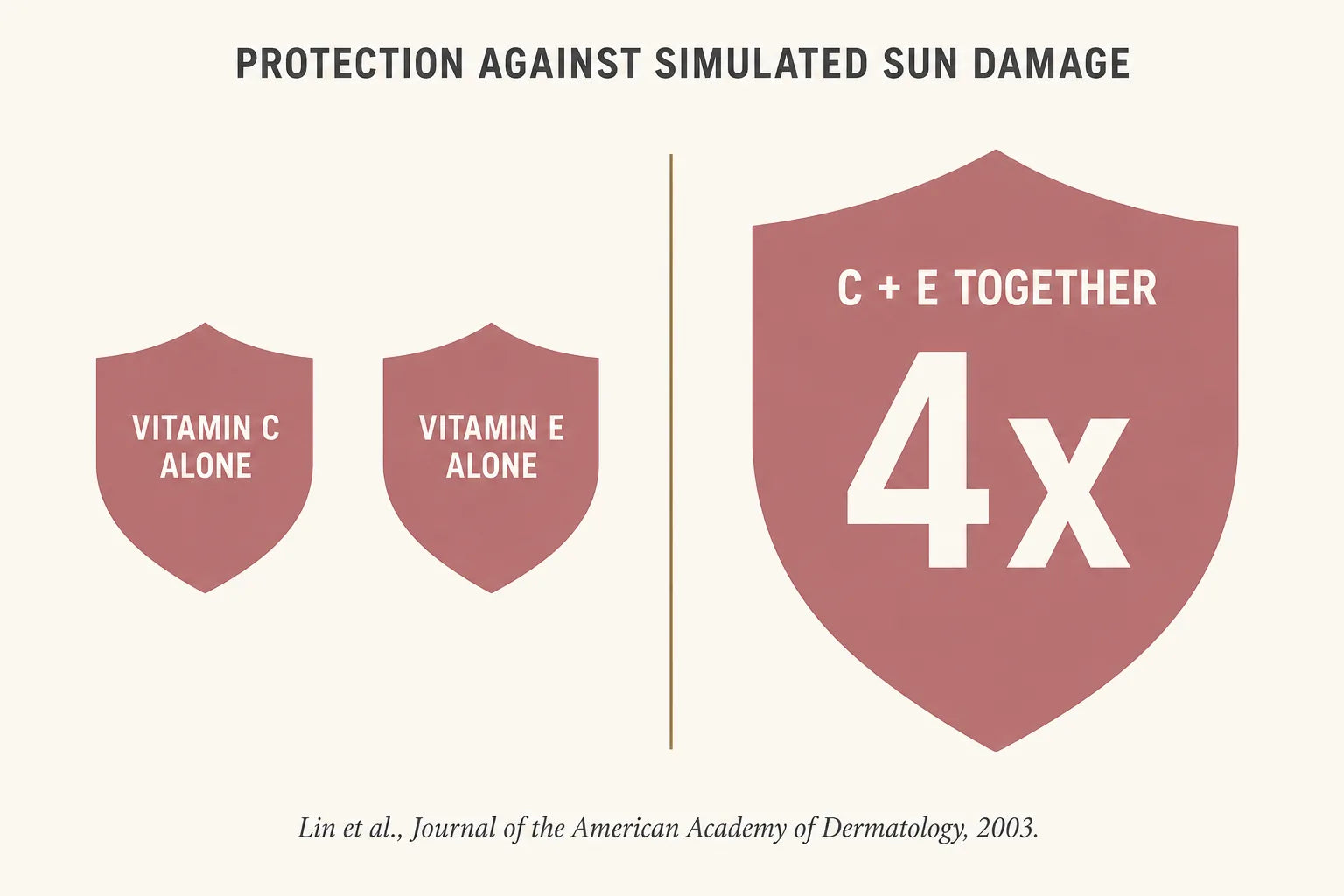
In a controlled human study, vitamin C and vitamin E used together gave roughly four times the protection against simulated sun damage, and the pair beat either vitamin used alone.7
Four times the protection, purely from pairing them.
And this is the part that still gives me chills, three years later.
My grandmother put rosehip oil and wheat germ oil on her skin out of the same handful.
Not because she understood electron transfer.
Because that's what was in the pantry.
The old recipes accidentally got right the exact pairing that dermatology journals wouldn't be able to explain for another century.
Tightening Herb #3: The Water. The Flood.
The third one is the layer everybody else sells, and I'm going to give it its proper place.
Important and visible and fast, and absolutely not the engine.
This is the moisture move: hyaluronic acid, with glycerin alongside it.
Hyaluronic acid binds a spectacular amount of water, up to about a thousand times its own weight, and your skin's own supply of it falls off sharply with age.
Put it on the surface and the top layer drinks.
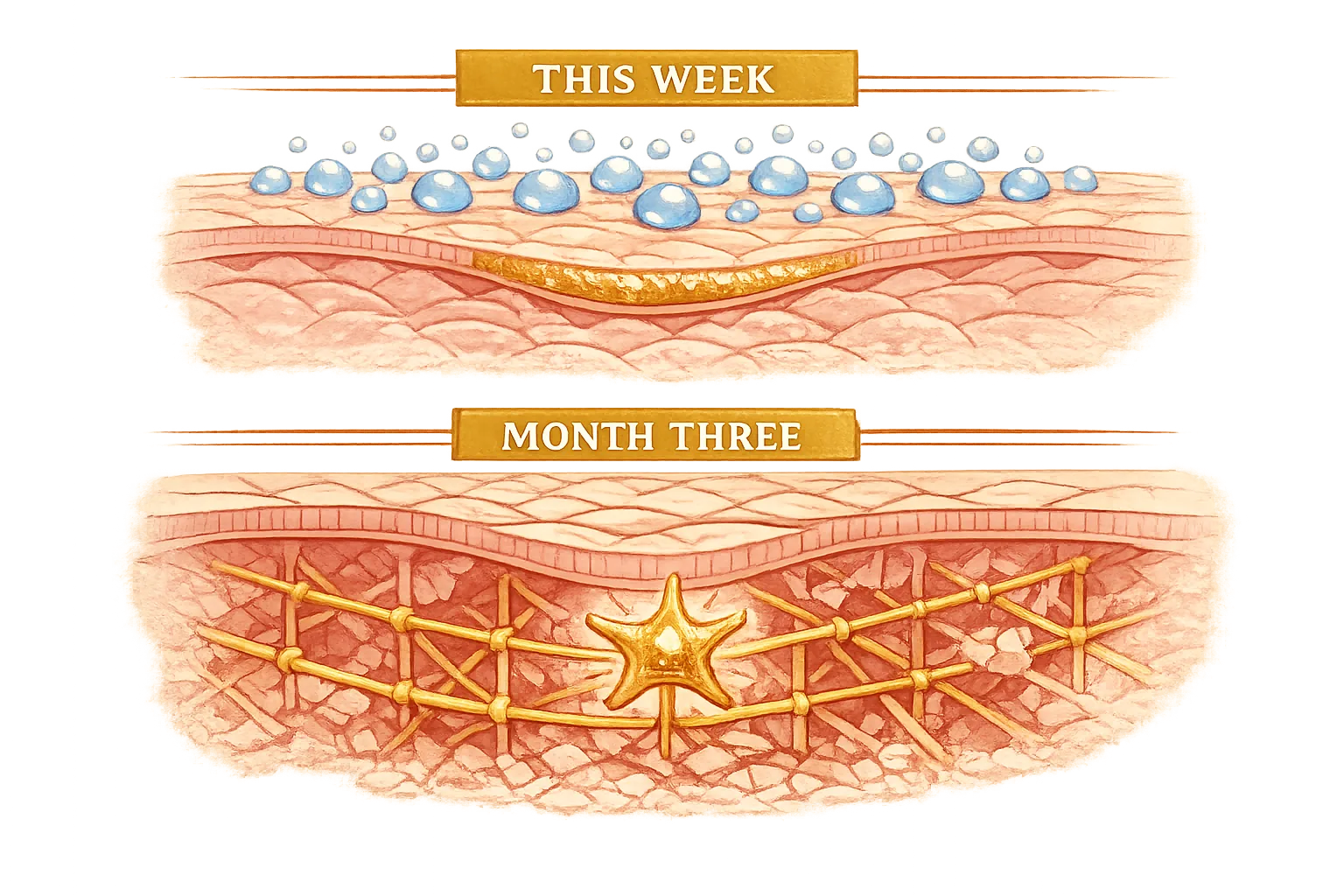
Lines that were sitting in dry, sunken skin suddenly have something underneath them again.
The numbers here are good, and they're fast.
In one clinical evaluation of a topical hyaluronic acid formula, hydration measured up 24% at four weeks and 38.9% at twelve weeks, with every single participant improving on hydration.10
In a separate clinical evaluation, the appearance of fine lines measured down 31% after six weeks.11
And in a study of 76 people aged 30 to 60 using topical hyaluronic acid twice a day for 60 days, hydration and elasticity both improved, with the smaller molecular forms measurably reducing wrinkle depth.9
Then there's glycerin, the least glamorous ingredient in skincare and quietly one of the best.
In head-to-head instrument testing against hyaluronic acid, urea, lactic acid and propylene glycol, glycerin came out as the most effective humectant of the lot.12
A cream containing glycerin has also been shown in controlled testing to significantly raise skin hydration and support the skin's barrier.13
So the third herb isn't the hero. It's the one you notice first.
It's the layer that makes the mirror kinder this week, while the other two do the slower work underneath.
What Happens When Somebody Actually Puts This On A Face
Gene activity in a biopsy is thrilling to a herbalist and abstract to a human being with a mirror.
So here's the rest of the research, measured on skin you can see.
In a double-blind, placebo-controlled trial running six months, topical vitamin C produced significant improvement in deep furrows and in the fine texture of the skin compared to placebo.
Under an electron microscope, the elastic tissue underneath had visibly changed for the better.2
In a randomized, double-blind, split-face study over three months, one side of each face got vitamin C and one side didn't.
The vitamin C side scored significantly better overall, and computer-assisted surface mapping confirmed smoother skin.3
In another double-blind half-face trial, biopsies showed new collagen forming, and the amount of new collagen tracked with how much better the skin looked.4
And in a 2023 systematic review of the topical vitamin C trials, every single randomized trial that measured skin surface topography found the vitamin C skin smoother and less wrinkled than control.5
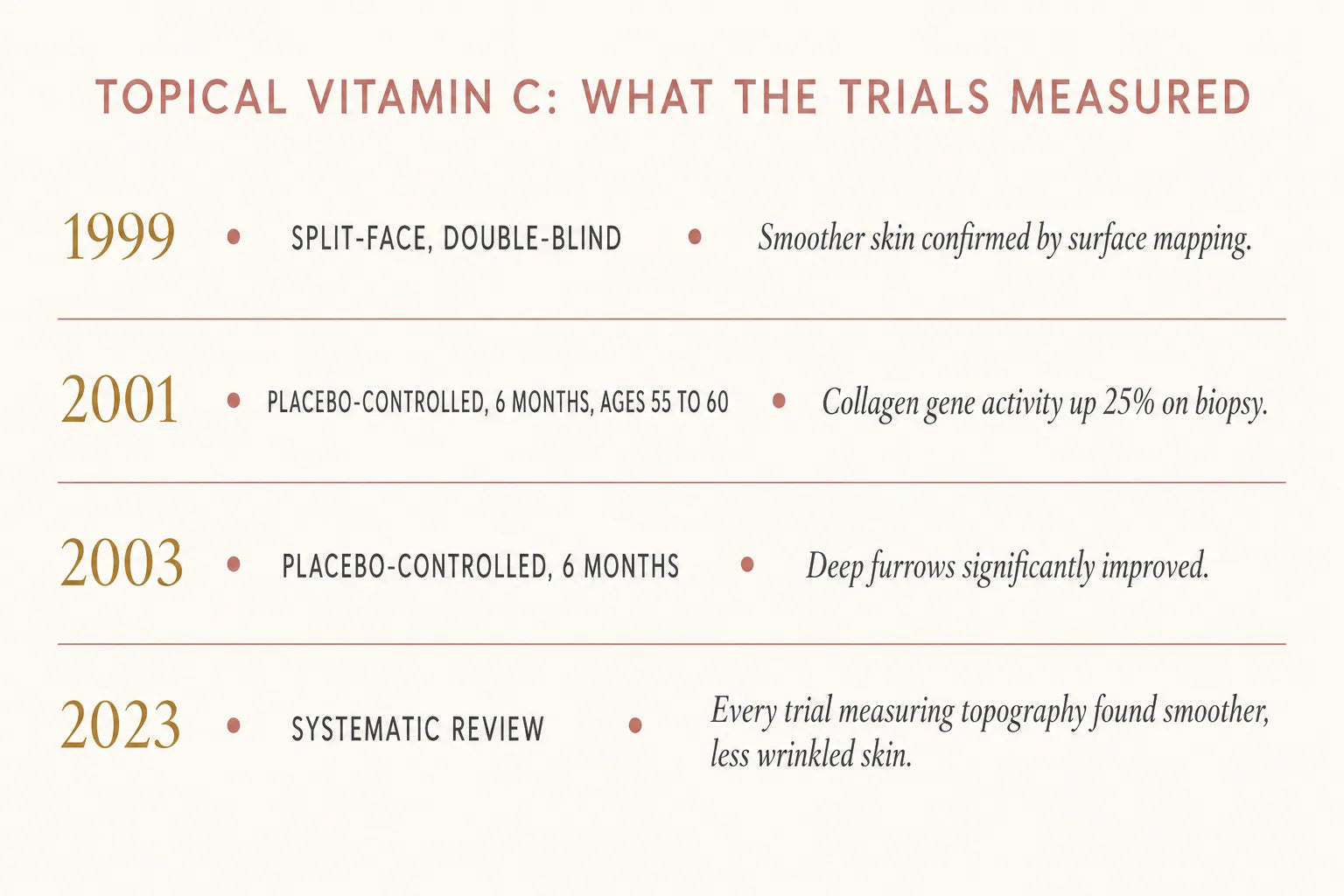
Four separate research groups, in different countries and different decades.
Skin biopsies, computer surface mapping, electron microscopy, and a placebo control on every one of them.
This is the best-evidenced ingredient in cosmetic skincare after retinoids and sunscreen, and the industry has spent twenty years selling you the moisture layer instead.
Now let me show you what we made with it.
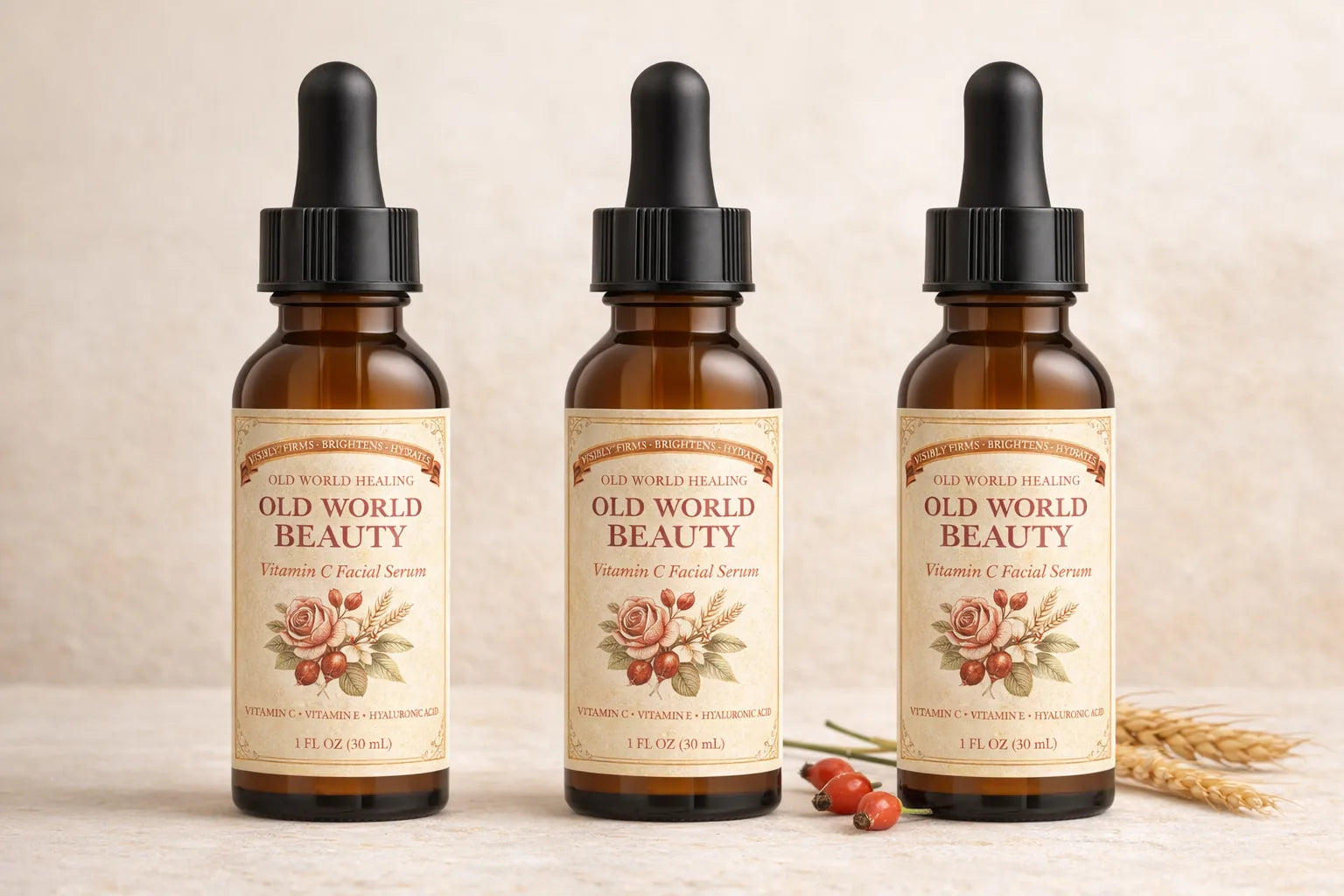
Old World Beauty
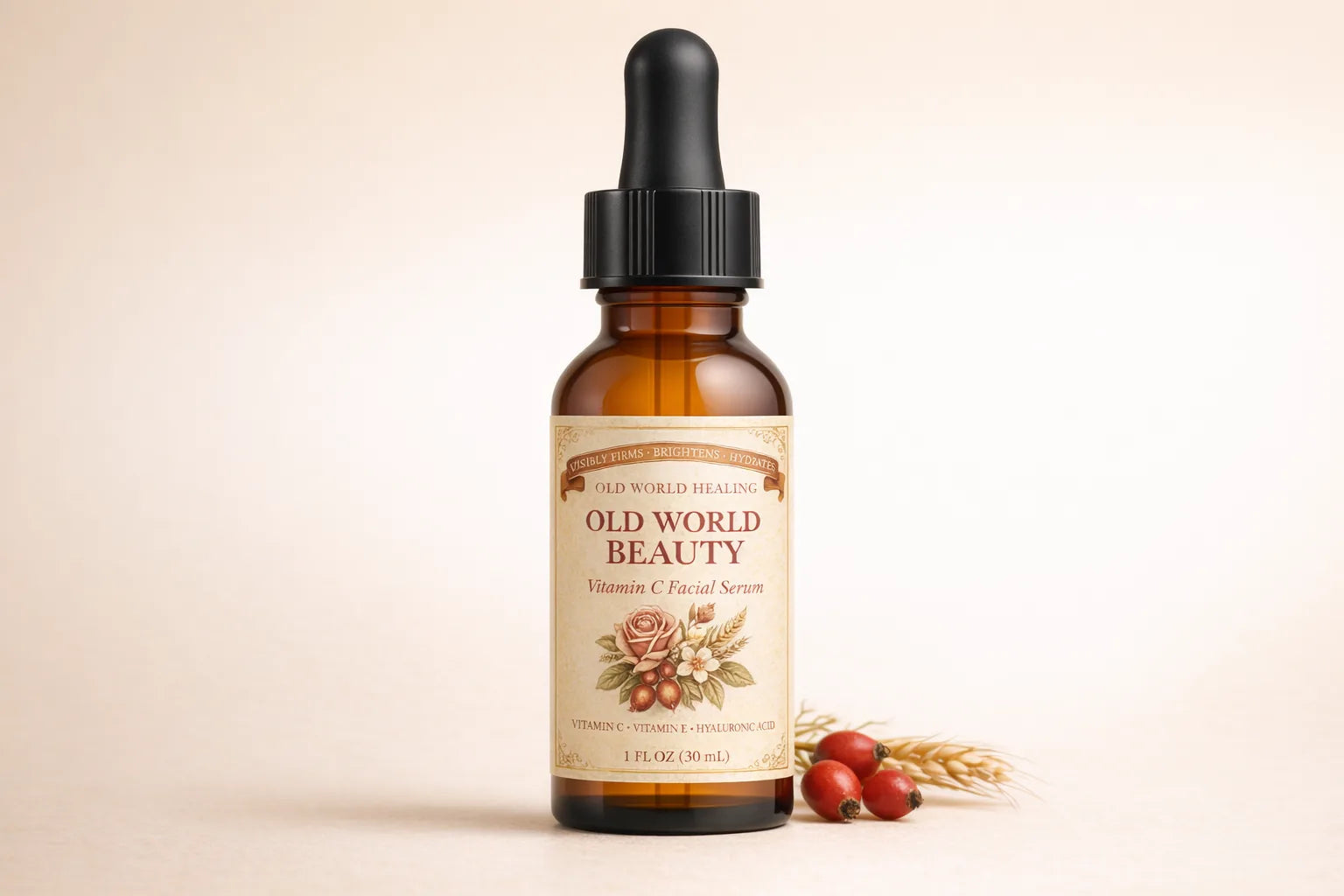
Old World Beauty is a topical serum built from that research, in the order the research suggests.
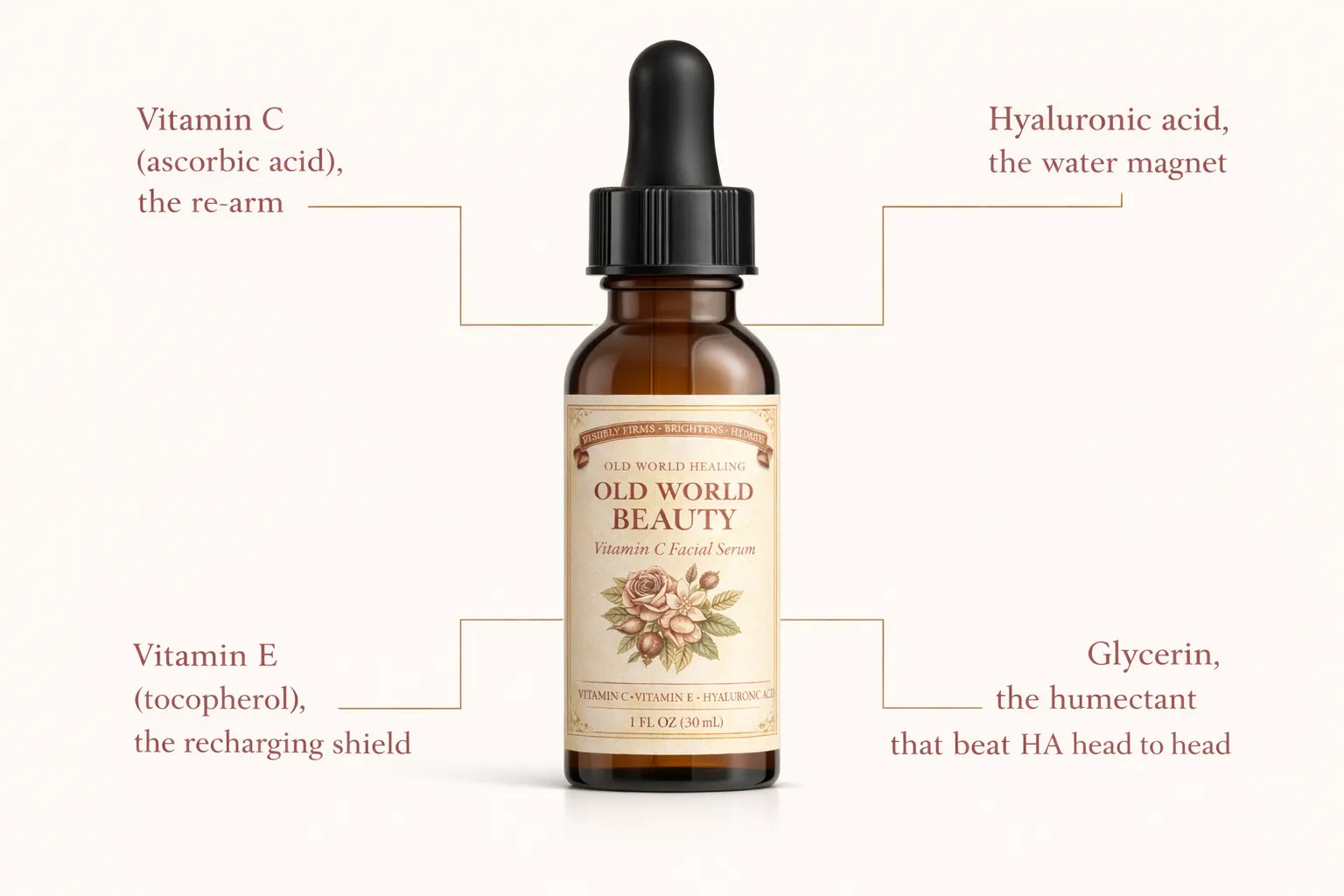
Vitamin C as ascorbic acid, the same form the trials used.
Vitamin E as tocopherol, so the shield has something to recharge.
Hyaluronic acid and glycerin underneath both, so the surface has water to work with while the slower part runs.
That's the whole idea.
Two vitamins that only work properly as a pair, over a moisture layer that lets you see something this week instead of next season.
Here's the full label, because I think you should read it before you buy anything.
Water, ascorbic acid (vitamin C), proprietary anti-aging blend with hyaluronic acid, polysorbate 80, denatured alcohol, dipropylene glycol, glycerin, fructose, sodium hydroxide, tocopherol (vitamin E).
Three honest notes about that label, and then I'll stop lecturing.
The blend is proprietary, and I won't invent a number to sound impressive. What I can tell you is which form of each vitamin is in there, which is more than most bottles on the shelf will tell you.
It's in the formula as a solvent, so I will never call this alcohol-free, and I won't tell you it suits every skin, because I don't know your skin. Patch test on your inner arm first and give it a full day before you go near your face.
The research on this page is research on the ingredients. Anybody who blurs that line is hoping you won't notice, and you deserve better than that from a brand that talks about grandmothers.
The Two Speeds (Read This Before You Order Anything)
I'd rather lose the sale than have you expecting the wrong thing in week one.
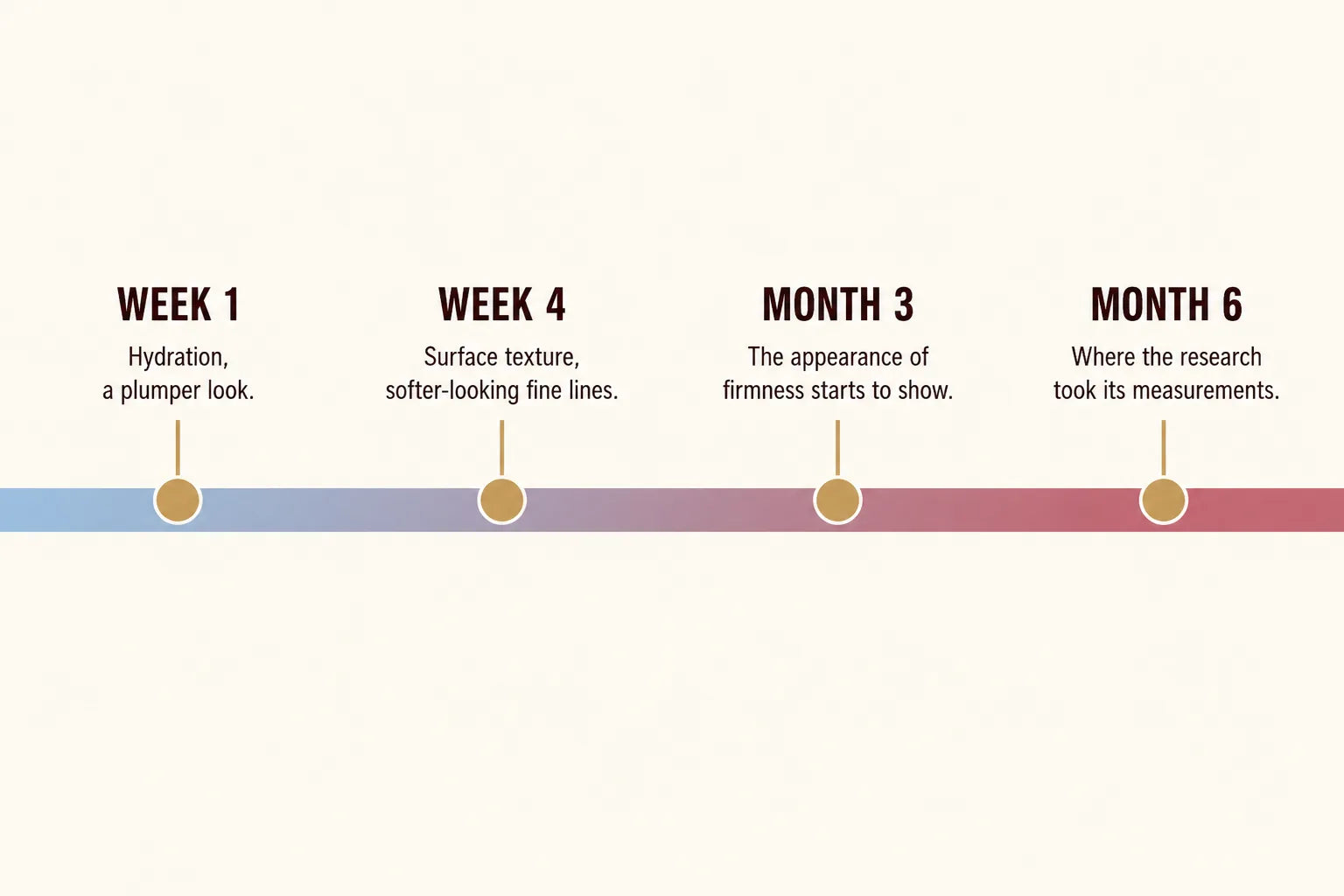
This works at two different speeds, and they're very far apart.
That's the water layer, which shows up as hydration and skin that looks plumper because it isn't sitting dry and sunken. You may well notice it in the first week. That's real, and it's also the easy part, and every decent serum on earth can do some version of it.
That's the vitamin work, down in the scaffolding layer, showing up as the appearance of firmness. The anchor trial ran six months before it took its biopsies, and the deep-furrow study ran six months too. Even the fastest of them, the split-face study, ran three.
Not one of them ran two weeks, because nothing happens at that depth in two weeks.
So if you're going to try this, try it the way the studies did.
Daily, and give it until month three before you make up your mind.
What People Tell Us

A Note On Proof
You may already know us.
Old World Healing started with Old World Relief, our topical cream.
More than 47,000 jars have gone out the door, with a 4.8 rating and over 2,800 five-star reviews.
Old World Beauty is new, so the accounts below are illustrative rather than customer reviews.
Illustrative customer accounts, not verified reviews
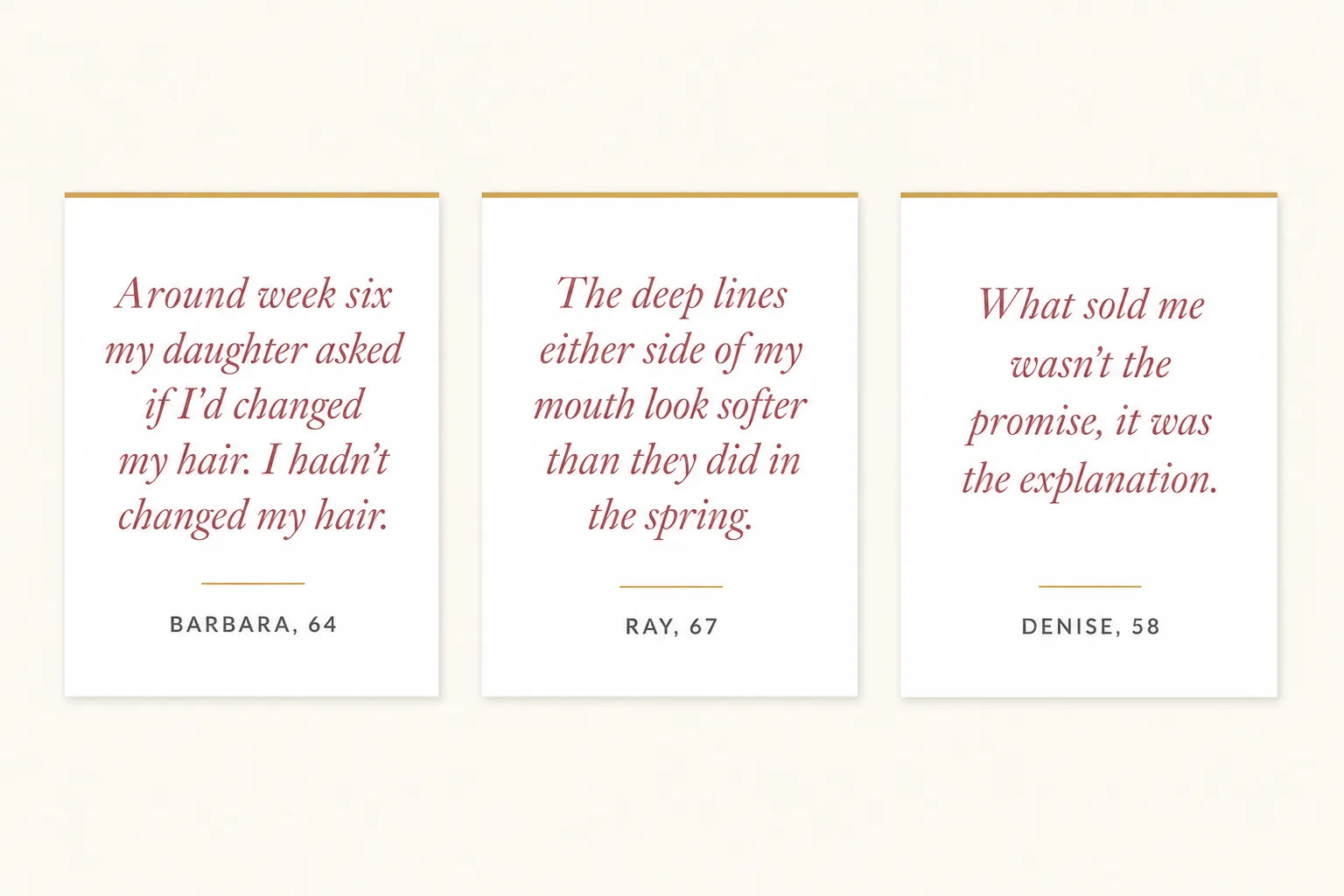
"The first week just felt like good hydration and I nearly wrote it off. Around week six my daughter asked if I'd changed my hair. I hadn't changed my hair. That's when I started looking in the mirror instead of avoiding it."Barbara, 64
"I'm a man who has never owned a serum. My wife bought it, I used it because it was sitting on the counter, and the honest answer is the deep lines either side of my mouth look softer than they did in the spring. That's all I've got. It's enough."Ray, 67
"What sold me wasn't the promise, it was the explanation. Thirty years of moisturizer on the top layer while the actual problem was two millimetres down. I felt annoyed and relieved at the same time."Denise, 58
"I patch tested it first because my skin is fussy and there's alcohol in it. It was fine on my arm, so I carried on. Three months in, the group photo from my son's wedding didn't make me wince. I don't know how else to measure it."Ellen, 71
Getting Your Bottle
Here's what I can tell you today.
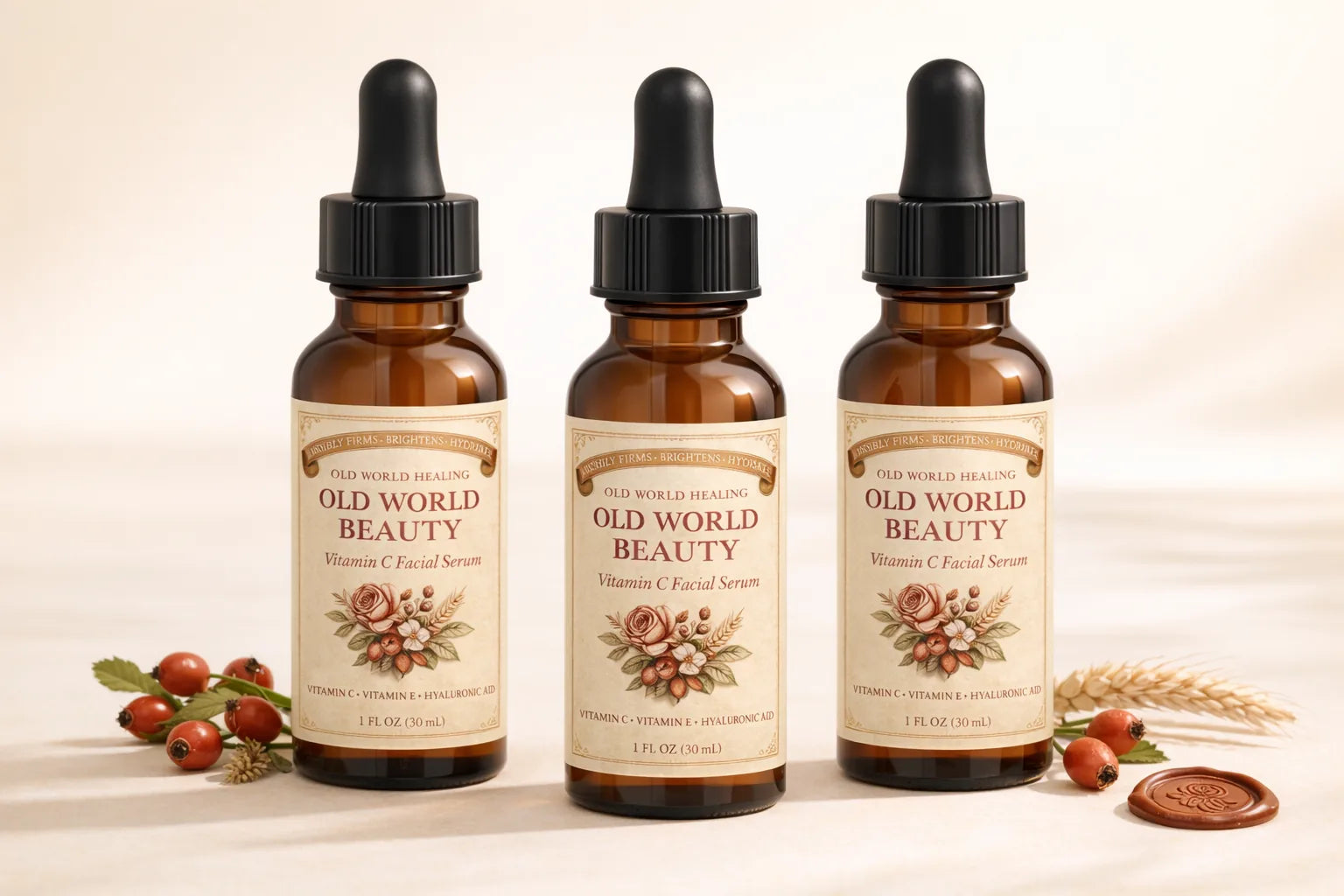
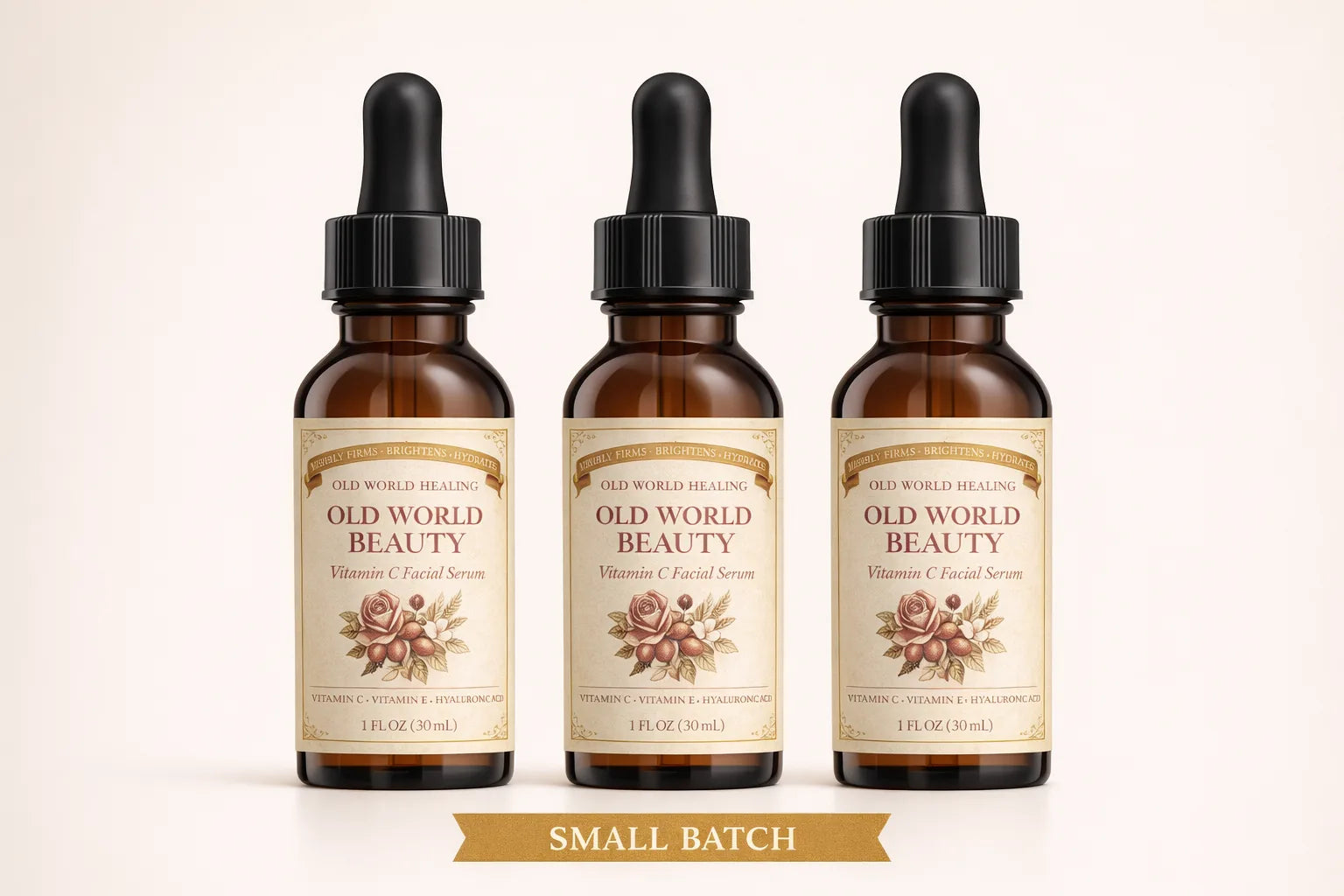
Old World Beauty is made in small batches, the way we make everything.
You can buy it once, or you can subscribe and have a fresh bottle arrive on its own.
A subscription costs $10 a month less than buying the same supply once, and the longer supplies cost less again per month.
Nothing is discounted for a first order and then quietly raised on you.
The subscription price you see is the price it bills at from the very first month.
Every order ships free, subscription or one time.
You can cancel any time before the next ship date, with no fee and no phone call.
And you have 90 days to decide.
If it isn't working for you, email us inside 90 days and we'll refund you in full.
You don't need to send the bottle back.
Ninety days is deliberate, because we told you to judge this at month three.
The multi-month supplies exist for the timeline rather than the discount.
One bottle gets you the water layer.
The vitamin layer is a three-to-six-month conversation, and running out in week five is the easiest way to never find out whether it works for you.
How To Use It
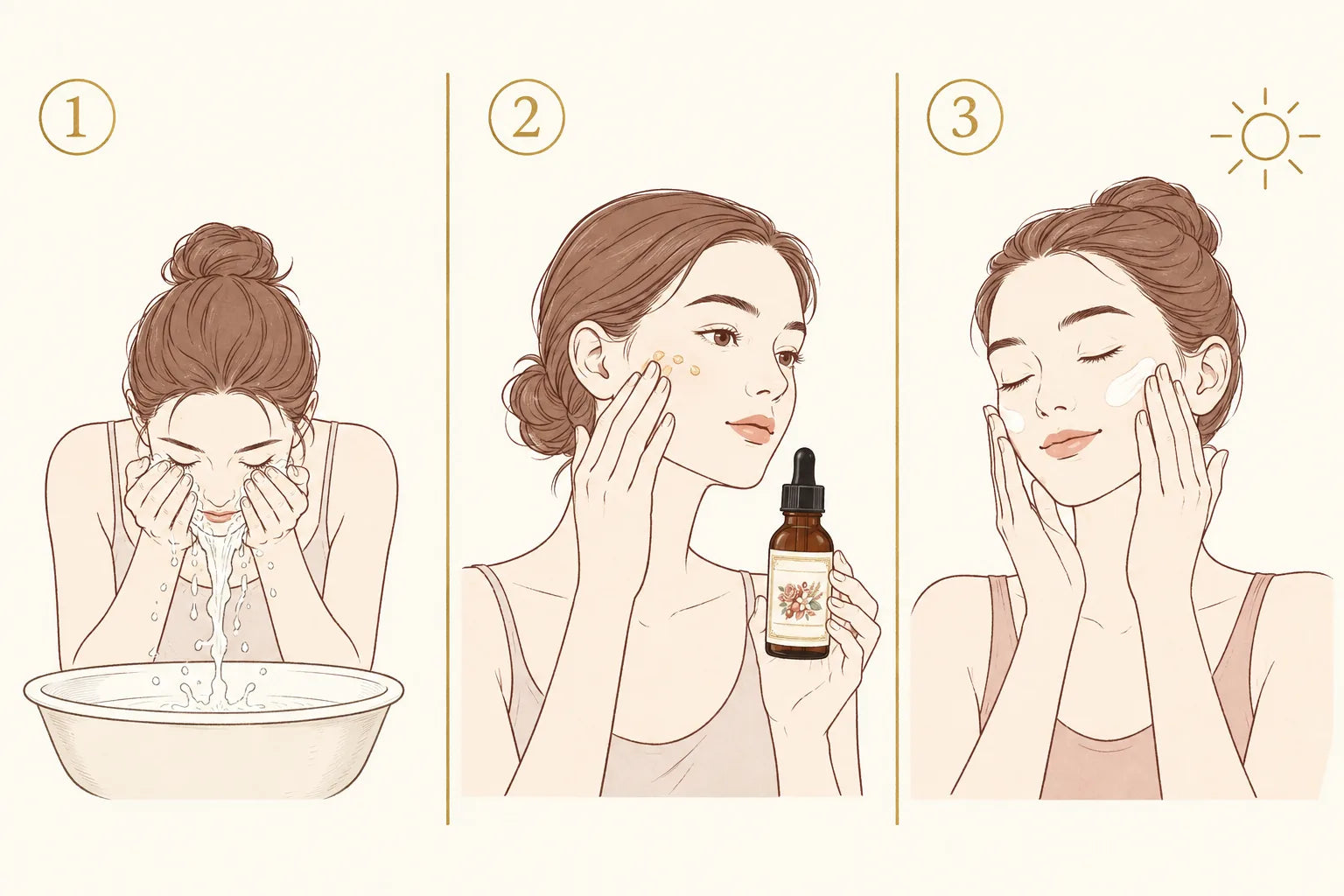
One. Start with clean, dry skin.
Two. Massage one to two droppers of Old World Beauty over your face and neck, avoiding direct contact with your eyes and mouth.
Three. Follow with your usual moisturizer once it has settled, and wear sunscreen during the day.
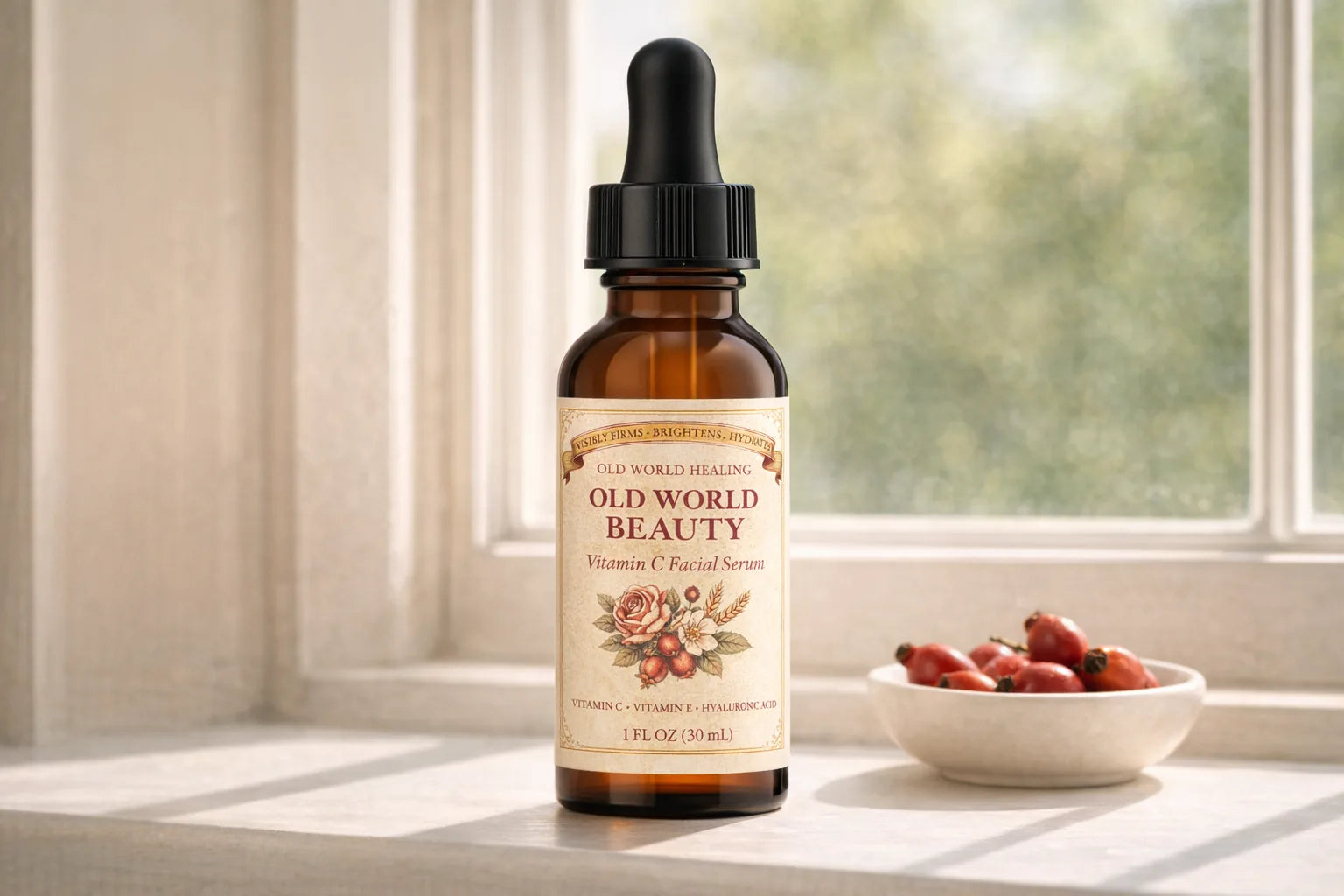
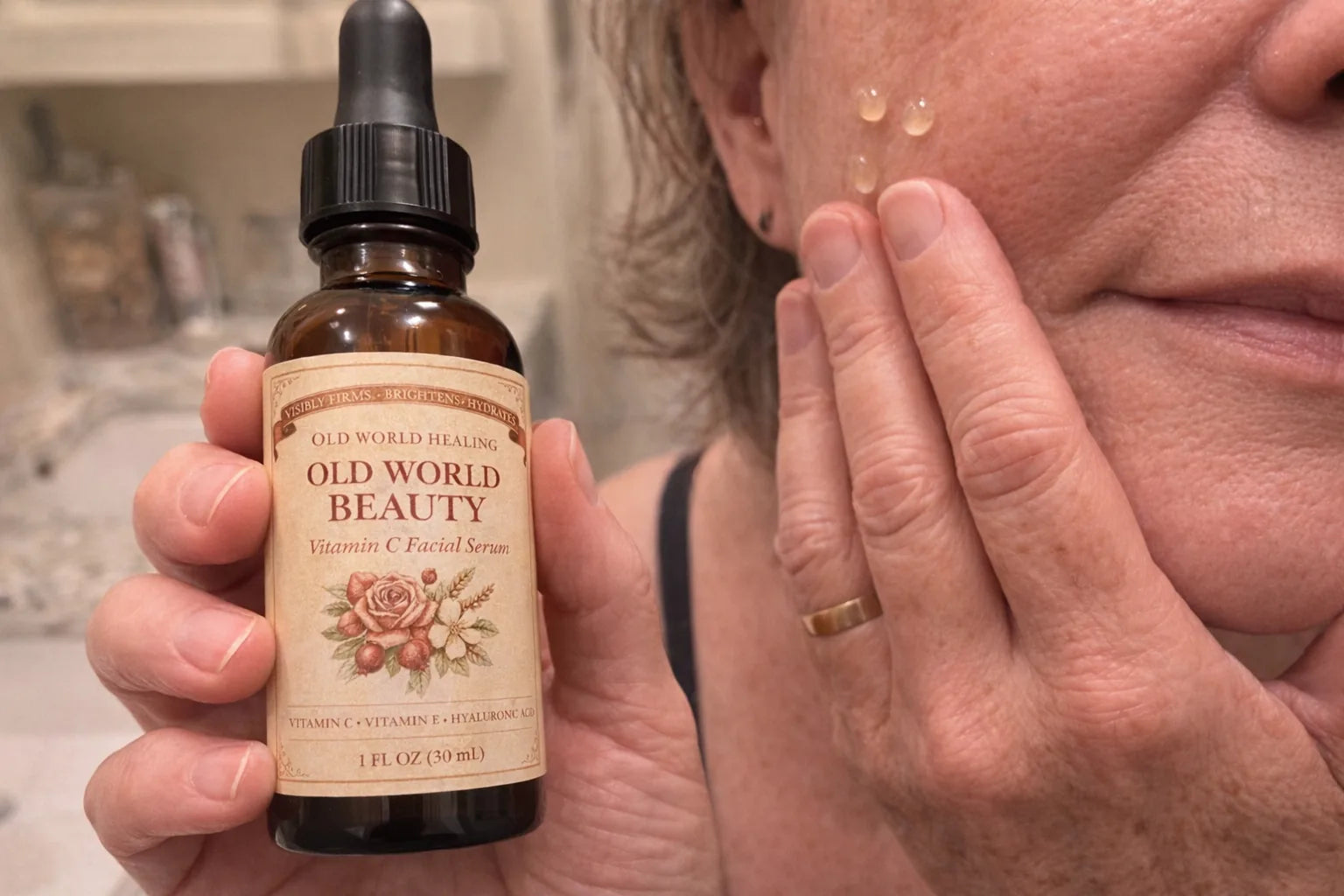
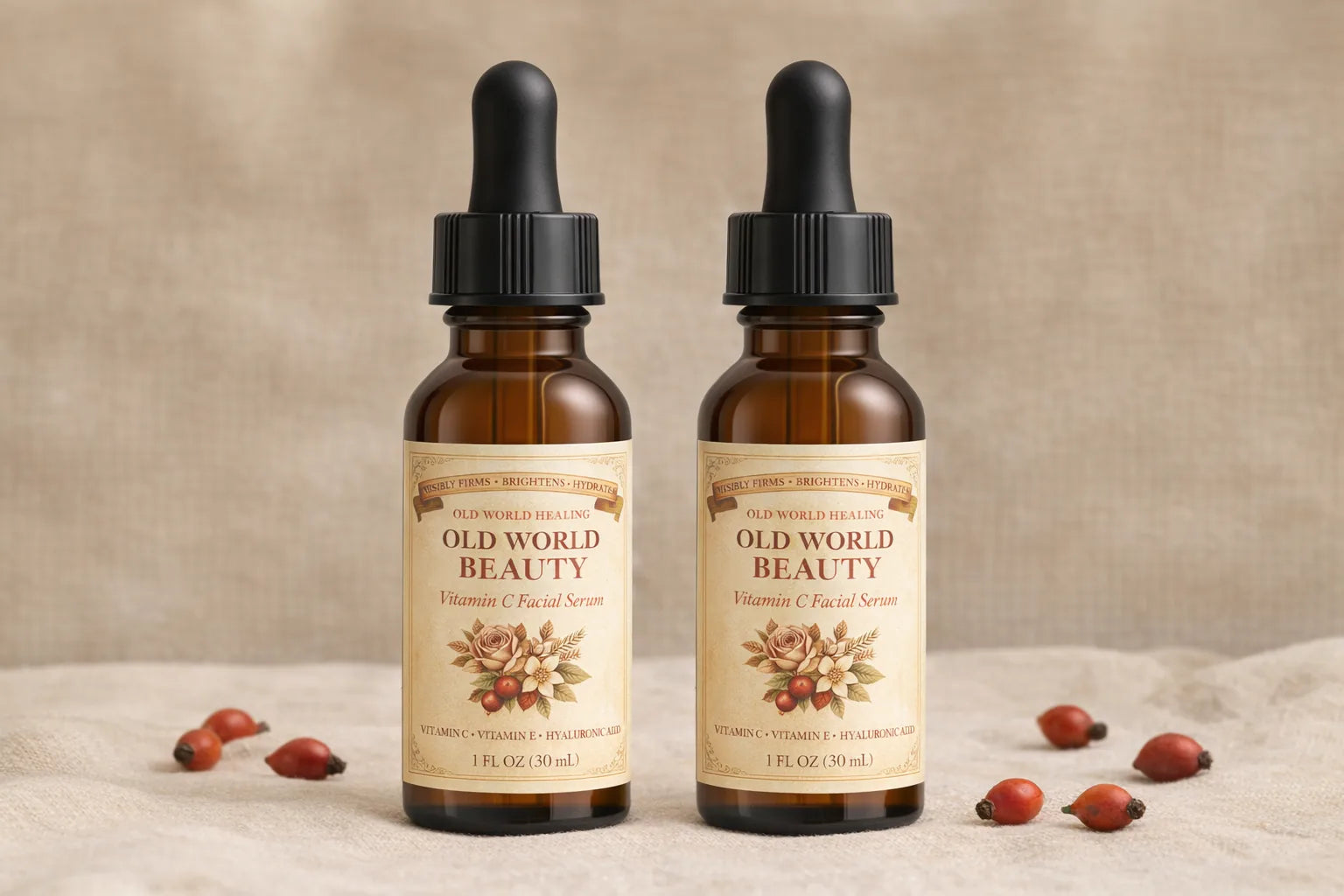
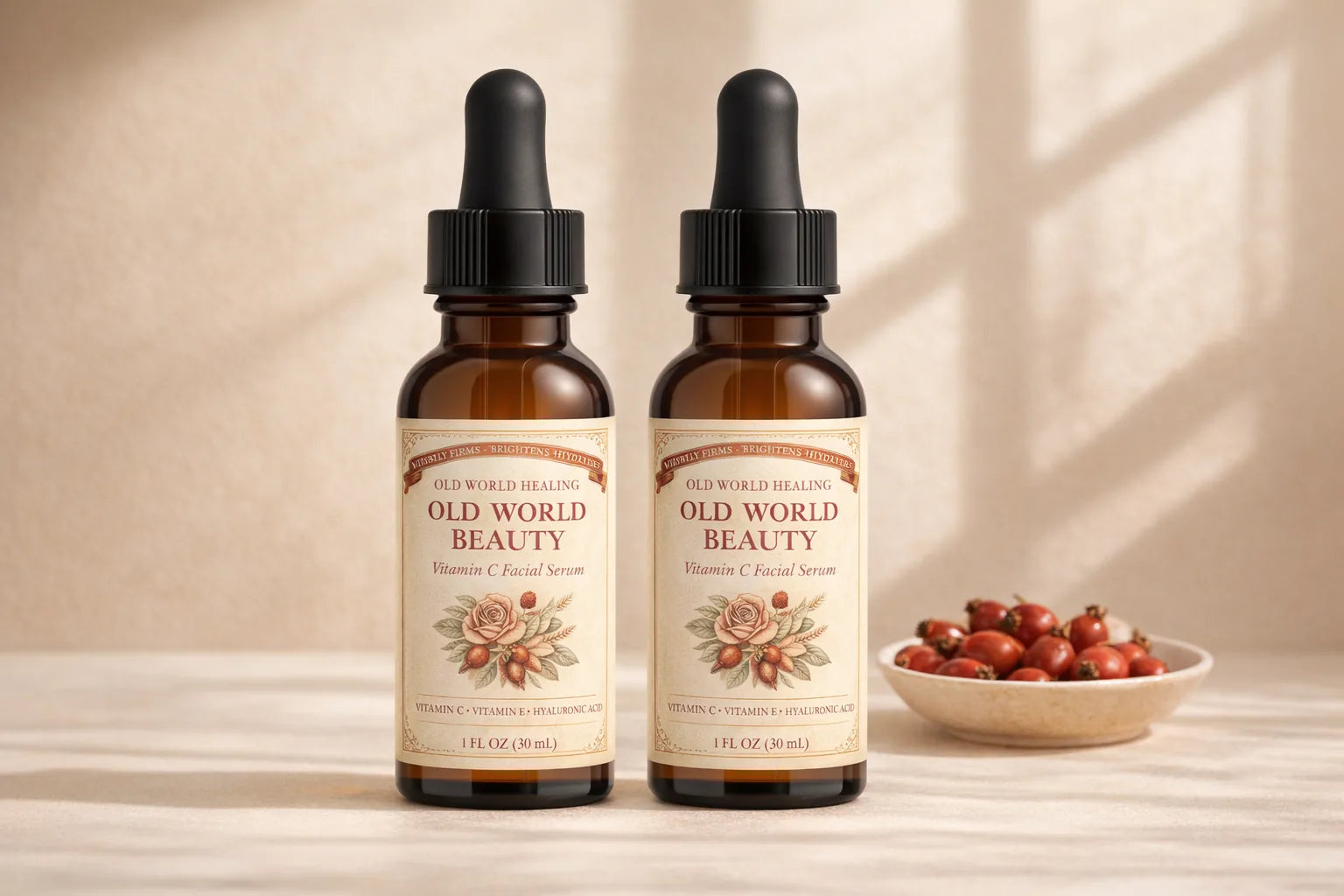
The bottle is 1 FL OZ (30 mL) of serum in amber glass, with a glass dropper in the cap, and the label marks it 6M once it's open.
Keep using that sunscreen especially.
Ultraviolet light is what sets the scissors loose in the first place, so working against the loop while the sun keeps feeding it is a fair fight rather than a won one.
Patch test on your inner arm before the first full application, and stop using it if your skin objects.
Two Versions Of Next Year

If nothing changes.
The scissors stay loose, because nothing is intercepting the radicals that set them off.
The net keeps fragmenting, and every fragment tips over one more of the cells that were supposed to rebuild it.
The gene keeps reading a quieter and quieter order sheet.
And two years from now you'll have the same cruel pair of photographs you have today.
Except the recent one will be the picture you're looking at right now, the one you don't much like, and you'll look at it and think you had no idea how good you had it.
You keep offering to take the picture.
If you interrupt the loop.
The water layer goes to work this week, and the mirror gets a little kinder almost immediately.
Underneath that, the one part the assembly line cannot run without is back in your skin every single day, alongside a shield that recharges instead of burning out by mid-morning.
Month three is where people start using the word "firmer" without being prompted.
And one afternoon somebody at a table looks up when they ask what you'd like.
You won't make anything of it. You'll just notice that it happened.
The three plans, one more time. $49 a month, or $89 every two months at $44.50 a month, or $129 every three months at $43.00 a month.
Buy any of those three supplies once instead, at $59, $109 or $159.
Free shipping either way, and 90 days to change your mind.
An Honest Note On How It's Made
We make this in small batches on purpose, and a batch takes as long as it takes.
Small batches are the trade we accept for making it the way our kitchen makes everything else.
What doesn't change is the rest of it: free shipping, 90 days to decide, and cancel whenever you like.
Questions People Ask Me

Two speeds, and I'd rather over-explain this than have you disappointed.
Hydration and a plumper look tend to show in the first week or two.
The appearance of firmness is a month-three story, because the research that measured anything at that depth ran three to six months.
Results vary from person to person.
Because of what they were aimed at.
A moisturizer or a plain hyaluronic acid serum works on a film about 0.02mm thick, and the collapse cycle runs around 2mm down.
Your drawer full of failures isn't evidence that nothing works.
It's evidence that everything in that drawer was pointed at the wrong layer.
No, and I want to be clear about it.
The 2001 trial happened to be run in postmenopausal women aged 55 to 60, and I'll always tell you who a study was done in.
But collagen falls by roughly 1% a year in everyone from their mid-twenties, and the collapse cycle doesn't check anybody's paperwork.
Plenty of the people reading this are men who'd never say the word serum out loud.
Then patch test on your inner arm and wait a full day before you put it anywhere near your face.
There's denatured alcohol in the formula as a solvent, so I won't call it alcohol-free and I won't promise it suits every skin.
Some people find vitamin C serums tingle at first.
If your skin objects, stop using it.
No, and I'd walk away from anybody who told you otherwise.
Every study on this page tested an ingredient, not this bottle.
That's the honest description of what we know and what we don't.
The blend is proprietary and I'm not going to publish a number.
I'd rather give you the true thing, which is the form of each active, than a made-up figure that sounds precise.
That was the objection I was most afraid of when I started reading, and it's the one the research answered best.
The gene doesn't leave and the factory never gets demolished.
The order sheet just gets quiet.
The 2001 participants were in their late fifties and the biopsies still showed the dial moving after six months.
Nobody has ever shown me the age at which a fibroblast stops responding.
Yes to both, and the sunscreen especially.
Ultraviolet light is what sets the scissors loose in the first place.
Wearing sunscreen while you use this is the difference between fighting the loop and fighting the loop with the tap still running.
Email us inside 90 days and we'll refund you in full.
You don't need to send the bottle back.
That's the whole policy, and there's no restocking fee hiding underneath it.
One Last Thing
The reason I wrote all of this down instead of just running an advertisement is that the explanation is worth more than the bottle.
If you never buy a thing from us, I want you to leave with this.
Your face didn't fail you. It didn't get lazy, and neither did you.
A gene went quiet, a net got cut, and the cells that were meant to rebuild it fell over.
Then everything sold to you for thirty years was aimed at a layer about a fifth the width of a hair.
That is a mechanism, not a verdict. And mechanisms have inputs.
Since this article went up, we've added a one-time purchase beside the subscription.
Both ship free, and both carry the same 90 days.
Illustrative customer accounts, not verified reviews
"Around week six my daughter asked if I'd changed my hair. I hadn't changed my hair."Barbara, 64
"The deep lines either side of my mouth look softer than they did in the spring. That's all I've got. It's enough."Ray, 67
"What sold me wasn't the promise, it was the explanation."Denise, 58
P.S. The single most useful sentence in this whole article is the one about the scissors.
A collapsed collagen-making cell doesn't only build less.
It also releases more of the enzyme that broke the scaffolding in the first place.
That's why your face changed faster in the last two years than in the ten before them.
It's also why the loop can start running the other way once something finally interrupts it.
P.P.S. If you only remember one number, remember 25%.
Six months of topical vitamin C, participants aged 55 to 60, and the collagen gene activity measured 25% higher on a skin biopsy than where it started.1
That isn't a model, and it isn't a promise from a brand.
It's a number somebody took out of real skin, in people your age, and published in 2001.
The instructions were never gone. They just got quiet.