"Why am I hungry an hour after dinner... and why does every single pound stick now?"
GLP-1 Isn't A Medication. It's A Hormone Your Own Gut Made For Free For 50 Years.

Something in your gut used to tell your brain "that's enough, start burning."
Researchers found the exact thing that went quiet... and why the $1,000-a-month shots are only a synthetic copy of it...
And how to feed that signal back on, so dinner is finally the end of eating for the night... and the afternoon belongs to you again.

GLP-1 is not a medication.
It's a hormone.
Your own body has been making it your whole life, for free, without a prescription and without a needle.
When your GLP-1 is switched ON, you eat a normal dinner and you're simply done.
You don't finish the plate out of habit and you don't go looking an hour later.
Your body burns what you give it instead of packing it away, and you have energy at four in the afternoon that you didn't have to caffeinate into existence.
When your GLP-1 goes OFF, everything flips.
You're never quite full.
The fat creeps on a pound or two a year, quietly, and it doesn't come off the way it used to.
And your energy drains out somewhere between lunch and dinner, every single day.
Same person. Same discipline you always had.
One switch.
The Most Expensive Drug In America Is A Copy Of Something Your Gut Used To Make For Free
Here's the part that should make you angry.
Those weight-loss injections everybody's talking about?
They're synthetic copies of GLP-1.
That's the whole trick.
They imitate a hormone your gut has been producing since the day you were born.
And the list price on them runs right around $1,000 a month.1, 2
A thousand dollars a month to rent a copy of something your own body made for nothing.
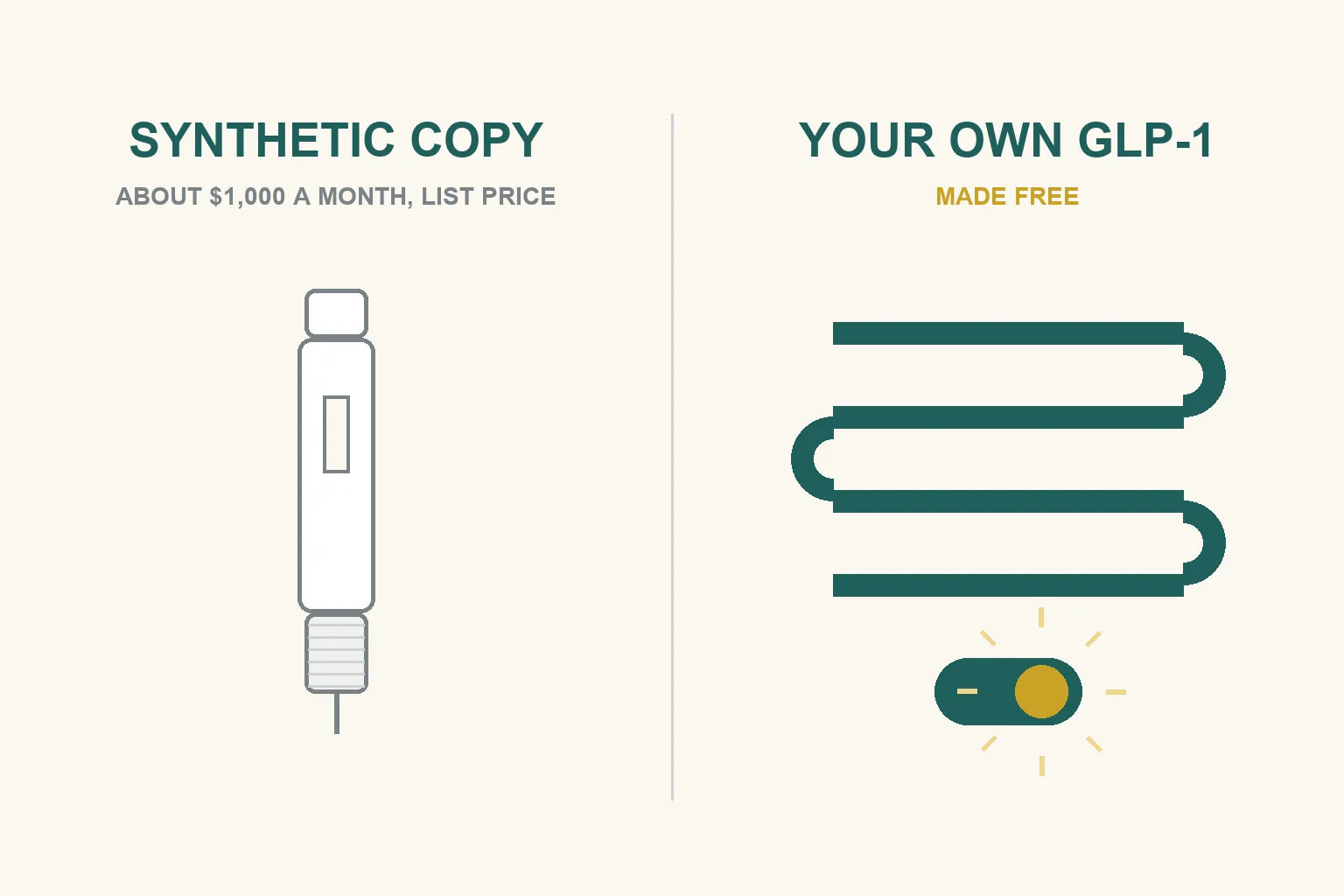
Nobody is going to run a commercial telling you your gut used to do this on its own.
There's no money in that.
But that's the actual question worth asking, and almost nobody is asking it.
Not "how do I get the shot."
Why did my own supply stop?
I'm Mary Miller.
I'm an herbalist and a natural health researcher, and I spend my days doing something fairly unglamorous: reading medical journals so the people who trust us don't have to.
We started Old World Healing because we kept finding the same pattern over and over.
The remedy our great-grandparents swore by turns out to have a mechanism underneath it, and the journals finally caught up.
This one is the clearest example I have ever put in front of you.
Because the answer to "why did my supply stop" turned out to be a single organism living in a layer of your gut about one millimeter thick.
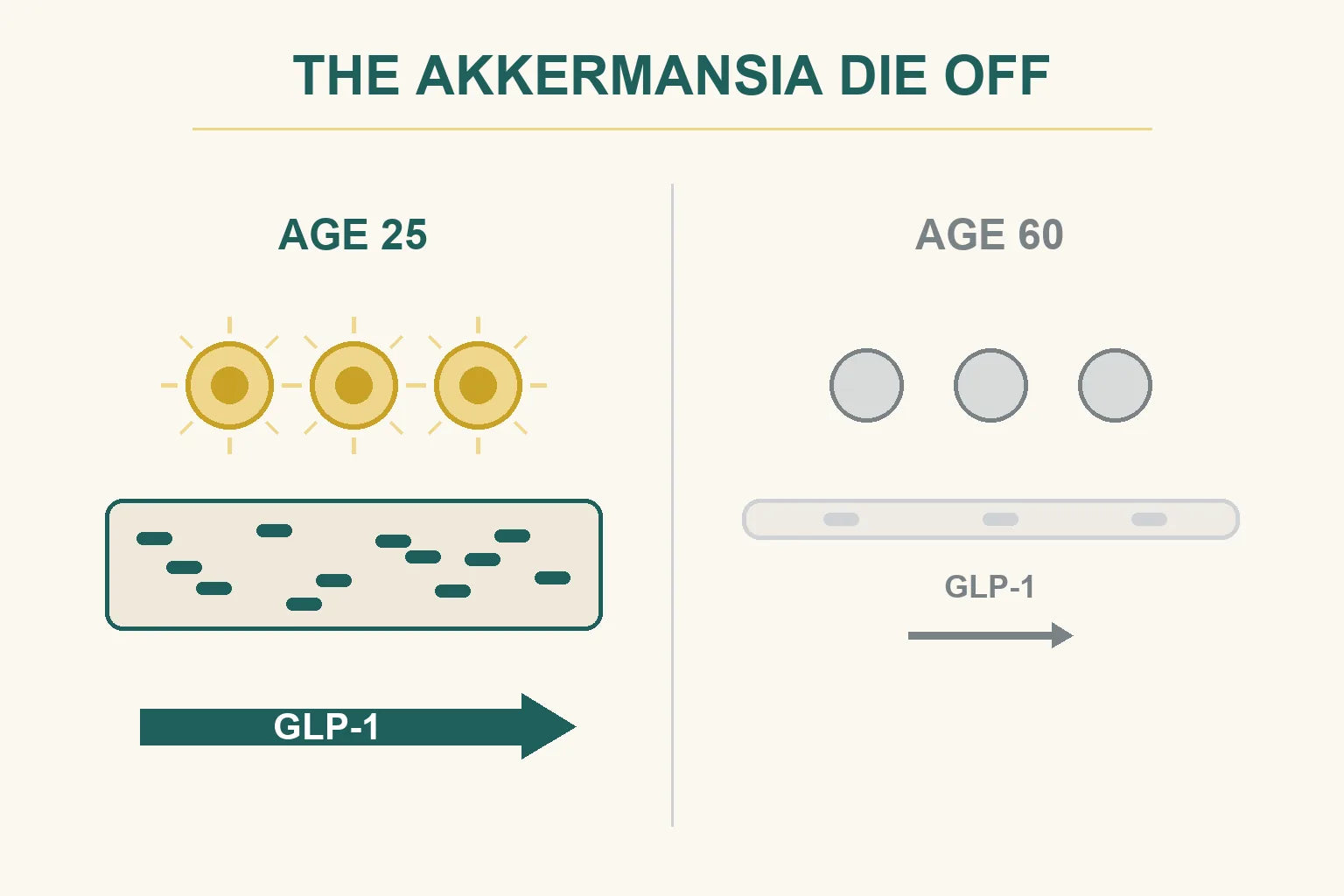
It has a name, science only gave it that name in 2004, and researchers have observed levels of it dropping as people get older.5
Stay with me, because once you see the machinery, you cannot unsee it.
And you will never blame your willpower for this again.
First, Meet The Little Factories That Make Your GLP-1
Your intestines aren't a smooth pipe.
The lining is studded with tiny specialized cells called L-cells.
Think of them as thousands of little factories built into the wall of your gut, each one with one job.
When food comes through, the L-cells release GLP-1 into your bloodstream.
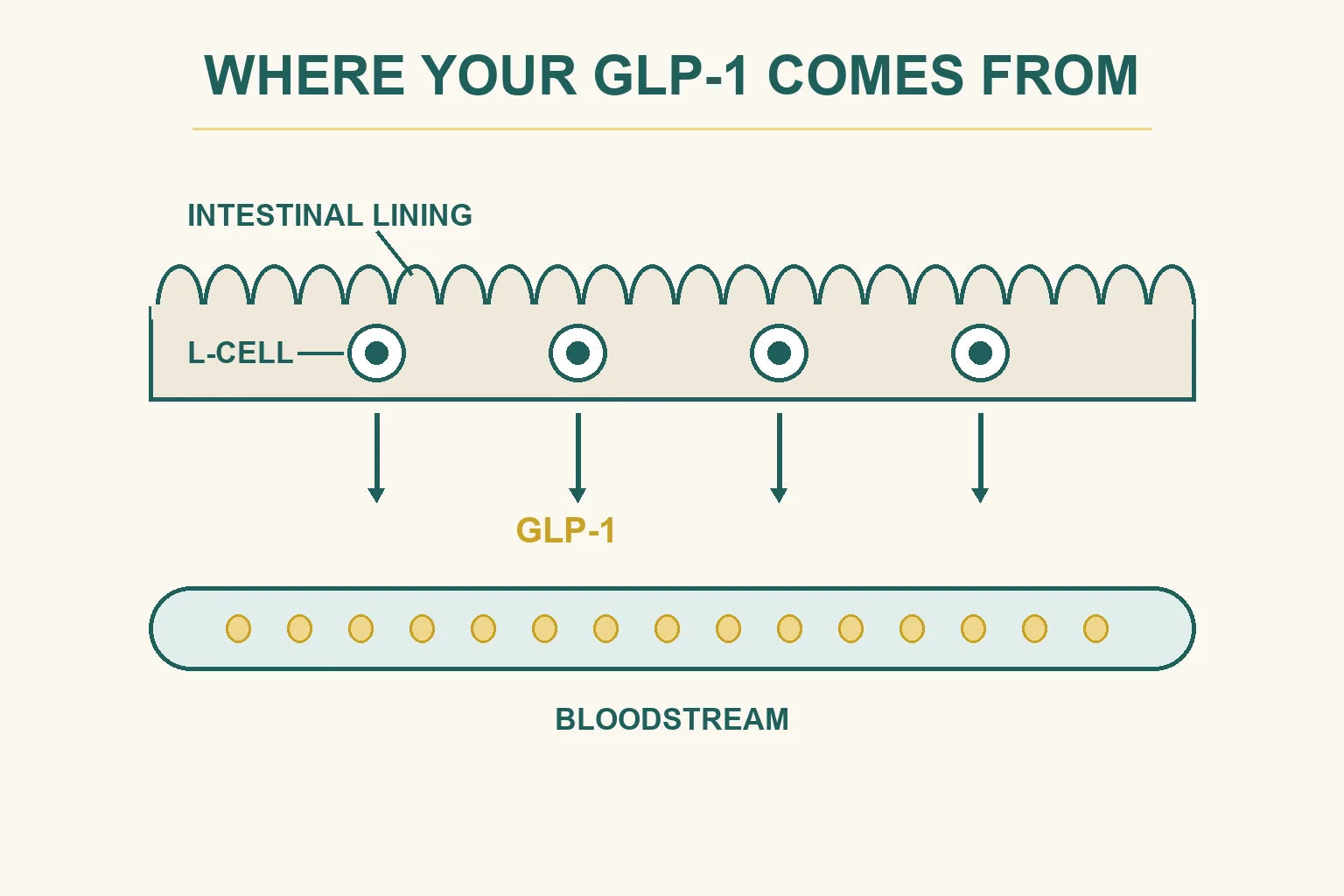
And GLP-1 does exactly three things you have been wishing for.
It tells your brain you're full, so the meal ends when the meal ends.
It slows how fast your stomach empties, so "full" actually lasts.
And it helps your body handle the sugar in that meal instead of shoving it straight into storage.
That's it. That's the hormone.
That's the thing in the pen.
Now here's the piece almost nobody knows.
Your L-cells don't fire on their own.
They aren't on a timer.
They're switch-operated, and they wait to be told.
Something has to walk up and press the button.
For most of human history, something did.
The One-Millimeter Layer Where The Button-Pusher Lives
Run your finger along the inside of your cheek.
That slick feeling is mucus, and there's a layer just like it coating the whole inside of your gut.
It's about a millimeter thick.
It isn't waste and it isn't gunk.
It's the padding that keeps the contents of your gut from grinding straight against your gut wall.
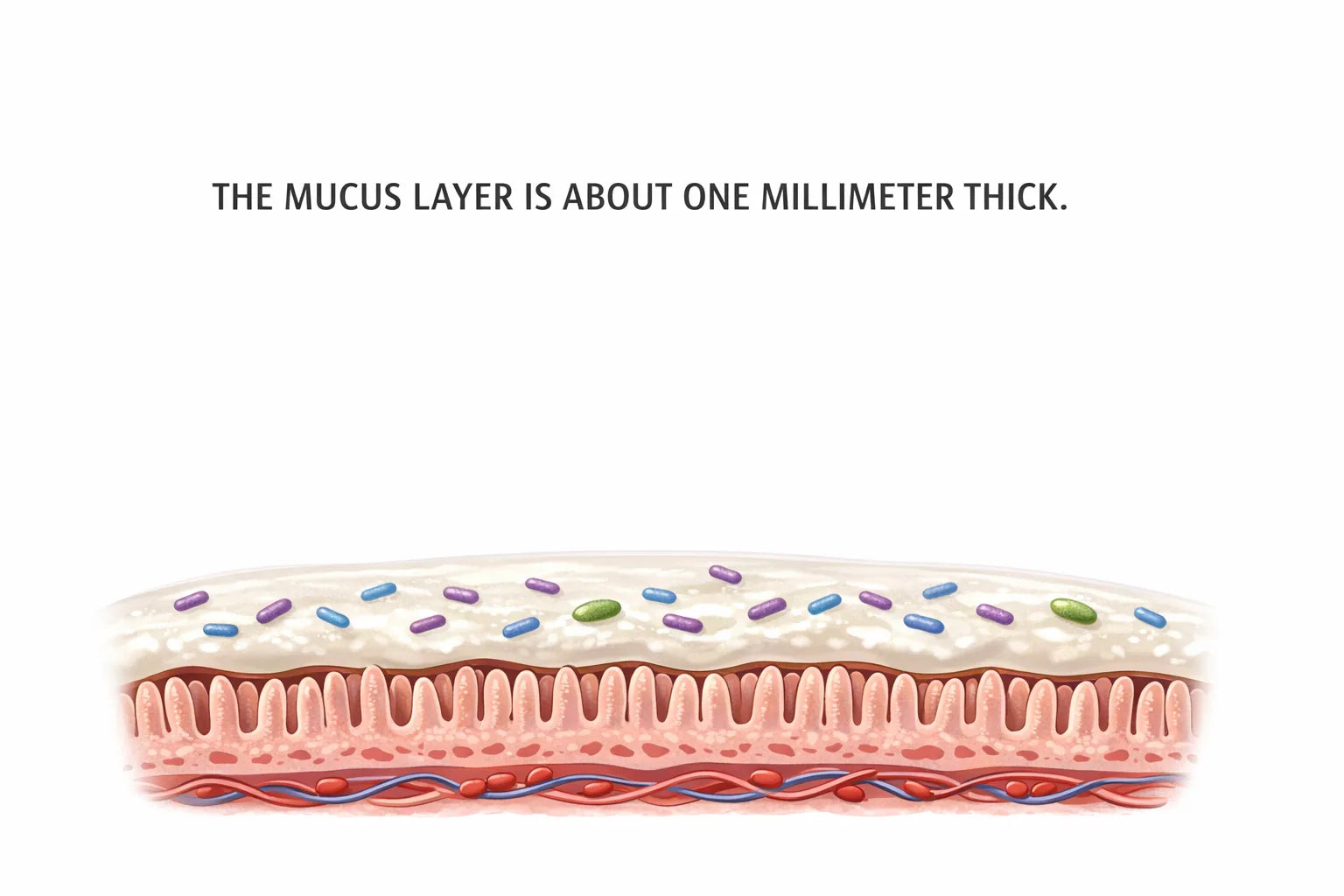
And living inside that layer, like a gardener who lives in the hedge she tends, is one bacterium.
Its name is Akkermansia muciniphila.
Say it once and forget it. What matters is what it does.
Akkermansia eats the old mucus and signals your gut to lay down fresh mucus, which keeps the layer thick and healthy.
Scientists call organisms like this "keystone" species, the way a keystone holds up a stone arch.
Pull the keystone out and the arch doesn't sag a little. The whole arch comes down.
Here's the strange part.
Science had no name for this bacterium until 2004, when a Dutch research team at Wageningen isolated it and described it for the first time.3
That's more recent than the smartphone.
An organism that had been living inside every healthy human gut for all of history, and we didn't have a word for it until 2004.
So no, your doctor didn't hide this from you.
Here's What Akkermansia Was Doing For You The Whole Time
In 2021, researchers publishing in Nature Microbiology found the actual mechanism, and it's the most satisfying thing I've read in years.
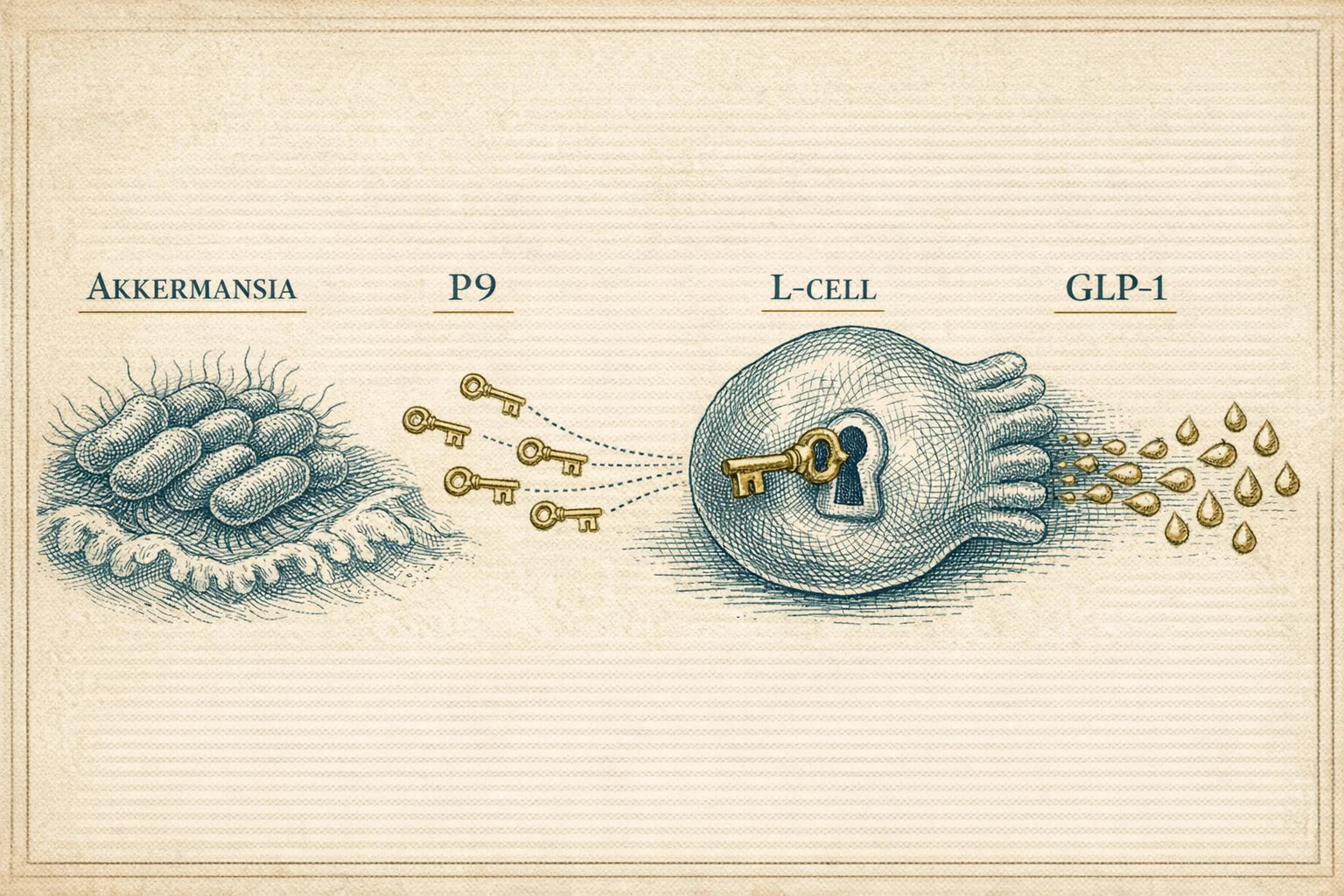
Akkermansia secretes a protein.
They named it P9.
P9 floats over to your gut's L-cells and fits into a specific docking point on the cell surface, the way a key fits a lock.
And when that key turns, the L-cell releases GLP-1.4
Read that again slowly.
There is a protein in your gut whose entire job is to press the button that makes your own natural GLP-1.
The researchers even purified P9 on its own and gave it to mice.
The GLP-1 release still happened, and the animals' brown fat cranked up its heat production too.4
That work is preclinical, meaning it was done in mice and in cells, not in people.
I'll be straight with you about that every time.
But it names the switch.
Not "supports metabolism" in some vague hand-wavy way.
An actual named protein, fitting an actual named lock, on an actual named cell.
And there's a second signaler, too.
When the fibers in your food get fermented down in the gut, they produce a short-chain fat called butyrate, and butyrate nudges those same L-cells.
So your GLP-1 supply has two hands on the switch.
The P9 key from Akkermansia.
And butyrate from fermented fiber.
So what do you suppose happens when both hands come off that switch at once?
"GLP-1 Starvation": How The Signal Went Quiet
Akkermansia lives in the mucus layer and feeds on the mucus layer.
Which means anything that thins that layer starves the tenant.
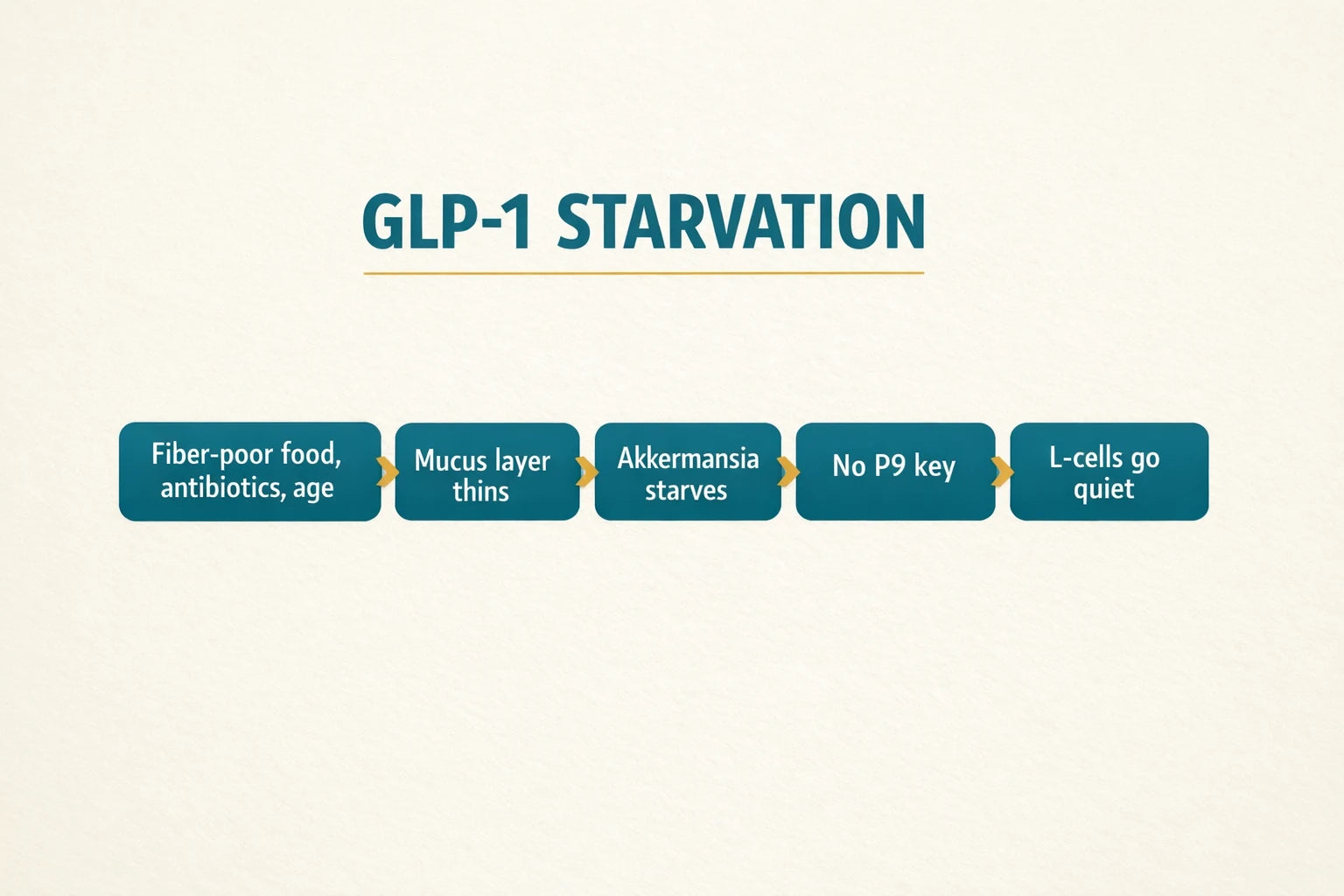
Three things thin it.
The layer is fed by fermentable fiber reaching the far end of your gut. Take the fiber out of the food supply and the layer thins, and the population living inside it shrinks with it.
Every course you have taken since childhood cleared out the neighborhood, and not every resident came back.
Researchers have observed that Akkermansia levels decline as people get older, and in aging animals, supplementing with it kept the mucus layer from thinning the way it otherwise did.5
Researchers have also observed that people carrying extra weight tend to have less Akkermansia and a thinner mucus layer than people who aren't.11
Then the loop starts feeding itself, and this is the ugly part.
Thin layer means less Akkermansia. Less Akkermansia means the layer gets thinner still.
Less Akkermansia also means less P9.
Less P9 means fewer keys turning in fewer locks.
Fewer keys turning means your L-cells go quiet, and your own GLP-1 supply dries up.
That is the whole thing. That's what I call GLP-1 Starvation.
Not a disease, and not a diagnosis.
Just a signal that stopped getting sent.
And now go back and look at your own life through that lens.
Hunger that never actually switches off, because the "you're full" message isn't being sent.
Cravings at nine at night that feel like a personality flaw and are actually a missing signal.
A hard crash in the afternoon.
And a body that stores everything you feed it, because the hormone that tells it to burn instead has gone quiet.
You didn't get weak. Your gut got evicted.

I want to sit in this for one honest minute, because I know what this actually costs.
It isn't the number on the scale.
It's the photo you stepped out of at your granddaughter's birthday, because you'd rather not see yourself in it.
But if I had to name the moment this costs the most, it's the Sunday morning after the week you actually did everything right.
You logged it all week. You said no to the bread.
You walked in the cold on Wednesday because you told yourself you would, and you did.
And now you're standing on the bathroom tile with one hand on the counter, because you always put a hand on the counter first.
You step on.
You wait for the number to settle.
And it's the same as last Sunday. Or it's up.
And something in your chest goes flat.
Not dramatic, and no tears.
Just that quiet drop, like the floor moved down half an inch under you.
Then comes the part nobody in your house ever sees, the sentence you'd never say out loud to your spouse or your kids.
"So that's it. I did everything right and it didn't matter."
"It's me. It was always me."
You get dressed. You go make the coffee.
You don't mention it to anybody.
And that afternoon you eat something you didn't plan to eat, and you call yourself weak for it, and you file one more piece of evidence in a fifteen-year case against your own character.
Now let me tell you what was actually happening that week.
Your L-cells were quiet the entire time.
Your body never once got the message that the meal was over, so you spent seven days fighting to replace a message that was never sent.
And then you punished yourself for losing a fight nobody told you was rigged.
I need you to hear this from somebody who reads the research for a living.
That verdict you handed down on yourself is wrong.
Not "be kinder to yourself" wrong. Mechanically wrong.
You cannot out-discipline a signal your gut stopped sending.
Fifteen years of trying and failing isn't a verdict on who you are.
It's a clue about what went missing.
Why Everything You Tried Failed (And It Wasn't You)
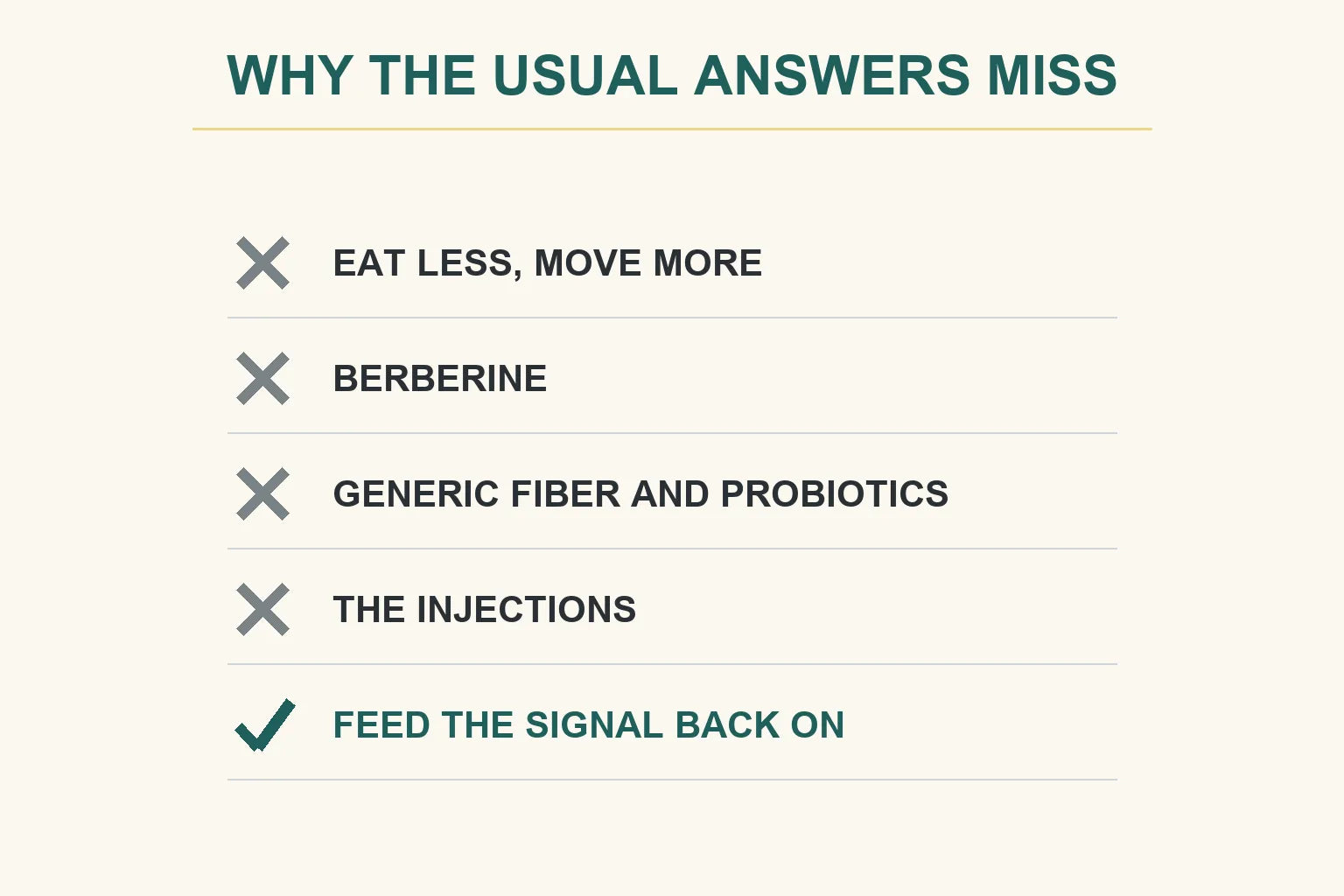
"Eat less, move more"
This is the advice you got in a seven-minute appointment, and on paper it isn't wrong.
In practice you were asked to use willpower to replace a hormone.
GLP-1 is what makes "enough" feel like enough without a fight.
Take that away and every meal becomes a negotiation you have to win, three times a day, forever.
Nobody wins that.
Not you, not me, and not the naturally lean person who thinks they're winning it on character.
Berberine, the "nature's Ozempic" story
You have seen this all over the internet, and it made a lot of money.
Here's what nobody selling it mentions.
Berberine doesn't touch the GLP-1 system at all.
The nickname was marketing, and health researchers have been publicly picking it apart for a while now.6, 7
The average weight difference in the research works out to about four pounds.6
If you tried it and got nothing, you weren't the problem. The story was.
Generic fiber and generic probiotics
Fiber is genuinely good for you and I'm not here to talk you out of it.
But a generic probiotic is a bag of whatever strains were cheapest to grow, and almost none of them are the organism that carries the P9 key.
You can throw a thousand seeds at a bare patch of dirt.
If the one plant you actually needed isn't in the bag, you just get weeds.
And the injections
I'm not going to attack them. For some people they clearly do something.
But look honestly at what they actually are.
They don't fix a quiet factory.
They ship in a synthetic substitute from the outside, month after month, at list prices around a thousand dollars.1, 2
The day the shipments stop, the substitute stops. Nothing underneath it changed.
That isn't a fix. That's rent.
The Trail Of Dates That Changed My Mind
I'm a skeptic by trade. Most of what crosses my desk is noise.
So let me hand you the timeline the way I found it, and let the dates do the work.

2004, the Netherlands. A Dutch team isolates the bacterium and gives it a name for the first time.3
2013, PNAS. In mice on a rich Western diet, giving Akkermansia turned the fat gain around, brought the thinned mucus layer back toward normal thickness, and improved how the animals handled insulin.8
2019, Nature Medicine. The first human trial, forty overweight adults, three months.
In the group given the pasteurized form, insulin sensitivity improved by 28.6% against placebo.
Insulin levels came down 34.1%, and total cholesterol dropped 8.7%.
Body weight moved down about 2.27 kg as a trend.9
2021, Nature Microbiology. The P9 protein is identified. The key and the lock get named.4
2026, Gut Microbes. And this is the one that made me put my coffee down.10
Let me tell you about the 2026 trial properly.

Adults with metabolic syndrome took pasteurized Akkermansia daily for three months.
The researchers measured something no supplement trial had measured this way before.
Not just weight. The participants' own GLP-1 response.
And in the people who started with LOW baseline levels of Akkermansia in their gut, the results came in against placebo: better insulin sensitivity, a higher GLP-1 excursion after a meal challenge, and reductions in body weight and trunk fat.10
Sit with the shape of that finding.
It worked best in the people who had the least of it to begin with.
Now think about who has the least of it.
The people who have eaten sixty years of modern food, taken every antibiotic course life handed them, and crossed into the decades when researchers have observed those levels drop.5
The person the research says responds best is the exact person reading this page.
There is now a third human trial on this same organism, published in 2026, looking at keeping weight off after you've lost it.12 I haven't read the full text yet, so I'm not going to quote a single number out of it at you.
But I'll tell you what its existence means.
We are past "one interesting study." Three human trials, on one organism, all pointing the same direction.
I don't get to say that about many things.
What Our Great-Grandparents Ate Without Knowing Why
Here's the part that made me laugh out loud in the middle of a research paper.
Akkermansia thrives on certain fermentable fibers.
Two of the best-studied are chicory root and cooled, starchy potato.
Now go look at what village kitchens in old Europe actually ran on.
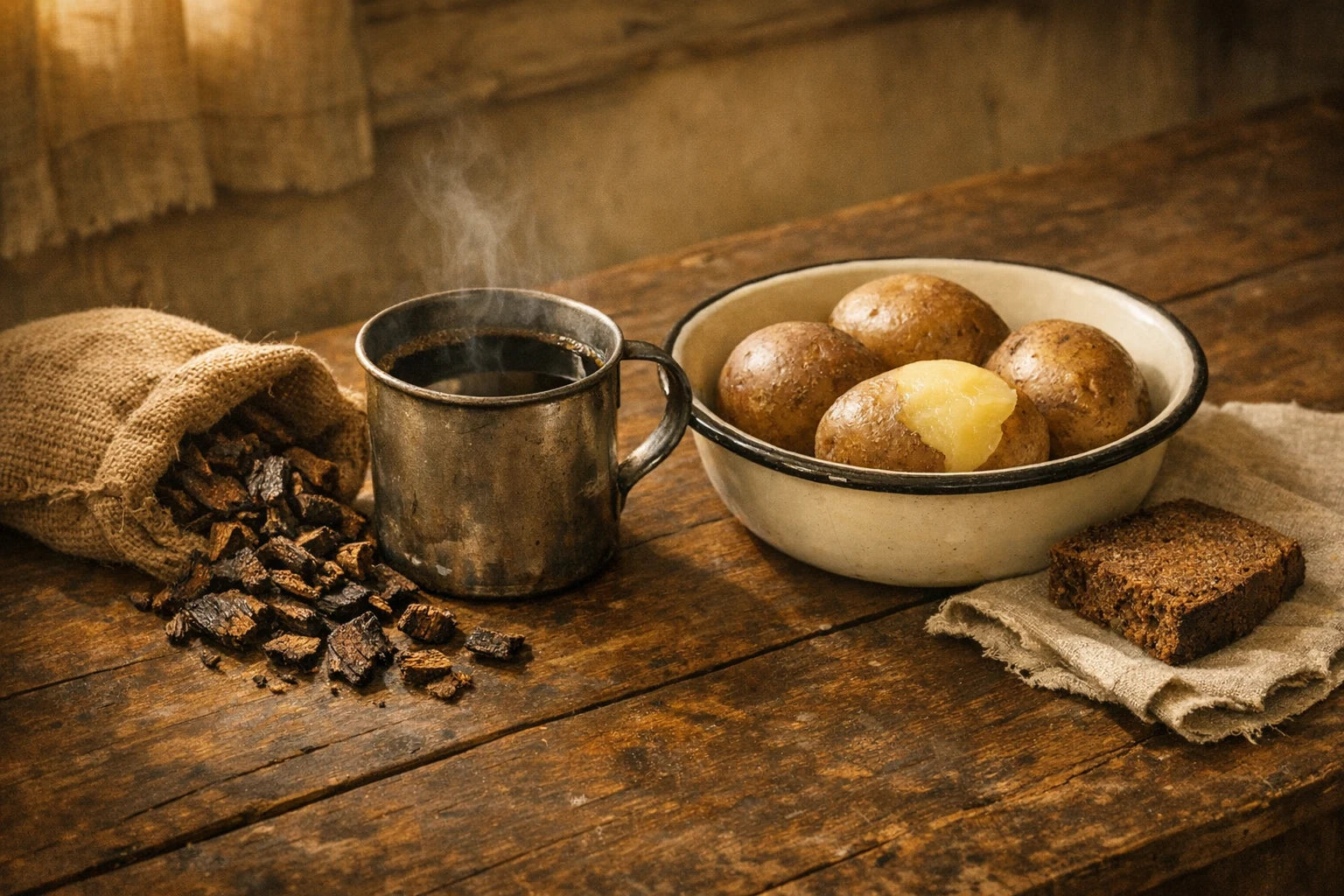
Chicory root coffee, roasted and ground and drunk daily across France, Poland and the American South, especially in the years when real coffee was scarce or too dear.
And potatoes from the cellar, boiled and then left to go cold, which isn't a small detail.
When a cooked potato cools, part of its starch changes form into what food scientists call resistant starch.
That resistant starch behaves like fiber, and it feeds the far end of your gut.
Our great-grandparents weren't counting anything.
They weren't tracking macros or doing a protocol.
They just ate the food that was in front of them, and that food happened to feed the exact organism that keeps the GLP-1 signal alive.
That's the whole old-world "secret."
They fed the gardener.
Then we stripped the fiber out of the food supply, invented the antibiotic, and handed the bill to our own metabolism sixty years later.
But You Cannot Eat Your Way Back To It
This is the question I get the moment I finish that story, and it's a fair one.
"Fine, Mary. Then I'll drink chicory coffee and eat cold potatoes."
Do it. Genuinely, it's good for you.
But it won't be enough on its own, and here's why.
Akkermansia is not in any food.
It isn't in yogurt, it isn't in sauerkraut, it isn't in kefir, it isn't in any grocery store on earth.
You either have a healthy population of it in your gut already, or you don't.
Fiber feeds the colony you have.
If the colony has already collapsed, you're fertilizing bare dirt.
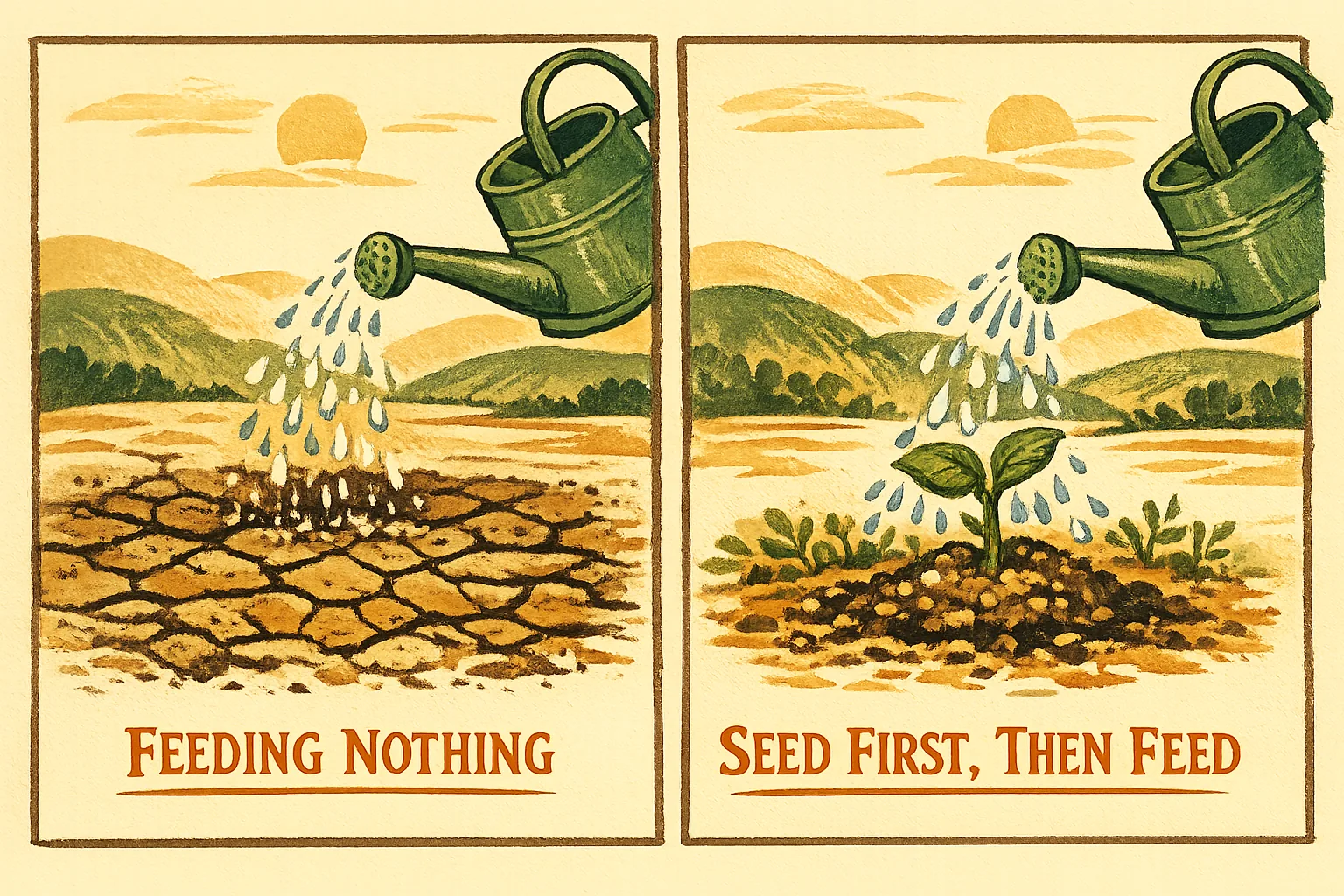
Which is exactly why the answer has to happen in a specific order.
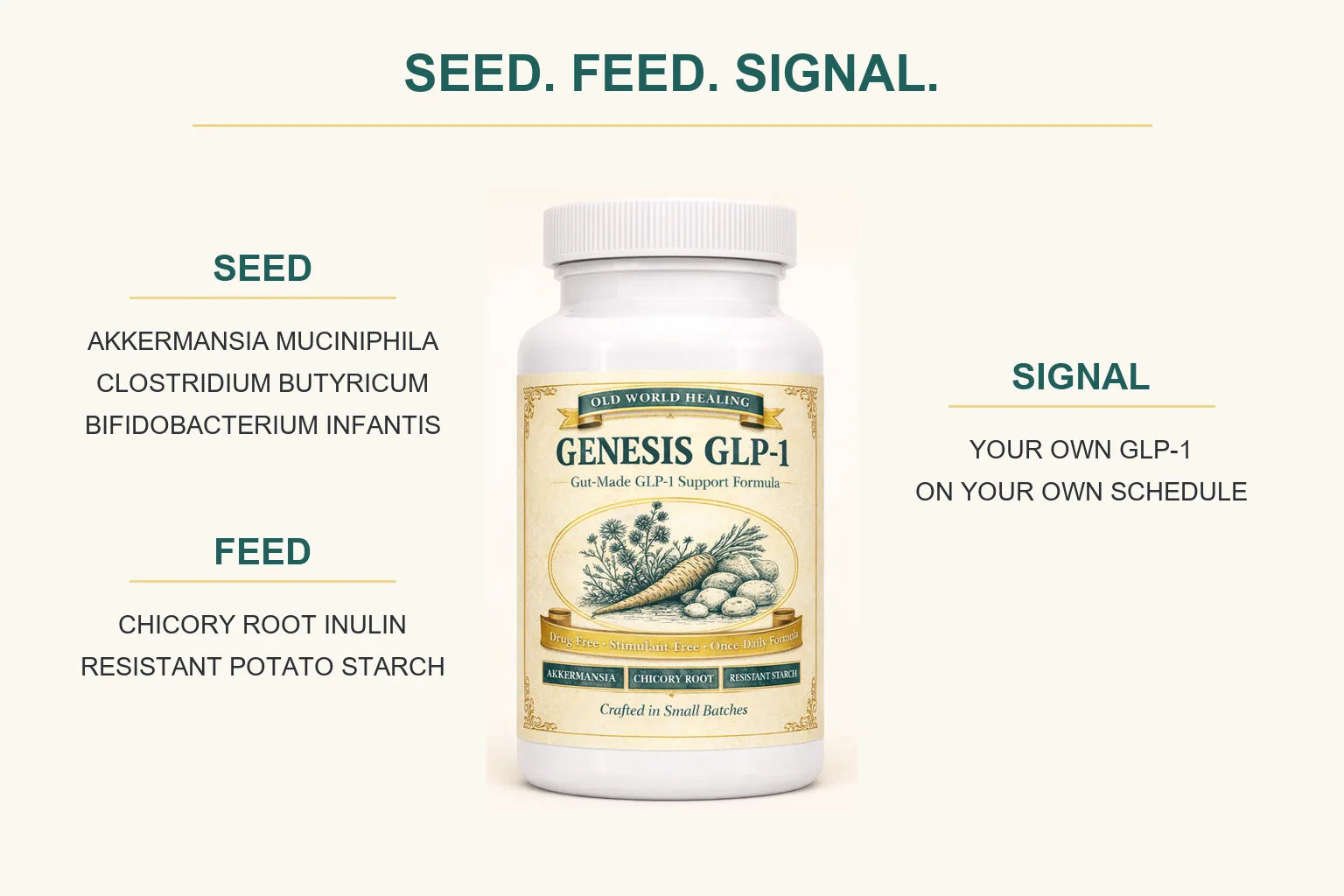
Seed the organism.
Feed it what it lives on.
Then let the signal come back on its own.
The P9 Protein: Putting The Key Back In Your Gut
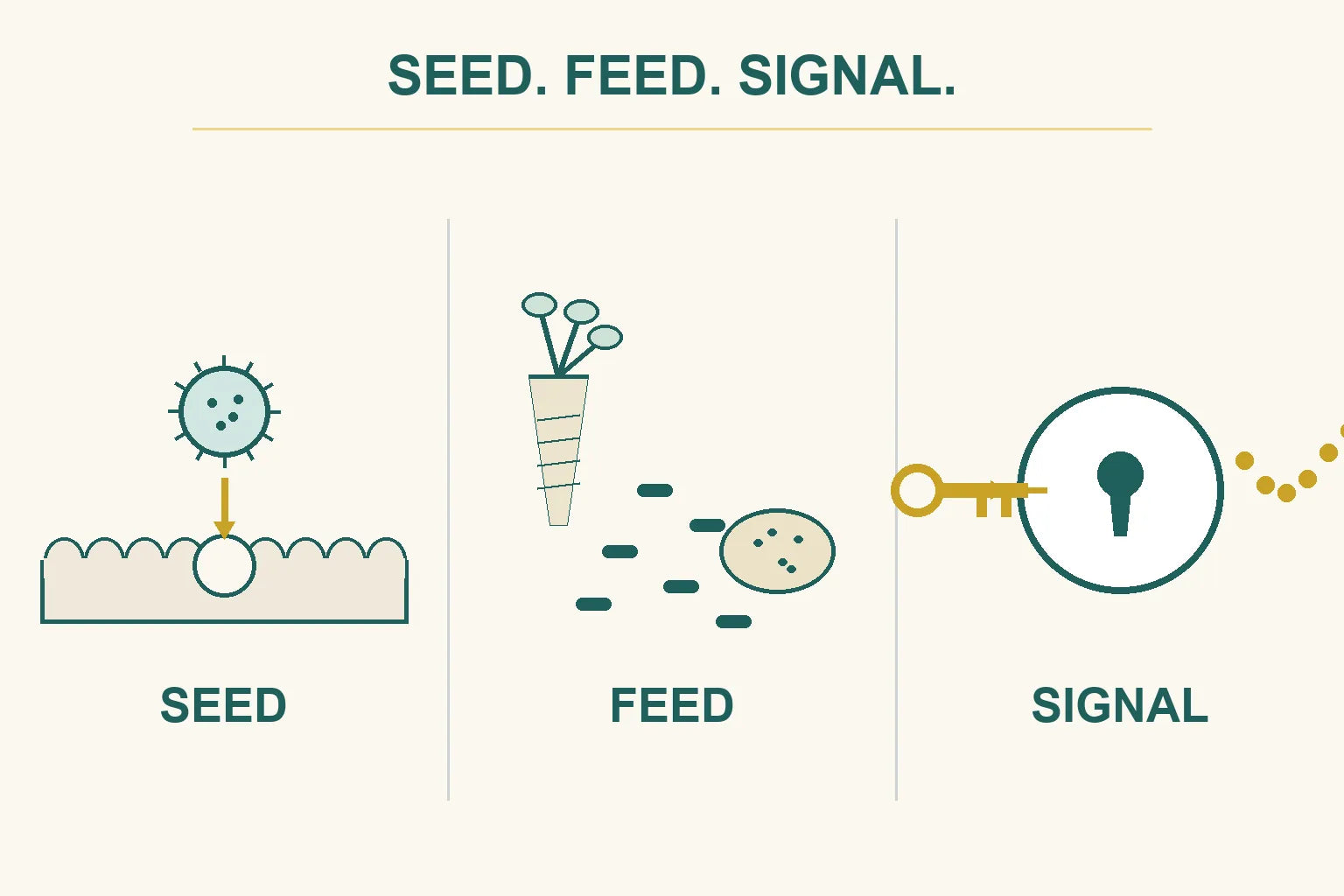
SEED: put the signalers back
The point of seeding isn't "more bacteria." It's these specific ones.
Akkermansia muciniphila. The keystone, the one that carries the P9 key and tends the mucus layer.
Three human trials, one named protein, and no dietary source anywhere on earth.
Clostridium butyricum. Your second GLP-1 signaler, and a butyrate factory.
In animal research, butyrate-producing C. butyricum raised both intestinal and blood GLP-1.13
Human trials on it are essentially absent, so I'm calling it what it is: promising support, not headline proof.
Bifidobacterium infantis. The peacekeeper, whose job is to calm the gut environment so the new colony can take hold and stay.
No weight claims here, not from me.
It holds the door open, and that's the whole job.
FEED: ship the fuel with the seed
You cannot plant a garden and walk away.
Chicory root inulin. This is the fiber class from the old-world coffee cup.
In a meta-analysis of 32 randomized trials, chicory inulin-type fructans were associated with lower body weight against placebo and a smaller waist measurement.14
In a separate human trial, oligofructose, the short-chain version of that same fiber, raised participants' own GLP-1 and PYY and cut how many calories they ate by 11% in under two weeks.15, 16
Resistant potato starch. This is the cellar potato, in powder form.
In a meta-analysis of trials in overweight adults, resistant starch was linked to improved fasting insulin, fasting glucose, and insulin sensitivity.17, 18
I want to be straightforward with you about those two, because I'd rather you trust me than be impressed by me.
Those fiber trials use large daily doses, measured in grams.
The fibers in this formula are here to feed the colony you're seeding, not to deliver a research-sized dose of fiber.
That's the honest framing, and it's the only one I'll use.
SIGNAL: let your gut do what a young gut does automatically
This is the part I love, because you don't have to do anything for it.
A restored colony behaves the way a healthy young gut behaves without being asked.
The P9 keys go out, and butyrate goes right behind them.
Your L-cells start getting tapped on the shoulder again.
And your body releases your own GLP-1, on your own schedule, meal by meal, in the amount your body decides.
Not a fixed synthetic dose on a weekly injection schedule.
Your supply, your timing, your body.
What We Made: Genesis GLP-1
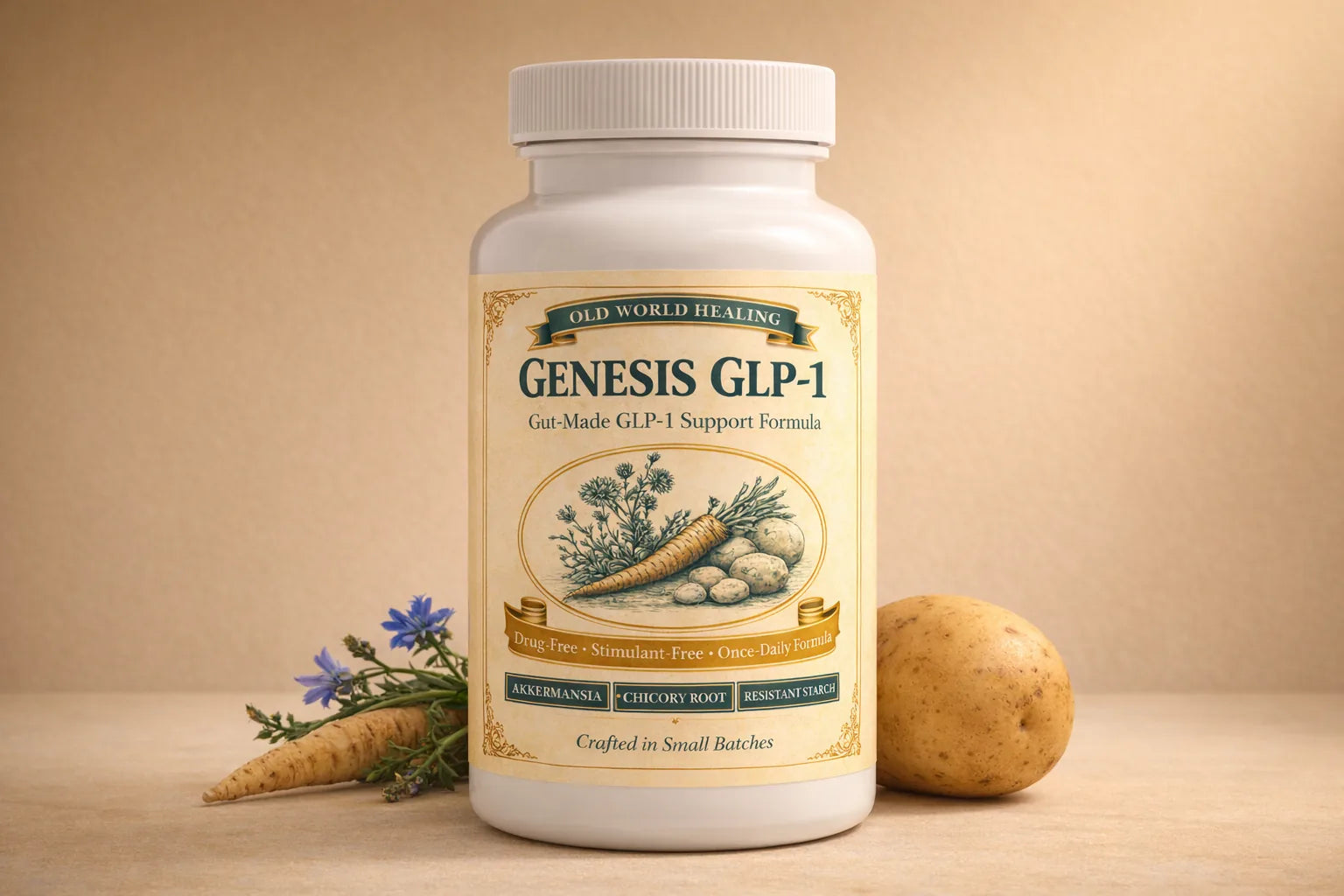
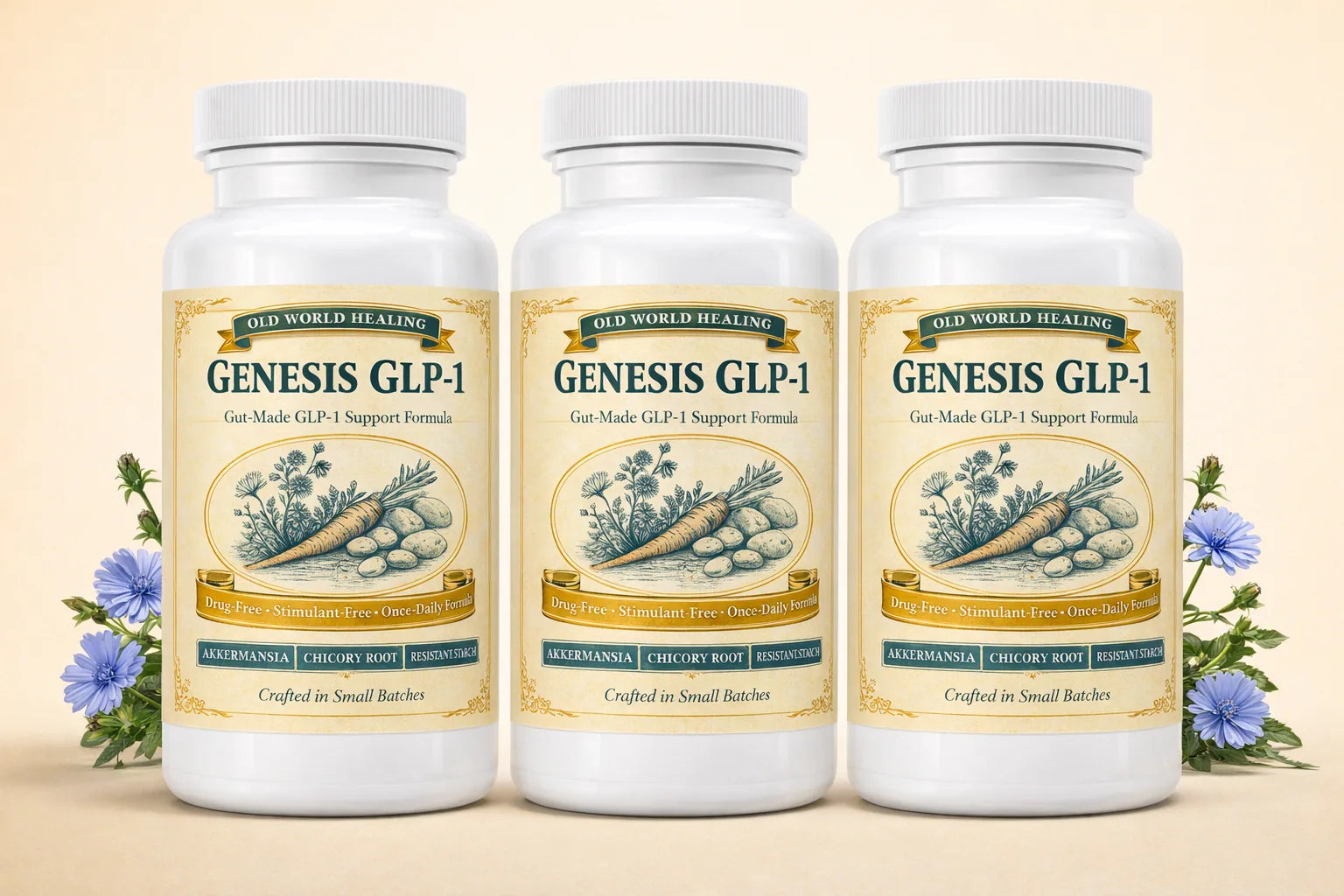
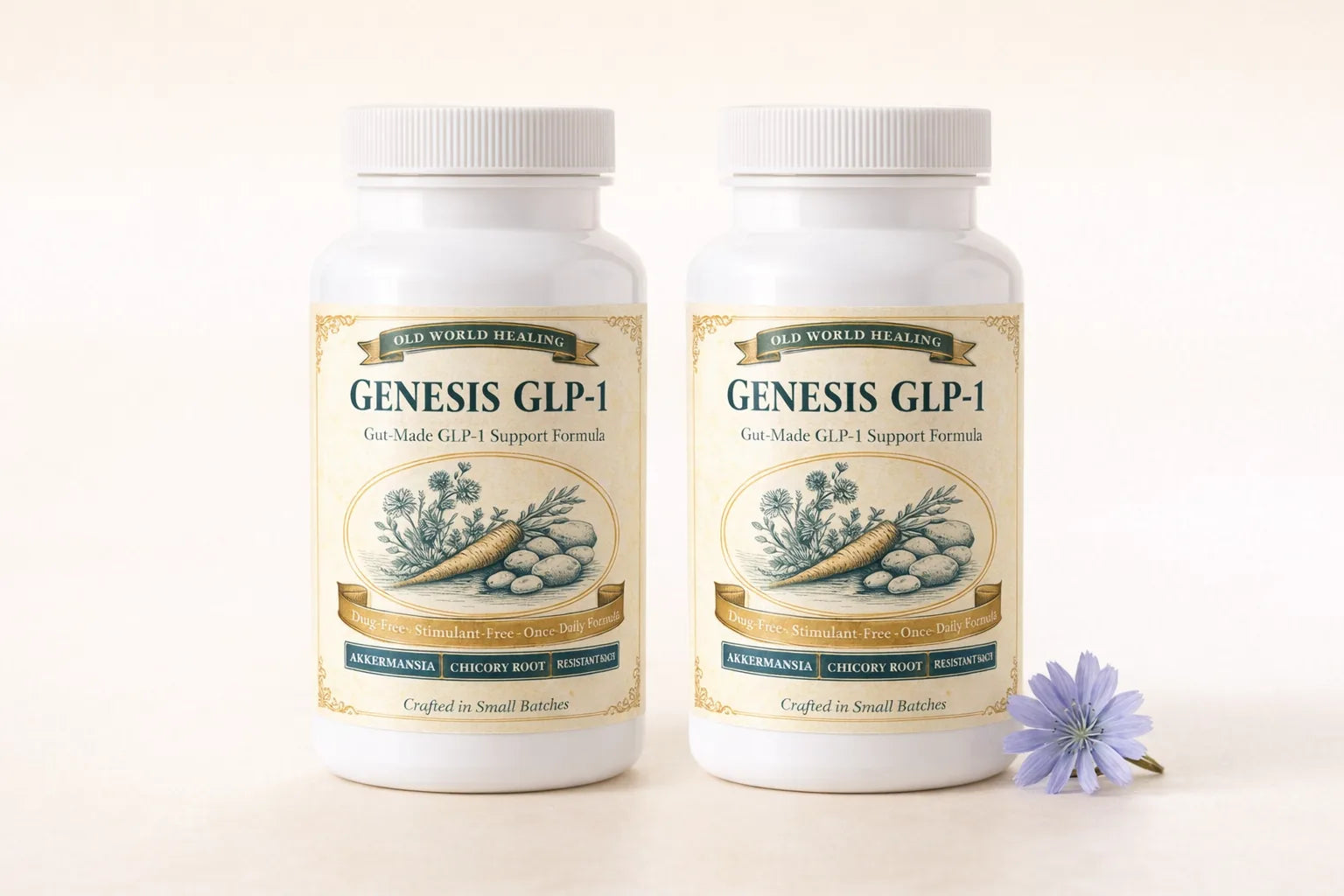
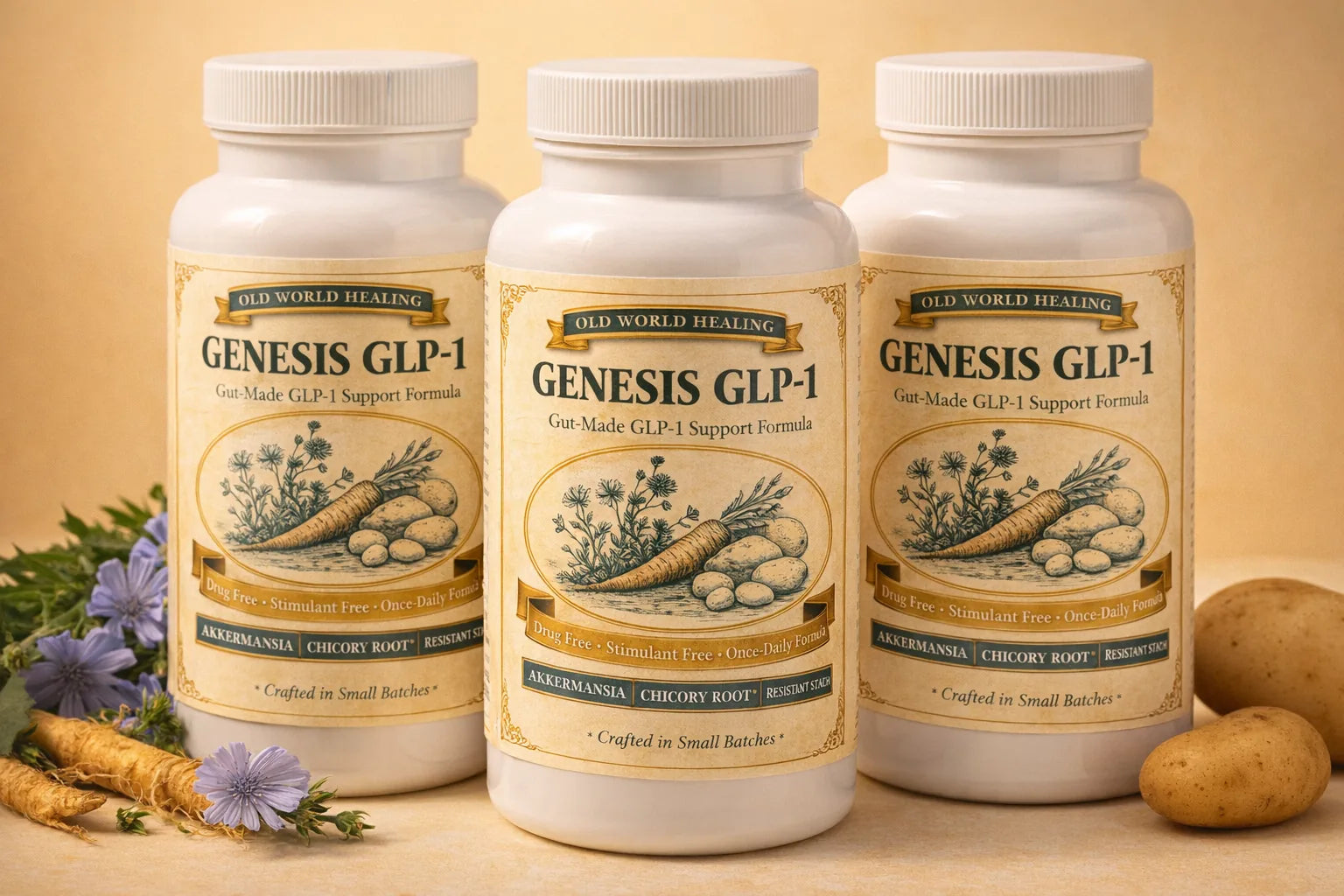
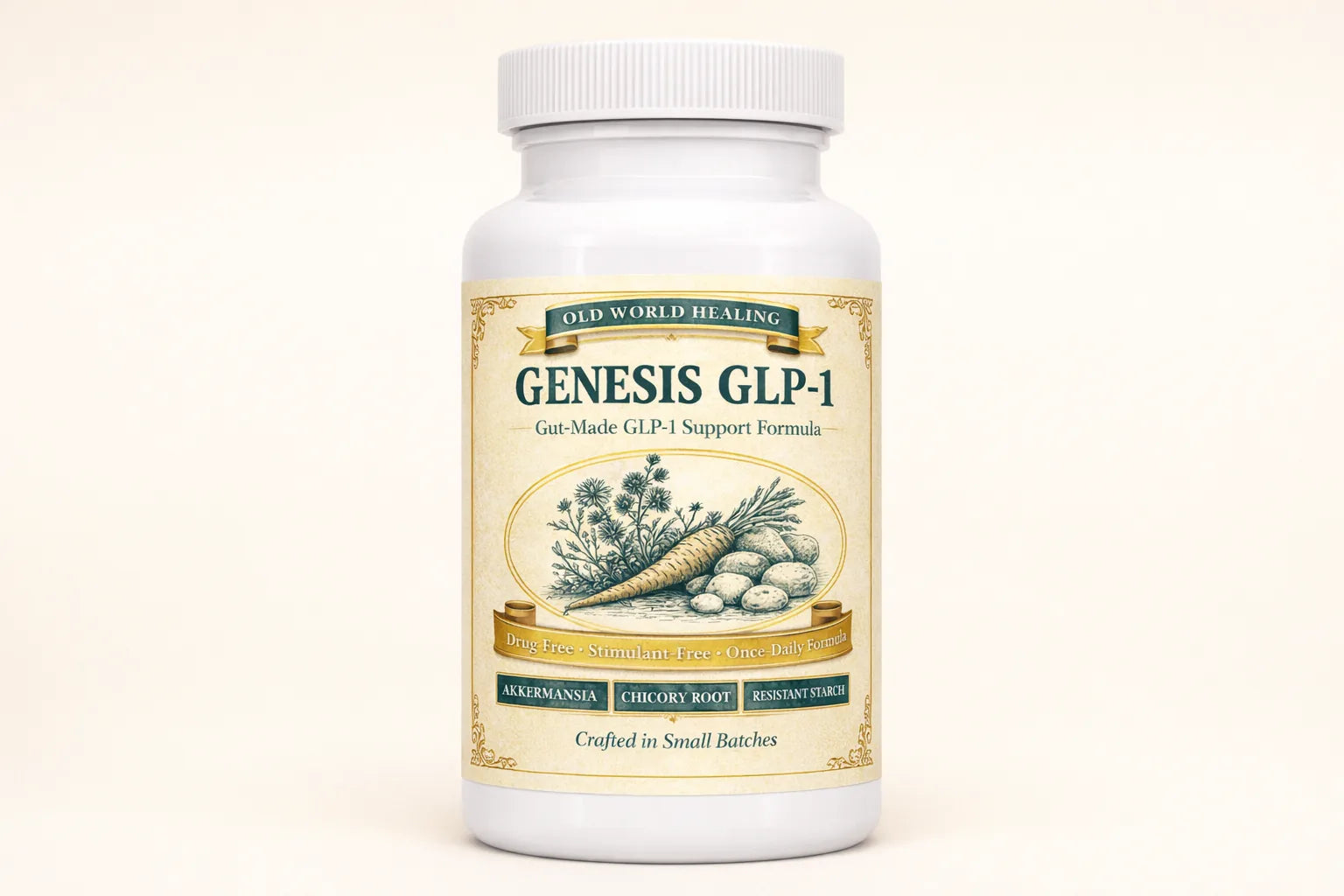
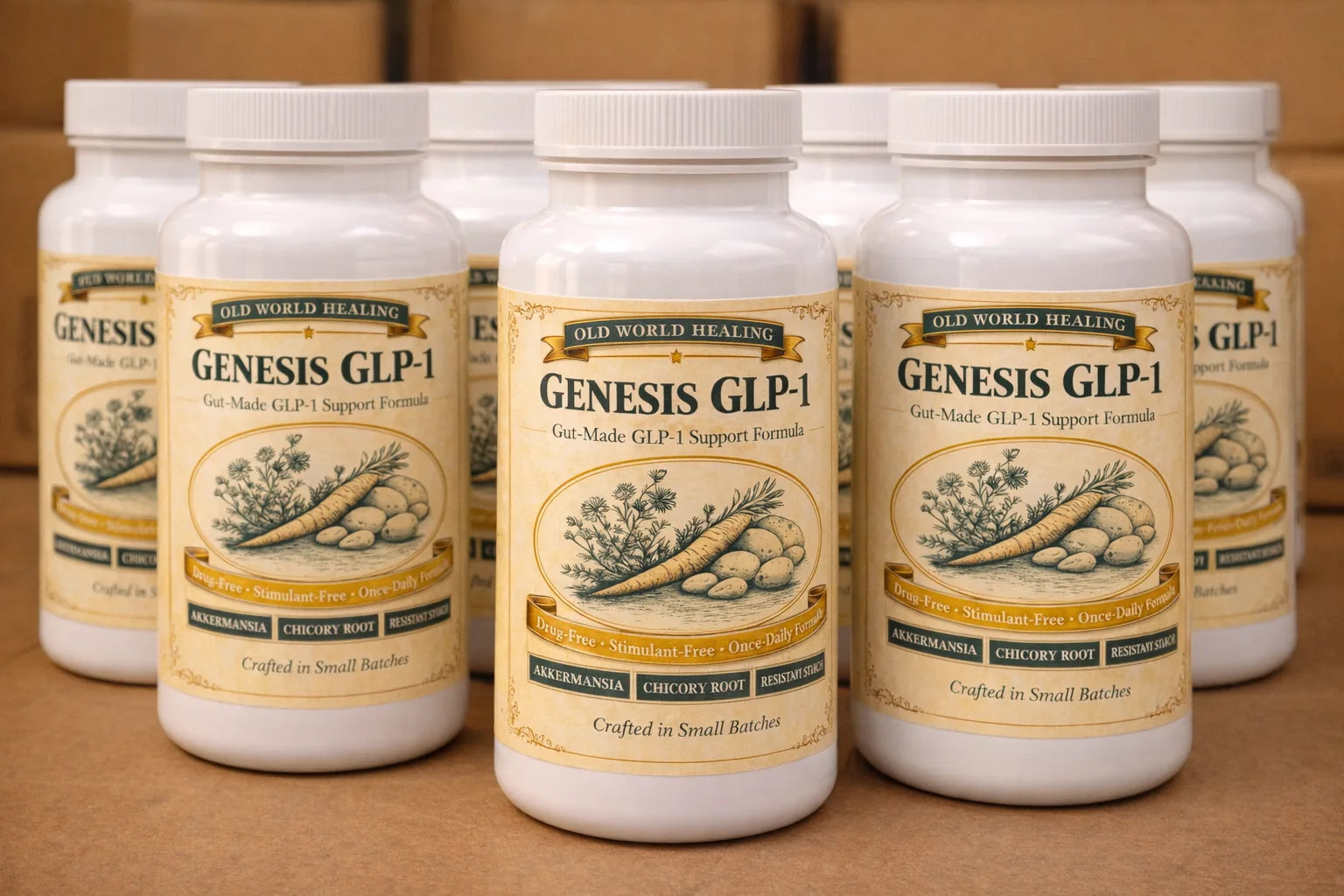
We built Genesis GLP-1 to do those three jobs in one place, in the right order.
Here's the whole formula:
Chicory Root Inulin (Cichorium intybus root), 211mg. The old-world coffee fiber. The colony's food.
Potato Starch (resistant starch), 100mg. The cellar potato, standing in for what a cold boiled potato used to do for your great-grandmother's gut.
Probiotic Blend, 36mg. Akkermansia muciniphila, Clostridium butyricum, and Bifidobacterium infantis. The keystone, the second signaler, and the peacekeeper.
That's the whole label.
No stimulants, and no berberine.
No proprietary blend of forty things nobody can pronounce, stacked on the label to look impressive.
Five ingredients, three jobs, one mechanism.
The formula is the folklore.
Chicory root is the coffee, and potato starch is the cellar.
The bacterium is the one modern life quietly took away from both.
Here's the positioning line I'd want you to remember if you forget everything else on this page.
The injections don't give you anything new.
They're an expensive imitation of a hormone your gut made for free for decades.
Genesis GLP-1 doesn't imitate the hormone. It's built to restore the gut engine that makes it.
Genesis GLP-1 is $49 a month on a subscription, or as little as $43.00 a month on the three-month supply.
If you would rather not subscribe, the same one-month supply is $59 as a one-time order on the product page.
Shipping is free every time, and a subscription can be cancelled before your next ship date.
Let Me Set Your Expectations Honestly, Because I'd Rather Keep You Than Impress You
I could write you a much more exciting paragraph than this one.
I'm not going to.
This isn't a shot, and it won't act like one.
The injections flood your system with a synthetic dose on day one.
Genesis GLP-1 does something slower and, I'd argue, more valuable.
It rebuilds the conditions that let your own supply come back.
A colony is not a dose.
You aren't swallowing an effect.
You're planting something and feeding it, and living things establish on their own timeline.
What people generally describe, and what the mechanism would predict, is gradual.
The evening pantry pull gets quieter before you consciously notice it stopped.
"Full" starts arriving earlier in the meal.
The three o'clock cliff flattens into a slope.
And fat loss gets easier, which is a different promise than fast.
The research effects here are real, and they're modest in size.9, 14
I'd rather hand you a modest true thing than a dramatic false one.
That's the whole reason we started Old World Healing.
Why Your Doctor Hasn't Brought This Up
Three plain reasons, none of them a conspiracy.
It's genuinely new. The organism only got its name in 2004, and the first human trial landed in 2019.
The GLP-1 trial landed in 2026, which is nowhere near old enough to have reached standard practice yet.
It isn't a drug. There's no sales rep walking into a doctor's office with lunch and a brochure for a gut bacterium.
Nobody's promoting it, so nobody hears about it.
Where it does exist, it's priced for a different customer. The handful of companies working with this organism sell mostly through premium direct-to-consumer channels at premium prices, aimed nowhere near the person reading this.
That last one is the reason we made this.
We think an organism your grandmother had for free shouldn't be a luxury good.
What The First Weeks Tend To Look Like
I want to walk you through a realistic arc, not a fantasy one.
Individual results vary, and nothing here is a promise about your body.
Mostly quiet, because you're seeding and a colony has to establish before it can signal. Some people notice their digestion settling first.
This is where the first thing people tend to mention shows up, and it's rarely the scale. It's the evening, when the stretch between dinner and bed stops being a negotiation.
"Full" starts showing up earlier in the meal. People describe leaving food on the plate without any decision being involved, which feels strange if it's been years.
The clothes-fit stretch, slow and unglamorous and going the right direction for once. This is also the window the human trials ran in, three months, so it's the honest place to judge it.
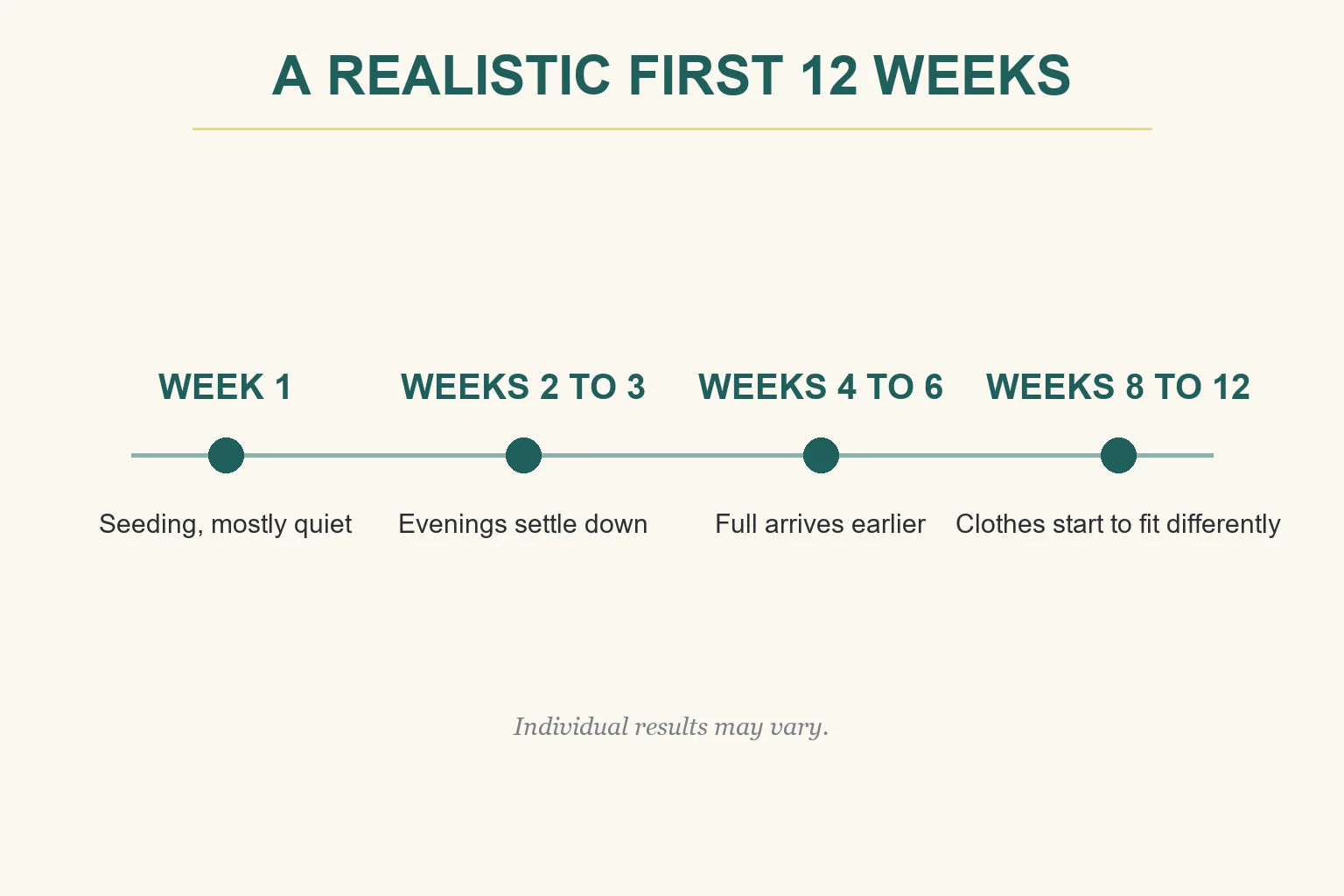
(Individual results may vary. Genesis GLP-1 is a dietary supplement, not a medication.)
Stories From People Who Started With The Same Question You Have

A Note On Proof
You may already know us.
Old World Healing started with Old World Relief, our topical cream.
More than 47,000 jars have gone out the door, with a 4.8 rating and over 2,800 five-star reviews.
Genesis GLP-1 is new, so the accounts below are illustrative rather than customer reviews.
"I stopped trusting myself around food at some point in my fifties. Dinner would end and forty minutes later I'd be standing in front of the pantry with the door open like an idiot. The part I didn't expect was that the pantry thing just quietly stopped being a thing. I didn't white-knuckle it. It stopped being interesting. My clothes are fitting differently and that's nice, but honestly the evenings are what I'd tell a friend about."
- Diane R., Ohio
"My sister-in-law is on the injections and she looks great and I couldn't do it. Not the needle, not the price, not signing up for it forever. What sold me on this was that the story finally made sense. Nobody had ever explained to me why I was hungry all the time, they just told me to eat less. Three months in, the three o'clock crash is the thing that's most obviously different. I get through the afternoon now."
- Raymond T., Texas
"I've bought a lot of things that didn't work, so I read the whole thing twice before I ordered. What I appreciated was being told upfront that it would be gradual. It was gradual. Around week five I noticed I was putting the fork down partway through dinner without thinking about it. That's not something I've done since my thirties."
- Patricia M., Florida
The Offer
Subscribe and save $10 every month.
That is the entire benefit, and it is the same $10 on every supply size, with the multi-month supplies bringing the per-month figure down again on top of it.
There is no introductory discount and no first-month gimmick, so a subscription bills the same price from your very first order until you skip or cancel.
- You choose the purchase type on the product page, subscription or one-time, and the supply size sits inside either one.
- Free shipping on every order, subscription and one-time alike.
- Cancel a subscription anytime before your next ship date, with no fee and no phone call.
- 90-day money-back guarantee on both purchase types, in full, with no bottle to send back.
The only number crossed out anywhere on this page is the one-time price of the same supply sitting beside its subscription price. Both of those are real prices you can actually pay, so there is no invented retail figure here and I am not going to make one up.
Two things I can tell you honestly about how to think about this.
First, this is a colony, not a dose.
A colony needs tending, not a single delivery.
The human trials ran three months, and that's roughly the window where the mechanism has had a fair chance to do its work.
Judging this after a week is like judging a garden the week you planted it.
Second, the comparison that matters.
The shots imitate the hormone at a list price around a thousand dollars a month.1, 2
This feeds your gut back into making its own.
A different pathway at a different price, with a different promise attached.
I'm not going to tell you it does what an injection does, because it doesn't, and anyone who says otherwise is selling you something.
Here is the guarantee, and it is the part I care most about getting right
Take Genesis GLP-1 for 90 days.
If it is not doing what you hoped, email us inside those 90 days and we will refund you in full.
You do not need to send the bottle back.
Ninety days is a deliberate number, not a round one.
Three months is the window the human trials ran in, and it is the window I told you to judge this in, so it is the window the guarantee covers.
How To Take It
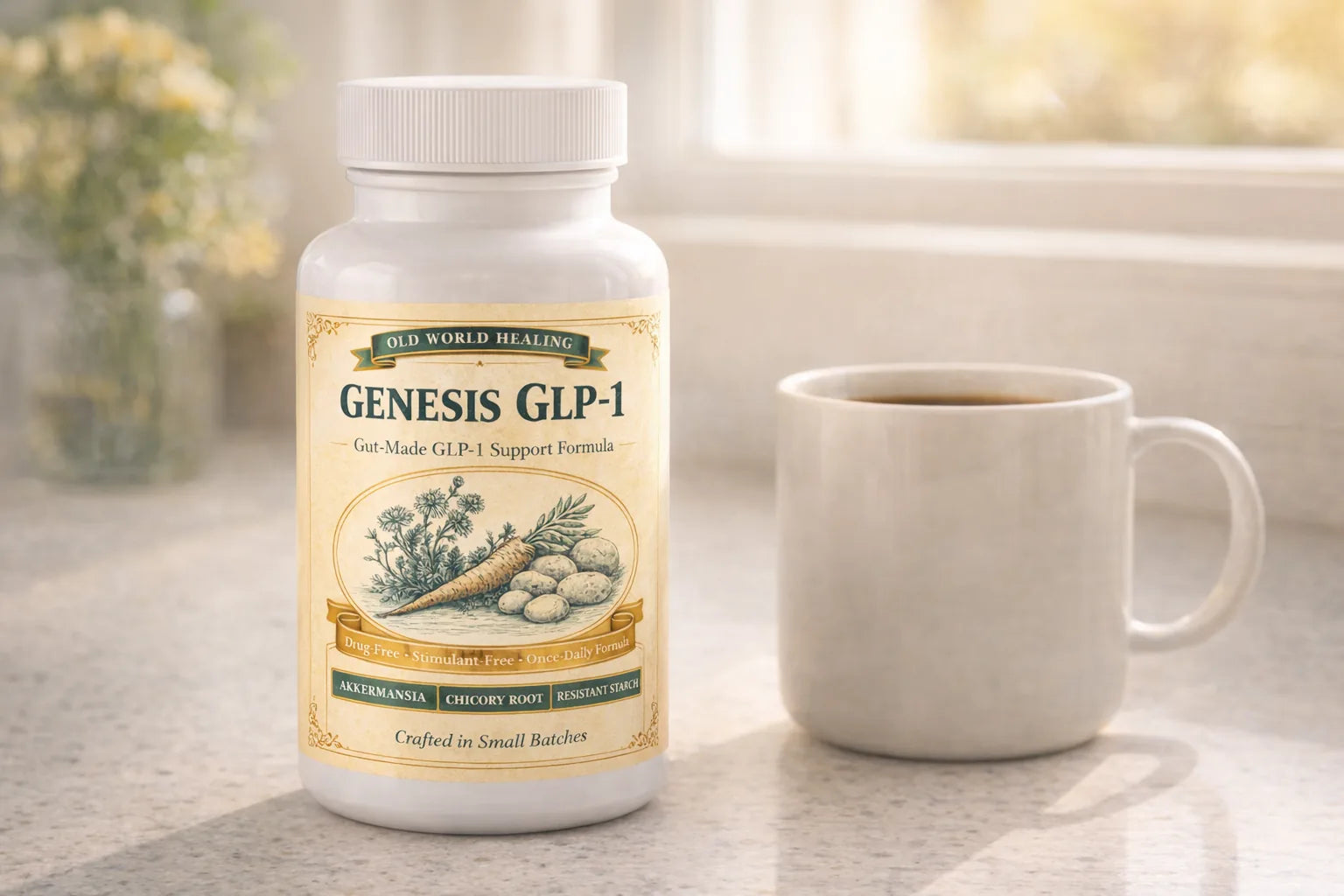
One capsule a day, taken with an eight ounce glass of water.
Each bottle holds 30 capsules, which is a serving size of one capsule and 30 servings in the bottle, so one bottle is one month.
Keep it in the fridge if you can, because refrigerating it keeps living organisms in better shape.
What I can tell you is the principle.
Take it daily, and take it consistently.
A colony that gets fed every day establishes. A colony that gets fed on Tuesdays does not.

Two Versions Of Next Year
I want you to actually picture both of these, because one of them is going to happen.
If nothing changes
The layer keeps thinning, because everything that thinned it is still in your life.
Next January you're a few pounds heavier than this January, the same way this January was heavier than the last one.
The pantry pull is still there at nine at night, and you're still calling it a willpower problem.
The three o'clock crash still takes the back half of your day.
And you're still doing the injection math in your head every time the subject comes up at a family dinner, and still deciding you can't.
Nothing dramatic happens, and that's exactly the point.
It just gets quietly worse, on repeat, while the good years keep going by.
If you feed the signal back on
You plant something.
The first month is undramatic and you almost forget you're doing it.
Then one evening in week three you're sitting on the couch at nine and you notice you haven't thought about the kitchen once.
By the third month you're leaving food on the plate without deciding to, and clothes are fitting the way they did a few summers back.
And when the next injection commercial comes on, you feel nothing at all.
No envy, and no math.
Because your body is doing its own work again, the way it did for fifty years before something evicted the gardener.
Questions People Ask Me
No, and I won't pretend otherwise.
The injections deliver a synthetic copy of GLP-1 from the outside.
Genesis GLP-1 is a supplement built to support your body's own GLP-1 production from the inside.
Different pathway, different scale, different price.
Anyone claiming a supplement matches an injection isn't being straight with you.
The opposite, actually.
Berberine never touches the GLP-1 system, which is why the "nature's Ozempic" nickname got taken apart by health researchers.6, 7
Akkermansia has three human clinical trials and a named protein mechanism behind it.
That's the entire difference.
Please do, they're good for you and they're literally in the formula for a reason.
But food feeds the colony. Food cannot plant it.
Akkermansia has no dietary source anywhere. If your population has already collapsed, you're fertilizing bare dirt.
Most people notice the evening cravings quieting first, generally somewhere in the second to fourth week.
The human trials ran three months. That's the honest window to judge it in.
Individual results vary.
Genesis GLP-1 is a dietary supplement made of fibers and probiotic organisms, not a drug.
That said, if you take prescription medication or you're managing a health condition, talk to your doctor before starting anything new.
That includes this.
Because you can check it.
Every claim on this page has a numbered source at the bottom, and you can read all of them yourself.
I've also told you plainly which parts of the research are in humans and which parts are in mice, and where our fiber doses sit against the trial doses.
A company trying to fool you doesn't volunteer that.
A colony needs tending, the same way a garden does.
How long you tend it is your call, and I'd rather you judge it on your own results over three months than take my word for anything.
You have 90 days, and you get all of your money back.
Email us inside those 90 days and we refund the order in full.
You don't need to send the bottle back either.
I chose 90 days because that's the window the human trials ran in, so it's the honest amount of time to judge this in.
No.
Five ingredients: chicory root inulin, potato starch, and three probiotic organisms. Nothing to keep you up at night.
One Last Thing Before You Go

If you take one idea off this page, make it this one.
For fifty years, your body handled "when to stop eating" and "when to burn instead of store" without asking your permission and without your effort.
You never had to think about it, because a signal was being sent for you.
It stopped getting sent.
That's a mechanical problem with a mechanical answer, and it was never a referendum on who you are.
The most expensive drug in America exists because that signal is valuable.
Your gut used to make it for nothing.
IMPORTANT: The Signal Your Gut Stopped Sending Is The One The $1,000 Shot Copies
PUT THE P9 KEY BACK IN YOUR GUT
Save Up To 63% (Today Only)Since this article went up, interest in Genesis GLP-1 has climbed sharply as more people work out that GLP-1 was never a medication in the first place.
Genesis GLP-1 is available to order, and orders ship within one business day.
Both purchase types are open: $49 a month on a subscription, or $59 for a one-time one-month supply.
Those are our standard prices, with no expiry date attached to them, and if that ever changes this line changes with it.
P.S. The finding I keep coming back to is the 2026 one.
Akkermansia worked best in the people who had the least of it left.
The research says the best responder is the person who has been depleted the longest.
If you've spent decades eating modern food and wondering why your body stopped cooperating, that study was describing you.
P.P.S. If you remember nothing else, remember the order of operations.
Seed the organism, because no food on earth contains it.
Feed it what the old world fed it, chicory root and cooled starchy potato.
Then let your own gut do the signaling, the way it did before anybody thought to bottle a copy of it and charge a thousand dollars a month for the privilege.